May 16, 2026
Firebird manganese processing technology represents a transformative approach to battery material manufacturing, addressing critical inefficiencies in traditional cathode active material production systems. Advanced manufacturing techniques in battery material processing are reshaping global supply chains as demand for energy storage solutions accelerates across multiple industrial sectors. Traditional approaches to cathode active material production have relied on fragmented, multi-stage operations that consume substantial energy while requiring extensive transportation networks. These conventional systems face mounting pressure from both cost optimization demands and geopolitical supply chain vulnerabilities that have emerged as critical considerations for manufacturers worldwide.
Furthermore, the battery recycling breakthrough has highlighted the importance of developing sustainable processing technologies that complement recycling initiatives throughout the battery lifecycle.
Revolutionary Integrated Processing Technology Transforms Manganese Beneficiation
Firebird manganese processing technology represents a fundamental departure from established industry practices by consolidating multiple processing stages into a single, continuous operation. The company's proprietary platform eliminates traditional intermediate steps by maintaining manganese sulfate in solution form throughout the entire production sequence, from raw ore input to finished cathode active materials.
This integrated methodology addresses several critical inefficiencies inherent in conventional processing chains. Traditional operations typically require ore to be processed at one facility, crystallised into intermediate products, transported to secondary locations, redissolved, and processed again through multiple purification stages. Firebird's approach bypasses these intermediate crystallisation and transportation steps entirely.
However, the broader mining innovation trends demonstrate that sustainable processing technologies are becoming increasingly important for industry competitiveness.
The technology platform encompasses four core processing capabilities:
• Hydrometallurgical extraction – Direct leaching of manganese ores using optimised chemical processes
• Advanced purification systems – Removal of impurities while maintaining solution integrity
• Integrated precursor manufacturing – Direct conversion to precursor cathode active materials
• Finished cathode material production – Final processing into battery-ready LMFP and LMR chemistries
Central to this innovation is the ore-agnostic design philosophy, which enables processing of various manganese ore types without requiring feedstock-specific equipment modifications or process adjustments. Testing with diverse ore compositions has demonstrated consistent product specifications regardless of input material variations.
When big ASX news breaks, our subscribers know first
Advanced Kiln Systems Deliver Unprecedented Energy Efficiency
The cornerstone of Firebird manganese processing technology lies in its proprietary kiln design, which achieves remarkable improvements in energy consumption compared to conventional rotary kiln systems commonly employed in manganese processing operations. This technology breakthrough addresses one of the most significant cost drivers in mineral processing while simultaneously reducing environmental impact.
Traditional manganese processing facilities utilising rotary kilns typically consume substantial amounts of thermal energy, with most operations requiring significant fuel inputs for maintaining processing temperatures. The conventional approach often results in heat losses through radiation, convection, and incomplete thermal transfer to the processed materials.
Firebird's advanced kiln technology incorporates several innovative design elements:
• Enhanced heat transfer mechanisms that maximise energy transfer efficiency
• Integrated waste heat recovery systems that capture and recirculate thermal energy
• Optimised residence time controls ensuring complete processing with minimal energy waste
• Advanced insulation systems reducing thermal losses to ambient conditions
The energy efficiency improvements extend beyond the kiln operation itself. The integrated facility design incorporates waste heat recirculation throughout multiple processing stages, creating a thermal cascade effect that maximises energy utilisation across the entire production line.
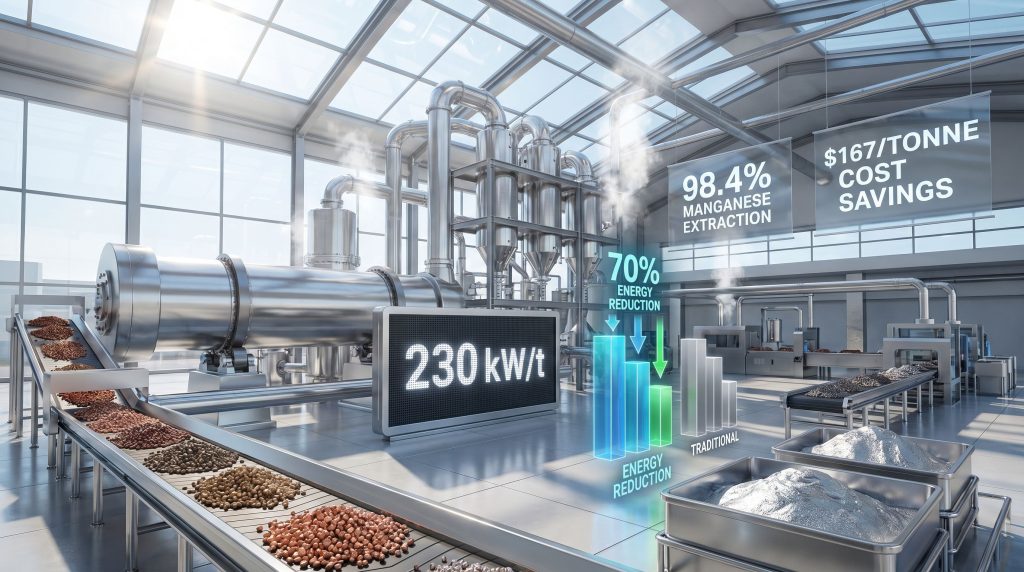
Testing data from pilot-scale operations indicates energy consumption ranging between 80-100 kWh per tonne of processed material, representing substantial improvements over conventional processing methods. These efficiency gains translate directly into reduced operational costs and lower carbon footprint per unit of finished product.
How Does Direct Solution Processing Work?
Traditional manganese processing for battery applications requires multiple discrete steps across different facilities, often located in separate geographic regions. Raw ore is typically processed into manganese sulfate crystals at one location, packaged and shipped to secondary facilities for redissolution, then processed again into precursor materials before final cathode material production.
This fragmented approach creates several operational disadvantages:
• Multiple handling operations increasing contamination risks and material losses
• Extended transportation requirements adding cost and supply chain complexity
• Intermediate storage needs requiring additional infrastructure and working capital
• Quality control challenges across multiple processing environments
• Supply chain vulnerability to transportation disruptions and geopolitical factors
Firebird's direct solution processing maintains manganese in liquid form throughout the entire production sequence, eliminating the need for intermediate crystallisation stages. This continuous solution-based approach enables processing from raw ore to finished cathode materials within a single integrated facility.
LMFP Battery Chemistry Drives Market Positioning Strategy
Lithium-manganese-iron-phosphate (LMFP) battery technology has emerged as a critical chemistry for next-generation energy storage applications, particularly in electric vehicle and grid-scale energy storage markets. This advanced cathode chemistry offers several performance advantages over traditional lithium iron phosphate (LFP) batteries, including improved energy density, enhanced thermal stability, and superior charging characteristics.
In addition to technological advances, energy transition strategies are increasingly focusing on securing domestic supply chains for critical battery materials.
The counter-current leaching technique employed in this system achieves extraction rates of 98.4% while maintaining only 1.5% residual manganese in processing residue. This high extraction efficiency maximises resource utilisation while minimising waste generation.
Major automotive manufacturers have begun incorporating LMFP technology into their vehicle platforms. BYD's unveiling of its Blade Battery 2.0 in March demonstrated improved driving performance, extended range, and accelerated charging capabilities using LMFP chemistry. This validation by a leading electric vehicle producer signals growing commercial acceptance and market demand for LMFP-based battery systems.
What Patent Rights Does Firebird Hold?
Firebird holds exclusive licensing rights to five LMFP battery patents covering all markets outside China through 2045. This intellectual property portfolio provides significant competitive positioning advantages, particularly as Western manufacturers seek alternatives to Chinese-dominated battery supply chains.
The patent portfolio encompasses:
• Advanced cathode material formulations for optimised LMFP performance
• Processing methodologies for efficient LMFP production
• Quality control techniques ensuring consistent battery performance
• Integration approaches for incorporating LMFP into existing battery manufacturing lines
• Performance optimization strategies maximising energy density and cycle life
Current global supply chains for LMFP cathode materials remain heavily concentrated in Chinese processing facilities, creating strategic vulnerabilities for Western battery manufacturers. This concentration represents both a supply security risk and a competitive disadvantage for companies seeking supply chain diversification.
Australian Demonstration Plant Validates Commercial Viability
The Australian Renewable Energy Agency's A$2 million grant under the Battery Breakthrough Initiative represents significant government endorsement of Firebird's technological capabilities and strategic importance. This funding supports construction and commissioning of the Australian Demonstration Plant (ADP), designed to showcase the complete integrated technology platform.
The grant follows extensive due diligence processes, including independent technical reviews conducted by qualified engineering consultants. This third-party validation provides credibility for the technology's commercial viability and technical feasibility beyond internal company assessments.
ARENA CEO Darren Miller emphasised the strategic importance of building domestic capability to convert Australian manganese into battery cathode materials, strengthening supply chain resilience while supporting next-generation battery manufacturing growth. The agency's decision to fund Firebird reflects recognition of both the technological innovation and strategic necessity of establishing Western cathode material processing capabilities.
Consequently, Australia's critical minerals reserve strategy aligns with Firebird's demonstration plant objectives.
The ADP facility specifications include:
• Complete processing demonstration from manganese ore to finished cathode materials
• Integrated technology validation across all processing stages within a single facility
• Commercial-scale equipment testing using representative industrial processing conditions
• Quality validation systems ensuring finished products meet battery manufacturer specifications
• Performance benchmarking against established industry standards and competing technologies
Firebird CEO Ron Mitchell stated that the funding directly supports construction and commissioning of what is intended to be the world's first fully integrated manganese-to-cathode active material processing facility outside China. The demonstration plant represents a critical step toward commercial-scale deployment and technology validation for potential offtake partners and project financiers.
Where Will the Demonstration Plant Be Located?
Final site selection for the ADP is nearing completion in Perth, Western Australia. The location provides access to skilled engineering talent, established mining industry infrastructure, and government support frameworks aligned with Australia's critical minerals strategy.
Technology Platform Creates Multiple Commercialisation Pathways
Firebird's integrated processing technology spans the complete value chain from raw manganese ore through finished cathode active materials, creating opportunities for multiple commercialisation strategies beyond traditional single-facility operations. The comprehensive technology platform enables licensing arrangements, joint ventures, and strategic partnerships across different geographic markets.
The company has outlined a staged development approach beginning with third-party ore processing arrangements in China (Stage 1), followed by scaled operations producing 300,000 tonnes annually of manganese sulfate in China plus 100,000 tonnes annually in alternative jurisdictions (Stage 2). This phased expansion strategy balances near-term commercial opportunities with longer-term strategic positioning in Western markets.
Technology licensing represents a significant opportunity given the platform's modular design and ore-agnostic capabilities. Multiple jurisdictions seeking domestic battery material processing capabilities could benefit from licensing arrangements, particularly countries with existing manganese mining operations but lacking downstream processing infrastructure.
For instance, the 50,000 tonnes per year manganese sulfate and 10,000 tonnes per year manganese tetroxide capacity facility requires $83.5 million capital expenditure, projecting 16.2% internal rate of return at $2,150 per tonne manganese sulfate pricing. These financial projections demonstrate commercial viability while indicating potential for attractive returns on invested capital.
What Research Initiatives Are Underway?
Ongoing research collaboration with Central Southern University focuses on producing LMFP cathode materials directly from manganese sulfate solutions, potentially eliminating additional crystallisation steps. This advancement would further streamline the processing chain while reducing operational costs and capital requirements.
Research and development initiatives include:
• Process optimisation for enhanced extraction efficiency and reduced energy consumption
• Product quality enhancement ensuring finished materials meet evolving battery performance requirements
• Scale-up engineering for transition from demonstration to commercial production levels
• Environmental impact reduction through waste minimisation and energy recovery systems
• Cost reduction strategies targeting competitive positioning against established processors
The next major ASX story will hit our subscribers first
Strategic Positioning Addresses Geopolitical Supply Chain Vulnerabilities
Current global battery supply chains for manganese-based cathode materials exhibit significant concentration risk, with processing capabilities almost entirely located within Chinese facilities. This geographic concentration creates strategic vulnerabilities for Western battery manufacturers, automotive original equipment manufacturers, and energy storage developers seeking supply chain diversification.
Moreover, the US-China trade war impacts have intensified the urgency for Western nations to develop alternative supply chain capabilities.
The concentration of processing capabilities in China results from decades of industrial development, government support for battery material sectors, and integrated supply chain optimisation. However, this concentration has become increasingly problematic as geopolitical tensions affect trade relationships and supply chain security considerations.
Western governments and major industrial players are accelerating efforts to reduce dependency on Chinese battery supply chains through policy frameworks, strategic investments, and regulatory incentives. These initiatives create favourable conditions for alternative processing capabilities in allied jurisdictions.
Firebird Chairperson Evan Cranston noted that Western governments and major industrial players are accelerating efforts to reduce battery supply chain dependency on Chinese processors. The company is positioned at the intersection of technological innovation and geopolitical necessity, with the ARENA grant strengthening engagement opportunities with large offtake partners, technology licensees, and project financiers critical to scaling beyond the demonstration phase.
What Strategic Advantages Does the Technology Offer?
Key strategic advantages include:
• Tier 1 jurisdiction operation providing supply chain security and regulatory certainty
• Allied government support through grants, policy frameworks, and strategic minerals initiatives
• Technology sovereignty reducing dependency on foreign-controlled processing capabilities
• Supply chain resilience diversifying cathode material sourcing options for Western manufacturers
• Economic development opportunities creating high-value manufacturing jobs and technology capabilities
The integrated approach delivers operational cost savings of $167 per tonne compared to conventional multi-facility processing chains, primarily through elimination of intermediate crystallisation, packaging, transportation, and redissolution steps.
Furthermore, the Australian government's strategic minerals priorities, energy storage objectives, and Net Zero 2050 commitments align directly with Firebird's technology deployment timeline. This policy alignment creates favourable conditions for commercial scaling and potential international expansion into other allied jurisdictions seeking similar supply chain diversification.
The demonstration plant success could catalyse broader adoption of integrated processing technologies across multiple markets, potentially transforming the geographic distribution of battery material manufacturing while enhancing supply chain resilience for the global energy transition. For detailed information about Firebird's latest developments, investors can access comprehensive project updates and technical specifications.
Please note that this analysis contains forward-looking statements and projections that involve inherent risks and uncertainties. Actual results may differ materially from those projected. Investors should conduct their own due diligence and consult qualified professionals before making investment decisions.
Looking to Capitalise on Australia's Battery Material Revolution?
Discovery Alert's proprietary Discovery IQ model delivers real-time alerts on significant ASX mineral discoveries, instantly empowering subscribers to identify actionable opportunities ahead of the broader market. Understand why historic discoveries can generate substantial returns by exploring major mineral breakthroughs, then begin your 14-day free trial today to position yourself ahead of the market.