
July 7, 2026
The Structural Scarcity Problem Reshaping How Gold Majors Allocate Capital
The global gold mining industry is quietly confronting a supply-side crisis that has little to do with ore grades or metallurgy. The real problem is jurisdictional. Decades of underinvestment in exploration, combined with increasingly rigorous environmental assessment requirements in the world's most stable mining destinations, have created a profound shortage of large, development-ready gold projects in tier-one jurisdictions. Senior producers sitting on record free cash flow are scanning the landscape for assets capable of meaningfully replacing declining reserves, and the list of qualifying candidates grows shorter each year.
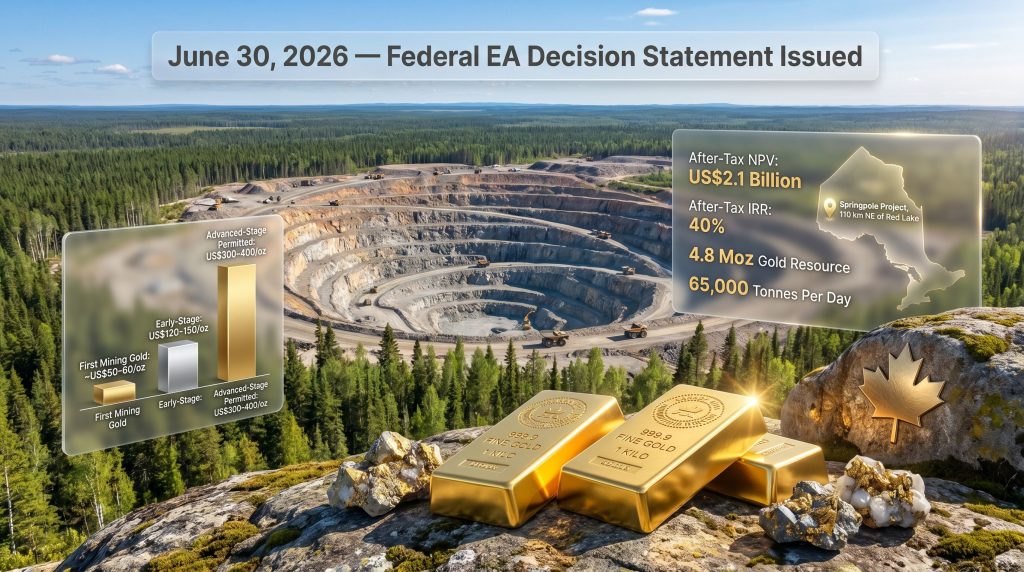
It is within this structural context that the First Mining Gold Springpole federal approval carries significance that extends well beyond a single company's regulatory calendar. The issuance of the federal Environmental Assessment Decision Statement on June 30, 2026 by Canada's Minister of Environment formally authorises an open-pit gold and silver operation capable of processing up to 65,000 tonnes of ore per day, situated approximately 110 kilometres northeast of Red Lake, Ontario. Understanding what that authorisation actually resolves, and what work remains, requires unpacking how Canada's layered environmental review system functions in practice.
When big ASX news breaks, our subscribers know first
Understanding Canada's Dual Environmental Assessment Architecture
Why Federal and Provincial Reviews Operate as Separate Processes
Canadian resource projects of significant scale often navigate two parallel but distinct environmental assessment streams, one federal and one provincial, each with its own legislative mandate, timeline, and decision-making authority. The federal process, governed primarily by the Impact Assessment Act (and its predecessor the Canadian Environmental Assessment Act), evaluates effects on matters of federal jurisdiction, including migratory birds, fish and fish habitat, Indigenous rights, and transboundary environmental effects.
Provincial assessments, in Ontario's case conducted under the Environmental Assessment Act, focus on provincial interests including land use, water quality, and local community impacts. For Springpole, a combined federal-provincial process was initiated, but the two tracks move toward separate ministerial decisions on different timelines. This is why the First Mining Gold Springpole federal approval in June 2026 does not, on its own, complete the regulatory clearance picture.
The Specific Authorisation the Federal Decision Statement Covers
What makes the Springpole project unusual, and what drove the complexity and duration of its federal review, is the physical engineering required to mine the deposit. The gold and silver mineralisation lies beneath Springpole Lake. Accessing it via open-pit methods requires constructing containment dikes and dewatering the lake, a scope of environmental intervention that inherently demands federal scrutiny given the implications for fish habitat and water systems under federal jurisdiction.
The Decision Statement's authorisation of dike construction and lake dewatering is therefore not a procedural formality. It resolves what had been, for years, the single highest-consequence binary question overhanging the project: would federal regulators ever permit this specific construction methodology? The answer, after 8.5 years, is confirmed.
Eight and a Half Years in the Making: Mapping the Regulatory Journey
A Phase-by-Phase Breakdown of the Springpole EA Process
| Phase | Year | Key Activity |
|---|---|---|
| EA Submission | 2018 | Federal-provincial combined process initiated |
| Team Expansion | 2020 | Dedicated permitting personnel brought on board |
| Terms of Reference | 2021 | Regulatory scope formally established |
| Draft EA Completed | 2022 | Technical documentation submitted for review |
| Regulator and Community Review | 2022-2024 | Approximately 3,500 questions and comments addressed |
| Final EA Submitted | 2024 | Comprehensive response document lodged |
| Federal Decision Issued | June 30, 2026 | Minister issues Decision Statement |
One detail worth noting is that the company did not have the internal resourcing to pursue this process aggressively in its earliest years. A dedicated permitting team was assembled only in 2020, which helped accelerate the pace through the more technically demanding phases. The volume of regulatory engagement, roughly 3,500 questions and comments from regulators, community representatives, and technical advisors, is itself a signal of how thoroughly the project's environmental footprint was scrutinised.
"For large-scale open-pit gold projects involving water body modification in Canada, the federal environmental assessment process is not a formality. It is a multi-year, technically intensive process with a genuinely uncertain outcome until the Decision Statement is issued."
Why These Timelines Are Structurally Unavoidable
It is tempting to interpret lengthy permitting timelines as regulatory inefficiency, but the complexity at Springpole is substantively justified. Open-pit mining requiring lake dewatering involves cumulative environmental modelling, hydrological studies, baseline ecological assessments across multiple seasons, and detailed mitigation planning. Regulators require long-duration baseline datasets to assess seasonal variability in fish populations, water temperature, and sediment movement. These datasets simply cannot be compressed.
For investors evaluating junior developers, this dynamic has an important implication: the permitting duration itself functions as a barrier to entry that, once cleared, confers durable competitive advantage. Furthermore, any new project seeking to replicate Springpole's regulatory position would face the same multi-year journey from scratch. The exploration pipeline challenges facing the broader sector make this barrier all the more consequential.
What Permitting Work Remains Before Construction Becomes Possible
Ontario's Provincial EA: The Final Regulatory Gate
As of mid-2026, the Ontario provincial environmental assessment process is in its closing phase. A draft decision document was released for public comment through the end of July 2026. Following the comment period, the company anticipates additional regulatory engagement before the file advances to Ontario's Minister of Environment for a final decision, which management is targeting by the end of summer 2026.
Critically, the provincial process, while still a formal regulatory hurdle, carries a fundamentally different risk profile than the federal review. The federal EA establishes the environmental envelope within which the project must operate. Provincial permitting and subsequent detailed engineering-based approvals must work within that established framework, which narrows the scope for binary outcomes.
Converting Community Term Sheets Into Binding Agreements
Simultaneously, the company is working to formalise its relationships with three affected First Nations communities:
- Cat Lake First Nation
- Lac Seul First Nation
- Slate Falls Nation
Term sheets and stated pathways to agreements with all three communities were announced in close proximity to the federal EA decision. However, converting these term sheets into full project agreements involves substantive negotiation of benefit packages, including employment commitments, equity participation, environmental monitoring roles, and revenue sharing arrangements. These negotiations require communities to have adequate time and capacity support to evaluate project risks and terms on their own terms, not on the developer's schedule.
Management has targeted binding agreements with all three communities by the end of summer 2026, aligning this social licence milestone with the expected provincial EA decision. Both tracks closing simultaneously would represent a comprehensive de-risking event for the project.
Conditions of Approval: What the Federal Decision Requires
The Decision Statement does not provide unconditional authorisation. Key compliance obligations include:
- Engineering design standards governing dike construction methodology and structural integrity
- Aquatic and terrestrial environmental monitoring programmes spanning construction and operational phases
- Ongoing compliance reporting tied to defined construction milestones
- Conditions governing the dewatering process and management of displaced water and aquatic species
These conditions add regulatory overhead but are standard components of federal EA decisions for projects of this scale. They do not represent new uncertainties; rather, they define the operating framework within which the project must be engineered.
The Social Licence Dimension: Indigenous Partnerships as Project Architecture
Why Indigenous Agreements Are Not Parallel to Regulatory Approvals, But Integral to Them
A persistent misconception among mining investors is that Indigenous community agreements are negotiated after regulatory approvals are secured, as a separate commercial process. At Springpole, the Anishinaabe-led impact assessment conducted by the affected First Nations communities was integrated into the federal review process itself, not appended to it. This reflects the evolution of Canada's legal and regulatory framework, informed by a robust Indigenous consultation framework following landmark Supreme Court decisions that established substantive consultation obligations at the Crown level.
The practical implication is that term sheets representing clear pathways to agreements with Cat Lake, Lac Seul, and Slate Falls are not simply commercial negotiations in progress. They reflect relationships built through years of technical engagement and community-led assessment, which is a meaningfully different foundation than arm's length benefit negotiations initiated after a project has received regulatory authorisation.
Springpole's Project Economics at Current Gold Prices
Pre-Feasibility Study Snapshot: November 2025 Update
| Metric | Value |
|---|---|
| Gold Price Assumption | US$3,100/oz |
| After-Tax IRR | 40% |
| After-Tax NPV | US$2.1 billion |
| Payback Period | Under 2 years |
| Annual Production Potential | 300,000+ oz gold |
| Indicated Gold Resource | 4.8 million oz |
| Indicated Silver Resource | 28 million oz |
At a 40% after-tax IRR and a payback period measured in months rather than years, Springpole's pre-feasibility economics are materially stronger than the typical Canadian gold development project at equivalent scale. The silver component, 28 million indicated ounces, provides meaningful by-product revenue that improves all-in sustaining cost metrics, though silver's contribution is often underappreciated in market valuations focused exclusively on gold ounces.
Disclaimer: Pre-feasibility study economics are based on assumed gold prices and engineering estimates that may differ materially from conditions at the time of a construction decision. These figures should not be interpreted as a guarantee of future project performance.
What a Feasibility Study Adds and Why It Matters for Financing
The step from a pre-feasibility study to a bankable definitive feasibility study is not merely a technical exercise. It is the document that project finance lenders and streaming companies require before committing capital. A feasibility study tightens engineering cost estimates from the typical pre-feasibility accuracy range of plus or minus 25–35% to a more bankable plus or minus 15%. It also resolves geotechnical, metallurgical, and infrastructure design questions at a level of detail sufficient for construction contracting.
Management has targeted feasibility study completion around mid-2027, with project financing engagement anticipated to begin in the latter part of 2026, as the feasibility study workstreams are underway. This sequencing matters: engaging financing partners before the feasibility study is complete is feasible because the terms of the federal EA have now removed the fundamental authorisation risk that previously made many lenders unwilling to allocate time to Springpole due diligence.
The next major ASX story will hit our subscribers first
Is First Mining Gold Undervalued Relative to Comparable Developers?
A Valuation Framework for Advanced-Stage Gold Projects
| Development Stage | Typical Market Valuation ($/oz Resource) |
|---|---|
| Early-Stage Projects | US$120-150/oz |
| Advanced-Stage, Permitted Developers | US$300-400/oz |
| First Mining Gold (Current Estimate) | ~US$50-60/oz |
The gap between First Mining's implied resource valuation and that of comparable advanced-stage developers is substantial enough to warrant serious analytical attention. At approximately US$50–60 per ounce of indicated gold resource, the company's market capitalisation embeds a discount that management attributes to the now-resolved federal permitting uncertainty. The logical hypothesis is that as subsequent milestones close, the market will progressively re-rate the stock toward the valuations commanded by permitted peers.
Why the Market Has Been Slow to Respond
Market re-rating following a regulatory milestone rarely happens instantaneously, particularly for projects where investors have been conditioned to expect setbacks after years of process. Institutional capital that left the register during the permitting period does not return in a single trading session. Sell-side coverage tends to lag milestone inflection points. Retail investors, who make up a larger portion of junior gold developer registers, often need to see multiple confirming catalysts before conviction builds.
The valuation context is further complicated by the fact that First Mining carries a second major undeveloped asset, the Duparquet project in Quebec, which management considers to be largely unrecognised in the current share price. Duparquet represents genuine resource optionality for a portfolio that, on a pure Springpole basis, already appears materially undervalued relative to peers.
The 18-Month Path to a Final Investment Decision
Key Milestones on the Development Roadmap
- End of Summer 2026: Provincial EA decision and binding community agreements targeted
- Late 2026: Engagement with project financing partners anticipated to begin
- Mid-2027: Feasibility study completion targeted
- Late 2027 / Early 2028: Infrastructure construction potentially commences
- Approximately 18 months from July 2026: Final Investment Decision (FID)
The billion-dollar-plus capital requirement for Springpole's construction phase places it firmly in the territory of project finance rather than equity markets alone. Streaming and royalty companies, project lenders, and infrastructure-focused private equity funds are the most likely capital providers, and the resolved federal permitting uncertainty meaningfully expands which of these parties will now engage in due diligence conversations.
Management has also acknowledged that advancing from a permitting-focused organisation to a construction-ready one requires deliberate team expansion. Individuals with large-scale mine construction experience are a scarce human resource in the industry, and recruiting them becomes considerably easier once a project can demonstrate regulatory clarity and a credible financing pathway.
Springpole in the Context of the Broader Canadian Gold Development Landscape
The Scarcity of Tier-One Projects Approaching Construction Readiness
The Canadian gold projects that today rank among the industry's most valued producing assets, including Côté Gold, Detour Lake, Canadian Malartic, Valentine, Greenstone, and Magino, all passed through difficult development and construction phases before being recognised as flagship operations. What they share is a combination of scale, jurisdictional stability, and the simple fact that they existed at a time when capital was willing to fund them through construction.
Springpole's resource base of approximately 4.8 million indicated ounces of gold and 28 million indicated ounces of silver, now with federal environmental authorisation in hand, positions it within a very small group of projects globally that could realistically see a shovel in the ground before 2030. According to Mining Technology, this federal approval represents one of the most significant regulatory milestones for a Canadian gold development project in recent years, reflecting the genuine structural difficulty of advancing large gold deposits through modern permitting regimes in any major western jurisdiction.
Senior Producer Dynamics and the M&A Backdrop
Senior gold producers generating record free cash flow face a well-documented reserve replacement challenge. Organic exploration pipelines have not kept pace with production depletion, and the lead time to advance a grassroots discovery to a permitted construction-ready project now routinely exceeds 15–20 years. The logical response is acquisition of assets that have already absorbed the bulk of that timeline.
Consequently, the broader gold M&A activity environment has intensified considerably, as majors seek to secure permitted, large-scale assets before competitors do. Springpole, having cleared the most consequential regulatory hurdle in its history, enters a more visible part of the strategic landscape for major producers evaluating where the next generation of production will come from. Whether that translates into a transaction or a joint venture arrangement depends on factors specific to individual producers' strategies and balance sheets, but the structural logic for senior producer interest has rarely been stronger.
Frequently Asked Questions: First Mining Gold Springpole Federal Approval
What Did the Federal Environmental Assessment Approval for Springpole Cover?
The Decision Statement issued on June 30, 2026 authorises Springpole to proceed as an open-pit gold and silver mining operation processing up to 65,000 tonnes of ore per day, including the construction of containment dikes and the dewatering of Springpole Lake. First Mining Gold's official environmental assessment documentation confirms that the process began in February 2018 and required responses to approximately 3,500 regulatory, community, and technical questions before the final environmental assessment was accepted and the ministerial decision issued.
What Permitting Steps Are Still Required Before Construction Can Begin?
The Ontario provincial environmental assessment is pending a ministerial decision targeted by the end of summer 2026. In parallel, First Mining is converting term sheet agreements with Cat Lake, Lac Seul, and Slate Falls First Nations into binding project agreements. Subsequent detailed engineering-based permit applications will follow once both processes conclude.
What Are Springpole's Core Economic Metrics?
Based on the November 2025 pre-feasibility study at a US$3,100/oz gold price: after-tax IRR of 40%, after-tax NPV of US$2.1 billion, payback period under two years, and annual production potential exceeding 300,000 ounces. The project hosts an indicated resource of 4.8 million ounces of gold and 28 million ounces of silver. In addition, the relationship between gold price and mining equities suggests that continued strength in gold pricing could further enhance these already compelling economics.
When Could First Mining Make a Final Investment Decision?
Management has outlined an approximately 18-month timeline from mid-2026 to a final investment decision, anchored by a feasibility study targeted for mid-2027 and project financing discussions expected to begin in late 2026.
How Does First Mining's Current Valuation Compare to Peer Developers?
The company currently trades at approximately US$50–60 per ounce of gold resource, representing a significant discount relative to early-stage project peers trading at US$120–150/oz and advanced-stage permitted developers that typically command US$300–400/oz.
What Is the Duparquet Project and Why Does It Matter?
Duparquet is First Mining's second major undeveloped gold asset, located in Quebec. Management considers its resource value to be largely absent from the company's current market capitalisation, representing an additional layer of optionality that could contribute to valuation re-rating as the First Mining Gold Springpole federal approval catalyses broader investor attention toward the company's full asset portfolio.
This article contains forward-looking statements and is intended for informational purposes only. It does not constitute financial advice. Readers should conduct their own due diligence before making investment decisions. Pre-feasibility study metrics are estimates based on assumed inputs and should not be relied upon as predictions of actual project performance.
Want to Track the Next Major Gold Discovery Before the Market Moves?
Discovery Alert's proprietary Discovery IQ model delivers real-time alerts the moment significant ASX mineral discoveries are announced, transforming complex geological data into actionable investment insights for both short-term traders and long-term investors — explore historic discoveries and their exceptional returns, then start your 14-day free trial at Discovery Alert to position yourself ahead of the broader market.