July 21, 2026
Understanding Flash Joule Heating: The Science Behind Millisecond Metal Recovery
The global electronics industry generates over 50 million metric tons of electronic waste annually, creating both environmental challenges and unprecedented opportunities for advanced materials recovery. Metallium secures supply deal with Glencore represents a pivotal moment in validating flash joule recycling technology for commercial-scale operations. Within this massive waste stream lies a concentrated repository of precious metals that often exceeds the grade quality found in traditional mining operations.
Flash Joule Heating represents a breakthrough in accessing these valuable resources through rapid thermal processing that fundamentally reimagines how we extract metals from complex electronic assemblies. This innovative approach aligns with broader industry innovation trends transforming materials recovery sectors.
What Makes Flash Joule Heating Different from Traditional E-Waste Processing?
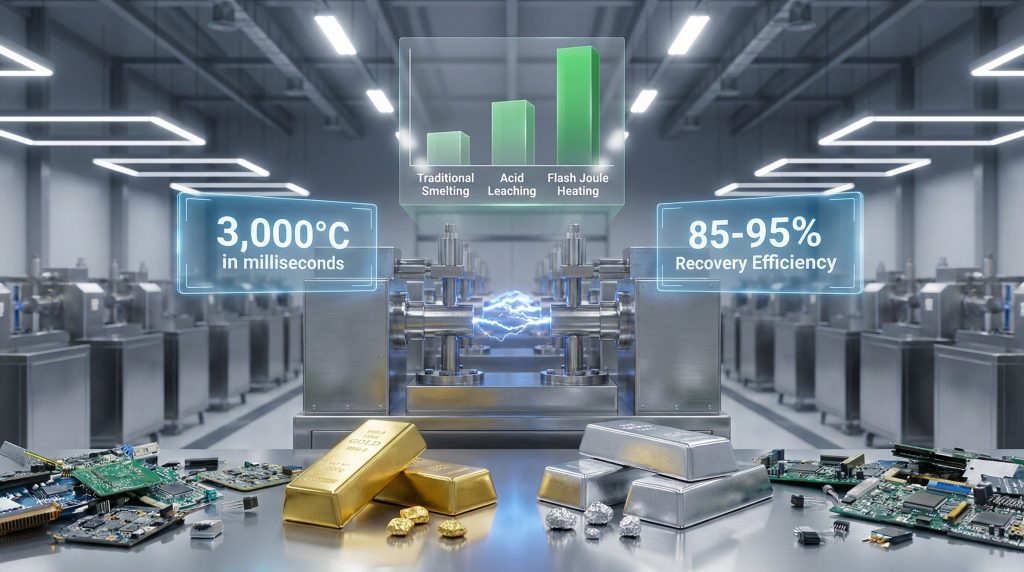
Traditional electronic waste processing relies on energy-intensive methods that can take hours to achieve metal separation. Conventional smelting operations typically reach temperatures of 1,200-1,500°C over extended heating cycles, while acid leaching processes use harsh chemicals to dissolve target metals over periods ranging from several hours to days. These established methods, while effective, require substantial infrastructure investments and generate significant environmental byproducts.
Flash Joule Heating technology transforms this paradigm by utilizing ultrafast electrical pulses to elevate material temperatures above 3,000°C (5,432°F) in milliseconds. This rapid thermal shock creates immediate separation of valuable metals from surrounding matrix materials without requiring acids or traditional smelting infrastructure. The process demonstrates recovery rates that consistently exceed 85-95% for precious metals.
Furthermore, conventional smelting efficiency ranges typically achieve 75-85% recovery rates, while acid leaching performance reaches 80-90%. The enhanced performance of Flash Joule Heating positions it as a superior alternative for processing complex electronic assemblies.
The Physics of Ultrafast Electrical Pulse Processing
The fundamental mechanism underlying Flash Joule Heating involves controlled electrical discharge through shredded electronic materials. When high-intensity electrical pulses pass through circuit board fragments, the rapid energy transfer creates localised heating that exceeds the melting points of target metals while maintaining structural integrity of the surrounding material matrix.
This process operates on principles similar to lightning strikes, where massive electrical energy release occurs over extremely short timeframes. The key innovation lies in controlling pulse duration, intensity, and frequency to optimise metal liberation while minimising energy consumption per unit of processed material.
Material Separation Mechanisms:
• Thermal shock differential: Metals expand and contract at different rates during rapid heating cycles
• Selective vaporisation: Precise temperature control targets specific metal liberation temperatures
• Matrix disruption: Rapid heating breaks down adhesive compounds and solder joints
• Magnetic separation enhancement: Heat treatment modifies magnetic properties for downstream processing
Recovery efficiency varies significantly based on feedstock composition and preparation. High-grade circuit boards containing dense concentrations of gold, silver, and platinum group metals achieve optimal recovery rates. However, semiconductor scrap and memory modules require adjusted pulse parameters to maximise precious metal extraction.
When big ASX news breaks, our subscribers know first
Commercial E-Waste Processing: Market Dynamics and Supply Chain Architecture
The transition from laboratory-scale Flash Joule Heating demonstrations to commercial-scale operations requires comprehensive understanding of feedstock availability, processing economics, and market positioning within established recycling networks. Metallium secures supply deal with Glencore illustrates how emerging processing technologies integrate with existing commodity trading infrastructure to access consistent material flows.
This partnership demonstrates the potential decarbonisation benefits achievable through advanced recycling methods compared to traditional mining operations.
Global Electronic Scrap Generation Patterns
Electronic waste generation follows predictable patterns tied to technology adoption cycles and replacement intervals. Developed economies typically generate 15-25 kilograms per capita annually, while emerging markets contribute 3-8 kilograms per capita with rapidly increasing generation rates as consumer electronics penetration expands.
Regional E-Waste Volume Distribution (2024-2026 Projections):
• North America: 7.2 million metric tons annually, growing at 3-4% per year
• Europe: 6.8 million metric tons annually, stabilising due to mature replacement cycles
• Asia-Pacific: 24.8 million metric tons annually, growing at 8-12% per year
• Other regions: 8.2 million metric tons annually, growing at 5-7% per year
Circuit board composition analysis reveals why electronic scrap represents attractive feedstock for advanced processing technologies. Printed circuit boards typically contain 250-300 grams of copper per kilogram, 15-25 grams of precious metals per kilogram, and varying concentrations of rare earth elements depending on application. This precious metal density significantly exceeds most natural ore deposits, where gold grades of 3-5 grams per metric ton are considered economically viable.
Supply Agreement Structures in Critical Materials Recovery
The Metallium-Glencore supply arrangement demonstrates how binding agreements structure feedstock security in emerging processing sectors. Under this contract, Glencore commits to supplying up to 2,400 metric tons of shredded e-scrap annually, with provisions for renewal that provide operational predictability essential for technology scaling.
This volume represents substantial feedstock security for a commissioning operation, indicating institutional confidence in Flash Joule Heating viability. The agreement progression from memorandum of understanding to binding supply contract reflects standard risk mitigation approaches in technology commercialisation.
Additionally, the partnership addresses critical minerals energy security objectives by establishing domestic processing capabilities for strategic materials.
Key Commercial Agreement Elements:
• Volume commitments: Annual minimums with upward adjustment provisions
• Quality specifications: Shredding size, contamination thresholds, moisture content limits
• Delivery reliability: Scheduled shipment intervals supporting continuous operations
• Pricing mechanisms: Market-linked formulas reflecting commodity price fluctuations
Industrial Partnership Models in Critical Materials Recovery
Major commodity traders increasingly recognise electronic waste processing as a strategic diversification opportunity that complements traditional mining and trading operations. This shift reflects both regulatory pressures toward circular economy practices and recognition that urban mining can deliver superior metal grades compared to many conventional ore deposits.
Why Major Commodity Traders Enter E-Waste Processing
Glencore's commitment to supply electronic scrap feedstock represents broader industry recognition that recycling infrastructure offers attractive risk-adjusted returns while supporting environmental stewardship objectives. As one of the world's largest diversified natural resource companies and a major recycler of end-of-life electronics, Glencore's validation provides crucial credibility for emerging processing technologies.
The partnership model addresses several strategic imperatives for established commodity firms. Diversification advantages beyond traditional mining exposure include reduced exploration risk, predictable feedstock availability, and proximity to end markets. Electronic waste streams offer more stable volume projections compared to mineral exploration, where successful discovery rates remain inherently uncertain.
Regulatory compliance positioning becomes increasingly important as governments implement circular economy frameworks. The European Union's Waste Electrical and Electronic Equipment (WEEE) Directive and similar emerging U.S. regulations create compliance advantages for companies demonstrating advanced recycling capabilities.
Margin optimisation through vertical integration enables commodity traders to capture value across multiple supply chain stages rather than solely focusing on trading margins. Processing electronic scrap domestically rather than exporting raw materials allows retention of value-added processing margins.
Operational Scale-Up Challenges in Novel Processing Technologies
The transition from laboratory validation to commercial production involves systematic risk management across technical, operational, and commercial dimensions. Metallium's commissioning phase illustrates typical scaling challenges that require sustained institutional support to navigate successfully.
Technology Validation Requirements include demonstrating consistent recovery rates across diverse feedstock compositions, optimising energy consumption per unit processed, and establishing quality control protocols that meet commodity trading standards. Laboratory results must translate to continuous production environments where material variability and operational constraints affect performance consistency.
Quality Assurance Protocols become critical when recovered metals enter commodity trading channels where precise chemical compositions and purity standards determine market acceptance. Flash Joule Heating must consistently produce recovered metals meeting London Bullion Market Association (LBMA) standards for precious metals and similar quality benchmarks for base metals.
The validation process requires sustained operation over multiple feedstock batches to demonstrate both technical reliability and commercial viability under real-world processing conditions.
Strategic Implications for US Critical Materials Independence
Electronic waste processing represents a strategic opportunity to reduce American dependence on foreign metal recovery capabilities while capturing value from domestic waste streams. The historical pattern of exporting high-value printed circuit board scrap overseas for processing reflects insufficient domestic capacity rather than technological limitations.
Domestic Processing Capacity Development
Current U.S. electronic waste processing primarily involves collection, sorting, and export of high-value components to facilities in Asia and Europe with established recovery infrastructure. This approach sacrifices significant value creation opportunities while creating supply chain vulnerabilities in critical materials access.
Metallium's Texas operation represents a pioneering attempt to onshore the recovery of critical metals from complex waste streams aligned with national strategic priorities. The facility's development coincides with broader federal initiatives supporting domestic critical materials supply chain resilience.
National Security Considerations in critical mineral supply chains have gained prominence following supply disruptions in rare earth elements, lithium, and other technology-essential materials. Electronic waste processing offers partial mitigation by recovering metals already present in domestic waste streams rather than relying on mineral imports or foreign processing facilities.
Regulatory Framework Supporting Advanced Recycling Technologies
Federal and state regulatory environments increasingly support advanced recycling technology deployment through targeted incentives and streamlined permitting processes. The Infrastructure Investment and Jobs Act allocated substantial funding for critical materials supply chain development, creating favourable conditions for domestic processing capacity expansion.
EPA Guidelines for electronic waste processing facilities emphasise environmental performance standards that favour advanced technologies over conventional smelting approaches. Flash Joule Heating's elimination of acid requirements and reduced emissions profile align with regulatory preferences for cleaner processing methods.
State-Level Incentives vary considerably, with Texas offering particularly attractive conditions for advanced manufacturing and processing operations through tax incentives, workforce development programmes, and infrastructure support. These incentives influenced Metallium's facility location decision and contribute to project economics.
Technology Commercialisation Pathways in Materials Recovery
The progression from academic research to commercial-scale processing involves navigating complex technical, regulatory, and commercial challenges while securing sustained institutional support. Metallium secures supply deal with Glencore represents a crucial milestone in technology commercialisation within materials recovery sectors, building on broader global mining innovation initiatives.
From University Research to Industrial Implementation
Rice University's initial Flash Joule Heating research focused on fundamental materials science applications before Metallium recognised commercial potential in electronic waste processing. This academic-to-industry transition required substantial additional development to address scalability, materials handling, safety protocols, and economic viability concerns not present in laboratory environments.
Intellectual Property Licensing Structures enable university research to reach commercial application while providing ongoing revenue streams supporting continued academic investigation. The partnership between Rice University and Metallium demonstrates how licensing agreements can facilitate technology transfer while maintaining academic research independence.
Scaling Challenges from research laboratory to commercial production facility involve exponential increases in complexity across multiple dimensions. Laboratory demonstrations typically process kilograms of material under controlled conditions, while commercial viability requires processing thousands of metric tons annually with consistent quality and economic performance.
Market Entry Strategies for Disruptive Processing Technologies
Establishing credibility in established commodity markets requires demonstrated technical performance, institutional validation, and commercial partnerships with recognised industry participants. Metallium's binding supply agreement with Glencore provides exactly this type of validation, enabling the company to focus on operational execution rather than feedstock security concerns.
Securing Anchor Customers through binding agreements creates operational predictability essential for technology scaling. The complementary binding offtake agreement currently being finalised between Metallium and Glencore would provide similar security for recovered metal sales, completing the commercial framework required for sustained operations.
Geographic Positioning for optimal feedstock access and market reach influences facility location decisions and operational economics. Texas provides advantages including central location for electronic waste collection, energy cost advantages, regulatory environment, and proximity to Gulf Coast export infrastructure should international sales opportunities develop.
The next major ASX story will hit our subscribers first
Future Outlook: Electronic Waste as Strategic Resource
The transformation of electronic waste from disposal burden to strategic resource reflects broader shifts in materials management philosophy and technological capabilities. Advanced processing technologies like Flash Joule Heating enable extraction of value from waste streams previously considered economically unviable for domestic processing.
Projected Growth in Electronic Waste Processing Demand
Five-year forecasts indicate continued acceleration in electronic waste generation driven by shorter device replacement cycles, expanding global electronics adoption, and proliferation of Internet of Things devices across multiple sectors. This growth trajectory creates sustained feedstock availability for processing technologies capable of handling diverse material compositions.
Critical Mineral Content Trends in evolving electronics continue favouring advanced processing methods. Modern smartphones, electric vehicle components, and renewable energy systems incorporate increasing quantities of precious metals, rare earth elements, and specialty alloys that justify sophisticated recovery investments.
Investment Flows into advanced recycling technologies have increased substantially over the past three years, with private equity, strategic corporate investors, and government funding sources all contributing to sector development. This capital availability supports technology scaling and commercial deployment across multiple competing approaches.
Competitive Landscape Evolution
Traditional recycling companies face pressure to adopt advanced processing methods or risk losing access to high-value feedstock streams. Established players are evaluating technology partnerships, acquisition opportunities, and internal development programmes to maintain competitive positioning as processing methods advance.
Technology Companies entering materials recovery sectors bring different capabilities and perspectives compared to traditional recycling operators. Software optimisation, process automation, and data analytics capabilities often provide advantages in scaling novel processing technologies efficiently.
Integration Opportunities across the value chain continue expanding as companies recognise synergies between collection, processing, and end-market sales. Vertical integration strategies enable margin capture while improving supply chain coordination and quality control.
| Processing Technology | Annual Throughput (MT) | Recovery Efficiency | Capital Investment |
|---|---|---|---|
| Traditional Smelting | 5,000-15,000 | 75-85% | $50-100M |
| Acid Leaching | 2,000-8,000 | 80-90% | $20-40M |
| Flash Joule Heating | 1,000-5,000 | 85-95% | $15-30M |
Frequently Asked Questions: Advanced E-Waste Processing
How does Flash Joule Heating compare to traditional recycling methods in terms of environmental impact?
Flash Joule Heating eliminates requirements for harsh chemicals typically used in acid leaching processes while reducing processing time from hours to milliseconds. This dramatically lowers energy consumption per unit processed and eliminates toxic waste streams associated with chemical processing methods.
What types of electronic waste show optimal results with Flash Joule Heating processing?
Circuit boards containing high concentrations of precious metals, semiconductor manufacturing scrap, and complex electronic assemblies demonstrate superior recovery rates. Material preparation through proper shredding and contamination removal significantly influences processing efficiency.
How do the economics of Flash Joule Heating compare against conventional processing methods?
While initial capital costs remain competitive with established technologies, operational advantages include elimination of chemical inputs, reduced processing time, faster throughput cycles, and higher recovery rates for valuable metals. These factors contribute to superior economic performance over operational lifecycles.
What role do government policies play in supporting advanced recycling technology deployment?
Federal and state incentives supporting critical materials supply chain development, combined with environmental regulations favouring cleaner processing methods, create favourable conditions for advanced recycling technology adoption. Consequently, these policy frameworks continue evolving to support domestic processing capacity expansion.
This analysis is based on publicly available information and industry developments as of January 2026. Technological performance claims and economic projections involve inherent uncertainties and should be verified through independent technical validation. Investment decisions should consider comprehensive due diligence beyond the scope of this educational content.
Looking to capitalise on breakthrough recycling technologies?
Discovery Alert's proprietary Discovery IQ model delivers real-time alerts on significant ASX mineral discoveries and emerging technologies, instantly empowering subscribers to identify actionable opportunities ahead of the broader market. Begin your 30-day free trial today and secure your market-leading advantage as innovative companies transform waste into valuable resources.