
May 16, 2026
The Structural Bottleneck Nobody Talks About: Why More Crude Alone Cannot Fix U.S. Fuel Prices
For decades, the dominant narrative around U.S. energy independence has focused almost exclusively on how much oil sits beneath American soil. Yet the more consequential constraint has never been upstream production capacity. It has been what happens after the crude is extracted. Processing infrastructure, specifically refining, is the invisible chokepoint between abundant domestic oil and genuine fuel self-sufficiency. Without enough refining capacity to convert that crude into gasoline, diesel, and jet fuel, even the most prolific oil fields deliver limited benefit to domestic consumers.
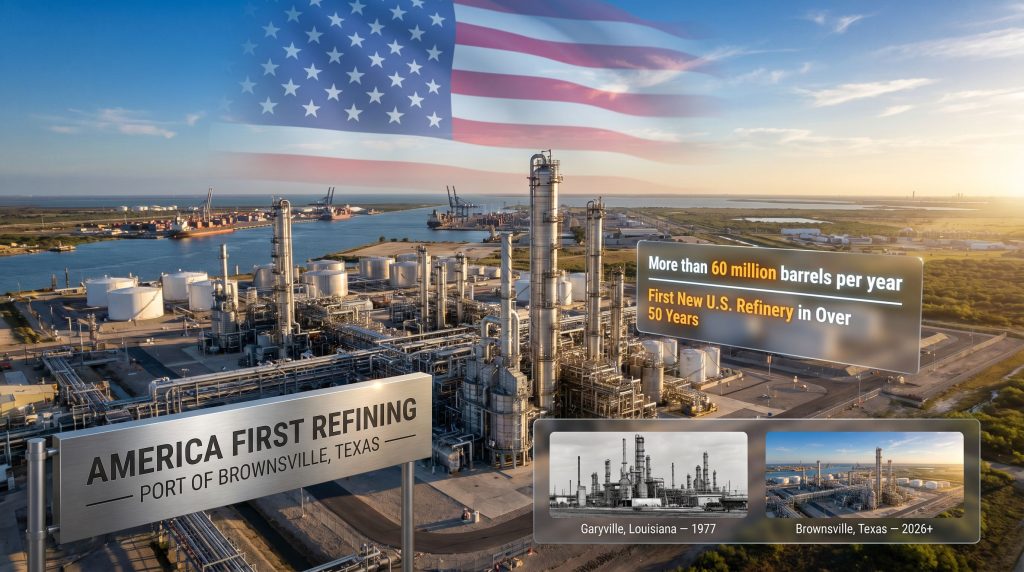
That structural reality is now driving one of the most significant industrial announcements in American energy history: Fluor building the U.S.'s first new refinery since 1977, at the Port of Brownsville, Texas, for America First Refining (AFR).
When big ASX news breaks, our subscribers know first
Why Half a Century Passed Without a Single New U.S. Refinery
The absence of greenfield refinery construction in the United States for nearly fifty years is not an accident of economics. It reflects a convergence of regulatory, financial, and strategic forces that made new builds functionally impractical for most of that period.
The last facility of this kind was completed in Garyville, Louisiana in 1977, constructed partly as a downstream response to the OPEC oil embargo of 1973. That embargo exposed Western vulnerability to imported supply disruptions with shattering clarity, and the Garyville refinery represented one institutional response to that lesson. Understanding OPEC's market influence remains as relevant today as it was during that pivotal period.
What followed in subsequent decades was not expansion but consolidation. The U.S. refining sector shrank from over 300 active refineries in the early 1980s to approximately 130 today, even as total processing throughput remained relatively stable. The industry achieved this through aggressive capacity upgrades at existing sites rather than greenfield development. Several factors made this the rational industrial choice:
- Environmental permitting for a new refinery is an extraordinarily lengthy and costly process, often spanning years before a single construction permit is issued
- Expanding an existing facility typically required far less regulatory burden than building from scratch on undeveloped land
- The capital cost of a greenfield refinery is measured in billions of dollars, with payback horizons spanning multiple decades, making the investment highly sensitive to long-term oil price assumptions
- Investor appetite for large-scale fossil fuel infrastructure weakened materially in the 2010s as ESG-focused capital allocation strategies became mainstream
- Several proposed refinery projects in the 2000s and early 2010s were announced but never advanced beyond preliminary planning stages, reinforcing institutional caution
The net effect was a sector that became increasingly efficient at processing crude through its existing footprint while leaving the country structurally exposed to supply disruptions at the refinery level.
Project Specifications: What Is Being Built at the Port of Brownsville
Fluor Corporation has been awarded the Front-End Engineering and Design (FEED) contract for the America First Refining facility in Brownsville, Texas. This is the critical pre-construction technical phase that transforms a conceptual project into a detailed engineering blueprint, forming the foundation for all subsequent investment and construction decisions. Notably, Fluor's award of this engineering contract marks a defining moment in American industrial history.
| Project Parameter | Detail |
|---|---|
| Developer | America First Refining (AFR) |
| Engineering & Design Contractor | Fluor Corporation |
| Current Phase | Front-End Engineering and Design (FEED) |
| Location | Port of Brownsville, Texas |
| Projected Annual Processing Capacity | More than 60 million barrels |
| Primary Output Products | Gasoline, diesel, jet fuel |
| Feedstock Source | Domestic crude oil |
| Historical Significance | First new U.S. greenfield refinery in approximately 50 years |
The FEED phase itself follows a structured pipeline before any physical construction begins:
- Conceptual design and project feasibility assessment
- FEED contract award (current stage)
- Detailed engineering, equipment specification, and procurement planning
- Final Investment Decision (FID) based on completed FEED outputs
- Construction mobilisation and site preparation
- Commissioning and phased operational startup
Completion of FEED does not automatically trigger construction. A formal Final Investment Decision remains a separate milestone, contingent on engineering outputs, regulatory approvals, and financing arrangements.
Why Brownsville, Texas Was Selected
The site selection for this facility reflects deliberate strategic logic rather than geographic convenience. The Port of Brownsville sits at the southern tip of Texas, positioned to capitalise on several converging logistical advantages:
- Proximity to prolific crude production zones: Both the Permian Basin and the Eagle Ford Shale formation are within viable pipeline reach, providing reliable access to domestic feedstock
- Deep-water port infrastructure: Ocean access enables both flexible import arrangements and potential export optionality for refined products
- Existing industrial corridor: South Texas hosts substantial existing petrochemical and energy infrastructure, reducing the cost and timeline for utility connections and support services
- Industrial zoning environment: The Brownsville region offers a regulatory and land-use environment more compatible with large-scale industrial development than many alternative locations
The Engineering Dimension: What Fluor Brings to This Project
Fluor Corporation's involvement carries significant weight beyond its technical credentials. As one of the world's largest engineering, procurement, and construction companies, Fluor has an extensive track record in large-scale refining and petrochemical infrastructure globally. Its selection for the FEED contract signals a level of project seriousness that distinguishes the Brownsville development from the numerous proposed U.S. refineries that failed to progress beyond announcement stage over the past two decades.
A key feature of the project's design philosophy, as indicated in Fluor's engagement, is a deliberate emphasis on commercially proven refining technologies. This stands in contrast to experimental or first-generation process approaches, and reflects a pragmatic commitment to execution reliability over theoretical innovation. Furthermore, understanding why Fluor is advancing this refining project provides valuable context for the engineering choices being made.
Modern refinery design in 2026 differs fundamentally from the engineering standards applied at Garyville in 1977. Contemporary configurations incorporate:
- Efficiency-optimised processing units designed to reduce per-barrel operating costs
- Cleaner processing methodologies aligned with contemporary emissions requirements
- Digital integration across monitoring, control, and maintenance systems
- Modular design elements that can support phased capacity expansion
These engineering advances mean the Brownsville facility, despite being comparable in strategic ambition to its 1977 predecessor, represents an entirely different generation of industrial capability.
A Structural Comparison: Garyville 1977 vs. Brownsville 2026
| Comparison Dimension | Garyville, Louisiana (1977) | Brownsville, Texas (2026+) |
|---|---|---|
| Policy Driver | Response to OPEC oil embargo | Domestic supply chain resilience |
| Geopolitical Context | Cold War energy nationalism | Middle East conflict-driven supply disruption |
| Technology Generation | First-generation modern refining | Commercially proven, efficiency-optimised design |
| Environmental Standards | Pre-EPA Clean Air Act amendment era | Contemporary emissions and efficiency requirements |
| Construction Rationale | Energy independence following import shock | Closing the gap between crude output and refined supply |
| Engineering Contractor | Not publicly specified | Fluor Corporation (FEED phase) |
The next major ASX story will hit our subscribers first
Global Supply Disruption as an Accelerant: The Hormuz Factor
The timing of the Brownsville announcement cannot be understood in isolation from the broader geopolitical context. Escalating conflict across the Middle East, triggered by joint U.S.-Israeli military strikes on Iran at the end of February 2026, effectively closed the Strait of Hormuz to routine commercial oil transit. The Strait is the world's most critical oil chokepoint, ordinarily facilitating the passage of the vast majority of Middle Eastern crude exports.
The consequences for global supply have been severe. According to executives from the world's largest oil companies, an estimated one billion barrels of oil have been removed from global markets across the two-month period following the onset of disruption. Saudi Aramco has partially mitigated the impact on its own export operations by rerouting volumes through its East-West Pipeline, which connects eastern production fields to the Red Sea port of Yanbu, bypassing the Strait entirely. However, that pipeline operates at finite capacity and cannot fully substitute for the Hormuz route at scale.
Despite these pressures, Aramco reported a 25% increase in year-on-year profits for Q1 2026, a counterintuitive result explained largely by the price spike effect that supply disruption generates. These broader geopolitical oil price factors have consequently accelerated conversations around domestic refining capacity.
| Aramco Metric | Data Point |
|---|---|
| Q1 2026 Profit Change (Year-on-Year) | +25% |
| Global Production Volume (2024) | 12.4 million barrels of oil equivalent per day |
| Net Refining Capacity | 4.1 million barrels per day |
| Global Refining Rank | 4th largest refiner worldwide |
| Primary Disruption Factor | Strait of Hormuz effective closure |
For U.S. policymakers and energy strategists, the Hormuz disruption delivered a sharply focused lesson: dependence on global fuel supply chains, even indirect dependence, introduces systemic vulnerability that domestic refining capacity can partially hedge against.
What 60 Million Barrels Per Year Actually Delivers
At more than 60 million barrels per year, the Brownsville facility would process in excess of 164,000 barrels per day of domestic crude. To contextualise that figure, the United States currently refines approximately 17 to 18 million barrels per day across its existing refinery network. The Brownsville project would therefore represent a meaningful but incremental addition to national throughput capacity.
Its significance, however, extends beyond raw volume. The facility targets three product streams, each with distinct strategic relevance:
- Gasoline: Consumer price sensitivity makes domestic gasoline supply a politically and economically visible issue. Additional refining capacity in this category has direct implications for retail pump prices in high-demand regions
- Diesel: Perhaps the most strategically critical output, diesel underpins logistics networks, agricultural operations, and heavy industry. Supply tightness in diesel markets cascades rapidly through the broader economy
- Jet fuel: Aviation sector demand has recovered strongly in the post-pandemic period, and jet fuel supply chain vulnerability was exposed acutely during recent disruption events
The Investment and Risk Landscape: What Could Prevent Completion
It is important to note that FEED completion does not constitute a binding commitment to construct. Investors and observers should treat the current milestone as a significant but preliminary step in a multi-year development process.
Several critical risk variables could affect whether the Brownsville project reaches operational status:
- Capital intensity: Greenfield refineries of this scale routinely require multi-billion dollar capital commitments, and cost escalation during construction phases is a well-documented risk in large-scale industrial projects
- Regulatory and permitting timelines: Environmental permitting for a new facility involves extensive review processes; delays at any stage can materially affect project economics
- Final Investment Decision uncertainty: FID requires alignment across engineering outputs, financing structures, and market outlook assumptions, none of which are guaranteed at the FEED stage
- Long-horizon energy transition risk: A refinery constructed today carries an operating horizon extending well into the 2050s and beyond, raising questions about demand trajectory for refined petroleum products over the full asset life
- Historical precedent of failed announcements: Multiple proposed U.S. refineries over the past two decades attracted initial publicity but never progressed to construction, creating a credibility benchmark that Brownsville must overcome
In addition, the U.S. oil production decline trend adds another layer of complexity to feedstock supply assumptions underpinning the project's long-term economics.
The Broader Strategic Signal: When Energy Security Rewrites Industrial Logic
The Brownsville project reflects a recalibration of how energy infrastructure decisions are being made in the United States. For much of the past three decades, market economics dominated these choices. The cheapest source of refined fuel, domestic or imported, was simply purchased. Domestic manufacturing was not treated as intrinsically valuable beyond its economic contribution.
That calculus appears to be shifting. The combination of Middle East supply disruption, oil price movements driven by trade tensions, and a broader reshoring impulse in U.S. industrial policy has elevated domestic refining capacity from an economic consideration to something closer to a strategic priority. This does not represent government funding or project-specific support for the Brownsville development specifically, but it does describe a policy environment that creates stronger commercial rationale for investments of this type than existed a decade ago.
Furthermore, Russian oil trading sanctions have reinforced the broader argument for reducing reliance on globally traded refined products. Whether this marks the beginning of a broader refinery construction cycle in America remains genuinely uncertain. The economic barriers that suppressed greenfield development for fifty years have not disappeared. Permitting complexity, capital requirements, and long-term demand uncertainty remain formidable. What has changed is the weight placed on energy resilience as a factor in infrastructure decision-making, and that shift may prove durable regardless of how specific geopolitical tensions evolve.
Frequently Asked Questions
Why has the U.S. not built a new refinery since 1977?
A sustained combination of environmental permitting complexity, high capital costs relative to expanding existing facilities, volatile oil price cycles that discouraged long-horizon investment, and a gradual industry-wide preference for consolidation over expansion all contributed to suppressing greenfield refinery construction for nearly five decades.
Where is the new refinery being built, and who is developing it?
The facility is being developed by America First Refining (AFR) at the Port of Brownsville in South Texas. Fluor building the U.S.'s first new refinery since 1977 has placed Fluor Corporation at the centre of this effort, contracted to complete the FEED phase — the detailed pre-construction engineering work that precedes a final investment decision.
How much will the new refinery process?
The Brownsville facility is designed to process more than 60 million barrels of domestic crude oil per year, producing gasoline, diesel, and jet fuel for the U.S. market.
Does this project have confirmed government backing?
No confirmed government funding or formal project-specific designation has been announced in connection with this project. The development is proceeding as a private sector initiative within a broader policy environment that prioritises domestic energy production.
When could the refinery become operational?
As of mid-2026, the project remains in the FEED phase. A definitive operational timeline depends on FEED completion, regulatory approvals, and a formal Final Investment Decision. Large-scale refinery projects typically require several years between FEED completion and first production.
Will one refinery make the U.S. energy independent?
A single facility cannot deliver comprehensive energy independence. However, Fluor building the U.S.'s first new refinery since 1977 directly addresses the structural gap between domestic crude production capacity and domestic refined product supply, which has been a persistent constraint on genuine fuel self-sufficiency.
Want To Stay Ahead of the Next Major Resource Discovery?
Discovery Alert's proprietary Discovery IQ model delivers real-time alerts on significant ASX mineral discoveries, instantly converting complex data across more than 30 commodities into a single, actionable gold-equivalent metric — giving subscribers a critical market edge the moment opportunities emerge. Explore why historic discoveries have generated substantial returns on Discovery Alert's dedicated discoveries page, and begin your 14-day free trial today to position yourself ahead of the broader market.