May 16, 2026
The Hidden Bottleneck Threatening India's Clean Energy Ambitions
The global race to secure critical minerals is no longer a distant geopolitical concern for India. It is a present industrial reality. As the country accelerates its transition toward electric mobility, renewable energy infrastructure, and advanced electronics manufacturing, a fundamental question emerges: where will the raw material inputs come from? For decades, India has relied on imports to satisfy demand for metals that are now classified among the world's most strategically sensitive commodities. That dependency is increasingly difficult to sustain in a world where supply chains for cobalt, nickel, copper, and antimony are tightening at pace.
The structural answer may not lie in opening new mines. It may lie in transforming what already exists at industrial scale: the residues, slags, and by-products generated by India's existing smelting and processing operations. This is the logic underpinning the Runaya critical metals production expansion in Rajasthan, a development that represents one of the more significant advances in India's domestic critical minerals processing landscape.
When big ASX news breaks, our subscribers know first
Understanding India's Critical Minerals Vulnerability
India's dependence on imported critical metals is not a new problem, but the stakes have changed dramatically. The country has formally identified 30 critical minerals as priorities for domestic supply chain development. These include cobalt, nickel, copper, lithium, and antimony, all of which feature prominently across the battery, electronics, and clean energy value chains that sit at the heart of India's industrial growth strategy.
The challenge is structural. India lacks the domestic primary mining base to self-supply many of these metals at the volumes its energy transition industries will require. The critical minerals demand surge across global markets is compounding this pressure significantly. For context:
- India imports the overwhelming majority of its cobalt requirements, with primary supply concentrated in the Democratic Republic of Congo
- Copper refining capacity, while growing, remains insufficient relative to projected electrification demand
- Antimony, used in grid-scale battery storage and flame retardant systems, has extremely limited domestic processing capability
- Nickel supply is heavily concentrated globally, with Indonesia and the Philippines controlling the bulk of primary ore output
India's critical minerals gap is not simply a trade issue. It represents a structural vulnerability across the country's fastest-growing industrial verticals, from EV battery manufacturing to data centre infrastructure.
The policy response has been meaningful. India's Critical Minerals Mission and associated production-linked incentive schemes signal strong intent to build domestic capacity. However, policy frameworks alone cannot create processing infrastructure. Physical investment in plant, technology, and operational expertise is required, and that is precisely what the Runaya expansion in Rajasthan is delivering. Furthermore, critical minerals and energy security concerns are increasingly shaping how India prioritises its industrial investment decisions.
Runaya's Position in India's Industrial Metals Ecosystem
Runaya is a Vedanta-backed industrial metals recovery company with a distinct operational model: it does not mine primary ore. Instead, it extracts value from the residues and by-products generated by large-scale industrial smelting operations, particularly those within the zinc processing sector.
This approach, broadly described as circular economy manufacturing, has significant advantages over greenfield primary extraction. It bypasses the lengthy environmental permitting, exploration, and development timelines associated with new mines while leveraging existing industrial infrastructure. Runaya's expanding critical metals portfolio is a direct reflection of this strategy in action.
Runaya's operational footprint in Rajasthan is anchored across three key locations: the Zinc Industrial Park, the Chanderiya facility, and the Dariba complex. These sites benefit from co-location with Vedanta's zinc smelting operations, providing a consistent and high-volume feedstock of industrial residues from which target metals are recovered.
| Operational Parameter | Detail |
|---|---|
| Parent / Backer | Vedanta Group |
| Primary Location | Rajasthan (Zinc Industrial Park, Chanderiya, Dariba) |
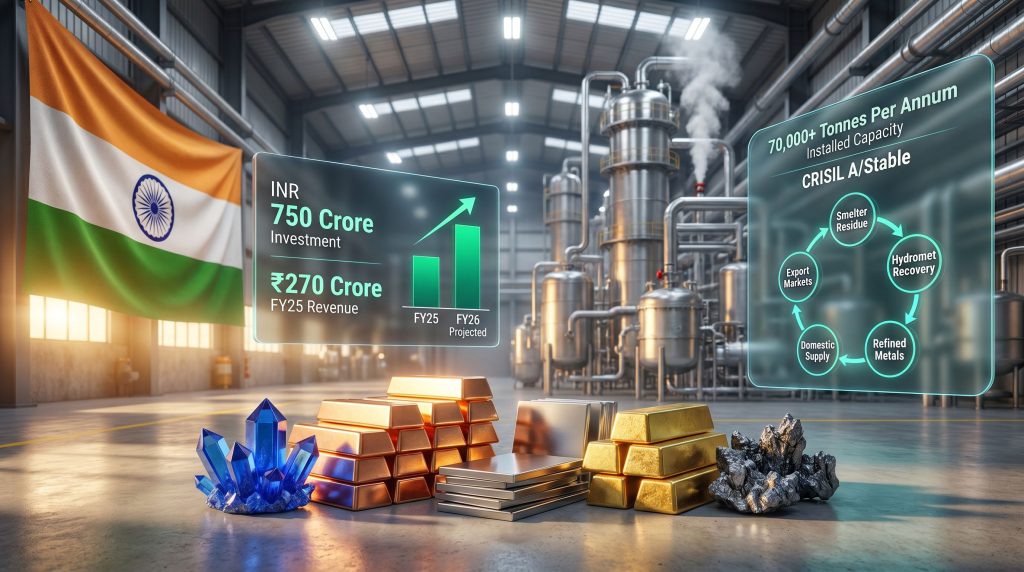
| Installed Capacity | 70,000+ tonnes per annum |
| Smelter Waste Recovery | ~50,000 MT per annum |
| Key Metals Portfolio | Cobalt, Cadmium, Copper, Nickel, Antimony + base metals |
| Energy Model | Renewable-powered operations |
The company also operates across green aluminium solutions, metallurgical powders, and metal recovery systems, giving it a diversified industrial sustainability profile that extends well beyond any single metal category.
How the Circular Manufacturing Process Works
The technical methodology behind Runaya's operations is worth understanding in detail, because it differs fundamentally from conventional metals production and carries distinct economic and environmental characteristics.
The process flow can be broken down as follows:
- Feedstock collection: Industrial residues, smelter slags, and by-products from co-located zinc processing facilities are collected and prepared for processing
- Hydrometallurgical recovery: Leaching and solvent extraction processes are used to selectively dissolve and separate target metals from complex mixed residue matrices
- Pyrometallurgical treatment: High-temperature processing techniques are applied where hydrometallurgical methods alone are insufficient to achieve target metal purities
- Refining and compounding: Recovered metals are refined into value-added products, including metal compounds and refined forms suitable for domestic industrial use and export markets
- Energy integration: Processing operations are powered by renewable energy sources, aligning with broader green manufacturing objectives
This methodology is particularly well-suited to zinc smelter residues, which characteristically contain recoverable concentrations of cobalt, cadmium, copper, indium, and germanium, among other metals. The co-location advantage at Rajasthan's zinc processing cluster means feedstock transport costs are minimal, and residue volumes are consistent and predictable, two factors that significantly de-risk the economics of recovery operations.
The circular manufacturing model transforms what would otherwise be a waste liability into a high-value resource stream, compressing both the capital and timeline requirements that would apply to a conventional greenfield mining project.
The Metals at the Centre of Runaya's Expansion
The choice of metals targeted in the Runaya critical metals production expansion in Rajasthan reflects a sophisticated reading of where India's industrial demand is heading over the next decade.
| Metal | Primary End-Use Sectors | Global Supply Risk Level |
|---|---|---|
| Cobalt | EV batteries, aerospace alloys, hard metals | High |
| Copper | Electrification, data centres, EVs, renewable infrastructure | High |
| Nickel | Battery cathodes, stainless steel | Medium-High |
| Cadmium | Power systems, thin-film solar (CdTe) | Medium |
| Antimony | Grid storage, flame retardants, semiconductors | Very High |
Cobalt remains one of the most scrutinised battery metals globally. While the industry has pursued cobalt reduction strategies in lithium-ion battery chemistry, cobalt-containing cathodes still dominate premium EV and aerospace applications. India's EV sector, growing rapidly under domestic manufacturing push policies, will require reliable cobalt supply chains. In addition, India's lithium supply strategy illustrates how the country is approaching the broader challenge of battery metals security across multiple fronts.
Antimony deserves particular attention as an often-overlooked but critically important metal. It is a key component in antimony-based grid storage batteries, which are gaining traction as an alternative to lithium-ion systems for stationary energy storage. China's export controls on strategic metals have further elevated supply concentration risk across antimony and related commodities. India's ability to produce antimony domestically from smelter residues therefore represents a meaningful strategic advantage.
Cadmium, while carrying toxicity considerations that require careful handling, remains industrially essential for cadmium telluride (CdTe) thin-film solar panels, a technology that is cost-competitive with silicon photovoltaics in certain deployment contexts. It is also used in nickel-cadmium battery systems for backup power applications.
Copper demand is perhaps the most universally understood. Every electric vehicle requires between 60 and 90 kilograms of copper, compared to approximately 20 kilograms in a conventional internal combustion engine vehicle. Data centres, a sector experiencing explosive growth driven by artificial intelligence infrastructure buildout, are also copper-intensive. India's ambitions in both sectors create a structural upside case for domestic copper recovery capacity.
Financial Scale and Growth Trajectory
The financial profile of Runaya's expansion programme provides a useful lens for understanding the commercial maturity of the residue-to-metal recovery model at scale.
| Financial Metric | Figure |
|---|---|
| Planned Capital Investment | INR 750 crore (~USD 90 million) |
| Deployment Timeline | 18 months |
| FY25 Revenue | INR 270 crore |
| Revenue Growth vs. Prior Periods | Approximately fourfold |
| FY26 Revenue Projection | Expected to approximately double |
| Credit Rating (Runaya Green Tech) | CRISIL A/Stable |
The fourfold revenue growth recorded in FY25 is significant. It confirms that the company's circular recovery model is not merely a conceptual proposition but a commercially validated industrial operation capable of generating meaningful revenue at scale. A CRISIL A/Stable credit rating assigned to Runaya Green Tech further signals institutional confidence in the business model, as CRISIL ratings reflect rigorous assessments of financial performance, operational stability, and credit risk.
The projected doubling of revenues in FY26, contingent on the successful commissioning of new capacity, would place Runaya in a materially different position within India's critical minerals processing landscape. At that scale, the company would represent one of the country's most substantial domestic processors of battery and energy transition metals. The battery raw materials market more broadly is evolving rapidly, consequently making this kind of domestic processing investment increasingly well-timed.
Disclaimer: Revenue projections and forward-looking financial statements are subject to execution risk, commodity price movements, and market conditions. They should not be interpreted as guaranteed outcomes.
The next major ASX story will hit our subscribers first
India vs. Global Peers: A Critical Metals Processing Benchmark
India's position in global critical metals processing is best understood through comparison with more established processing economies. The gap is significant but not insurmountable, particularly given the structural advantages of the residue recovery model.
| Region | Critical Metals Processing Approach | Domestic Capacity Status |
|---|---|---|
| China | Vertically integrated, primary + secondary | Dominant globally |
| European Union | Recycling-led, Critical Raw Materials Act | Scaling rapidly |
| United States | Primary mining + recycling investment | Rebuilding post-IRA |
| India (Runaya model) | Residue recovery + circular manufacturing | Early-stage but accelerating |
China's dominance across critical metals processing is well documented. Its vertically integrated model, spanning ore extraction through to refined metal production and battery manufacturing, gives it structural cost and supply chain advantages that are extremely difficult to replicate through conventional greenfield development on comparable timelines.
What makes the Runaya approach strategically compelling is that it does not attempt to compete with primary mining economics. Instead, it exploits a feedstock advantage that primary miners cannot easily access: the concentrated residue streams generated within existing industrial clusters. This is a faster, lower-capital, and environmentally preferable pathway to building domestic processing capacity than attempting to establish new primary mines and smelters.
The Cluster Model: Why Geography Matters
One of the less immediately obvious strategic advantages of Runaya's Rajasthan operations is the cluster dynamic created by co-location within Vedanta's zinc industrial complex. Industrial clusters generate compounding advantages that isolated facilities cannot replicate:
- Shared infrastructure: Road, power, water, and logistics networks are shared across co-located operations, reducing per-unit overhead costs
- Feedstock reliability: Proximity to smelting operations ensures a predictable, contractually structured supply of residue feedstock rather than reliance on spot market procurement
- Knowledge concentration: Technical expertise in metallurgical processing concentrates within clusters, improving operational efficiency over time
- Scale expansion pathways: Incremental capacity additions within an established cluster are significantly less capital-intensive than building new standalone facilities
Rajasthan's position as India's leading zinc processing region, anchored by Vedanta's Hindustan Zinc operations at Chanderiya and Dariba, gives these facilities access to one of the largest and most consistent smelter residue streams available anywhere in the country.
Downstream Industrial Demand Driving the Expansion Case
The Runaya critical metals production expansion in Rajasthan is not occurring in isolation. It is a response to genuine and growing downstream demand across multiple Indian industrial sectors.
Electric Vehicles: India's EV market is growing rapidly, with two-wheeler electrification already well advanced and four-wheeler EV penetration accelerating. Domestic battery manufacturing, whether through gigafactory development or cell assembly, requires reliable access to cobalt, nickel, and copper at commercially viable prices.
Renewable Energy: India targets 500 GW of renewable energy capacity by 2030, a build-out that will consume enormous quantities of copper for cabling, inverters, and grid connections, alongside cadmium for certain thin-film solar applications.
Data Centres: AI-driven data centre growth is creating a new, previously underappreciated demand vector for copper and other metals. Hyperscale data centres being developed across India as part of the country's digital infrastructure expansion are copper-intensive facilities.
Advanced Manufacturing: India's ambition to become a global electronics and semiconductor manufacturing hub creates demand for specialty metals including antimony, indium, and germanium, some of which can be recovered from zinc smelter residue streams.
Frequently Asked Questions: Runaya Critical Metals Expansion in Rajasthan
What metals is Runaya expanding production of at its Rajasthan facilities?
Runaya is expanding cobalt, cadmium, and copper production capacity, alongside nickel, antimony, and other base metals recovered from industrial residues generated within the Rajasthan zinc processing cluster.
Where exactly are Runaya's Rajasthan operations located?
Operations are spread across the Zinc Industrial Park, the Chanderiya facility, and the Dariba complex in Rajasthan, all co-located within or adjacent to Vedanta's Hindustan Zinc industrial infrastructure.
What is Runaya's current installed production capacity in Rajasthan?
Runaya currently operates with installed production capacity exceeding 70,000 tonnes per annum, with smelter waste recovery of approximately 50,000 metric tonnes per annum.
How much is Runaya investing in its critical metals expansion?
The company has committed INR 750 crore (approximately USD 90 million) for deployment across an 18-month period to build out additional critical metals processing capacity.
What is the connection between Runaya and the Vedanta Group?
Runaya is backed by the Vedanta Group, one of India's largest diversified natural resources conglomerates. This relationship provides Runaya with access to feedstock from Vedanta's zinc smelting operations and the broader industrial infrastructure of the Rajasthan zinc processing cluster.
How does Runaya's circular manufacturing model work?
The model recovers target metals from the residues and by-products of zinc smelting through a combination of hydrometallurgical and pyrometallurgical processing techniques. Recovered metals are then refined into value-added products for domestic industrial use and export.
What credit rating has been assigned to Runaya Green Tech?
CRISIL has assigned a CRISIL A/Stable rating to Runaya Green Tech. This rating reflects a strong degree of financial safety and operational stability, signalling that institutional creditors view the business model and financial trajectory as sound.
Strategic Conclusions: What the Rajasthan Expansion Signals for India's Critical Minerals Future
The Runaya critical metals production expansion in Rajasthan is most accurately understood not as a single company's growth story, but as an early demonstration of what a domestically anchored circular metals manufacturing sector in India could look like at scale.
Several conclusions emerge from the evidence:
- Residue recovery is a viable fast-track: The circular economy model delivers domestic processing capacity far more quickly and with lower capital intensity than greenfield primary mining development
- Cluster geography creates durable advantages: Co-location within Rajasthan's zinc industrial cluster generates compounding cost, feedstock, and infrastructure advantages that isolated facilities cannot replicate
- Commercial validation is established: Fourfold revenue growth to INR 270 crore in FY25 and a CRISIL A/Stable rating confirm that the business model works at industrial scale
- The metals portfolio is well-calibrated: Cobalt, copper, nickel, cadmium, and antimony collectively address India's most acute critical mineral import vulnerabilities across its highest-growth industrial sectors
- The INR 750 crore investment signals a strategic inflection: At this capital scale and deployment pace, Runaya is transitioning from niche recovery to large-scale critical minerals manufacturing
India's critical minerals strategy cannot be reduced to a single policy framework or a single company. But the type of investment represented by Runaya's Rajasthan expansion, anchored in existing industrial infrastructure, commercially proven, and aligned with genuine downstream demand, offers a credible template for how India can close its critical metals processing gap at meaningful speed.
The broader implication is that India's approach to critical minerals security may ultimately be built as much from the inside out, transforming industrial waste streams into strategic metal supply, as from the top down through primary exploration and mining development. That is a materially different industrial pathway, and Rajasthan may be where it is most visibly taking shape.
Want to Stay Ahead of Significant Mineral Discoveries Before the Broader Market Does?
Discovery Alert's proprietary Discovery IQ model delivers real-time alerts on significant ASX mineral discoveries across cobalt, copper, nickel, and antimony — the very metals driving India's critical minerals ambitions — instantly translating complex data into actionable investment insights for traders and long-term investors alike. Explore how historic mineral discoveries have generated substantial returns and begin your 14-day free trial today to secure a market-leading edge.