August 5, 2026
The Hidden Cost Architecture That Makes Iron-Air Economics Genuinely Disruptive
Most discussions about the competitiveness of long-duration energy storage start and end with a single number: cost per kilowatt-hour. That framing is fundamentally incomplete. The real story of why the Form Energy iron-air battery expansion is reshaping grid planning assumptions lies not in a headline price, but in a layered economic architecture that conventional $/kWh comparisons entirely miss.
Understanding this architecture requires stepping back from the technology itself and examining what grid operators, hyperscalers, and utilities are actually solving for. A four-hour lithium-ion battery is an exceptional product for a specific problem: smoothing intraday renewable generation volatility, managing peak demand windows, and providing fast-response grid services.
However, it is a poor tool for a fundamentally different problem: maintaining grid reliability across multi-day weather events, prolonged wind droughts, or sustained periods of low solar irradiance that can stretch across entire regions for 48 to 100 hours or more.
That structural gap is the commercial foundation on which the Form Energy iron-air battery expansion is being built. Furthermore, as critical minerals in the energy transition continue to shape storage economics, the significance of iron-air's mineral-independent architecture becomes increasingly clear.
When big ASX news breaks, our subscribers know first
Why the Duration Gap in Energy Storage Is Getting Harder to Ignore
The Mathematics of Stacking Lithium-Ion for Multi-Day Applications
When analysts benchmark iron-air against lithium-ion on a raw $/kWh basis, they are often comparing systems designed for entirely different use cases. A single four-hour lithium-ion unit priced at the current global average of approximately $80/kWh (BloombergNEF, cited in John Fitzgerald Weaver, ESS News / pv magazine USA, April 28, 2026) cannot replace a 100-hour iron-air system.
Achieving equivalent discharge duration using lithium-ion requires stacking approximately 25 separate four-hour units, multiplying both capital expenditure and balance-of-plant integration costs by a corresponding factor.
The relevant comparison metric for multi-day applications is the Levelised Cost of Storage (LCOS), which incorporates capital cost, round-trip efficiency, cycle life, operating costs, and the cost of replacement over a system's operational lifetime. As discharge duration requirements extend beyond 8 to 12 hours, the LCOS of lithium-ion stacks rises sharply, while single-unit iron-air systems maintain a relatively flat cost profile regardless of discharge duration.
This is the core of why the Form Energy iron-air battery expansion has attracted demand that is outpacing even the company's own internal forecasts.
Lithium-Ion's Expanding Duration Profile Is Not Without Limits
It would be an oversimplification to characterise lithium-ion as static. The technology continues to advance aggressively. Chinese LFP 314 Ah storage cells, which represent the dominant format in grid-scale deployments, have made significant efficiency and density gains in recent years.
However, those same cells rose approximately 22% in price over a six-month period through early 2026 as lithium supply tightened and demand from both the electric vehicle and stationary storage sectors surged simultaneously (Vincent Shaw, ESS News, April 22, 2026). The lithium market downturn has demonstrated just how volatile this supply chain can be.
That price volatility introduces a structural risk that is easy to overlook during periods of cheap lithium supply. Iron-air's primary inputs — iron, water, and ambient air — carry no equivalent supply chain exposure. Iron is among the most abundant elements in the Earth's crust and is domestically available in the United States at industrial scale.
This materials advantage is not merely a talking point; it represents a fundamental difference in long-term cost trajectory risk between the two technologies.
The assumption that lithium will remain cheap indefinitely has already been tested and found wanting. The 2021–2022 lithium carbonate price spike and the more recent LFP cell price increases in early 2026 both illustrate how demand concentration in a single mineral can rapidly destabilise storage economics across an entire industry.
How the Iron-Air Electrochemical Cycle Actually Works
Rusting at Industrial Scale as a Grid-Scale Energy Storage Mechanism
The operating principle behind iron-air battery technology is conceptually straightforward, though technically sophisticated at scale. During the discharge cycle, metallic iron at the anode oxidises in the presence of an aqueous electrolyte and oxygen drawn from ambient air. This oxidation reaction, chemically analogous to rusting, releases electrons that flow through an external circuit to deliver electricity to the grid.
During the charging cycle, the process reverses. Applied electrical current reduces the iron oxide back to metallic iron, effectively storing energy in the chemical bond state of the iron. Air electrodes at the cathode manage oxygen intake and release throughout both cycles.
Key technical characteristics of the iron-air architecture include:
-
No rare earth minerals required: The system relies entirely on iron, water, and air, eliminating exposure to lithium, cobalt, nickel, or manganese supply chains.
-
No thermal runaway pathway: Unlike lithium-ion cells, which contain organic electrolytes that can combust under overcharge or physical damage conditions, iron-air chemistry is inherently non-flammable. Form Energy's system has achieved UL9540A certification, independently confirming zero thermal runaway risk across all testing conditions.
-
Duration scalability: Discharge duration is primarily a function of iron mass, not cell count. This means extending duration requires adding iron material rather than additional cell stacks, keeping marginal cost increases linear rather than exponential as duration grows.
-
100-hour continuous discharge capability: This far exceeds any lithium-ion configuration currently available at commercial scale, and enables grid operators to model multi-day storage as a single integrated asset rather than a patchwork of shorter-duration units.
Technology Comparison: Where Iron-Air Sits in the Storage Landscape
| Technology | Typical Duration | Key Materials | Thermal Runaway Risk | Approximate 2026 Cost | Long-Term Cost Target |
|---|---|---|---|---|---|
| Lithium-Ion (LFP) | 2 to 4 hours | Lithium, iron, phosphate | Present | ~$80/kWh (global avg.) | ~$60 to $70/kWh |
| Vanadium Flow | 4 to 12 hours | Vanadium, sulphuric acid | Low | $150 to $250/kWh | $150 to $200/kWh |
| Iron Flow (ESS Inc) | 12 to 24 hours (transitioning) | Iron, salt electrolyte | Very Low | Limited commercial data | Under redevelopment |
| Iron-Air (Form Energy) | Up to 100 hours | Iron, water, air | None (UL9540A certified) | ~$77/kWh (implied) | $20/kWh (stated target) |
Sources: BloombergNEF pricing data cited in Weaver, ESS News, April 28, 2026; Form Energy cost targets and UL9540A certification confirmed in company announcements; implied pricing derived from The Information reporting on the Google-Xcel agreement.
The Scale of the Form Energy Iron-Air Battery Expansion: Pipeline Numbers in Context
A 375% Pipeline Increase in Six Months
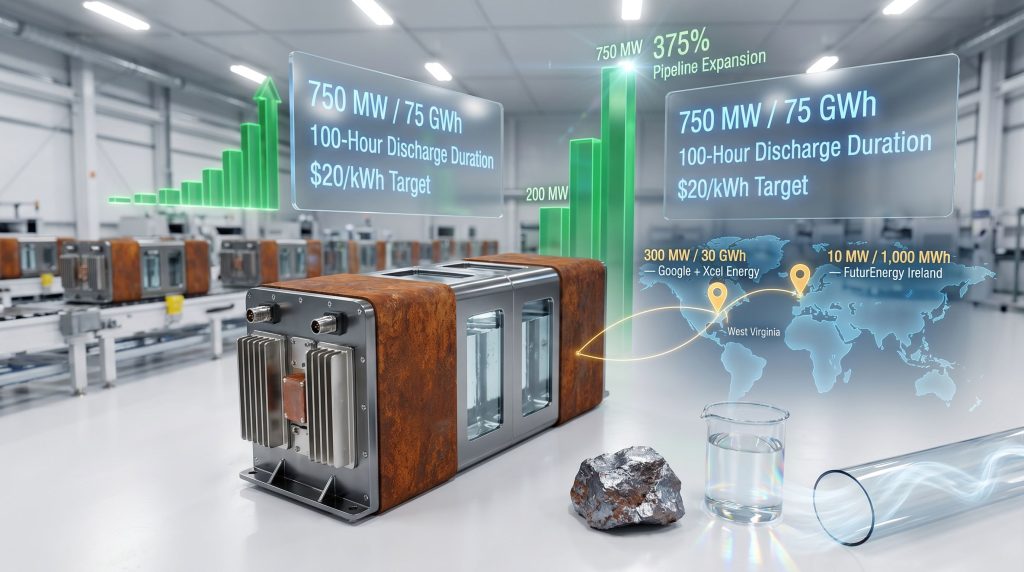
The pace of commercial traction behind the Form Energy iron-air battery expansion is genuinely unusual for a capital-intensive infrastructure technology at early commercial scale. In October 2025, Form Energy CEO Mateo Jaramillo disclosed in an interview with Latitude Media that the company had contracted over 200 MW / 20 GWh of capacity. That figure already exceeded the company's own forward projections for 2028, 2029, and 2030 combined.
By April 2026, the pipeline had grown to approximately 750 MW / 75 GWh of capacity under active development (John Fitzgerald Weaver, ESS News / pv magazine USA, April 28, 2026). That represents a 375% expansion in contracted MW within six months — a velocity that is extremely rare in industries where project lead times typically run three to five years.
The key projects anchoring this pipeline include:
-
Google / Xcel Energy (Minnesota): 300 MW / 30 GWh under definitive agreement; reported transaction value approximately $1 billion per The Information.
-
Crusoe Energy AI Portfolio: Approximately 120 MW / 12 GWh signed in March 2026, targeting AI data centre load.
-
FuturEnergy Ireland: 10 MW / 1,000 MWh system in northwest Ireland, expected online by 2029, marking Form Energy's first international deployment.
-
Additional undisclosed U.S. projects making up the balance of the 75 GWh figure.
The Revenue Implication Across Two Pricing Scenarios
| Pricing Scenario | Per-kWh Price | Total Pipeline Revenue (75 GWh) |
|---|---|---|
| Long-term stated target | $20/kWh | ~$1.5 billion |
| Implied current pricing (pre-incentive) | ~$77/kWh | ~$5.7 billion |
Disclaimer: These figures are illustrative projections based on stated targets and implied transaction economics. Actual revenues will depend on contract terms, production costs, tax credit eligibility, manufacturing scale outcomes, and policy conditions. This is not financial advice.
Deconstructing the Google-Xcel Deal: What the $1 Billion Price Tag Actually Means
Why the Sticker Price Is the Wrong Number to Analyse
The reported $1 billion transaction value for the 300 MW / 30 GWh Minnesota deployment (The Information, cited in Weaver, ESS News, April 28, 2026) implies a delivered cost of approximately $33/kWh, which would appear to make iron-air already cost-competitive with lithium-ion on a raw installed basis. However, this figure reflects the post-incentive economics faced by the customer, not the pre-incentive price paid by Form Energy's manufacturing operation.
Unpacking the actual cost structure requires working through the U.S. tax incentive layers applicable to the transaction:
-
30% Investment Tax Credit (ITC): Applies to the full installed cost of qualifying energy storage projects under the Inflation Reduction Act.
-
10% Domestic Content Bonus Credit: Available for projects incorporating domestically manufactured components. Form Energy's West Virginia manufacturing facility qualifies, adding a 10-percentage-point ITC adder.
-
100% First-Year Bonus Depreciation: Google can depreciate the full capital cost of the project in year one, significantly reducing the net present value of the investment outlay.
-
Reverse-engineered pre-incentive price: Accounting for these credits, the original transaction value before incentives is estimated at approximately $2.3 billion, or roughly $77/kWh (analysis by John Fitzgerald Weaver, ESS News / pv magazine USA, April 28, 2026).
From Form Energy's perspective as the manufacturer, the economics look different again. Under the Inflation Reduction Act's Section 45X Advanced Manufacturing Production Credit, domestically produced battery cells and modules qualify for a credit of up to $45/kWh. Adding this manufacturing credit to the implied customer price produces a combined revenue signal of approximately $122 to $123/kWh, which provides meaningful context for the company's current unit economics, even as it remains well above the stated long-term $20/kWh cost target.
The layered U.S. tax incentive architecture means that a single headline transaction price can simultaneously represent a competitive cost for the buyer, a viable price point for the manufacturer, and a figure that looks nothing like either party's actual financial exposure. Analysts modelling iron-air competitiveness must disaggregate each layer to reach conclusions that are actually useful.
West Virginia Manufacturing: The Capacity Constraint That Defines Form Energy's Near-Term Trajectory
Form Factory 1: Scale, Heritage, and Production Targets
Form Energy's manufacturing facility in Weirton, West Virginia occupies 550,000 square feet of a site with industrial heritage dating to the region's steel production era. The factory employs over 900 people, including approximately 300 directly engaged in battery production, with trial manufacturing initiated in 2024 and high-volume production ramp currently underway.
The facility's expansion target is significant: Form Energy is scaling toward a footprint exceeding 1 million square feet by 2028, with a stated production goal of at least 500 MW of annual capacity, equivalent to 50 GWh of energy discharge output per year.
The strategic tension here is immediately apparent. The Google-Xcel Energy project alone is a 300 MW system, which would consume approximately 60% of the factory's projected annual output once full capacity is reached in 2028. The remaining 450 MW of contracted pipeline beyond the Google project will require either accelerated expansion beyond current plans or a production schedule extending well past 2028.
This manufacturing bottleneck is arguably the single most important variable in assessing whether the Form Energy iron-air battery expansion can translate pipeline momentum into delivered revenue at scale.
The Revenue and Timeline Arithmetic
At the stated $20/kWh long-term target price, 75 GWh of pipeline represents approximately $1.5 billion in cumulative revenue. At the implied current pre-incentive pricing of approximately $77/kWh, that same pipeline scales to over $5.7 billion. At 500 MW of annual production capacity, fulfilling the full 75 GWh pipeline would require approximately 18 months of full-capacity operation, assuming no further demand additions during that period.
Given that the pipeline has grown 375% in six months and shows no visible deceleration, the more realistic scenario is that contracted demand will continue to grow faster than manufacturing capacity can fulfil it, at least through the mid-decade period. In this context, understanding the broader battery metals investment landscape helps clarify why iron-air's commodity independence is such a compelling differentiator.
The next major ASX story will hit our subscribers first
Form Energy Goes International: The Ireland Deployment and What It Signals
Northwest Ireland as a Proof of Concept for European Grid Applications
The agreement between Form Energy and FuturEnergy Ireland for a 10 MW / 1,000 MWh iron-air system in northwest Ireland, expected to be operational by 2029, carries strategic significance that extends well beyond its modest scale. This is Form Energy's first deployment outside the United States, and it was not selected arbitrarily.
Ireland operates one of the most wind-penetrated electricity grids in the world. Wind generation regularly accounts for more than 40% of annual electricity production, and the system periodically experiences curtailment events where wind output exceeds grid absorption capacity during periods of low demand. Multi-day storage is uniquely suited to address this structural challenge because it can absorb surplus generation over extended wind-abundant periods and discharge it during subsequent demand cycles.
The Ireland deployment does more than prove the technology in a non-U.S. regulatory environment. It demonstrates that Form Energy's commercial thesis does not depend exclusively on U.S. policy incentives. European grid operators facing similar renewable integration challenges represent a potential long-duration storage market that is structurally analogous to the U.S. opportunity, with the added urgency created by aggressive renewable expansion targets under EU energy policy.
The Medium-Duration Storage Market: Structural Pressure From Both Ends
ESS Inc: Navigating an Existential Financial Position
While the Form Energy iron-air battery expansion has demonstrated strong commercial traction, the broader picture of non-lithium energy storage in the United States is considerably more complicated. ESS Inc, which developed an 8-hour iron flow battery, has encountered severe financial difficulties as its original market positioning has been eroded by lithium-ion products entering its target duration range at increasingly competitive prices.
The company's 2025 financial results were stark:
-
Net loss: $63.4 million
-
Annual revenues: $1.6 million
-
Cash position entering 2026: Approximately $1 million
-
Emergency capital raise: $15 million secured in early 2026 to maintain operations
-
Leadership change: New CEO and CTO appointments in early 2026
ESS has responded by abandoning its original 8-hour product and pivoting to a new 12 to 24-hour platform called Energy Base, with the strategic rationale that longer durations are where non-lithium chemistries can maintain a defensible competitive advantage. Recent commercial wins include a $9.9 million contract with Concurrent Technologies Corporation and the U.S. Air Force Research Laboratory for a 27 MWh microgrid project, alongside a 50 MWh utility opportunity in Arizona.
A company holding approximately $1 million in cash against annual losses exceeding $60 million faces existential financial risk regardless of product pivot quality. The $15 million emergency raise provides limited runway, and the pace of new contract execution will determine whether the pivot to Energy Base can generate sufficient revenue momentum before capital is exhausted again.
EOS Energy: More Runway, Unresolved Market Questions
EOS Energy occupies a similar structural position to ESS Inc, facing revenue shortfalls against projections while operating in a competitive segment being compressed from below by lithium-ion pricing improvements. The company has announced a headquarters relocation from New Jersey to Pennsylvania as part of a state-level investment commitment and retains greater financial runway than ESS Inc. However, the underlying market headwinds affecting all non-lithium medium-duration manufacturers remain unresolved.
The fundamental challenge for both companies is that the four to eight-hour duration segment, which they originally targeted as the natural home for non-lithium electrochemistries, is no longer a safe haven. Lithium-ion products have expanded their duration profile aggressively, and competitive pricing pressure in this segment is intensifying rather than easing. Consequently, rising critical minerals demand is simultaneously benefiting technologies that can sidestep this dependency entirely.
The IRA Tax Architecture: A Strategic Moat With a Policy Risk Caveat
How the Inflation Reduction Act Creates Structural Cost Advantages for Domestic Manufacturers
The layered benefit structure of the Inflation Reduction Act creates a manufacturing environment that is materially advantageous for domestically produced battery systems. The key provisions directly relevant to Form Energy's commercial model include:
-
Investment Tax Credit (30% base + 10% domestic content adder): Reduces the effective capital cost for project purchasers, expanding the addressable market for systems that would otherwise be priced above competitor alternatives.
-
Section 45X Advanced Manufacturing Production Credit (up to $45/kWh): Directly compensates domestic battery manufacturers on a per-unit production basis, providing revenue support during the period when manufacturing scale is being established and unit costs are still above long-term targets.
-
100% Bonus Depreciation: Allows project owners to recover the full capital cost in year one for tax purposes, reducing the net present value of capital investment and improving project returns for buyers.
Form Energy's West Virginia facility positions the company to capture both the 45X production credit and the domestic content ITC adder simultaneously, creating a combined incentive stack that international competitors manufacturing outside the United States cannot access under current policy settings.
The critical caveat is that IRA provisions are subject to legislative revision. Projects contracted beyond 2028 carry policy risk that is difficult to price with certainty. This is a relevant factor for investors and grid planners modelling the long-term economics of the iron-air battery expansion beyond the current contracted pipeline. Furthermore, how technologies like direct lithium extraction evolve will also influence the relative competitiveness of lithium-dependent alternatives.
Competitive Scenarios Through 2030: Three Pathways for Iron-Air Market Position
How the Long-Duration Storage Landscape Could Evolve
| Storage Segment | Primary Technology | Duration | Competitive Status (2026) |
|---|---|---|---|
| Short-duration (1 to 2 hours) | Lithium-Ion | 1 to 2 hours | Mature, highly competitive |
| Medium-duration (4 to 8 hours) | Lithium-Ion, Flow Batteries | 4 to 8 hours | Compressed by Li-ion expansion |
| Long-duration (8 to 24 hours) | Flow Batteries, Iron Flow | 8 to 24 hours | Emerging, limited deployments |
| Multi-day (24 to 100+ hours) | Iron-Air | 24 to 100 hours | Early commercial stage, Form Energy leading |
Three distinct scenarios describe how Form Energy's position could evolve through the end of the decade:
Scenario 1 (Base Case: Manufacturing Execution): Factory expansion completes on schedule in 2028, enabling 500 MW of annual production. Pipeline fulfilment proceeds systematically. Pricing converges toward $50 to $60/kWh, maintaining competitiveness against long-duration lithium alternatives while approaching commercial viability without IRA support.
Scenario 2 (Bull Case: Demand Acceleration): AI data centre load growth and grid reliability mandates drive pipeline expansion beyond 100 GWh before 2028. The Ireland project catalyses European deployments. IRA incentives remain intact. Form Energy captures a durable first-mover premium in the multi-day storage segment, achieving a defensible scale advantage before competing technologies can close the duration gap.
Scenario 3 (Bear Case: Lithium Disruption): Next-generation lithium-ion configurations, potentially including solid-state cells or advanced stacking architectures, reach 12 to 24-hour durations at below $50/kWh within the decade. IRA incentive changes reduce the effective customer cost advantage of iron-air. Form Energy's $20/kWh target proves insufficient to offset lithium's scale advantages, and the multi-day storage market develops more slowly than projected.
Disclaimer: Scenario projections are speculative in nature and should not be interpreted as forecasts or financial advice. Outcomes will depend on numerous variables including technology development timelines, policy continuity, manufacturing execution, and demand growth rates that cannot be predicted with certainty.
Frequently Asked Questions: Form Energy Iron-Air Battery Expansion
What makes Form Energy's iron-air battery different from other long-duration storage technologies?
Form Energy's iron-air battery uses iron, water, and ambient air as its primary inputs, enabling up to 100 hours of continuous discharge. This architecture eliminates rare earth mineral dependencies, carries zero thermal runaway risk (UL9540A certified), and scales duration by adding iron mass rather than additional cell stacks, creating a fundamentally different cost structure at multi-day discharge durations compared to lithium-ion or flow battery alternatives.
What is the current size of Form Energy's project pipeline?
As of April 2026, Form Energy has approximately 750 MW / 75 GWh of capacity under active development, representing a 375% expansion from its October 2025 pipeline of over 200 MW / 20 GWh. (John Fitzgerald Weaver, ESS News / pv magazine USA, April 28, 2026.)
What are the real economics of the Google-Xcel Energy deal?
The reported transaction value is approximately $1 billion, implying roughly $33/kWh delivered to Google after tax incentives. Accounting for the 30% base ITC, 10% domestic content adder, and 100% bonus depreciation available to Google, the pre-incentive price is estimated at approximately $2.3 billion, or $77/kWh. Form Energy additionally captures up to $45/kWh in Section 45X manufacturing credits, producing a combined revenue signal of approximately $122 to $123/kWh at current scale. (Analysis: Weaver, ESS News, April 28, 2026; The Information transaction reporting.)
Where is Form Energy manufacturing its batteries?
Form Energy operates Form Factory 1 in Weirton, West Virginia, a 550,000-square-foot facility with over 900 employees. The factory is being expanded to over 1 million square feet by 2028, targeting at least 500 MW of annual production capacity.
Has Form Energy deployed any projects outside the United States?
Yes. In 2026, Form Energy announced a 10 MW / 1,000 MWh project with FuturEnergy Ireland in northwest Ireland, expected to be operational by 2029. This is the company's first international deployment and its first in a European grid environment characterised by high wind penetration and renewable curtailment challenges.
What is Form Energy's long-term cost target and how far away is it?
Form Energy has stated a long-term cost target of $20/kWh. Current implied pre-incentive pricing based on the Google transaction is approximately $77/kWh, indicating substantial margin compression is still required as manufacturing scales. The global average for four-hour lithium-ion storage currently sits at approximately $80/kWh, meaning the $20/kWh target would represent a roughly 75% discount to that benchmark if achieved. (BloombergNEF data cited in Weaver, ESS News, April 28, 2026.)
Key Takeaways: What the Iron-Air Expansion Means for the Energy Storage Industry
The Form Energy iron-air battery expansion is generating more than commercial momentum. It is revealing structural dynamics within the broader energy storage industry that are not visible from a simple technology cost comparison.
-
Iron-air's 100-hour discharge capability occupies a duration segment that lithium-ion cannot efficiently address without exponential cost increases from unit stacking.
-
The U.S. IRA tax incentive architecture creates a layered economic advantage for domestic iron-air manufacturing that makes headline transaction prices a misleading benchmark for competitive analysis.
-
Manufacturing capacity, not market demand, is the binding constraint on Form Energy's near-term growth. A pipeline that grew 375% in six months is already straining a factory designed for 500 MW per year.
-
Medium-duration non-lithium competitors face existential financial pressure as lithium-ion expands its competitive duration range, creating a consolidation dynamic that may accelerate through the remainder of the decade.
-
The Ireland deployment establishes that the iron-air commercial thesis extends beyond U.S. policy-dependent economics, with high-wind European grid markets presenting structurally analogous demand for multi-day storage solutions.
-
Policy continuity under the IRA remains the single largest exogenous risk factor for iron-air project economics beyond the current contracted pipeline.
For broader coverage of long-duration energy storage project developments, policy updates, and technology trends across all major storage chemistries, readers can explore ESS News (pv magazine), which provides ongoing industry analysis from global storage markets.
Want to Know Which ASX Companies Are Positioned Across the Critical Minerals Driving the Energy Storage Revolution?
Discovery Alert's proprietary Discovery IQ model scans ASX announcements in real time, instantly identifying significant mineral discoveries across the commodities — from iron ore to lithium — that underpin the technologies reshaping global grid infrastructure. Explore historic discoveries and their market returns to understand the scale of opportunity, then begin your 14-day free trial to position yourself ahead of the next major find.