August 11, 2026
West Africa's Gold Land Rush: Why the Senegal-Mali Shear Zone Is Redefining Mid-Tier M&A Strategy
The geological architecture of West Africa has been understood for decades, yet certain structural corridors remain systematically underexplored relative to their endowment potential. The Senegal-Mali Shear Zone, a major orogenic gold system extending across two sovereign territories, sits squarely in this category. While the Birimian greenstone belts of Ghana and Burkina Faso attracted waves of institutional capital through the 1990s and 2000s, the SMSZ has only recently begun drawing comparable strategic attention from producers capable of committing the capital needed to unlock its scale.
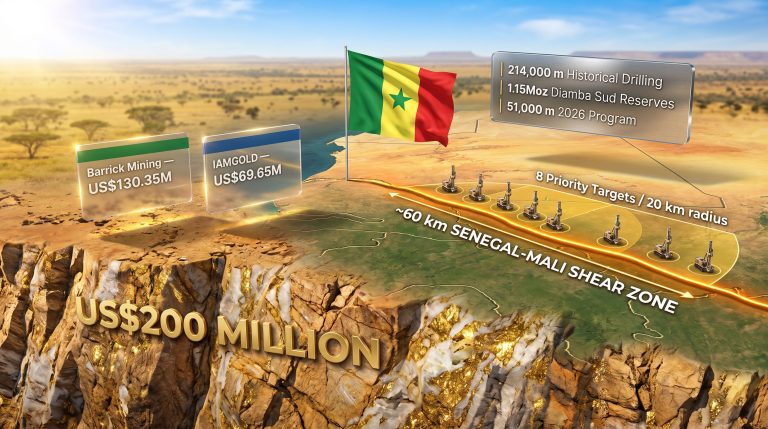
That dynamic is now shifting materially. Fortuna Mining buys Bambadji gold project in Senegal from subsidiaries of Barrick Mining and IAMGOLD for US$200 million in cash, representing one of the most consequential exploration-stage transactions in West Africa's recent history. Furthermore, its structure reveals something important about where mid-tier gold producers believe the next decade of value creation will originate.
When big ASX news breaks, our subscribers know first
Understanding the Senegal-Mali Shear Zone's Geological Significance
Orogenic gold systems form along major crustal-scale fault structures during periods of tectonic compression, and the SMSZ exhibits the kind of deep-seated structural architecture historically associated with large, high-continuity gold deposits. Unlike the more heavily explored Birimian terranes to the south and east, the SMSZ's Kédougou-Kéniéba Inlier straddles the Senegal-Mali border and contains Paleoproterozoic supracrustal sequences geologically analogous to the most productive gold-bearing greenstone packages found elsewhere across the West African craton.
What makes the Kédougou region specifically compelling is the intersection of multiple first-order structural controls. Gold mineralisation in orogenic systems tends to concentrate where subsidiary fault splays intersect the main shear corridor, creating fluid traps that focus hydrothermal gold precipitation. The combination of favourable host lithologies, structural complexity, and a historical record of near-surface oxide mineralisation across the broader district suggests the region's endowment has been only partially tested.
Senegal's comparative regulatory stability adds a further dimension that pure geological metrics cannot capture. While neighbouring Mali and Burkina Faso have experienced significant political disruption in recent years, Senegal has maintained a functioning democratic governance framework and a relatively transparent mining code. For institutional capital allocators assessing sovereign risk in West Africa, this distinction is increasingly reflected in the premiums being applied to exploration assets situated within Senegal's borders, a trend consistent with broader gold exploration trends across the continent.
What the Bambadji Acquisition Actually Comprises
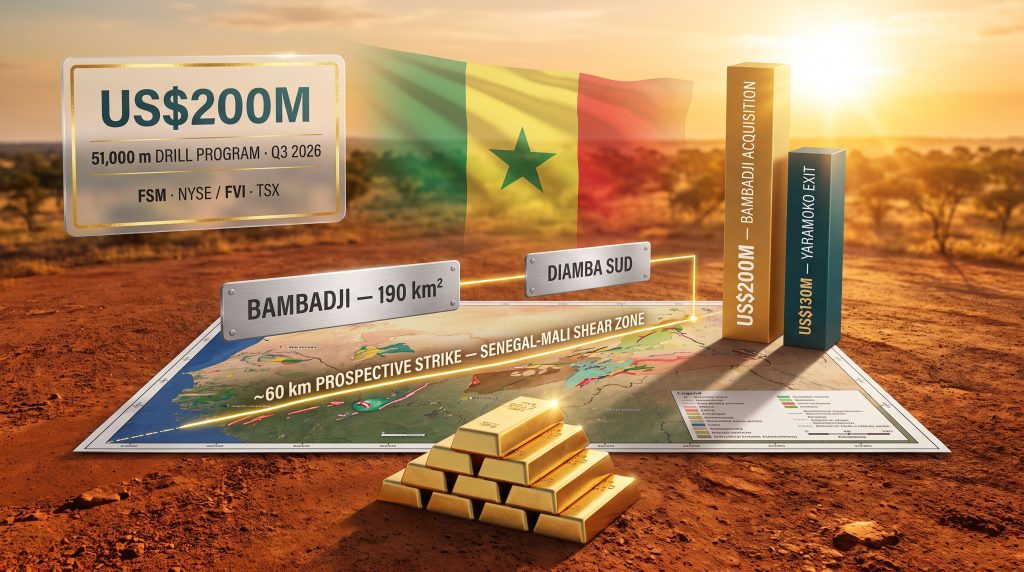
Fortuna Mining buys Bambadji gold project in Senegal as a 190 km² advanced exploration package situated directly adjacent to its existing Diamba Sud project, which is already at the feasibility stage. The combined land position now gives the company control over approximately 60 km of continuous prospective strike along the SMSZ corridor, a scale of tenure that is unusual for a mid-tier operator and that meaningfully changes the exploration optionality within Fortuna's portfolio.
The asset's history under two technically rigorous prior operators is relevant context. Both Barrick Mining and IAMGOLD are among the industry's most systematic exploration organisations, with deep internal technical capabilities. The fact that meaningful historical datasets, drill results, and geological interpretations now transfer to Fortuna as part of the acquisition provides a substantial head start in target generation. Exploration programmes built on inherited data from major operators can compress the typical timeline from acquisition to maiden resource declaration.
| Metric | Bambadji | Diamba Sud | Combined Platform |
|---|---|---|---|
| Land Area | 190 km² | Feasibility stage | Expanded West Africa tenure |
| Strike Length (combined) | ~60 km total | Anchor asset | Largest Fortuna SMSZ position |
| Exploration Stage | Advanced exploration | Feasibility | Multi-stage pipeline |
| Structural Setting | Senegal-Mali Shear Zone | Senegal-Mali Shear Zone | Continuous corridor |
| Prior Operators | Barrick Mining, IAMGOLD | Fortuna Mining | Data-rich foundation |
Deconstructing the $200 Million Deal Structure
The transaction's financial architecture is worth examining in detail because it reflects a sophisticated approach to deal-making that is increasingly common among major operators exiting exploration-stage assets during elevated commodity price cycles.
Transaction Summary:
- Buyer: Fortuna Mining Corp (NYSE: FSM; TSX: FVI)
- Sellers: Subsidiaries of Barrick Mining (NYSE: B; TSX: ABX) and IAMGOLD (TSX: IMG; NYSE: IAG)
- Total Consideration: US$200 million, entirely in cash
- Royalty Retention: A 0.5% net smelter return royalty applicable to the first 1.75 million ounces of gold produced from Bambadji Nord
- IAMGOLD's Attributable Proceeds: Approximately US$70 million before taxes and transaction costs
The NSR royalty structure embedded in this transaction deserves particular attention. A net smelter return royalty entitles the holder to a fixed percentage of revenue generated from metal sales, calculated after processing and transport costs but before operating and capital expenditures. By retaining a 0.5% NSR on the first 1.75 million ounces from Bambadji Nord, both Barrick and IAMGOLD have effectively preserved financially meaningful upside participation in any future production success without committing further capital to bring that production into existence.
This royalty-backed exit structure has become the preferred divestment mechanism for majors and senior producers offloading non-core exploration assets during high gold price environments. It allows sellers to monetise at premium valuations while retaining optionality, and buyers to acquire strategic ground without the sellers fully abandoning their exposure to the discovery thesis.
For context, at a gold price of US$3,000 per ounce, a 0.5% NSR on 1.75 million ounces represents gross royalty revenue of approximately US$26.25 million to the sellers over the life of the royalty period, assuming full production is achieved. This is a meaningful financial preservation mechanism layered on top of the US$200 million upfront cash payment.
Fortuna's Strategic Capital Rotation: From Burkina Faso to Senegal
To fully appreciate the Bambadji transaction, it must be viewed through the lens of Fortuna's broader portfolio transformation over the preceding twelve months. In 2025, the company divested its Yaramoko gold mine in Burkina Faso for approximately US$130 million, a deliberate decision to reduce exposure to a jurisdiction that had experienced significant security deterioration and regulatory uncertainty following successive military coups. This repositioning also aligns with evolving gold M&A activity patterns being observed across global markets.
The arithmetic of that capital rotation is striking:
- US$130 million in proceeds received from the Yaramoko divestment in Burkina Faso
- US$200 million committed to acquire Bambadji in Senegal
- Net additional capital deployed into the Senegal platform: approximately US$70 million
This is not simply a like-for-like asset swap. It represents a deliberate upgrade in the quality of Fortuna's West African jurisdiction exposure, accepting a higher capital outlay in exchange for a more stable operating environment and a structurally superior exploration address. The company's West African portfolio is now concentrated entirely across Senegal and Ivory Coast, both of which offer materially different risk profiles compared to the Sahel jurisdictions experiencing ongoing instability.
Why Mid-Tier Producers Are Rewiring Their West African Exposure
Fortuna's repositioning is part of a broader, industry-wide pattern. Several mid-tier gold producers with West African operations have been systematically reducing their Burkina Faso and Mali exposure since 2022, redirecting capital toward Senegal, Ivory Coast, Ghana, and Côte d'Ivoire. The operational and financial costs of maintaining mines in conflict-affected regions, including elevated security spending, supply chain disruptions, and workforce risks, have compressed margins considerably.
Consequently, exploration-stage assets in stable jurisdictions are commanding higher valuation multiples than producing assets in unstable ones. This dynamic fundamentally reshapes how exploration acreage is priced along the SMSZ, as institutional capital chases the combination of geological prospectivity and sovereign safety simultaneously.
The $8 Million Exploration Programme: Reading Fortuna's Confidence Level
Board-approved capital commitments to exploration programmes immediately following an acquisition reveal more about management's internal confidence than any public statement. Fortuna's decision to allocate US$8 million to an exploration programme covering the remainder of 2026, incorporating 51,000 metres of drilling with a planned Q3 2026 start, is a materially significant signal.
To put the drilling scale in context: 51,000 metres across a 190 km² land package implies an average drill hole density of approximately one hole per 3.7 km² across the entire permit area, assuming roughly 150-metre average drill depths. In practice, these exploration drilling programmes concentrate drilling activity on the highest-priority targets identified through historical data synthesis, geochemical sampling, and geophysical interpretation. The density suggests Fortuna has already identified a meaningful number of priority targets from the inherited Barrick and IAMGOLD datasets.
Key exploration objectives for the 2026 programme include:
- Testing for structural and mineralisation continuity between Bambadji and the Diamba Sud resource
- Identifying new standalone discovery targets across the broader 190 km² permit area
- Generating sufficient drilling data to support a maiden resource estimate in a subsequent programme phase
Results from a 51,000-metre programme, if drilling commences in Q3 2026, could begin entering the public domain before year-end, creating a series of near-term catalysts that may generate significant market attention.
The next major ASX story will hit our subscribers first
Scenario Modelling: What Bambadji Could Become
| Scenario | Core Assumption | Potential Outcome |
|---|---|---|
| Base Case | Drilling confirms mineralisation extends from Diamba Sud into Bambadji | Integrated combined development plan; expanded resource base |
| Bull Case | New high-grade zones discovered along previously untested strike extensions | Standalone resource declaration; potential separate development pathway |
| Conservative Case | Limited new discoveries in initial 51,000m programme | Bambadji held as strategic land bank; optionality preserved for future cycles |
Important disclaimer: Scenario projections above are speculative in nature and are presented for analytical context only. They do not represent forecasts, guidance, or investment recommendations. Exploration-stage assets carry inherent geological risk, and outcomes may differ materially from any scenario outlined.
Contextualising the $200 Million Price Tag in the West African M&A Landscape
At US$200 million for an asset without a publicly disclosed JORC or NI 43-101 compliant mineral resource estimate, the Bambadji transaction is structurally unusual. The overwhelming majority of exploration-stage acquisitions at this price level involve some form of declared resource inventory that provides a quantitative anchor for valuation. Bambadji appears to have been priced primarily on the basis of geological prospectivity, strategic adjacency to a feasibility-stage project, and the quality of the structural setting within the SMSZ.
Applying a simple per-kilometre valuation metric to the 60 km combined strike length implies an acquisition cost of approximately US$3.3 million per kilometre of prospective SMSZ ground. Comparable transactions across other major West African structural corridors suggest this pricing reflects both the scarcity of large-scale, contiguous, well-documented exploration packages in stable jurisdictions and the elevated gold price environment in which the deal was executed.
The fact that Barrick and IAMGOLD chose to monetise Bambadji at this price point rather than advance it themselves is also informative. It suggests the asset sits below their internal materiality thresholds for capital allocation — not that the geology is uncompelling, but that the timeline and capital required to advance it to production do not compete effectively against larger opportunities within their respective portfolios.
Key Risks Investors Should Evaluate
Geological and Exploration Risk
No publicly disclosed compliant resource estimate has been referenced in connection with this transaction. The mineralisation continuity assumed at acquisition may not be confirmed through drilling. A maiden resource estimate, even with a 51,000-metre programme underway, is likely 12 to 24 months from publication given standard industry timelines for data compilation, modelling, and independent audit.
Jurisdiction and Operational Risk
While Senegal offers materially better sovereign risk characteristics than several regional peers, the Kédougou region presents logistical complexity common to remote West African exploration settings. Infrastructure limitations, including road access, power availability, and water sourcing, directly affect drilling cost per metre and programme execution timelines. Notably, Fortuna has already secured key environmental approval for the adjacent Diamba Sud project, which demonstrates a working understanding of Senegal's regulatory processes. However, community engagement and social licence considerations in the Kédougou region remain factors that require active management.
Financial and Balance Sheet Risk
A US$200 million all-cash outlay represents a substantial balance sheet commitment for a mid-tier producer. Investors should assess the transaction's impact on Fortuna's liquidity position, debt metrics, and financial flexibility relative to its existing capital commitments across its operating mine portfolio and the ongoing Diamba Sud feasibility programme. The opportunity cost of deploying this capital into exploration rather than production growth or shareholder returns is a legitimate consideration for equity investors, particularly in the context of the prevailing gold price outlook.
Frequently Asked Questions
What exactly did Fortuna Mining acquire with the Bambadji deal?
Fortuna Mining acquired a 190 km² advanced gold exploration project in Senegal's Kédougou region from subsidiaries of Barrick Mining and IAMGOLD for US$200 million in cash. The sellers retained a 0.5% NSR royalty on the first 1.75 million ounces of gold produced from the Bambadji Nord area.
Why is Bambadji strategically important to Fortuna?
Bambadji is directly adjacent to Fortuna's Diamba Sud project, which is at the feasibility stage. The combined land package gives Fortuna approximately 60 km of continuous prospective strike along the Senegal-Mali Shear Zone. Advancing this position through a definitive feasibility study process could significantly enhance the asset's long-term value.
How much is Fortuna spending to explore Bambadji in 2026?
Fortuna has approved an initial US$8 million exploration programme incorporating 51,000 metres of drilling, with drilling expected to begin in Q3 2026.
What did IAMGOLD receive from the transaction?
IAMGOLD's attributable share of the cash proceeds is approximately US$70 million before taxes and transaction costs. The company characterised Bambadji as a non-core exploration asset.
Does Bambadji have a declared mineral resource?
No publicly disclosed JORC or NI 43-101 compliant resource estimate for Bambadji has been referenced in connection with this transaction. The acquisition appears to be valued on geological prospectivity and strategic adjacency to Diamba Sud.
What the Bambadji Transaction Signals for the Broader Sector
The scale and structure of this deal carry implications beyond Fortuna's individual portfolio. Several sector-wide themes are crystallised in a single transaction:
- Large-scale land consolidation along major structural corridors is emerging as a primary value creation strategy for mid-tier producers seeking to compress per-ounce discovery costs
- Stable jurisdiction premiums are quantifiable and growing, with Senegal commanding exploration valuations that reflect its comparative regulatory and security advantages over regional peers
- Elevated gold prices are enabling strategic acquisitions that would have been financially difficult to execute in lower price environments, creating a window of opportunity for well-capitalised mid-tiers
- Royalty-backed exits are the preferred divestment structure for majors offloading non-core exploration assets, preserving upside participation without ongoing capital exposure
- Fortuna's dual-asset Senegal platform, anchored by Diamba Sud at feasibility and now extended by Bambadji's exploration pipeline, represents one of the most significant consolidated positions held by a mid-tier producer along the SMSZ
Whether drilling confirms the geological thesis embedded in this US$200 million commitment will become clear over the next 12 to 24 months. What is already evident is that Fortuna Mining buys Bambadji gold project in Senegal as part of a sophisticated reading of where mid-tier gold value creation is heading in West Africa — and the sector is paying close attention.
Want to Stay Ahead of the Next Major West African Gold Discovery?
Discovery Alert's proprietary Discovery IQ model delivers real-time alerts the moment significant ASX mineral discoveries are announced, transforming complex geological and market data into actionable investment insights for both short-term traders and long-term investors — explore historic discoveries and the returns they generated to understand the opportunity, then begin your 14-day free trial to ensure you're positioned before the broader market moves.