
July 10, 2026
The Geological Bet Behind West Africa's Most Watched Gold Development
Few corners of the global gold mining industry generate as much investor attention right now as the West African craton. Stretching from Ghana's productive Ashanti Belt through Mali's prolific Birimian greenstone terranes and into Senegal's less-explored eastern corridors, this ancient geological province has quietly produced more new gold discoveries per exploration dollar spent than almost any other region on earth over the past two decades. Yet one country within this arc has remained conspicuously underweighted in most institutional mining portfolios: Senegal.
That dynamic is shifting with considerable speed. The Fortuna Mining Diamba Sud gold project in Senegal is the single most significant catalyst driving this reassessment, representing a capital commitment of nearly $400 million toward transforming an underexplored structural corridor into a cornerstone producing asset. Understanding what this project means requires moving beyond headline numbers and examining the geological logic, jurisdictional mechanics, and capital deployment calculus that underpin it.
When big ASX news breaks, our subscribers know first
Why Senegal's Geological Setting Is More Significant Than Its Production History Suggests
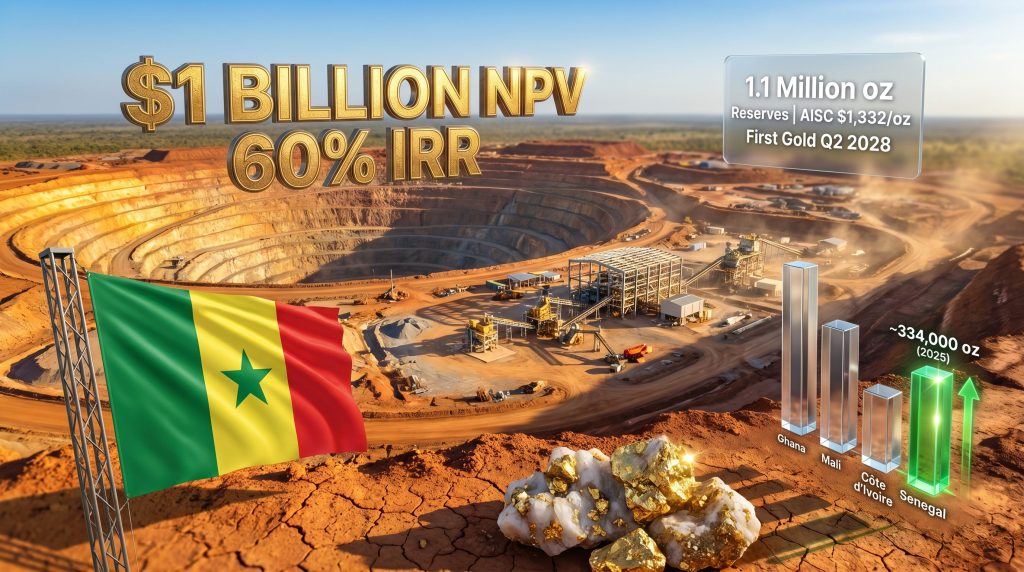
Senegal's mining identity has historically been anchored in phosphate extraction and mineral sands operations rather than hard rock gold. The country's gold output of approximately 334,000 ounces in 2025 places it firmly in the shadow of regional heavyweights. By comparison, Ghana produces around 3.0 million ounces annually, while Mali generates approximately 2.2 million ounces. Côte d'Ivoire sits closer to 1.0 million ounces per year.
| Country | Estimated 2025 Gold Output | Key Operators |
|---|---|---|
| Ghana | ~3.0 million oz | Gold Fields, Newmont, AngloGold |
| Mali | ~2.2 million oz | Barrick, B2Gold, Allied Gold |
| Côte d'Ivoire | ~1.0 million oz | Endeavour Mining |
| Senegal | ~334,000 oz | Endeavour (Sabodala-Massawa), Managem (Boto) |
What these production figures obscure is Senegal's geological endowment. Eastern Senegal sits within the Kenieba-Koudougou Inlier, a structurally complex Birimian-age greenstone belt that straddles the Senegalese-Malian border. This same geological architecture hosts some of West Africa's most significant gold deposits on the Malian side, including assets operated by Barrick and B2Gold. The Senegalese portion of this inlier has seen dramatically less systematic modern exploration, which explains both the country's modest output and the scale of opportunity still available to first movers.
Birimian greenstone belts are among the most geologically prospective terranes globally for orogenic gold deposits. These systems form where ancient ocean floor was subducted and accreted onto cratons, creating the shear zones and structural traps that concentrate gold-bearing hydrothermal fluids. Furthermore, the 1.75 grams per tonne average grade at Diamba Sud's probable reserve base is consistent with economically robust open-pit orogenic deposits elsewhere in the Birimian, and the structural setting suggests that mineralisation may extend well beyond current resource boundaries. Current gold exploration trends highlight why this type of under-drilled Birimian corridor commands increasing institutional attention.
Diamba Sud's Feasibility Study: What the Numbers Actually Tell You
The completed definitive feasibility study for the Fortuna Mining Diamba Sud gold project in Senegal delivered a materially upgraded picture compared to the earlier preliminary economic assessment, though not without cost escalation that deserves careful interpretation.
| Metric | Value |
|---|---|
| Probable Mineral Reserves | 20.5 million tonnes at 1.75 g/t Au |
| Contained Gold (Reserves) | 1.1 million ounces |
| Initial Capital Cost | ~$398 million (40% increase from PEA) |
| All-In Sustaining Cost (AISC) | $1,332/oz (8% increase from PEA) |
| Post-Tax NPV (at $3,500/oz Au) | ~$1 billion |
| Internal Rate of Return (IRR) | ~60% |
| Net Asset Value | ~$896 million |
| Targeted First Gold Production | Q2 2028 |
| Mine Life | 9.4 years |
| Peak Annual Production | ~230,000 oz/year |
The 40% capital cost escalation from PEA to feasibility study is a figure that tends to alarm retail investors but is broadly understood by experienced mining analysts as an expected feature of project maturation. A preliminary economic assessment is based on order-of-magnitude cost estimates, often carrying accuracy ranges of plus or minus 35 to 50%. A feasibility study narrows that range to plus or minus 15%, which invariably captures costs that were understated at the earlier stage. The movement from PEA to feasibility study at Diamba Sud is therefore a sign of growing project definition, not a deteriorating economic case.
More telling is the upward revision in total production, which increased by 25% between the two study stages, while the net asset value rose 12% even with higher capital costs. This combination signals that the geological model improved more than the cost base deteriorated.
Key Insight: At a gold price of $3,500 per ounce and an AISC of $1,332 per ounce, Diamba Sud generates an operating margin of approximately $2,168 per ounce. This margin structure places it among the more profitable mid-tier open-pit gold developments anywhere in West Africa at current gold price assumptions.
A 60% internal rate of return at a $3,500 per ounce gold price assumption is an exceptionally strong result for a greenfield project at this scale. For context, major mining financiers typically require IRRs of 15 to 20% before committing project debt. A 60% IRR provides enormous downside headroom, meaning the project remains strongly viable across a wide range of gold price scenarios below the base case assumption.
Gold Price Sensitivity: Testing the Margin Resilience
The robustness of Diamba Sud's economics across gold price scenarios is one of its most important investment characteristics. With AISC fixed at $1,332 per ounce, the project generates meaningful positive cash flow even at gold prices substantially below current spot:
- At $2,500/oz: Operating margin of approximately $1,168/oz, project remains cash-generative
- At $3,000/oz: Operating margin of approximately $1,668/oz, strong free cash flow generation
- At $3,500/oz: Operating margin of approximately $2,168/oz, NPV of ~$1 billion
This margin resilience matters because gold mining projects have lives measured in decades, and the gold price will inevitably cycle through periods of weakness. A project that maintains profitability across a $1,000 per ounce range of price variation provides a fundamentally different risk profile to one that depends on elevated prices to remain viable. Consequently, understanding the broader gold price outlook for miners is essential context when evaluating long-life assets such as this one.
Senegal's Permitting Advantage and What It Means for Capital Allocation
One of the most underappreciated dimensions of the Fortuna Mining Diamba Sud gold project in Senegal is the speed at which Senegal's regulatory apparatus approved the environmental permit for the project's environmental and social impact assessment. The ESIA was approved within nine months of submission, a timeline that stands in sharp contrast to comparable processes in Peru, Mexico, and parts of North America, where environmental permitting frequently extends across multiple years and sometimes decades.
This is not a trivial distinction. Permitting timelines represent dead capital: money invested in project development that generates no return until production begins. Every additional year of permitting delay adds carrying costs, increases the risk of gold price deterioration before production commences, and creates windows for political or regulatory changes to alter project economics. A nine-month ESIA approval cycle compresses this risk window dramatically. In addition, understanding grade, king, permitting dynamics helps explain why rapid regulatory progress at Diamba Sud is such a commercially meaningful outcome.
The regulatory pathway for Diamba Sud has progressed through the following milestones:
| Milestone | Date / Status |
|---|---|
| Mining Permit Application Submitted | February 4, 2026 |
| Environmental Decree Issued (ESIA Approved) | June 2026 |
| Final Construction Permit | Expected within weeks of July 2026 |
| Final Investment Decision (FID) | Expected mid-2026 |
| Full Construction Start | Targeted Q4 2026 |
| First Gold Pour | Targeted Q2 2028 |
Fortuna has already committed $73 million to early works, funding access road construction and camp expansion ahead of the final investment decision. This pre-FID capital deployment reflects a calculated risk management strategy: by commencing early works before the final permit arrives, the company compresses the overall construction timeline and reduces the gap between permit receipt and first gold production.
Similarly, the decision to pre-order critical processing equipment ahead of the FID is a deliberate response to supply chain dynamics in the global mining equipment market. Long-lead items such as SAG mills, flotation circuits, and large-format generators face extended delivery queues during periods of elevated mining sector activity. Locking in delivery schedules early insulates the project from cost escalation and schedule slippage driven by external supply constraints.
Navigating Political Transition in a Rapidly Evolving Jurisdiction
Senegal's political landscape has undergone considerable turbulence since President Bassirou Diomaye Faye assumed office in 2024. The subsequent rupture between Faye and former Prime Minister Ousmane Sonko, and the cabinet restructuring that followed, created a period of institutional uncertainty that unsettled some observers of the Senegalese business environment.
Fortuna's maintenance of its investment timeline through this period reflects an important distinction that sophisticated mining investors draw between political volatility and institutional continuity. These are not the same thing. A country can experience significant political turbulence at the executive level while maintaining consistent, functioning regulatory and legal frameworks that govern commercial activity. Senegal's mining code, permitting processes, and fiscal framework have remained stable through recent political changes, which is the variable that ultimately determines whether long-term capital deployments remain viable.
The contrast with neighbouring jurisdictions is instructive. Burkina Faso, Mali, and Niger have all experienced military coups since 2021 and have taken actions that materially impaired existing mining operations, including nationalisations, forced renegotiations of mining contracts, and security deterioration that restricted operational access. Senegal, despite its political turbulence, has maintained democratic governance and contractual stability, placing it in a fundamentally different risk category for foreign mining capital.
Jurisdictional Risk Framework: Long-term mining investment decisions depend less on short-term political stability and more on the durability of the frameworks that govern permitting, taxation, and contract enforcement. Senegal's track record on all three dimensions compares favourably with the broader West African peer group.
Fortuna's Regional Ambitions: Building a West African Gold Platform
The Fortuna Mining Diamba Sud gold project in Senegal is best understood not as a standalone development but as the centrepiece of a broader West African growth strategy. Fortuna has articulated a target of increasing total annual gold production by approximately 60%, from its current base to over 500,000 ounces by 2028. Diamba Sud, with peak annual production of ~230,000 ounces, is the single largest contributor to closing that gap.
Beyond Diamba Sud, Fortuna has signalled active evaluation of acquisition and exploration opportunities across Senegal, Côte d'Ivoire, and Guinea, with potential deal announcements flagged before the end of 2026. This signals a capital allocation philosophy oriented toward building a multi-asset West African platform rather than a single-project company, which has important implications for how the company is valued relative to peers.
The $15 million exploration program currently underway at the Diamba Sud land package adds a speculative but potentially significant dimension to the investment thesis. The Kenieba-Koudougou Inlier geological setting is under-drilled by modern standards, and incremental resource additions from ongoing exploration could extend the mine life beyond the current 9.4-year base case, directly improving the project's NPV by adding production years at a negligible marginal cost relative to the initial capital outlay. The robust feasibility study results published by Fortuna provide the full technical detail underpinning these projections.
The next major ASX story will hit our subscribers first
What Diamba Sud Signals for Senegal's Gold Sector Trajectory
If Diamba Sud reaches its targeted peak output of 230,000 ounces per year, it would by itself increase Senegal's national gold production by approximately 70% from its 2025 base. When combined with existing production from Endeavour Mining's Sabodala-Massawa complex and Managem's Boto operation, and accounting for other pipeline projects including Thor Explorations' Douta project, Senegal's annual gold output could conceivably exceed 700,000 ounces by 2030.
That trajectory would represent a fundamental repositioning of Senegal within the West African gold hierarchy, moving it from a peripheral producer toward a jurisdiction capable of hosting a cluster of significant, internationally financed mining operations. However, the gold investment uncertainty that persists across global markets means that project execution and fiscal predictability will remain critical variables for sustaining capital inflows into the region.
Three structural conditions will determine whether this potential is realised:
-
Permitting consistency: The nine-month ESIA timeline at Diamba Sud must be replicable for future projects rather than an exceptional outcome for a single well-capitalised operator.
-
Taxation predictability: Mining investors price sovereign fiscal risk into their required returns. Stable royalty and corporate tax frameworks that do not change retrospectively are essential to sustaining capital inflows.
-
Regulatory transparency: Clear, publicly accessible rules governing exploration licensing, environmental compliance, and community consultation reduce the friction costs of doing business and lower the risk premium that investors apply to Senegalese assets.
Fortuna's investment at this scale, and the international attention it is generating, creates a potential template effect: if Diamba Sud is built on time, on budget, and into a stable regulatory environment, it will lower the perceived risk threshold for the next generation of investors considering Senegal. That compounding effect on the country's reputation as a mining destination may ultimately prove as significant as the project's direct economic contribution.
Frequently Asked Questions: Fortuna Mining Diamba Sud Gold Project in Senegal
What is the Diamba Sud gold project?
Diamba Sud is an open-pit gold development project located approximately 600 kilometres east of Dakar in eastern Senegal, within the Kenieba-Koudougou Inlier geological corridor. It is owned and operated by Fortuna Mining, which acquired the asset through its 2023 takeover of Chesser Resources. The project holds probable mineral reserves of 20.5 million tonnes grading 1.75 grams per tonne gold, containing approximately 1.1 million ounces of recoverable gold.
When will Diamba Sud produce its first gold?
Fortuna Mining targets first gold production in Q2 2028, subject to receipt of the final construction permit and a positive final investment decision. Early works, including access road construction and camp expansion, are already underway under a dedicated $73 million early works budget.
How much will it cost to build the Diamba Sud mine?
The feasibility study estimates total initial capital expenditure of approximately $398 million, representing a 40% increase from the earlier preliminary economic assessment. This escalation is consistent with normal project maturation as cost estimates are refined from conceptual to bankable study level.
What is the projected return on the Diamba Sud investment?
At a gold price assumption of $3,500 per ounce, the feasibility study estimates a post-tax net present value of approximately $1 billion and an internal rate of return of approximately 60%. The all-in sustaining cost of $1,332 per ounce provides significant margin across a wide range of gold price scenarios.
Is Senegal a stable jurisdiction for gold mining investment?
Senegal presents a differentiated risk profile within West Africa. While the country has experienced political volatility in recent years, its mining code, permitting framework, and contractual structures have remained stable. The country's nine-month ESIA approval for Diamba Sud demonstrates a functional regulatory system operating at competitive speed. Relative to Burkina Faso, Mali, and Niger, which have all experienced military coups and taken actions adverse to existing mining investments, Senegal occupies a materially lower jurisdictional risk category.
What is Fortuna Mining's broader West African strategy?
Fortuna Mining is pursuing a regional platform strategy across West Africa, with Diamba Sud as the production anchor. The company has stated its intention to evaluate acquisition and exploration opportunities in Senegal, Côte d'Ivoire, and Guinea, with potential transactions possible before the end of 2026. The company's overall production target of over 500,000 ounces per year by 2028 represents approximately 60% growth from its current base.
Disclaimer: This article contains forward-looking statements and financial projections based on publicly available information. All project economics are subject to commodity price movements, regulatory approvals, construction execution risks, and other factors that could cause actual outcomes to differ materially from those projected. This article does not constitute financial advice. Readers should conduct their own due diligence before making any investment decisions.
Want to Catch the Next Major West African Gold Discovery Before the Market Does?
Discovery Alert's proprietary Discovery IQ model scans ASX announcements in real time, instantly identifying significant mineral discoveries across gold and 30-plus other commodities — so subscribers can act on actionable opportunities ahead of the broader market. Explore historic discoveries and their exceptional returns, then begin your 14-day free trial to position yourself at the forefront of the next major find.