May 12, 2026
The World's Most Consequential Mine Restart: Understanding What Grasberg's Recovery Really Signals
Few events in global commodity markets expose supply chain fragility quite like the disruption of a single mega-mine. When one asset is large enough to meaningfully shift global supply curves on its own, any interruption ripples outward with disproportionate force. That is precisely the dynamic playing out at Grasberg in the remote highlands of Papua, Indonesia, where a phased operational recovery is reshaping near-term copper supply expectations across markets that are already running with minimal buffer.
The Freeport Grasberg recovery timeline is not simply a mining operations story. It is a case study in how geological risk, corporate communication structures, investor psychology, and macro commodity fundamentals interact in real time. Understanding each of these layers separately, and then together, reveals why this single mine's restart schedule is being monitored by copper buyers, equity investors, and electrification infrastructure planners around the world.
When big ASX news breaks, our subscribers know first
Why Scale Transforms Grasberg Into a Market-Moving Asset
Most mines operate in relative anonymity from a commodity pricing perspective. Grasberg does not. The Grasberg complex in West Papua, Indonesia, holds a position that few mining assets anywhere in the world can match: it is simultaneously recognised as the world's largest gold mine by reserve base and the second-largest copper mine globally by the same measure. At full operational throughput, the site is capable of producing approximately 1.6 billion pounds of copper and around 1.3 million ounces of gold annually, based on the 2027 to 2029 average production expectations outlined in Freeport-McMoRan's guidance.
To understand why that matters, consider how global copper production works in practice. Unlike oil, where a cartel of producing nations can theoretically adjust output in coordinated fashion, copper supply is dominated by a relatively small number of very large mines. When one of those mega-assets underperforms, there is no reserve capacity sitting idle elsewhere in the system to compensate. Substitute supply takes years, sometimes decades, to develop through the discovery, permitting, and construction pipeline.
The demand side compounds this structural tightness considerably. Copper's role in the electrification economy has expanded beyond the traditional construction and industrial sectors that previously anchored demand growth. Electric vehicles require roughly three to four times more copper than their internal combustion equivalents, grid-scale battery storage facilities are intensely copper-dependent, and the data centre buildout driven by artificial intelligence computing infrastructure adds a layer of demand that few commodity analysts had fully priced in just three years ago. Against that backdrop, a disruption at Grasberg is not a minor operational inconvenience. It is a genuine supply event.
Block Cave Mining: The Technical Vulnerability That Makes Grasberg Susceptible to Geologic Events
To appreciate why the September 2025 mudflow incident was so operationally damaging, it helps to understand what block cave mining actually involves and why it carries specific geological risk profiles that differ fundamentally from open-pit or conventional underground methods.
Block cave mining is a large-scale, low-cost underground technique where ore is undercut from below and allowed to cave in under gravity into collection points called drawpoints, from which it is hauled to the surface. The method is well-suited to large, low-grade ore bodies and is used at Grasberg because the geometry of the deposit makes it the most economically viable extraction approach as the historic open pit ore body has been exhausted.
The critical vulnerability in block cave systems is groundwater. As ore caves and is drawn down through the system, it passes through zones of varying moisture content. When ore conditions are wetter than predicted, the granular broken rock can behave more like a slurry than a solid, generating underground mudflows that can travel rapidly through ore-handling infrastructure. The consequences of such an event in a confined underground environment are severe: infrastructure damage, blocked logistics corridors, and in the worst cases, loss of life.
This is precisely what occurred at Grasberg in September 2025. Wetter-than-expected ore conditions contributed to an underground mudflow event that claimed seven lives and forced an operational suspension of approximately one month across affected production areas. The incident damaged ore-handling systems, logistics corridors, groundwater management infrastructure, and critically, Production Block 1 of the Grasberg Block Cave (GBC), which became the key bottleneck for the entire recovery program.
Block cave mines that operate at significant depth, as Grasberg does, face elevated groundwater management challenges. The deeper the extraction horizon, the more complex the hydrological conditions the operation must manage continuously.
The Ownership Structure and Its Role in Communication Gaps
Understanding the Freeport Grasberg recovery timeline also requires understanding the ownership architecture that governs how information flows from site to market. Grasberg is operated by PT Freeport Indonesia (PTFI), in which Indonesian state entities hold a 51.24% majority interest. Freeport-McMoRan (FCX), the NYSE-listed parent company, retains the remaining 48.76% while continuing to manage day-to-day operations at the complex.
This dual-layer ownership structure creates a communication dynamic that can generate apparent contradictions in public statements without those contradictions reflecting any genuine operational disagreement. PTFI executives interact with Indonesian government stakeholders, local media, and regulatory bodies using a different communication register than FCX's investor relations team, which is bound by US securities law disclosure obligations.
When PTFI leadership speaks publicly about operational timelines, the framing may be more conservative or more contextual than what a parent company would communicate to financial markets. That layering of communication channels is not evidence of a management dispute. It reflects the structural reality of operating a strategically significant asset under joint governance with a sovereign majority stakeholder.
What the Phase-by-Phase Restart Actually Looks Like
The recovery from the September 2025 incident has unfolded in distinct operational stages, each with specific capacity targets and critical path dependencies.
Phase 1: Stabilisation Through Unaffected Assets (Late 2025)
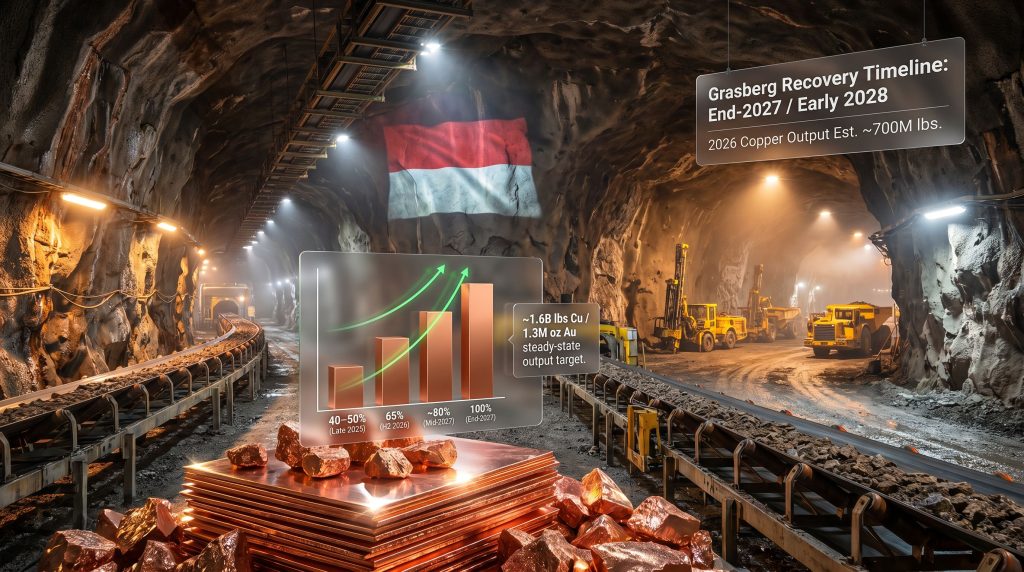
Immediately following the incident, Grasberg's unaffected underground zones, specifically the Deep Mill Level Zone (DMLZ) and Big Gossan mine, continued operating. These assets provided a production floor during the period when the Grasberg Block Cave was fully suspended. Operating capacity during this phase ranged between approximately 40% and 50% of the complex's full output potential.
Phase 2: Partial GBC Restart (April to May 2026)
The Grasberg Block Cave began a partial restart in April 2026, marking the first meaningful step toward recovering the production capacity lost through the GBC suspension. Repair works on Production Block 1, the most critically damaged component of the system, commenced in May 2026. FCX revised its H2 2026 capacity guidance downward from an earlier estimate of 85% to 65% at this point, the most significant single-event production guidance revision in the company's recent history.
Phase 3: Ramp Toward Full Throughput (Mid-2027)
Production Block 1 repairs are targeted for completion by early 2027, which would then allow GBC to begin ramping toward its full contribution to the ore-handling system. By mid-2027, the operation is expected to reach approximately 80% of full capacity, with Production Block 1 integrated into normal operational flow.
Phase 4: Full Production Restoration (End-2027 to Early 2028)
FCX's official guidance targets full operational recovery by the end of 2027. PTFI executives have indicated that early 2028 represents a more conservative estimate. According to Reuters, FCX has stated publicly that any material deviation from its disclosed schedule would trigger formal market disclosure obligations under applicable securities law, providing investors with a degree of structured assurance around the timeline.
| Recovery Milestone | Target Date | Capacity Level | Critical Path Item |
|---|---|---|---|
| DMLZ and Big Gossan restart | Late 2025 | 40% to 50% | Unaffected zones only |
| GBC partial restart | April 2026 | Partial GBC contribution | Safety clearance |
| H2 2026 operating guidance | H2 2026 | 65% | Revised from 85% |
| Production Block 1 repair completion | Early 2027 | Path to 80% | Infrastructure work |
| Approximately 80% capacity | Mid-2027 | ~80% | Block 1 integration |
| Full production (FCX target) | End-2027 | 100% | No further delays |
| Full production (PTFI estimate) | Early 2028 | 100% | Conservative scenario |
| Steady-state output | 2027 to 2029 average | ~1.6B lbs Cu / ~1.3M oz Au | Sustained throughput |
The Communication Discrepancy That Moved Copper to a Three-Month High
In early May 2026, PTFI's leadership indicated in comments accessible to Indonesian and international media that full recovery at Grasberg could extend into early 2028. For market participants who had not closely tracked FCX's April 23, 2026 quarterly earnings disclosures, this sounded like a new and material negative development.
Copper prices immediately responded, climbing to a three-month high on supply concern. The market interpreted the PTFI commentary as an unannounced timeline extension, a reading that would have had significant implications for near-term copper supply models.
FCX moved quickly to clarify. The company indicated that the recovery schedule and all associated operational adjustments had already been disclosed to markets on April 23, 2026, more than two weeks before the media coverage in question. The company characterised reports framing the PTFI commentary as new information as misleading, given that the underlying data points had been in the public domain since the quarterly earnings release.
The market reaction to FCX's clarification was swift and instructive:
- FCX shares gained approximately 5% in a single Wall Street trading session following the clarification
- Copper advanced more than 2.5% in international markets as the clarification reduced uncertainty without introducing any new negative information
- The net effect was a pricing reset that reflected relief rather than new fundamental improvement
The episode is a textbook example of how information asymmetry between a parent company's investor communications and a subsidiary's local stakeholder communications can generate market volatility that bears no relationship to any actual change in operational reality.
The next major ASX story will hit our subscribers first
What This Tells Investors About Copper Market Sensitivity
The Grasberg communication episode is worth examining carefully from an investor psychology standpoint, because it reveals something important about where global copper supply currently sits relative to demand. Furthermore, the copper market trends heading into the latter half of the decade suggest that this sensitivity will only intensify.
In a commodity market with abundant supply buffer, the distinction between a 2027 and a 2028 full recovery date at a single mine would be largely inconsequential. Markets would absorb the difference without dramatic price movement. The fact that copper hit a three-month high on what ultimately proved to be a non-event illustrates precisely how thin the margin between supply and demand has become in the copper market heading toward the late 2020s.
Several demand-side forces are driving this tightness simultaneously:
- EV adoption curves in major markets continue to accelerate, with each additional vehicle requiring multiples of the copper used in conventional transport
- Grid infrastructure expansion programs in the United States, Europe, and across Asia are absorbing copper at scale, with timelines measured in decades rather than years
- AI data centre construction is emerging as a copper-intensive demand category that sits largely outside traditional commodity demand models
- Renewable energy installations, from utility-scale solar to offshore wind, are copper-intensive per megawatt installed
Against that demand backdrop, Grasberg's recovery timeline is not merely a corporate operational matter. It is a near-term supply variable that affects pricing, procurement strategies, and project economics across a significant portion of the global economy. In addition, critical minerals like copper are increasingly central to broader energy transition strategies at a national and international level.
Risk Factors That Could Extend the Timeline Further
While FCX's official guidance targets full recovery by end-2027, several categories of risk could push the actual completion date closer to PTFI's more conservative early 2028 estimate, or potentially beyond it.
Geological and Hydrogeological Risks
The underlying cause of the September 2025 incident, wetter-than-expected ore conditions in the block cave, has not been fully eliminated as an ongoing operational risk. Block cave mining systems at depth operate in complex hydrogeological environments where groundwater inflows can change as the cave propagates and new geological horizons are exposed. A recurrence of abnormal moisture conditions during Production Block 1 integration could delay the recovery ramp materially.
Infrastructure and Power Transition Risks
The coal-to-natural gas power conversion program at Grasberg has already been pushed back approximately 18 months as a result of the September 2025 incident and its aftermath. This delayed transition has knock-on effects for operational efficiency and environmental compliance timelines. Power infrastructure reliability is a non-negotiable dependency for underground mining at this scale, and any further complications in the energy transition program would affect the overall cost structure and potentially the production ramp rate.
Logistical and Workforce Constraints
Grasberg's remote location in the highlands of West Papua presents persistent logistical challenges that are difficult to fully appreciate from outside the operational context. Specialised underground mining equipment has long procurement lead times globally, and the combination of post-incident demand for replacement components alongside existing global supply chain constraints creates meaningful execution risk for the repair timeline. Contractor and workforce capacity in the region is also finite, particularly for specialised underground mining roles.
Regulatory and Sovereign Risk
With Indonesian state entities holding majority ownership, operational decisions at PTFI exist at the intersection of corporate strategy and sovereign policy. Environmental compliance requirements associated with the power transition program introduce regulatory timeline risk that is not fully within FCX's control to manage unilaterally. Consequently, understanding permitting and regulatory frameworks is essential context for evaluating any large-scale mining operation's recovery prospects.
The 2027 to 2029 Production Window and Its Market Significance
If the Freeport Grasberg recovery timeline proceeds broadly as guided, the period between end-2027 and 2029 will see the complex reach its steady-state output of approximately 1.6 billion pounds of copper and 1.3 million ounces of gold annually. The timing of that recovery window is significant beyond the obvious supply implications.
Peak demand growth projections from electrification and grid infrastructure programs in major economies converge in the same timeframe. The late 2020s represent the period when many large-scale renewable energy and EV infrastructure programs, launched in the first half of the decade, begin drawing copper in earnest at the construction and installation phase. The recovery of Grasberg's full output during precisely this window creates a scenario where supply and demand may experience a brief rebalancing before structural deficits reassert themselves in the early 2030s.
For investors, this convergence is not a reason for complacency. It is a reason to distinguish carefully between short-term price dynamics driven by the Grasberg recovery and the longer-term structural copper price growth thesis, which remains intact regardless of whether Grasberg reaches full capacity by December 2027 or March 2028.
Key Signals Worth Monitoring Before the Next Guidance Update
Investors and market participants tracking the Freeport Grasberg recovery timeline should focus on the following observable milestones and disclosure events. According to Mining.com, industry analysts are paying particularly close attention to FCX's scheduled communications in the coming quarters.
- FCX CEO Kathleen Quirk's presentation at the Bank of America Global Metals, Mining and Steel Conference, where Grasberg's operational status is expected to be addressed directly
- Production Block 1 repair progress, which will be the most consequential indicator of whether the early 2027 completion target is being met
- FCX quarterly earnings releases, which carry disclosure obligations under US securities law and would capture any material change to the recovery schedule
- Any formal market disclosure from FCX regarding operational updates outside of scheduled earnings cycles, which would signal that a material change to the timeline has occurred
- Indonesian regulatory developments affecting PTFI operating conditions, particularly around environmental compliance and the power transition program
The gap between Freeport's end-2027 target and PTFI's early 2028 estimate is narrow in absolute terms. However, in a copper market operating with limited supply headroom, even a single quarter of delayed recovery at an asset of Grasberg's scale carries tangible consequences for commodity pricing, procurement strategy, and the economics of the electrification infrastructure programs that are reshaping global energy systems. Production Block 1's repair progress over the coming months will be the clearest leading indicator of which scenario ultimately prevails.
This article is intended for informational purposes only and does not constitute financial or investment advice. Projections, timelines, and production estimates referenced herein are based on publicly available guidance from Freeport-McMoRan and PT Freeport Indonesia as reported by Reporte Minero (May 12, 2026). Actual outcomes may differ materially from forward-looking statements. Readers should conduct their own due diligence and consult qualified financial advisors before making investment decisions.
Want To Stay Ahead of the Next Major ASX Mineral Discovery Before the Market Moves?
Discovery Alert's proprietary Discovery IQ model delivers real-time alerts on significant ASX mineral discoveries, turning complex geological and commodity data into actionable insights — precisely the kind of market intelligence that matters when supply disruptions at assets like Grasberg remind investors how quickly copper markets can reprice. Start your 14-day free trial today and explore Discovery Alert's discoveries page to understand how historic mineral discoveries have generated substantial returns for well-positioned investors.