August 7, 2026
The Supply Chain Anatomy of a Smelter Restart
Refined copper does not simply emerge from a mine. Between ore extraction and the copper cathode that feeds electrical infrastructure, EV manufacturing, and grid expansion lies a complex chain of intermediate processing steps, each dependent on the one before it. When any link in that chain fractures, the consequences ripple outward in ways that are rarely captured by headline production figures alone. Understanding how smelting capacity interacts with mine output, concentrate logistics, and downstream demand is essential context for evaluating what the Freeport Indonesia Manyar smelter restart actually means for global copper markets.
The September 2026 restart of the Manyar smelter is not a simple switch being flipped back on. It is the visible endpoint of a recovery sequence that began with a catastrophic upstream event, worked through a triage phase favouring one facility over another, and is now progressing toward a multi-stage ramp-up that will not reach full output until well into 2027. For copper market participants, the distinction between a restart announcement and a genuine supply addition is critical.
When big ASX news breaks, our subscribers know first
What Actually Connects a Papuan Mine to an East Java Smelter
The Concentrate Supply Chain and Why It Determines Everything
Copper smelters do not process raw ore. They process copper concentrate, a partially refined material produced at or near the mine site through flotation and other beneficiation processes. The Grasberg complex in Papua's highlands is one of the world's most significant sources of this feedstock, containing not only copper but meaningful gold and silver byproducts that add considerable economic weight to each tonne of material processed.
Both of Freeport Indonesia's downstream processing facilities, the Manyar smelter and PT Smelting, draw their concentrate supply from Grasberg. This creates a structural dependency that is easy to underestimate. When Grasberg's output falls, neither smelter can simply source feedstock elsewhere on short notice. Copper concentrate is not a fungible commodity in the way that finished cathode is. Long-term offtake agreements, logistics infrastructure, and blending specifications all constrain how quickly a smelter can pivot to alternative concentrate sources.
This is the fundamental reason why the September 2025 mudflow incident at the Grasberg Block Cave mine did not merely slow production. It effectively starved both downstream facilities of their sole meaningful feedstock source, forcing a triage decision about which smelter would receive priority access to the concentrate that did remain available. The various copper processing methods used across the industry further illustrate how feedstock-specific each facility's operational design can be.
Treatment and Refining Charges: The Hidden Indicator of Smelter Feed Scarcity
One market dynamic that rarely surfaces in mainstream coverage is the role of treatment and refining charges, commonly referred to as TC/RCs, in signalling concentrate market tightness. These are the fees that smelters charge miners to process concentrate into refined metal. When concentrate is abundant, TC/RCs rise because miners compete for smelter capacity. When concentrate is scarce, as has been the case globally through 2024 and into 2025 and 2026, TC/RCs fall or collapse toward zero because smelters compete for available feedstock.
The Grasberg disruption compounded an already stressed global concentrate market. Major smelting operations across Asia, particularly in China, have faced shrinking margins as TC/RCs have hit historically depressed levels. The partial recovery of Grasberg concentrate volumes matters not just for Freeport Indonesia's own facilities but as a marginal input into a global supply equation where every additional tonne of available concentrate carries outsized pricing significance. Furthermore, the global copper supply gap makes these feedstock disruptions even more consequential for long-term market balances.
The September 2025 Trigger Event and Its Cascading Consequences
How a Single Geological Event Disrupted Two Industrial Facilities
The Grasberg Block Cave mine, operating beneath the exhausted open-pit that made Grasberg globally famous, experienced a fatal mudflow incident in September 2025. Block cave mining involves inducing the controlled collapse of ore above a network of extraction tunnels, a method suited to the massive, lower-grade ore bodies that remain after open-pit operations conclude. The technique is inherently sensitive to geotechnical conditions, and when those conditions deteriorate suddenly, the consequences can be severe.
The incident halted mining activities entirely, cutting off the concentrate supply that both Manyar and PT Smelting depend upon. With volumes severely constrained during the early recovery phase, Freeport Indonesia made the operational decision to prioritise PT Smelting as the primary recipient of available concentrate. PT Smelting, as the more established of the two facilities, was better positioned to maintain efficient operations at reduced throughput levels, while Manyar was placed in a care-and-maintenance holding pattern.
Why Prioritisation Decisions Reflect More Than Operational Logic
The decision to favour PT Smelting over Manyar during the triage phase reflects several layers of consideration beyond simple operational efficiency. PT Smelting has longer-established relationships with downstream cathode buyers and a more entrenched position within existing supply contracts. Interrupting its output would have carried greater immediate commercial consequences. Manyar, while newer and ultimately designed to expand Indonesia's total processing footprint, had less embedded contractual exposure at the time of the disruption.
There is also a regulatory dimension. Indonesia's downstream processing mandates require that copper concentrate be processed domestically before export. Maintaining some level of domestic smelting throughput, even at reduced volumes, helps Freeport Indonesia demonstrate ongoing compliance with these requirements during an acknowledged force majeure period.
Facility Comparison: Manyar and PT Smelting Side by Side
Understanding the distinction between the two facilities helps clarify why the Freeport Indonesia Manyar smelter restart carries its own specific significance, separate from PT Smelting's continued operation.
| Feature | Manyar Smelter | PT Smelting |
|---|---|---|
| Location | East Java, Indonesia | East Java, Indonesia |
| Operational Status (Mid-2026) | Restarting September 2026 | Fully operational |
| Concentrate Source | Grasberg Block Cave | Grasberg Block Cave |
| Facility Vintage | Newer facility | Established facility |
| 2026 Role | Partial-year contributor | Full-year primary processor |
| Path to Full Capacity | Late 2027 | Already at functional capacity |
Both facilities share the same geographic region and the same feedstock dependency, which illustrates how concentrated Indonesia's copper processing infrastructure remains around a single upstream source. Diversifying that dependency is a long-term strategic challenge that no amount of downstream investment can fully resolve without addressing mine-level resilience.
The Four-Phase Ramp-Up: What Each Stage Actually Means
Phase 1 Through Phase 4 Unpacked
The ramp-up is structured as a phased recovery rather than an immediate return to nameplate capacity. Each phase is constrained not by the smelter's own mechanical readiness but by the rate at which Grasberg can supply sufficient concentrate volumes. This upstream dependency means that the ramp-up schedule is as much a mining recovery story as it is a smelting operations story.
The four phases break down as follows:
-
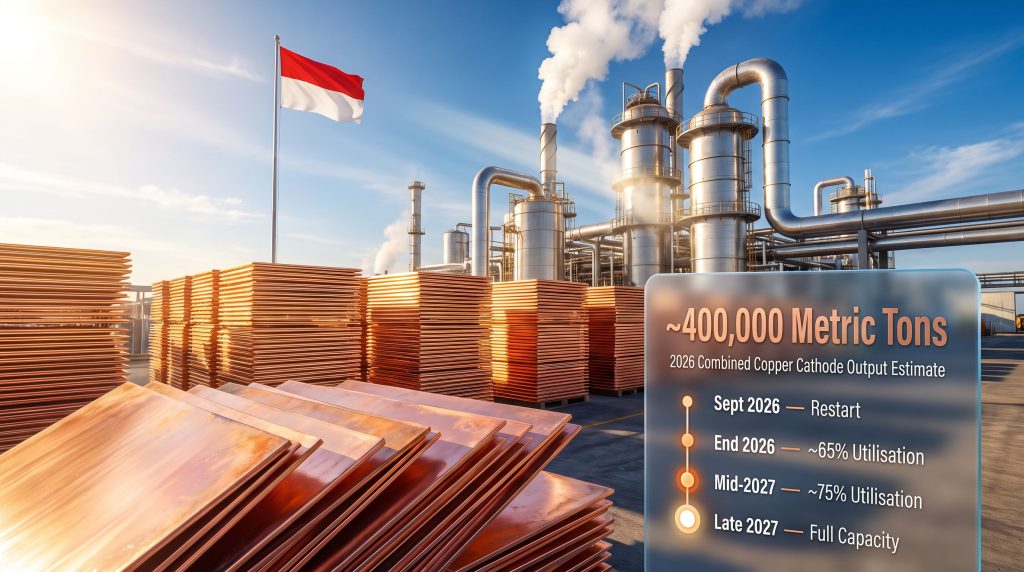
September 2026: Initial restart at minimal throughput. Concentrate volumes from Grasberg remain below pre-incident levels, meaning the smelter operates well below its designed processing rate. This phase establishes that the facility is mechanically sound and operationally ready to scale.
-
End of 2026: Utilisation projected to reach approximately 65%. As Grasberg's recovery progresses and concentrate shipments increase, Manyar can begin processing at a rate that represents a meaningful, if still partial, contribution to combined output figures.
-
Mid-2027: Utilisation projected to reach approximately 75%. Continued Grasberg recovery supports further throughput increases. The smelter moves from restart mode into genuine operational ramp territory.
-
Late 2027: Full operational capacity targeted, contingent on Grasberg approaching pre-incident production levels. This is the horizon at which the facility can be considered fully restored as a copper supply contributor.
The binding constraint throughout this entire sequence is not smelter capacity. It is concentrate availability from a single upstream source that is itself recovering from a geotechnical incident. Investors and market participants treating the September 2026 restart date as a supply catalyst should apply significant discounting to near-term volume expectations.
Why Earlier Restart Windows Were Not Achieved
There had been expectations within some market quarters that a Q2 2026 restart might be achievable. The failure to meet that window reflects the conservative pace of Grasberg's mine recovery. Block cave operations, once disrupted by geotechnical events, require careful reassessment of ground conditions, reinforcement of extraction infrastructure, and gradual re-establishment of draw schedules before production can safely resume at meaningful rates. Rushing this process risks compounding the original incident with secondary events.
2026 Copper Cathode Output: What 400,000 Metric Tons Tells Us
Interpreting the Combined Production Estimate
Combined copper cathode output from both Manyar and PT Smelting is estimated at close to 400,000 metric tons for the full 2026 calendar year. However, this figure requires careful interpretation.
| Metric | 2026 Estimate |
|---|---|
| Total Copper Cathode Output (Both Facilities) | ~400,000 metric tons |
| Manyar Smelter Contribution | Partial year from September only |
| PT Smelting Contribution | Full year at operational capacity |
| Implied Grasberg Recovery Status at Year End | Partial, with full recovery targeted end-2027 |
The approximately 400,000 metric ton figure encompasses a full year of PT Smelting output combined with only a partial-year Manyar contribution beginning in September. This means the true annualised combined capacity of both facilities, once Manyar is fully operational and Grasberg has fully recovered, would be considerably higher than 2026's headline number.
Global Context for the Output Figure
Global refined copper production runs at approximately 25 to 26 million metric tons per year across all producing nations. Indonesia's combined output from these two facilities represents a meaningful but not dominant share of global supply. However, the significance lies less in the absolute volume and more in the trajectory. A facility moving from zero output to partial output to full output over an 18-month window represents a discrete, trackable supply addition in a market where marginal supply changes carry disproportionate price influence.
The next major ASX story will hit our subscribers first
Indonesia's Resource Processing Agenda and What It Means for Long-Term Copper Supply Chains
The Regulatory Architecture Behind Domestic Smelting Investment
Indonesia has constructed a legislative framework designed to ensure that the value generated by its mineral endowment accrues domestically rather than being exported in raw or semi-processed form. Export restrictions on unprocessed minerals, phased in over multiple years, have compelled mining operators to invest in in-country processing capacity or face export prohibition.
For copper specifically, this means that concentrate produced at Grasberg must be processed within Indonesia before the resulting refined metal can enter export markets. The Manyar facility is a direct product of this policy environment. Its construction and operation are not merely commercial decisions by Freeport Indonesia; they are compliance obligations embedded in the company's operating framework within the country.
What This Means for Supply Chain Resilience
The concentration of both upstream mining and downstream smelting within a single country, connected by a single concentrate source, creates a supply chain that is efficient under normal conditions but structurally fragile under stress. The September 2025 incident demonstrated exactly this vulnerability. A geotechnical event at one mine simultaneously curtailed output at two smelting facilities and reduced Indonesia's refined copper contribution to global markets for an extended period.
As the energy transition continues to drive copper demand higher across EV manufacturing, renewable energy infrastructure, and grid modernisation, the resilience of key supply nodes like the Grasberg-Manyar corridor will attract increasing scrutiny. The Freeport McMoRan outlook for 2025 and beyond reflects broader concerns about how geopolitical and operational risks interact with tightening supply fundamentals.
Macro Forces That Amplify the Restart's Significance
Several broader market forces make the Freeport Indonesia Manyar smelter restart more consequential than a standalone operational update would suggest. In addition, the copper supply crunch already under way globally means that any meaningful restoration of processing capacity carries amplified market significance.
-
Energy transition demand acceleration: Copper intensity in renewable energy systems and electric vehicles is structurally higher than in the fossil fuel infrastructure they replace, creating sustained demand growth that supply additions struggle to match.
-
Concentrate market tightness: Globally depressed TC/RCs signal that smelter feed is scarce across the industry, making any incremental recovery of concentrate supply from a major source like Grasberg a meaningful market event.
-
Geopolitical supply diversification pressures: Buyers of refined copper in markets outside Asia are increasingly focused on supply chain geography, with Indonesia's processing capacity forming part of a non-Chinese smelting base that carries strategic value.
-
Grasberg's gold byproduct significance: The Grasberg deposit is among the world's richest in terms of gold co-production with copper. Smelter throughput recovery also implies recovery of gold and silver byproduct streams, adding a precious metals dimension to what is primarily framed as a copper story.
What Market Participants Should Watch Through 2027
Leading Indicators and Monitoring Frameworks
For those tracking the copper market implications of this restart sequence, the following indicators deserve attention. Furthermore, understanding the broader copper price drivers at play will help contextualise each new data point as the ramp-up progresses.
-
Concentrate shipment volumes from Grasberg: These are the leading variable in the entire ramp-up equation. Before cathode output can increase, concentrate volumes must increase. Shipping data and Freeport McMoRan's quarterly reports are the primary tracking mechanisms.
-
TC/RC movements in the spot and annual benchmark markets: Improvement in treatment and refining charges would signal broader concentrate availability recovery, partially influenced by Grasberg's contribution.
-
Quarterly production disclosures: Freeport McMoRan reports operational data quarterly, providing regular checkpoints against the approximately 400,000 metric ton 2026 cathode target and the phased utilisation milestones.
-
Indonesian regulatory developments: Any changes to export licensing conditions, downstream processing requirements, or operating agreement terms could affect the pace or priority of smelter operations.
-
Copper spot price response to incremental supply additions: In a market where sentiment and positioning amplify fundamental signals, the pace at which Manyar's ramp-up is priced in will depend significantly on how traders interpret each quarterly production update. Analysts tracking the London Metal Exchange copper benchmark will find these quarterly updates particularly informative.
Key Takeaways for Copper Market Observers
-
The Freeport Indonesia Manyar smelter restart in September 2026 is the beginning of a multi-quarter ramp, not an immediate supply restoration event.
-
Grasberg's mine recovery is the controlling variable. Until that recovery is complete, the smelter cannot reach full throughput regardless of its own mechanical readiness.
-
Combined 2026 cathode output of approximately 400,000 metric tons reflects a partial Manyar contribution layered onto a full year of PT Smelting output, with the full picture only becoming clear in 2028.
-
The TC/RC market context adds a layer of significance beyond Freeport Indonesia's own balance sheet, as Grasberg concentrate recovery contributes to a globally stressed feedstock market.
-
Indonesia's resource processing policy framework means this facility's operational continuity carries compliance weight alongside its commercial significance.
-
The gold and silver byproduct streams associated with Grasberg concentrate add a precious metals dimension that pure copper-focused analysis tends to underweight.
This article is intended for informational purposes only and does not constitute financial or investment advice. Copper production forecasts, utilisation estimates, and capacity timelines referenced herein reflect publicly reported guidance and are subject to material change based on operational, geological, and regulatory developments. Readers should conduct independent research before making any investment decisions.
Want to Track the Next Major Copper Discovery Before the Market Moves?
Discovery Alert's proprietary Discovery IQ model scans ASX announcements in real time, transforming complex mineral data across 30+ commodities into clear, actionable insights — so subscribers can identify significant copper and multi-commodity discoveries the moment they are announced. Explore historic examples of exceptional discovery returns and begin a 14-day free trial to position yourself ahead of the broader market.