
June 10, 2026
The Metallurgical Data Gap Holding Back Mine Waste Recovery
At the heart of every successful mine waste recovery project lies a problem that laboratory results alone cannot solve. Bench-scale testing can confirm that a particular leach chemistry reacts with target minerals, but it cannot replicate the variability of real feedstock, the mechanical behaviour of aged tailings under continuous throughput, or the reagent consumption dynamics that determine whether a process is economically viable at scale. This is the fundamental gap that pilot plant programmes are designed to close, and it is precisely why the deployment of the Fulcrum EnviroTech mine waste pilot plant in Ontario represents a meaningful technical inflection point for legacy site recovery in one of Canada's most historically productive gold regions.
The timing is significant. The current gold price outlook has sustained multi-year highs, environmental remediation obligations on legacy mine sites are intensifying across North American jurisdictions, and clean processing technology has matured to the point where cyanide-free hydrometallurgy is no longer a theoretical proposition. The convergence of these forces is creating conditions where mine waste reprocessing, long dismissed as marginal economics, is attracting serious capital and engineering attention.
When big ASX news breaks, our subscribers know first
Ontario's Legacy Gold Districts: More Than a Historical Footnote
A Century of Production and What It Left Behind
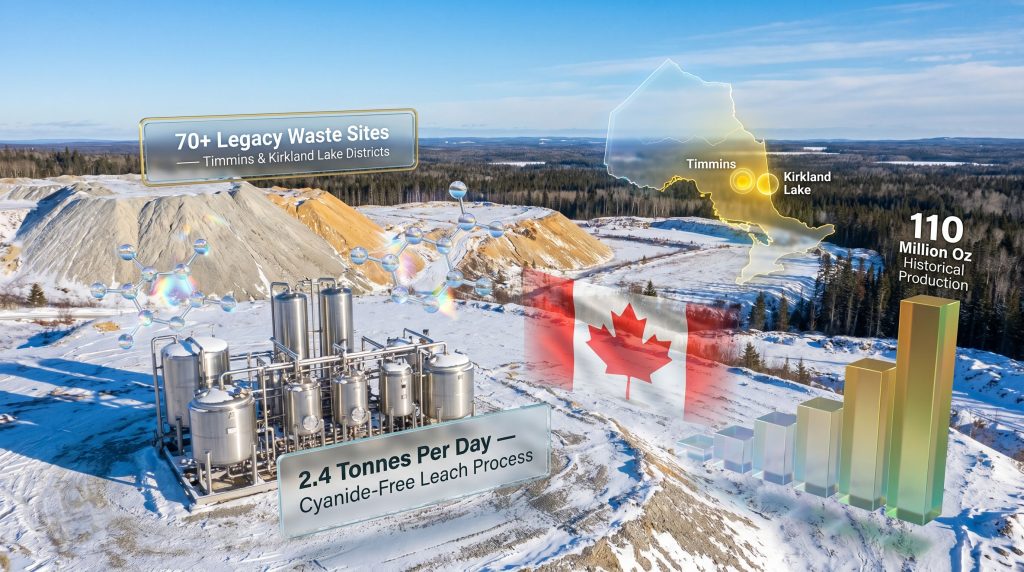
Ontario's Timmins and Kirkland Lake gold camps represent one of the most concentrated histories of precious metals extraction anywhere in the world. Collectively, these two districts produced more than 110 million ounces of gold across the past century, a figure that places them among the elite tier of global gold-producing regions. What is less widely understood is what that scale of production left behind.
Historic mining practices, particularly those predating modern metallurgical techniques, routinely left recoverable metals in tailings and waste rock. Early cyanide circuits operated at lower efficiencies than contemporary systems, and many ore types processed before the 1970s were never subjected to the fine grinding or pre-oxidation steps that improve gold liberation. The result is a substantial residual resource distributed across more than 70 identified legacy waste sites within these two districts alone.
These sites are not simply environmental liabilities. For companies with the right processing technology and territorial rights, they represent a secondary resource base with several structural advantages over greenfield exploration:
- No drilling campaigns required to establish resource presence
- Surface infrastructure often partially intact
- Established site access and proximity to regional services
- Known geological context from historical production records
- Potential for dual-value creation through resource recovery and site rehabilitation
The challenge has always been processing economics. Legacy waste material is characteristically complex, with variable grain size distribution, oxidised sulphide mineralogy, and in many cases, residual reagent contamination from earlier processing cycles. These characteristics reduce the effectiveness of conventional cyanide leaching and have historically made reprocessing uneconomical at prevailing metal prices.
How the Four-Party Structure Reduces Development Risk
Engineering Credibility Through Partnership Architecture
The deployment structure behind the Fulcrum EnviroTech mine waste pilot plant in Ontario is notable for how deliberately it distributes risk and responsibility across specialised parties. Rather than a single company attempting to develop, own, and operate novel processing infrastructure, the programme combines four distinct competencies under a coordinated framework.
| Partner | Core Contribution |
|---|---|
| Fulcrum EnviroTech | Programme management, site selection, operations oversight |
| TDI (Test Design Implement Solutions) | Equipment supply, installation, commissioning, and facility operation |
| Extrakt Process Solutions | Cyanide-free leach technology (non-commercial licensing) |
| Bechtel Energy Technologies & Solutions | Technical support via existing Extrakt alliance |
A structurally important element of the contract is equipment ownership. TDI retains ownership of the pilot plant, while Fulcrum holds lease options that allow continued access beyond the initial testing programme. This arrangement materially reduces Fulcrum's upfront capital exposure during the validation phase, which is precisely the period of highest technical uncertainty. It is a structure increasingly favoured by junior resource companies seeking to advance processing concepts without the balance sheet burden of owning specialised equipment that may require modification as the technology is refined.
Bechtel's involvement as a technical support partner warrants specific attention. Bechtel is one of the world's largest engineering and project delivery organisations, with deep experience in large-scale metallurgical and chemical processing infrastructure. Its participation in the programme, even in a support capacity, adds engineering credibility and provides a credible pathway to scale-up advisory if pilot results support commercial development.
Understanding the Cyanide-Free Leach Approach
Why Conventional Processing Falls Short on Legacy Waste
Cyanide-based gold leaching has been the industry standard for over a century, but its application to legacy mine waste carries specific limitations that are not always well understood outside the metallurgical community. When applied to aged tailings, cyanide leach efficiency is frequently compromised by several factors:
- Preg-robbing behaviour: Carbonaceous material present in many historic tailings adsorbs dissolved gold from solution before it can be recovered, reducing overall yield
- Sulphide oxidation states: Prolonged surface exposure alters sulphide mineralogy, changing the way gold is locked within the mineral matrix
- Fine particle losses: Historic milling practices often produced a broad particle size distribution, with ultra-fine fractions that behave differently in leach circuits
- Reagent competition: Elevated base metal content in waste material increases cyanide consumption, directly affecting processing economics
Extrakt Process Solutions' cyanide-free leach technology is designed to address these limitations through an alternative hydrometallurgical pathway. While the precise reagent chemistry is proprietary, cyanide-free leach systems in this class typically utilise oxidising lixiviants or halide-based chemistries that interact differently with gold-bearing mineral phases, potentially offering higher selectivity on complex feed material. Furthermore, the leaching environmental benefits of avoiding cyanide-based reagents are increasingly relevant to project permitting timelines.
The Regulatory and Social Licence Dimension
Beyond pure metallurgy, the regulatory landscape around cyanide use at non-operational legacy sites introduces friction that cyanide-free processing directly avoids. Environmental permitting for new cyanide operations requires extensive risk assessment, spill containment infrastructure, and ongoing monitoring obligations. At legacy sites where the land-use history is complex, obtaining community and regulatory acceptance for cyanide-based reprocessing can extend project timelines significantly. Cyanide-free processing substantially reduces this permitting burden, which in Ontario's structured regulatory environment translates directly into faster programme execution.
The Teck-Hughes Project: Why This Asset Is the Starting Point
Kirkland Lake Provenance and Technical Baseline
The Teck-Hughes project sits within the Kirkland Lake mining district, a corridor that produced some of Canada's highest-grade gold mines during the twentieth century. The Kirkland Lake camp is historically distinguished by its association with steep, high-grade gold veins hosted in syenite intrusions, a geological setting that produced exceptionally rich ore but also generated waste material with residual gold content that may not have been economically recoverable under earlier processing regimes.
Critically, Fulcrum completed a pilot plant scoping study covering both Teck-Hughes and its Sylvanite asset prior to this deployment agreement. That scoping work established a preliminary technical baseline, meaning the 12-batch pilot programme is not entering blind. The data generated will build directly on existing metallurgical characterisation to produce the operational and engineering datasets required for a credible commercial feasibility assessment, comparable in rigour to what a definitive feasibility study would demand at a later stage.
The pilot plant is engineered to process up to 2.4 tonnes per day of material, running approximately 12 processing batches over four weeks during the initial programme phase. This throughput scale is specifically chosen to generate statistically meaningful data across variable feed conditions, something that cannot be achieved in a laboratory setting where sample sizes are constrained and continuous-flow dynamics are absent.
Sylvanite and the Broader Portfolio Logic
Sylvanite represents a second tailings asset within Fulcrum's Ontario portfolio, located within the same historically productive corridor as Teck-Hughes. The pilot plant's capacity to evaluate third-party waste material, in addition to Fulcrum's own projects, positions the facility as a multi-asset evaluation platform. This design flexibility is strategically significant: it means the programme can generate comparative metallurgical data across different waste types within the same regional geology, strengthening the technical foundation for portfolio-wide development decisions.
Scaling the Business Case: From Pilot to Commercial Reality
The Development Pathway in Sequential Terms
Understanding where the pilot programme fits within a broader commercialisation trajectory helps contextualise what the current programme will and will not deliver. The table below outlines the sequential development logic:
| Development Stage | Primary Output |
|---|---|
| Scoping Study (completed) | Preliminary technical baseline for Teck-Hughes and Sylvanite |
| Pilot Plant Programme (current) | Metallurgical, operational, and engineering datasets at 2.4 tpd |
| Data Analysis Phase | Recovery rate confirmation, reagent consumption, throughput optimisation |
| Commercial Feasibility Assessment | Economic modelling informed by pilot outputs |
| Potential Commercial Deployment | Scale-up decision contingent on economics and capital availability |
The capital-light structure of the current programme is well-suited to the risk profile of this stage. Pilot-scale data generation is inherently experimental, and maintaining flexibility to adjust parameters, switch feedstocks, or extend the testing period without incurring additional capital expenditure is operationally valuable. The equipment lease options embedded in the TDI contract provide exactly this flexibility.
Fulcrum Metals CEO Ryan Mee has described the programme as creating a pathway toward commercialising Teck-Hughes while simultaneously establishing a platform capable of supporting future mine waste recovery opportunities across the region, characterising the underlying model as scalable and capital-efficient. (Source: Mining Technology, June 2026)
Third-Party Waste Assessment as a Revenue Diversification Avenue
One dimension of the programme that carries speculative but plausible commercial potential is the facility's capacity to assess waste samples from third-party sources. If pilot results demonstrate consistent recovery performance across variable feed types, the Fulcrum EnviroTech mine waste pilot plant in Ontario could evolve toward a toll-processing or technical assessment service model for other legacy waste site owners across the Timmins and Kirkland Lake regions. This would create a revenue stream that is not dependent on advancing any single asset to production, while simultaneously building the regional dataset that strengthens the case for broader deployment of the cyanide-free technology platform.
The next major ASX story will hit our subscribers first
The Competitive Landscape of Mine Waste Processing Technologies
Positioning Cyanide-Free Leaching Against Alternatives
Understanding how Extrakt's approach compares to other available technologies helps frame the strategic rationale for its selection in this programme.
| Processing Approach | Environmental Profile | Suitability for Complex Legacy Waste | Commercial Maturity |
|---|---|---|---|
| Conventional cyanide heap leach | High regulatory scrutiny | Reduced efficiency on preg-robbing material | Proven at scale |
| Cyanide-free leach (alternative hydrometallurgy) | Lower chemical risk profile | Designed for variable, complex feed | Pilot to commercial transition |
| Bioleaching (microbial oxidation) | Minimal chemical inputs | Effective on sulphide-locked gold | Limited commercial deployment |
| Gravity and physical separation | Near-zero chemical use | Commodity and liberation dependent | Mature for coarse gold only |
The cyanide-free leach category occupies a strategically important middle ground: it offers the processing flexibility of chemical leaching while avoiding the regulatory and environmental overhead associated with cyanide. For Ontario legacy sites where complex mineralogy reduces cyanide effectiveness and community acceptance is a factor in site selection, this positioning is commercially rational rather than merely ideologically motivated. Consequently, mine reclamation innovation of this kind is gaining increasing traction across North American jurisdictions.
What the 70+ Legacy Sites Mean for Long-Term Pipeline Value
Scale, Variability, and the Data Advantage
The estimated 70-plus legacy waste sites across the Timmins and Kirkland Lake districts are not a homogeneous resource. Each site carries distinct mineralogical characteristics shaped by the original ore type, the processing technology in use at the time of operation, and the duration and conditions of surface exposure since closure. This variability means that blanket assumptions about recovery rates are unreliable, and site-specific metallurgical testing is essential before any commercial assessment can be made.
This is precisely where the pilot plant's multi-sample capability becomes a long-term strategic asset. By generating comparative processing data across different waste types within a defined regional geology, Fulcrum EnviroTech can progressively build a proprietary dataset that informs prioritisation across its broader pipeline. Accurate drill results interpretation from historical site records further supplements this picture, allowing the team to correlate surface waste characterisation with deeper geological context. In an environment where 110 million ounces of historical gold production implies substantial residual mineralisation, even modest systematic recovery improvements across multiple sites could translate into material economic value.
It is important to note that all projections regarding commercial viability, recovery rates, and future revenue streams remain subject to pilot programme outcomes, commodity price movements, and regulatory processes. Nothing in this article should be construed as financial or investment advice.
Frequently Asked Questions: Fulcrum EnviroTech Pilot Plant in Ontario
What is the primary purpose of the Fulcrum EnviroTech mine waste pilot plant in Ontario?
The facility is a standalone processing plant engineered to recover precious and critical metals from legacy mine waste using a cyanide-free leach process. Its central purpose is to generate the metallurgical and engineering data needed to bridge the gap between laboratory-scale testing and potential commercial deployment, with initial operations focused on material from the Teck-Hughes project.
Who owns the pilot plant equipment?
TDI retains ownership of all equipment under the contract terms. Fulcrum Metals holds lease options permitting continued use of the facility for additional testing beyond the initial four-week programme, an arrangement that limits Fulcrum's upfront capital commitment.
What makes Extrakt's technology different from conventional gold recovery methods?
Extrakt Process Solutions' cyanide-free leach system uses an alternative chemical pathway to dissolve and recover precious metals, avoiding the environmental, regulatory, and metallurgical limitations associated with cyanide-based processing. This is particularly relevant for legacy waste material where cyanide efficiency is frequently compromised by mineralogical complexity and organic carbon content.
What territorial rights does Fulcrum hold for the Extrakt technology?
Fulcrum Metals holds exclusive rights to deploy Extrakt's cyanide-free processing technology across legacy gold mine waste sites within the Timmins and Kirkland Lake mining districts of Ontario, covering the two most historically significant gold-producing regions in Canada's mining history.
What happens after the initial 12-batch programme?
The operational and metallurgical data generated during the four-week pilot programme will feed directly into a commercial feasibility assessment. The pilot plant's lease structure allows extended testing if additional batches are required to refine understanding of specific feed types or processing parameters. Future development decisions will be contingent on pilot outcomes and economic modelling.
Want to Invest in the Next Major Mineral Discovery Before the Market Moves?
Discovery Alert's proprietary Discovery IQ model delivers real-time alerts on significant ASX mineral discoveries, transforming complex data into actionable investment insights — explore historic discoveries and their remarkable returns, then begin your 14-day free trial at Discovery Alert to position yourself ahead of the broader market.