May 16, 2026

The global economy stands at a critical inflection point where traditional efficiency-focused supply chains collide with emerging requirements for strategic resilience. Advanced economies find themselves confronting an uncomfortable reality: their technological sovereignty depends on materials controlled by geopolitical rivals. This dependency extends far beyond simple trade relationships, encompassing fundamental questions about economic security, industrial competitiveness, and national defence capabilities.
The concentration of critical mineral supply chains represents one of the most significant structural vulnerabilities facing developed economies today. Unlike conventional commodities, these materials serve as essential inputs for technologies that define modern economic power: renewable energy systems, advanced manufacturing, electronic warfare capabilities, and next-generation transportation infrastructure. The strategic implications extend beyond immediate supply disruptions to encompass long-term questions about technological leadership and economic independence.
Recent high-level coordination among G7 finance ministers signals recognition that market-based solutions alone cannot address these structural dependencies. The meeting in Washington brought together not only the world's largest advanced economies but also key mineral-producing nations and multilateral development institutions, indicating a comprehensive approach to G7 critical minerals supply chain diversification that transcends traditional bilateral trade arrangements.
What Are Critical Minerals and Why Do They Drive Economic Security?
Critical minerals constitute the elemental foundation of modern technological civilisation, encompassing rare earth elements, lithium, cobalt, graphite, and specialised metals that enable everything from smartphone manufacturing to grid-scale energy storage. These materials differ fundamentally from traditional commodities in their unique properties, limited substitutability, and concentrated geographic distribution.
The economic significance of these materials extends far beyond their relatively modest market sizes. While global rare earth markets represent approximately $12 billion annually, their absence would paralyse industries worth trillions of dollars. This disconnect between nominal value and systemic importance creates unique vulnerabilities that traditional market mechanisms cannot adequately address.
Economic Vulnerability Matrix for Critical Minerals
| Mineral Category | Primary Applications | Market Concentration | Strategic Importance |
|---|---|---|---|
| Rare Earth Elements | Permanent magnets, electronics, defence systems | 70% mining, 90% processing | Essential for renewable energy and military applications |
| Lithium | Battery manufacturing, energy storage | 60% processing concentration | Critical for transportation electrification |
| Cobalt | High-performance batteries, aerospace alloys | 70% from single region | Vital for grid stabilisation and electric mobility |
| Graphite | Battery anodes, steel production, nuclear applications | 80% processing dominance | Fundamental for energy transition infrastructure |
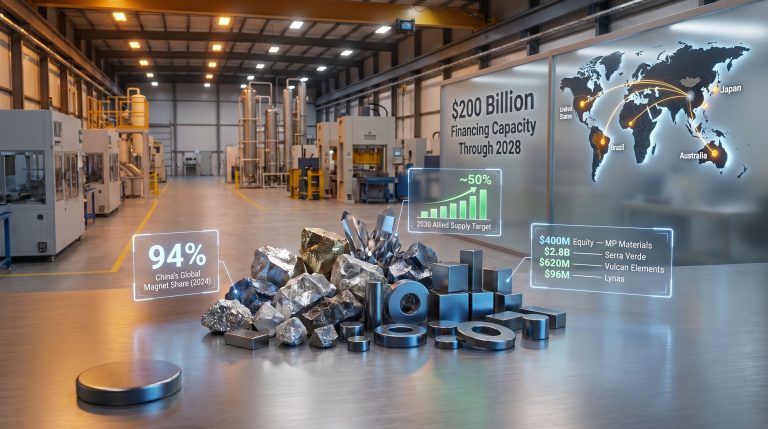
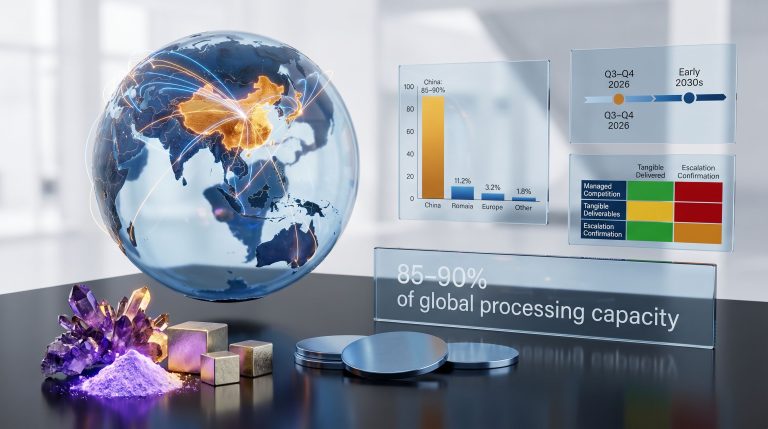
The processing concentration figures reveal the true scope of dependency relationships. While mining operations can potentially be diversified across multiple geographic regions, processing capabilities require substantial technological expertise, environmental compliance infrastructure, and decades of industrial development. China's dominance in rare earth processing, approaching 90% of global capacity according to statements from Japanese Finance Minister Katayama Satsuki, represents a bottleneck that cannot be quickly replicated elsewhere.
Industrial Applications and Economic Multiplier Effects
The strategic importance of critical minerals becomes evident when examining their role in high-value manufacturing sectors. Rare earth permanent magnets enable wind turbine efficiency improvements that reduce electricity generation costs by 15-20% compared to conventional alternatives. Similarly, lithium-ion battery chemistry improvements directly influence the economic viability of electric vehicle adoption and grid-scale renewable energy deployment.
Defence applications create additional layers of strategic dependency. Advanced guidance systems, electronic warfare capabilities, and next-generation fighter aircraft all rely on rare earth elements with no viable substitutes. This dependency means that supply disruptions could compromise national security capabilities within months, creating vulnerabilities that extend far beyond economic considerations.
When big ASX news breaks, our subscribers know first
How Does Supply Chain Concentration Threaten Economic Stability?
The concentration of critical mineral supply chains creates systemic risks that transcend normal market volatility, encompassing deliberate manipulation, cascade failures across interconnected industries, and constraints on technological innovation. These vulnerabilities represent fundamental threats to economic stability that require coordinated policy responses rather than purely market-based solutions.
Price Manipulation and Strategic Coercion Mechanisms
Concentrated supply chains enable dominant producers to leverage export restrictions as geopolitical tools, creating immediate supply shocks that cascade through global manufacturing networks. The characterisation by Minister Katayama of such tactics as "weaponisation" reflects G7 recognition that current market structures facilitate strategic coercion rather than efficient resource allocation.
Export restrictions can trigger price increases of 300-500% within weeks, as observed in historical precedents involving rare earth elements. These price spikes propagate through supply chains with multiplier effects, forcing manufacturers to either accept dramatically higher input costs or suspend production entirely. The economic damage extends beyond immediate price impacts to encompass inventory writedowns, contract cancellations, and production facility idle time.
Industrial Production Cascade Effects
Manufacturing delays in critical mineral-dependent sectors create ripple effects throughout interconnected supply chains. A 30-day disruption in rare earth supplies can force automotive manufacturers to halt electric vehicle production for 60-90 days due to component inventory depletion and supplier contract complications.
The semiconductor industry faces particularly acute vulnerabilities, with chip fabrication requiring precise rare earth inputs that cannot be substituted without extensive reengineering. Production shutdowns in semiconductor facilities create shortages that affect:
• Consumer electronics manufacturing
• Automotive production lines
• Industrial automation systems
• Telecommunications infrastructure deployment
• Medical device manufacturing
Defence contractors experience additional complications due to security clearance requirements and specialised performance standards that limit sourcing flexibility. Military hardware production often requires rare earth materials meeting specific purity and consistency standards that may not be available from alternative suppliers without years of qualification testing.
Innovation and Technological Sovereignty Constraints
Research and development programmes face fundamental constraints when critical material access becomes uncertain or politically conditional. Advanced battery chemistry research, for example, requires consistent access to high-purity lithium compounds and specialised cobalt alloys that may not be available through diversified supply chains for several years.
Clean energy transition timelines become dependent on external material suppliers, creating strategic vulnerabilities in climate policy implementation. Wind and solar deployment targets established by G7 governments assume continued access to rare earth permanent magnets and specialised materials that current supply chains cannot guarantee.
The intersection of technological advancement and material dependency means that innovation leadership increasingly depends on supply chain resilience rather than purely domestic research capabilities.
What Economic Strategies Are G7 Nations Implementing for Diversification?
G7 nations have adopted a comprehensive framework for G7 critical minerals supply chain diversification that encompasses direct investment mechanisms, market-based incentive structures, and multilateral coordination through international financial institutions. The strategy represents a fundamental shift from efficiency-focused procurement toward resilience-centred supply chain architecture.
Direct Investment and Multilateral Financing Coordination
Japan's $20 million commitment to the Asian Development Bank initiative represents a template for coordinated multilateral financing that channels government resources through established international institutions. This approach provides political cover for recipient nations while ensuring professional project management standards and transparent allocation processes.
The multilateral structure enables risk-sharing among G7 nations while leveraging institutional expertise in infrastructure development and technical assistance. The Asian Development Bank's role as coordinating institution suggests future expansion of similar programs through other regional development banks serving mineral-producing regions in Africa and Latin America.
Key Investment Framework Components:
• Technical assistance for mining infrastructure development
• Processing facility capacity building programmes
• Transportation network improvements for new supply routes
• Environmental and social compliance support systems
• Technology transfer agreements with mineral-producing nations
Market-Based Incentive Structures and Procurement Preferences
G7 governments are implementing procurement policies that provide price premiums for supplies sourced from diversified supply chains, creating market incentives for private sector investment in alternative production capacity. These policies typically offer 5-15% price premiums for materials sourced from approved alternative suppliers, sufficient to justify the additional risks and costs associated with developing new supply sources.
Tax incentive programmes for domestic processing capabilities include accelerated depreciation schedules for specialised equipment and research credits for technology development. These policies aim to rebuild processing capacity within G7 economies while supporting private sector innovation in extraction and refinement technologies.
Trade policy coordination among G7 nations creates harmonised tariff structures that disadvantage concentrated supply sources while providing preferential access for materials from partner economies. This approach leverages collective G7 market access as an incentive for mineral-producing nations to develop alternative supply chains.
Technology and Infrastructure Development Priorities
Investment in advanced mineral processing technologies focuses on reducing environmental impacts and improving efficiency to compete with established suppliers. Research programmes emphasise automation, waste reduction, and energy efficiency improvements that can offset higher labour and regulatory compliance costs in G7 economies.
Digital traceability systems enable verification of mineral sourcing and processing compliance with environmental and labour standards. These systems provide transparency that supports premium pricing for responsibly sourced materials while creating market differentiation opportunities for alternative suppliers.
How Will Regional Economic Partnerships Transform Mineral Markets?
The transformation of global mineral markets through G7 critical minerals supply chain diversification strategies will create new patterns of regional economic integration, fundamentally altering trade flows and development finance structures across mineral-producing regions. The participation of Australia, Argentina, India, Indonesia, South Korea, and South Africa in G7 coordination meetings signals the emergence of strategic partnerships that extend far beyond traditional buyer-seller relationships.
Strategic Partnership Models and Economic Integration Frameworks
The characterisation by Minister Katayama of mineral partnerships as creating "win-win situations" reflects recognition that successful diversification requires genuine economic advantages for producing nations rather than exploitative extraction relationships. This approach encompasses technology transfer, infrastructure development, and capacity building that enables partner economies to capture greater value from their mineral resources.
Technical assistance programmes focus on developing domestic processing capabilities within mineral-producing nations, enabling them to export higher-value refined materials rather than raw ores. This value-added approach increases revenue for producing nations while creating alternative processing capacity that reduces G7 dependence on concentrated suppliers.
Geographic Diversification and Regional Specialisation Patterns
The global scope of G7 partnership development encompasses complementary regional strengths across multiple continents, reducing vulnerability to regional conflicts or natural disasters that could disrupt concentrated supply chains.
Regional Partnership Development Matrix:
| Region | Primary Mineral Focus | Development Priority | Partnership Model |
|---|---|---|---|
| Southeast Asia | Rare earth elements, nickel, tin | Processing infrastructure expansion | Technology transfer and equipment financing |
| Africa | Cobalt, lithium, platinum group metals | Sustainable mining capacity development | Environmental compliance and community engagement |
| Latin America | Lithium, copper, rare earths | Advanced extraction technology deployment | Research collaboration and workforce development |
| Australia | Comprehensive mineral portfolio | Next-generation processing facilities | Strategic alliance and joint venture frameworks |
Economic Development and Capacity Building Integration
Partnership frameworks emphasise local workforce development and technology transfer that creates sustainable economic benefits beyond mineral extraction. This approach includes university exchange programmes, technical training initiatives, and research collaboration agreements that build long-term capabilities within partner economies.
Infrastructure development extends beyond mining-specific facilities to encompass transportation networks, port facilities, and power generation capacity that supports broader economic development. The Japanese contribution to Asian Development Bank technical assistance programmes represents a model for coordinated infrastructure investment that serves multiple economic sectors.
The emphasis on mutual benefit and sustainable development reflects G7 recognition that successful supply chain diversification requires partner nations to view mineral development as economically advantageous rather than externally imposed.
What Are the Long-Term Economic Implications of Supply Chain Diversification?
The economic implications of G7 critical minerals supply chain diversification extend far beyond immediate supply security, encompassing fundamental shifts in global trade patterns, international development finance, and competitive dynamics across technology-intensive industries. The transformation will unfold across multiple timeframes with distinct economic characteristics and adjustment requirements.
Short-Term Economic Adjustment Period (2025-2027)
Initial diversification efforts will generate increased material costs as G7 economies absorb premium pricing for alternative suppliers and invest in new supply chain infrastructure. Manufacturing sectors dependent on critical minerals should anticipate 15-25% cost increases during the transition period as established supply chains adjust to incorporate new sources.
Investment flows will redirect toward alternative mineral-producing regions, creating development finance opportunities but also potential asset stranding in regions excluded from diversified supply chains. Private sector capital allocation will shift toward projects offering supply chain resilience rather than purely cost-optimised production.
Economic Adjustment Indicators:
• Manufacturing input cost inflation in technology sectors
• Increased government spending on infrastructure and technical assistance
• Private sector investment reallocation toward alternative suppliers
• Temporary supply chain disruptions during transition implementation
Medium-Term Structural Transformation (2027-2030)
Competitive alternative supply sources will emerge as G7 investment in processing infrastructure and technology transfer programmes achieve operational scale. Market dynamics will shift from monopolistic price setting toward competitive pricing as multiple suppliers develop capacity to serve advanced economy demand surge in critical minerals.
Regional economic integration will deepen through mineral trade relationships, creating new patterns of South-South cooperation and trilateral development finance. Mineral-producing nations will develop stronger economic ties with each other as they coordinate responses to G7 partnership opportunities.
Enhanced supply chain transparency and environmental standards will create market premiums for responsibly sourced materials, driving innovation in extraction and processing technologies. This premium market will support higher-cost production in developed economies while incentivising environmental compliance improvements globally.
Long-Term Global Economic Rebalancing (2030+)
Fundamental shifts in economic power will emerge as mineral markets develop multipolar competitive structures. The current concentration of processing capacity will give way to distributed production networks spanning multiple continents and regulatory frameworks.
Structural Economic Changes:
• Reduced systemic risk from supply chain concentration
• Enhanced price stability through competitive market dynamics
• Strengthened economic sovereignty for G7 economies
• Expanded economic opportunities in mineral-producing developing nations
• Innovation acceleration in extraction and processing technologies
International economic relationships will evolve toward greater reciprocity as mineral-producing nations develop stronger bargaining positions and alternative market access. This rebalancing will support broader development goals while reducing dependency vulnerabilities for all participants whilst strengthening critical minerals energy security.
How Will Market Competition Evolve Under Diversified Supply Chains?
The evolution toward diversified critical minerals supply chains will fundamentally reshape competitive dynamics, creating opportunities for new market entrants while forcing established suppliers to compete on factors beyond geographic advantage. This transformation encompasses pricing mechanisms, innovation incentives, and market structure changes that will define industry competition for decades.
Enhanced Competition and Price Discovery Mechanisms
Multiple suppliers competing for G7 market access will eliminate monopolistic pricing power and create transparent price discovery mechanisms based on quality, reliability, and environmental performance rather than geopolitical leverage. Competitive bidding processes will replace bilateral negotiation as the primary means of contract allocation.
Innovation incentives will drive efficiency improvements as suppliers invest in advanced technologies to achieve cost competitiveness. Research and development spending in extraction and processing technologies will increase substantially as companies seek sustainable competitive advantages in diversified markets.
Market transparency will improve through standardised reporting requirements and digital traceability systems that enable buyers to verify sourcing practices and environmental compliance. This transparency will support premium pricing for superior performance while penalising substandard practices.
Regional Economic Integration and Cooperative Development
Strengthened trade relationships between G7 economies and mineral-producing partners will create new frameworks for economic cooperation that extend beyond mineral trade. These relationships will encompass technology transfer, educational exchange, and joint research initiatives that build long-term competitive capabilities.
Technology transfer programmes will accelerate development in partner economies by providing access to advanced extraction and processing technologies previously concentrated in developed economies. This knowledge sharing will create new centres of excellence in mineral production while reducing technology gaps between developed and developing nations.
Shared prosperity models will emerge through resource partnerships that ensure mineral-producing nations capture appropriate value from their natural resources while providing stable supply access to consuming economies. Revenue-sharing agreements and local content requirements will support domestic economic development in producing regions.
The next major ASX story will hit our subscribers first
What Investment Opportunities Emerge from G7 Diversification Strategy?
The G7 critical minerals supply chain diversification strategy creates substantial investment opportunities across multiple sectors, from direct mining and processing operations to supporting infrastructure and technology development. These opportunities span different risk profiles and return expectations, accommodating diverse investor preferences and capital requirements.
Mining and Processing Investment Themes
Early-stage mining projects in politically stable regions offer potential for substantial returns as demand for diversified supply sources increases. Priority regions include established mining jurisdictions with strong regulatory frameworks and existing infrastructure that can support expanded operations.
Processing facility development within G7 economies represents opportunities for higher-value manufacturing that benefits from proximity to end users and reduced transportation costs. Government incentives for domestic processing capabilities may provide additional return enhancement through tax credits and accelerated depreciation schedules.
Investment Focus Areas:
• Rare earth processing facilities in North America and Europe
• Lithium extraction and refinement in established mining regions
• Battery recycling and circular economy technologies
• Advanced automation and robotics for mining operations
• Environmental compliance and remediation technologies
Infrastructure and Technology Investment Opportunities
Transportation networks connecting new mining regions to processing facilities and end markets require substantial capital investment in rail, port, and pipeline infrastructure. These projects typically offer stable, long-term returns supported by government guarantees and multilateral development bank financing.
Digital supply chain management systems represent high-growth opportunities as companies invest in traceability and compliance monitoring technologies. Software and hardware solutions that enable real-time monitoring of mineral sourcing and processing conditions will experience strong demand growth.
Technology Investment Categories:
• Blockchain-based supply chain traceability systems
• Advanced analytics for mineral quality assessment
• Automation technologies for hazardous environment operations
• Environmental monitoring and remediation equipment
• Energy-efficient processing technologies
Financial Innovation and Risk Management Solutions
Insurance products for supply chain disruption will expand to address new risk factors associated with diversified sourcing strategies. Specialised coverage for political risks, environmental liabilities, and operational disruptions will support private sector investment in higher-risk regions.
Commodity hedging instruments adapted to diversified supply chains will enable companies to manage price volatility across multiple sourcing relationships. These financial products will need to account for quality differentials, transportation costs, and regulatory compliance factors that affect pricing in diversified markets.
Development finance mechanisms combining government guarantees with private capital will create new asset classes offering enhanced returns for acceptable risk levels. These blended finance structures will support infrastructure development while providing institutional investors with exposure to emerging market growth.
How Do Environmental and Social Considerations Shape Economic Strategy?
Environmental and social governance factors increasingly influence economic decision-making in critical minerals development, creating market premiums for responsible practices while imposing compliance costs that affect competitive dynamics. These considerations shape investment flows, regulatory frameworks, and consumer preferences in ways that fundamentally alter industry economics.
Environmental Standards and Market Differentiation
Sustainable mining practices serve as market differentiators that command premium pricing from environmentally conscious buyers. Companies demonstrating superior environmental performance through reduced water usage, minimal ecosystem disruption, and effective waste management can achieve 10-20% price premiums for their products.
Carbon footprint considerations in sourcing decisions reflect corporate sustainability commitments that influence procurement policies across G7 economies. Life-cycle assessments encompassing extraction, processing, and transportation emissions become important factors in supplier selection and contract negotiation.
Circular economy principles drive investment in recycling technologies that recover critical minerals from end-of-life products. These secondary supply sources reduce dependence on primary extraction while offering potentially lower environmental impacts and reduced geopolitical risk.
Environmental Performance Metrics:
• Water consumption per unit of mineral production
• Greenhouse gas emissions throughout supply chain
• Land use impact and ecosystem restoration efforts
• Waste generation and management practices
• Energy efficiency in extraction and processing operations
Social Impact and Community Development Integration
Community benefit-sharing arrangements in mineral-producing regions ensure local populations receive appropriate compensation for resource extraction activities. These agreements typically include employment preferences, infrastructure development commitments, and revenue sharing that supports local economic development.
Indigenous rights protection serves as a partnership requirement that affects project feasibility and operational licensing. Consultation processes, cultural preservation commitments, and traditional knowledge recognition become essential components of project development in many mineral-rich regions.
Local economic development through mineral value chains creates employment opportunities beyond direct extraction activities. Processing facilities, equipment manufacturing, and service provision generate multiplier effects that support broader regional economic growth.
Successful mineral development increasingly requires explicit community consent and ongoing social licence maintenance, making social performance as important as technical and financial capabilities.
What Challenges Could Limit Economic Diversification Success?
Several significant challenges could constrain the effectiveness of G7 critical minerals supply chain diversification efforts, encompassing capital requirements, technical limitations, and geopolitical response factors that may complicate implementation. Furthermore, understanding these potential obstacles enables more realistic planning and appropriate risk mitigation strategies.
Capital Requirements and Financing Constraints
Massive investment requirements for alternative infrastructure present fundamental financing challenges that may exceed available development finance resources. Conservative estimates suggest global requirements of $200-300 billion over the next decade, with G7 nations expected to contribute approximately 60% through various financing mechanisms.
Long development timelines for new mining operations create cash flow challenges that deter private sector investment. Mineral projects typically require 7-15 years from initial discovery to commercial production, with uncertain returns and substantial regulatory risks that complicate project financing.
Competition for limited development finance resources intensifies as multiple sectors seek government support for strategic initiatives. Critical minerals development must compete with renewable energy, transportation infrastructure, and defence modernisation programmes for scarce public financing.
Financing Gap Analysis:
• Estimated global investment requirement: $200-300 billion
• Current committed government funding: $20 million (Japan/ADB initiative)
• Private sector investment capacity: Limited by risk perception
• Multilateral development bank capacity: Requires substantial expansion
• Commercial bank participation: Constrained by long payback periods
Technical and Operational Implementation Risks
Complex geology in alternative mineral deposits may present technical challenges that increase extraction costs or reduce ore quality compared to established operations. Many alternative deposits feature lower grades, more complex mineralogy, or challenging environmental conditions that complicate development.
Skills and technology gaps in emerging mining regions require substantial capacity building investments that extend project timelines and increase costs. Technical expertise, regulatory knowledge, and operational experience concentrated in established mining regions cannot be quickly replicated elsewhere.
Quality and consistency standards for industrial applications may not be achievable from new suppliers without extensive qualification processes. High-technology applications require precise material specifications that new suppliers may struggle to meet consistently.
Geopolitical Response and Market Manipulation Risks
Potential retaliation through aggressive pricing or export restrictions could undermine diversification efforts by making alternative suppliers economically unviable. Dominant suppliers may use their market position to eliminate emerging competition through predatory pricing or supply disruptions.
Counter-strategies designed to maintain market dominance may include increased investment in downstream processing capabilities, preferential pricing for key customers, or political pressure on potential alternative suppliers. These responses could complicate G7 diversification efforts and increase implementation costs whilst triggering pivot in critical minerals strategy.
Regional conflicts or political instability affecting alternative supply sources could undermine diversification benefits and create new vulnerabilities. Political risk factors in some mineral-producing regions may limit their viability as reliable alternative suppliers, particularly in light of US–China trade war impacts.
Frequently Asked Questions About G7 Critical Minerals Strategy
Q: How long will implementation take to achieve meaningful supply chain diversification?
Economic modelling suggests initial impact within 5-7 years as new processing facilities become operational and alternative suppliers develop production capacity. Full strategic independence from concentrated supply sources likely requires 10-15 years of sustained investment and political commitment across multiple election cycles.
Q: What are the total estimated costs for supply chain diversification?
Industry analysis indicates global investment requirements of $200-300 billion over the next decade, with G7 nations contributing approximately 60% through government financing, development bank programmes, and private sector incentives. Individual nation contributions will vary based on domestic consumption requirements and strategic priorities.
Q: How will diversification affect material costs for end consumers?
Short-term price increases of 15-25% are anticipated during transition periods as premium pricing for alternative suppliers and infrastructure development costs are absorbed by supply chains. Long-term price stability and reduced volatility should emerge as competitive markets develop, potentially reducing total cost of ownership despite higher unit prices.
Q: Which regions offer the most promising alternative supply development opportunities?
Southeast Asia provides strong potential for rare earth processing expansion, whilst Africa offers substantial reserves of cobalt and lithium requiring infrastructure development. Australia and Canada represent lower-risk options with existing regulatory frameworks, whilst Latin America offers significant lithium resources requiring technological and environmental compliance support, including India's lithium supply strategy.
Q: What role will private sector investment play in diversification efforts?
Private capital will provide the majority of required funding, with government programmes focused on risk mitigation, infrastructure development, and technical assistance rather than direct project financing. Blended finance mechanisms combining public guarantees with private investment will be essential for achieving necessary scale.
Economic Outlook: Transforming Global Mineral Markets Through Strategic Coordination
The G7 critical minerals supply chain diversification initiative represents a fundamental transformation in global economic strategy, shifting from efficiency-maximising supply chains toward resilience-focused approaches that prioritise strategic security alongside cost optimisation. This transition will reshape international trade patterns, create new development opportunities in mineral-producing regions, and establish more balanced competitive dynamics in technology-critical sectors.
Success requires sustained political commitment across multiple electoral cycles, substantial financial resources that may strain government budgets, and innovative partnership models that provide genuine economic benefits for mineral-producing nations. The complexity of coordinating policies across multiple sovereign governments whilst managing private sector incentives creates implementation challenges that could delay or compromise diversification objectives.
The economic implications extend far beyond supply chain security to encompass fundamental questions about globalisation, international development, and economic sovereignty in an era of strategic competition. The initiative may establish precedents for coordinated industrial policy among advanced economies whilst creating new models for North-South economic cooperation based on mutual benefit rather than traditional dependency relationships.
The success of G7 critical minerals diversification will likely determine whether advanced economies can maintain technological leadership whilst managing geopolitical risks, establishing a template for strategic economic coordination in other sectors facing similar concentration vulnerabilities.
Market participants should anticipate continued volatility during transition periods, substantial investment opportunities in alternative supply development, and gradual rebalancing of global economic relationships as new patterns of resource trade emerge. The ultimate economic impact will depend on implementation effectiveness, geopolitical stability, and the ability of alternative suppliers to achieve competitive cost and quality standards.
Furthermore, as the critical minerals diversification framework gains momentum, strategic partnerships will increasingly define the competitive landscape. Additionally, environmental and social governance considerations will continue to shape investment flows whilst technological innovation drives efficiency improvements across diversified supply chains.
Investment decisions should consider the long-term nature of supply chain transformation, the potential for political and regulatory changes affecting implementation, and the evolving competitive dynamics as market structures adjust to diversified sourcing strategies. Consultation with qualified investment professionals is recommended for exposure to critical minerals markets and related investment opportunities.
Want to Position Yourself Ahead of G7 Critical Minerals Market Shifts?
Discovery Alert's proprietary Discovery IQ model delivers real-time alerts on significant ASX mineral discoveries, empowering subscribers to identify actionable opportunities in critical minerals and other high-potential commodities before the broader market. Begin your 14-day free trial today and gain immediate access to morning AI trade alerts that transform complex mineral data into clear investment insights.