
May 22, 2026
What Is Galena Mine Mechanization and Why Does It Matter?
Underground mining operations face constant pressure to increase productivity while maintaining safety standards and controlling costs. The transformation from traditional manual extraction methods to sophisticated mechanized systems represents one of the most significant operational shifts in modern mining. This technological evolution fundamentally alters the economics of underground lead-silver operations through dramatic improvements in extraction volumes, cycle times, and worker safety protocols. Furthermore, galena mine mechanization provides the foundation for implementing AI drilling innovation that further optimises operational efficiency.
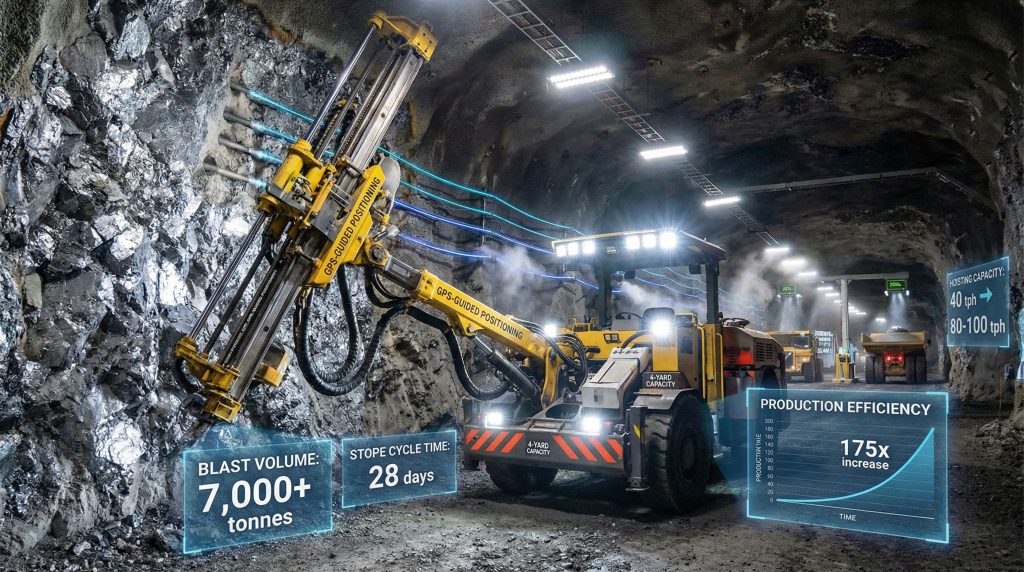
The mechanization of galena mining involves three critical technological components that work in concert to achieve exponential productivity gains. Long-hole drilling systems replace conventional handheld equipment with precision-controlled rigs capable of creating massive blast patterns. Remote-controlled load-haul-dump vehicles eliminate direct worker exposure while maintaining efficient material transport. Enhanced hoisting systems handle the dramatically increased throughput volumes generated by mechanized extraction methods.
Key Performance Indicators for Mechanised Galena Operations
| Metric | Manual Method | Mechanised Method | Improvement |
|---|---|---|---|
| Blast Volume | 30-40 tonnes | 7,000+ tonnes | 175x increase |
| Stope Cycle Time | 12-14 months | 28 days | 93% reduction |
| Cost per Tonne | Baseline | 60% lower | Major efficiency gain |
| Hoisting Capacity | 40 tph | 80-100 tph | 100-150% increase |
The operational scale transformation becomes apparent when examining current mill utilisation metrics. Operations typically process 400-500 tonnes per day against installed mill capacity of 1,150 tonnes per day, representing only 35% utilisation. This massive underutilisation creates embedded operating leverage that mechanisation can unlock without requiring additional mill infrastructure investment.
Modern galena mine mechanization addresses multiple operational constraints simultaneously rather than targeting individual bottlenecks. The integration of automated drilling, loading, and hoisting systems creates a multiplicative effect on productivity that exceeds the sum of individual component improvements. Additionally, these advances align with broader industry evolution trends shaping the mining sector.
When big ASX news breaks, our subscribers know first
How Does Long-Hole Stoping Technology Work in Galena Mines?
Long-hole stoping technology revolutionises underground extraction through precision-controlled drilling patterns that create optimised blast zones within ore bodies. Unlike conventional methods requiring extensive manual labour and smaller-scale operations, mechanised systems employ computer-controlled drilling rigs to establish parallel hole configurations across entire stope faces.
The drilling methodology incorporates several sophisticated techniques:
- Fan drilling patterns: Multiple holes originate from single setup points to maximise coverage
- Calculated hole spacing: Precise intervals determined by ore hardness and fragmentation requirements
- Sequenced blast timing: Controlled detonations optimise rock breakage while minimising overbreak
- Remote detonation protocols: Eliminate worker exposure during explosive operations
Equipment Specifications for Mechanised Galena Extraction
Primary Drilling Equipment:
- Hydraulic drill rigs with 4-6 meter drilling capacity enabling deep penetration
- Automated rod handling systems for continuous operation without manual intervention
- GPS-guided positioning systems ensuring precise hole placement accuracy
- Integrated dust suppression systems maintaining air quality compliance standards
Material Handling Systems:
- 4-yard capacity LHD units for primary loading operations
- 2-yard LHDs designated for secondary cleanup operations
- 20-ton haul trucks for efficient transport to hoisting stations
- Automated weighing systems providing real-time production tracking data
The transformation from 30-40 tonne manual blasts to 7,000 tonne mechanised extractions represents a fundamental shift in mining scale and complexity. This 175-fold increase in blast volume requires corresponding upgrades throughout the entire material handling chain, from initial loading through final hoisting to surface processing facilities.
Mechanised drilling systems achieve superior fragmentation control compared to manual methods. Computer-controlled parameters ensure consistent hole spacing and blast timing, resulting in more uniform rock breakage that optimises downstream processing efficiency. The precision drilling capability reduces ore dilution by minimising waste rock inclusion during extraction. These systems integrate seamlessly with data-driven operations that enable real-time performance monitoring.
What Are the Economic Benefits of Mechanised Galena Mining?
Mechanisation delivers transformational economic advantages through multiple channels that compound to create substantial operational improvements. Labor productivity enhancements, capital efficiency gains, and operational cost reductions combine to reshape the fundamental economics of underground galena extraction.
Labour Productivity Transformation:
Traditional galena mining requires extensive manual drilling crews for each stope, with extraction cycles spanning 12-14 months of continuous labour input. Mechanised systems reduce direct labour requirements by approximately 70% while simultaneously increasing output volumes by orders of magnitude. This productivity multiplication enables the same workforce to generate dramatically higher production rates.
Capital Efficiency Metrics:
- Accelerated revenue realisation: 28-day cycles versus 12-14 month cycles improve cash flow timing
- Enhanced asset utilisation: Mill capacity utilisation increases from 35% toward potential 100%
- Optimised working capital: Shorter production cycles reduce capital tied up in work-in-progress inventory
Industry Insight: Mechanised operations typically achieve payback periods of 18-24 months on equipment investments, compared to 4-6 years for conventional expansion programs.
Cost Structure Analysis: Manual vs. Mechanised Operations
| Cost Category | Manual Operations | Mechanised Operations | Variance |
|---|---|---|---|
| Direct Labour | $45-60/tonne | $18-25/tonne | -58% to -62% |
| Equipment Maintenance | $8-12/tonne | $15-20/tonne | +67% to +88% |
| Energy Consumption | $12-15/tonne | $10-13/tonne | -13% to -17% |
| Total Operating Cost | $65-87/tonne | $43-58/tonne | -34% to -38% |
The economic transformation extends beyond simple cost reduction to include revenue acceleration through cycle compression. Under conventional methods, metal from a stope reaches the mill 12-14 months after capital commitment, while mechanised cycles deliver ore within 28 days. This acceleration significantly improves net present value calculations by advancing cash flow realisation.
Fixed Cost Absorption Benefits:
Mill operations carry substantial fixed costs including maintenance, depreciation, and overhead that currently distribute across relatively low throughput volumes. As mechanisation increases production toward nameplate capacity, these fixed expenses spread across greater tonnage, reducing the fixed component of all-in sustaining costs per unit produced.
The antimony byproduct economics demonstrate additional value creation opportunities. Antimony production carries negligible incremental extraction costs since the ore requires mining regardless of antimony recovery. This creates a pure margin enhancement as antimony revenue accrues without proportional cost allocation to that specific mineral stream. Modern AI-powered efficiency solutions further amplify these cost advantages.
How Do Hoisting System Upgrades Support Mechanised Production?
Hoisting infrastructure represents the critical bottleneck constraining underground mechanised operations from achieving their full potential. Traditional systems designed for manual mining volumes cannot accommodate the material flows generated by mechanised extraction without creating severe production limitations.
Technical Specifications for Modern Galena Hoisting:
- Enhanced motor capacity: Upgraded from 1,750 hp to 2,250 hp systems providing 28.6% power increase
- Expanded skip capacity: Increased payload handling for full loads from deepest operational levels
- Accelerated cycle speed: Enhanced from 690 fpm to 1,200-1,400 fpm for rapid material movement
- Automation integration: Computer-controlled scheduling and load optimisation systems
Hoisting Bottleneck Resolution Strategy
The phased upgrade approach addresses production constraints while maintaining operational continuity throughout the transition period:
Phase 1 Implementation:
- Primary motor replacement and power system upgrades providing immediate capacity enhancement
- Skip weighing systems enabling load optimisation and production tracking
- Backup motor installation ensuring operational redundancy during peak production periods
Phase 2 Completion:
- Hoist pad modifications facilitating faster cycle times and improved efficiency
- Advanced braking systems supporting higher-speed operations with enhanced safety protocols
- Communication infrastructure enabling remote monitoring and operational oversight
The hoisting capacity increase from 40 tonnes per hour to 80 tonnes per hour directly addresses the production ceiling created by 7,000-tonne mechanised blasts. Without corresponding hoist improvements, mechanised extraction systems would operate at maximum efficiency while ore accumulates at the shaft collar, negating productivity gains through material handling bottlenecks.
Performance Enhancement Results:
The doubled skipping speed eliminates queuing delays and enables continuous ore flow from extraction points to surface processing facilities. This improvement maintains the mechanised system's rapid 28-day cycle times by ensuring material handling keeps pace with extraction rates. Similarly, enhanced haulage safety protocols demonstrate how mechanisation improves operational reliability.
What Role Does Automation Play in Modern Galena Mining?
Automation technologies extend beyond basic mechanisation to encompass comprehensive operational management systems that optimise performance through real-time monitoring, predictive maintenance protocols, and adaptive operational parameters.
Core Automation Components:
- HMI touchscreen controls: Centralised operation management enabling coordinated equipment control
- Real-time monitoring systems: Continuous equipment performance tracking with immediate anomaly detection
- Remote access capabilities: Off-site operational oversight enabling rapid response to changing conditions
- Automated optimisation: Self-adjusting parameters responding to ore conditions and equipment performance
Safety Integration in Mechanised Systems
Mechanised galena mining incorporates multiple safety layers that significantly reduce worker exposure to hazardous conditions:
- Remote-controlled equipment operation eliminates worker presence in active blast zones
- Automated ventilation systems maintain optimal air quality standards throughout underground workings
- Real-time gas monitoring with automatic shutdown protocols prevents personnel exposure to dangerous atmospheres
- Emergency communication systems throughout underground workings enable rapid response coordination
The remote-controlled LHD equipment exemplifies automation safety integration by enabling operators to position loading equipment without physical presence in dust-generating or potentially unstable areas. This technological advancement materially reduces occupational exposure and injury risk compared to manual loading methods.
Operational Optimisation Through Automation:
Automated systems continuously adjust operational parameters based on real-time conditions rather than relying on periodic manual adjustments. This responsiveness optimises equipment performance, reduces wear rates, and maximises productive time through predictive maintenance scheduling that addresses potential issues before they cause operational disruptions.
How Does Mechanisation Impact Galena Ore Processing Efficiency?
Mechanised extraction produces significantly more consistent ore fragmentation patterns, directly improving downstream processing efficiency through enhanced mill throughput and recovery rates. Controlled blasting parameters reduce oversize material generation while minimising fine particle creation, optimising material flow through processing circuits.
Processing Advantages:
- Consistent feed size distribution: Reduces crusher wear and energy consumption requirements
- Improved mineral liberation: Enhanced mineral exposure optimises flotation process performance
- Higher throughput capacity: Steady material supply enables continuous mill operation at optimal rates
- Enhanced quality control: Automated sampling systems provide superior grade control data accuracy
Mill Utilisation Optimisation
| Utilisation Level | Daily Throughput | Annual Production | Capacity Constraint |
|---|---|---|---|
| Current (35%) | 400-500 tonnes | 146,000-183,000 tonnes | Mining rate |
| Target (75%) | 850-900 tonnes | 310,000-328,000 tonnes | Hoisting capacity |
| Maximum (100%) | 1,150 tonnes | 420,000 tonnes | Market demand |
The mechanised fragmentation control delivers ore with superior size consistency, reducing variability that can disrupt mill operations. Uniform particle size distribution improves flotation kinetics and recovery rates while reducing energy consumption in grinding circuits.
Grade Control Enhancement:
Mechanised mining enables more precise ore-waste boundary control through systematic drilling patterns and controlled blasting. This precision reduces dilution rates and improves head grades delivered to the mill, directly enhancing revenue per tonne processed.
The 490 grams per tonne silver head grade positions this operation as the third-highest-grade silver mine globally, making efficient processing critical to maximising value recovery. Mechanised extraction methods preserve this high-grade characteristic through reduced dilution and improved selectivity.
The next major ASX story will hit our subscribers first
What Are the Technical Challenges in Galena Mine Mechanisation?
Mechanisation implementation encounters several technical obstacles specific to galena ore characteristics and underground operational constraints that require specialised solutions and careful planning.
Geological Considerations:
- Ore hardness variability: Requires adjustable drilling parameters to accommodate changing rock conditions
- Structural complexity: Faulting and folding patterns affect blast design and fragmentation outcomes
- Water management: Increased production volumes generate proportionally higher mine water flows
- Ground stability: Larger extraction voids require enhanced support systems and monitoring protocols
Equipment Integration Challenges:
- Space constraints: Underground dimensions limit equipment size and manoeuvrability options
- Ventilation requirements: Increased diesel equipment operation demands enhanced airflow capacity
- Maintenance accessibility: Remote underground locations complicate service operations and parts delivery
- Power distribution: Higher electrical demands require substantial infrastructure upgrades
The transition from manual to mechanised systems creates temporary operational complexity as crews adapt to new equipment and procedures. Training requirements increase substantially, and initial productivity may decline during learning curve periods. Furthermore, major global operations demonstrate that successful mechanisation requires comprehensive workforce development.
Infrastructure Adaptation Requirements:
Existing underground infrastructure designed for manual operations requires significant modifications to accommodate mechanised equipment. Tunnel dimensions, electrical capacity, and ventilation systems need upgrading to support larger equipment and higher production rates.
How Do Environmental Factors Influence Mechanised Galena Operations?
Environmental compliance becomes increasingly complex with mechanised operations due to the increased scale and intensity of mining activities, requiring comprehensive mitigation strategies and monitoring systems.
Key Environmental Considerations:
- Dust generation: Mechanised operations produce substantially more airborne particulates requiring control measures
- Noise levels: Equipment operation increases underground and surface sound levels affecting nearby communities
- Energy consumption: Higher power requirements impact carbon footprint and energy management strategies
- Waste rock management: Increased production generates proportionally more waste material requiring disposal
Mitigation Strategies for Environmental Impact
- Advanced dust suppression: Comprehensive water spray systems and enhanced ventilation improvements
- Noise control measures: Equipment enclosures and optimised operational scheduling to minimise disturbance
- Energy efficiency programs: Variable frequency drives and equipment operation optimisation to reduce consumption
- Waste minimisation: Selective mining techniques and improved ore-waste separation to reduce disposal volumes
Environmental monitoring systems require upgrading to handle increased production volumes and associated environmental loads. Real-time monitoring becomes essential for maintaining compliance with regulatory standards while optimising operational efficiency.
What Future Technologies Will Advance Galena Mine Mechanisation?
Emerging technologies promise substantial further improvements in mechanised galena mining efficiency, safety, and operational optimisation through artificial intelligence, autonomous systems, and advanced sensor technologies.
Next-Generation Developments:
- Autonomous equipment: Fully automated LHDs and haul trucks operating without direct human control
- AI-powered optimisation: Machine learning algorithms for blast design and production scheduling
- Digital twin technology: Virtual mine models enabling advanced operational planning and scenario modelling
- Advanced sensor systems: Real-time ore grade analysis during extraction for immediate decision-making
Implementation Timeline for Advanced Technologies
| Technology | Development Stage | Commercial Availability | Implementation Cost |
|---|---|---|---|
| Autonomous LHDs | Pilot testing | 2026-2027 | High ($2-5M per unit) |
| AI Blast Optimisation | Early adoption | 2025-2026 | Medium ($500K-1M) |
| Digital Twin Systems | Mature technology | Available now | Medium ($1-3M) |
| Real-time Grade Control | Field testing | 2025-2026 | High ($3-7M) |
The convergence of these technologies will create synergistic effects that exceed individual component benefits. Autonomous equipment operating within AI-optimised parameters while providing real-time grade data to digital twin models will enable unprecedented operational efficiency and resource utilisation.
Predictive Maintenance Evolution:
Future mechanised systems will incorporate machine learning algorithms that predict equipment failures before they occur, enabling proactive maintenance scheduling that minimises operational disruptions. These systems will analyse vibration patterns, temperature fluctuations, and performance metrics to optimise maintenance timing and reduce unplanned downtime.
Frequently Asked Questions About Galena Mine Mechanisation
What is the typical payback period for galena mine mechanisation investments?
Mechanisation projects typically achieve payback within 18-24 months due to significant operational cost reductions and increased production volumes. The exact timeline depends on ore grade characteristics, equipment costs, and operational scale factors.
How does mechanisation affect employment in galena mining operations?
While mechanisation reduces direct mining labour by 60-70%, it creates new positions in equipment operation, maintenance, and technical support roles. The net employment impact varies by operation size and local labour market conditions, often resulting in higher-skilled job creation.
What are the main technical risks in galena mine mechanisation projects?
Primary risks include equipment integration challenges, geological uncertainties affecting blast performance, and operational learning curves during transition periods. Proper planning and phased implementation help mitigate these risks through systematic risk management approaches.
How does mechanised galena mining compare to other underground mining methods?
Mechanised long-hole stoping offers superior productivity compared to cut-and-fill or shrinkage stoping methods, but requires higher capital investment and more complex planning. The method works optimally in competent rock with regular ore body geometry.
What maintenance requirements come with mechanised galena mining equipment?
Mechanised equipment requires specialised maintenance programs including hydraulic system servicing, electronic component calibration, and wear part replacement schedules. Maintenance costs typically represent 15-20% of total operating expenses but provide substantial reliability improvements.
Disclaimer: This article contains forward-looking statements and projections about mining operations and technology implementation. Actual results may vary significantly from forecasts due to operational, geological, market, and technological factors. Investors should conduct independent research and consult qualified professionals before making investment decisions.
Looking to Capitalise on Mining Technology Advancements?
Discovery Alert's proprietary Discovery IQ model delivers instant notifications when ASX-listed mining companies announce significant operational breakthroughs and technological implementations that could drive substantial share price movements. Stay ahead of mechanisation trends and mining efficiency developments by exploring Discovery Alert's discoveries page, which showcases historic examples of how major mining announcements have generated exceptional market returns for early investors.