June 16, 2026
The Geopolitics of Gallium: Why One Western Australian Project Is Drawing Serious Attention
Few metals sit at a more precarious intersection of technology dependency and geopolitical fragility than gallium. While lithium and cobalt dominate headlines in the critical minerals conversation, gallium quietly underpins some of the most consequential technologies of the current decade: the power transistors inside electric vehicle chargers, the radar systems aboard next-generation fighter aircraft, the high-efficiency chips managing heat inside AI data centres, and the compound semiconductors enabling 5G infrastructure. Without gallium, these technologies either don't exist or become dramatically less efficient.
Understanding that context is essential before examining what the Western Yilgarn Cardea 1 gallium discovery actually represents, both geologically and strategically.
When big ASX news breaks, our subscribers know first
Why Gallium's Supply Picture Is More Alarming Than Most Investors Realise
Gallium is not a rare element in the earth's crust, but it is extraordinarily rare in a commercially concentrated form. It does not form its own ore deposits in any meaningful quantity. Instead, it occurs as a trace constituent within bauxite, zinc sphalerite, and coal fly ash, recovered almost exclusively as a byproduct of processing those primary commodities. This byproduct dependency means gallium supply is inherently constrained by the production economics of other industries, not its own market dynamics.
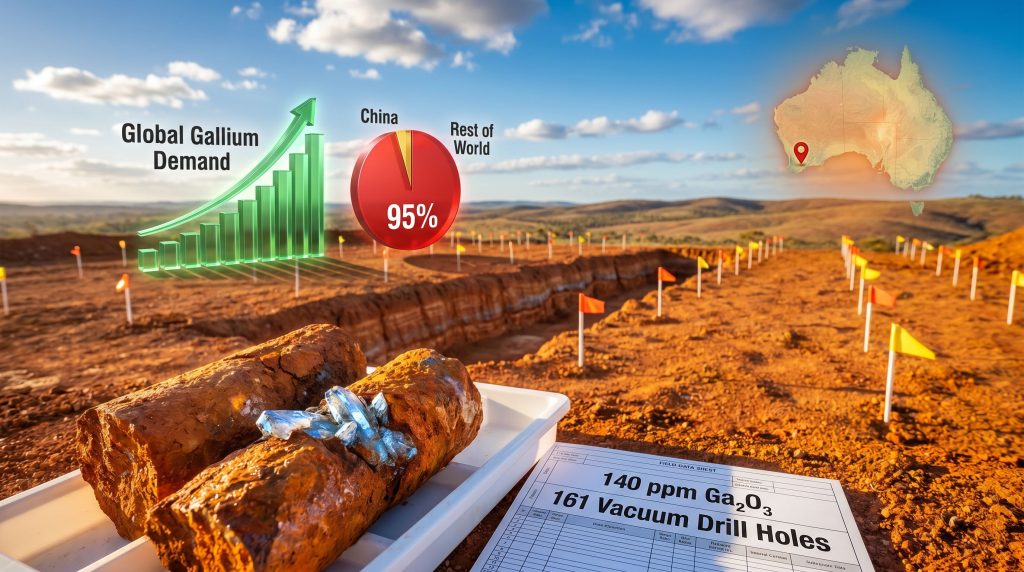
China recognised this structural quirk decades ago and built an integrated alumina refining and gallium recovery industry that now accounts for more than 95% of global raw gallium production. No other country comes remotely close to matching that share. When China introduced export restriction measures on gallium in August 2023, tightening them further through 2024 and 2025, technology manufacturers across the United States, Europe, Japan, and South Korea were confronted with an uncomfortable reality: their supply chains for a non-substitutable semiconductor input ran almost entirely through a single country.
The response from Western governments has been to formally list gallium as a critical mineral requiring domestic supply chain development. Australia's critical minerals list includes gallium, alongside the United States, the European Union, and Japan, all of which have taken this step. In Australia's case, gallium's inclusion provides access to government support mechanisms including potential co-investment pathways through Export Finance Australia's Critical Minerals Facility, though any specific project-level support depends on individual applications and assessments.
The structural reality is stark: gallium's supply risk is not a future scenario. It is an active constraint operating right now on some of the world's most important technology supply chains. Any credible new discovery in a politically stable, mining-friendly jurisdiction carries strategic weight that far exceeds what resource size alone would suggest.
What Makes the Darling Range Geologically Suited to Gallium Mineralisation
The geological setting of the Western Yilgarn Cardea 1 gallium discovery is not coincidental. Western Australia's Darling Range hosts one of the world's great lateritic bauxite provinces, feeding major alumina refineries that collectively process tens of millions of tonnes of bauxite annually. The reason this matters for gallium is rooted in geochemistry.
During the lateritisation process, prolonged tropical and subtropical weathering breaks down primary aluminium-bearing silicate minerals and reconcentrates aluminium hydroxides in near-surface horizons. Gallium, which sits directly below aluminium on the periodic table and shares nearly identical ionic radius and charge characteristics, behaves geochemically like aluminium during this process. It substitutes for aluminium within the crystal lattice of gibbsite, boehmite, and diaspore, the principal aluminium hydroxide minerals in bauxite. The result is that wherever lateritic bauxite concentrates, gallium concentrates alongside it.
This means the Darling Range was always a geologically logical target for gallium deposits exploration. What has changed is the economic and geopolitical context that makes exploring for gallium in bauxite provinces worthwhile as a primary objective rather than a secondary consideration.
The Cardea 1 Project: Location and Geological Setting
Cardea 1 is situated within the Central Bindoon area of the Darling Range, a region already established within Western Australia's premier bauxite province. The mineralisation at Cardea 1 is hosted within shallow lateritic and bauxitic surface units, occupying the same weathered horizons that characterise commercial bauxite across the broader Darling Range system.
The project's location within an established bauxite province is operationally significant. Existing land tenure frameworks, infrastructure corridors, and processing facilities in the region reduce the sovereign risk and logistical complexity that greenfield critical minerals projects in undeveloped jurisdictions typically face.
Breaking Down the Re-Assaying Program and What It Found
The methodology underpinning the Cardea 1 results deserves careful explanation, because it differs substantially from a conventional drilling campaign and carries specific implications for how the results should be interpreted.
Rather than conducting a new drilling program, the company re-assayed drill pulps from 161 vacuum drill holes that had previously been collected for bauxite evaluation. Vacuum drilling is a dry, air-powered technique particularly well-suited to shallow lateritic systems, where the unconsolidated to semi-consolidated nature of the weathered profile makes conventional rotary or core drilling unnecessarily expensive. The drill pulps, essentially the fine material collected during drilling, were retained from the original bauxite program and then submitted for gallium analysis.
This re-assaying approach is a genuinely cost-efficient first-pass screening methodology. It extracts maximum informational value from existing sample material without the capital outlay of a new drilling campaign. However, it cannot replace systematic resource-definition drilling, which requires tighter hole spacing and more rigorous sampling protocols to meet JORC reporting standards. Furthermore, interpreting drill results at this stage requires careful consideration of what first-pass data can and cannot confirm.
The results from this program were as follows:
| Metric | Result |
|---|---|
| Drill holes re-assayed | 161 vacuum drill holes |
| Depth of mineralisation | Surface to approximately 7 metres |
| Peak gallium oxide grade | Exceeding 140 ppm |
| Typical high-grade intersections | 80 to 100 ppm gallium oxide |
| Typical intersection thickness | 2 to 4 metres |
| Mineralisation style | Laterally extensive, multi-zone |
Putting the Grades in Context
One of the less commonly understood aspects of gallium economics is that the metal is already commercially recovered from bauxite feed at grades of roughly 50 to 100 ppm in operating Chinese alumina refineries using the Bayer process. The Bayer process, which dissolves aluminium hydroxide minerals in hot caustic soda, simultaneously dissolves gallium into the process liquor. Gallium is then selectively extracted from this liquor using solvent extraction or electrodeposition techniques.
The significance of Cardea 1 returning peak grades exceeding 140 ppm gallium oxide and consistent intersections of 80 to 100 ppm is that the project's mineralisation sits at or above the grade range at which gallium is already commercially recovered as a Bayer process byproduct in China. This does not automatically make Cardea 1 economic, but it does mean the grades are not marginal relative to existing production benchmarks.
Importantly, gallium grades in lateritic systems are typically reported in ppm of gallium or gallium oxide, not as a percentage. A grade of 100 ppm gallium oxide translates to roughly 76 ppm elemental gallium, reflecting the oxygen content of the oxide form. Investors unfamiliar with this convention sometimes misinterpret ppm gallium oxide figures, so understanding the distinction matters.
The Strategic Case for Shallow Lateritic Gallium Systems
The depth profile of Cardea 1's mineralisation is one of its most commercially relevant characteristics. Mineralisation from surface to approximately 7 metres depth sits firmly within the domain of bulk mechanical surface mining methods. Strip ratios at this depth are low, and the capital intensity of mining is substantially reduced compared to deeper open-pit or underground operations.
This shallow geometry also has implications for processing. Lateritic gallium mineralisation of this type is amenable to hydrometallurgical extraction using alkaline leach chemistry, the same chemical principle that underlies the Bayer process. If the Cardea 1 material can be processed through a modified Bayer-type circuit, the project could potentially leverage proximity to existing alumina processing infrastructure in Western Australia's southwest, reducing the capital burden of standalone processing facilities.
The dual-commodity framing of Cardea 1 as both a bauxite production asset and a gallium-bearing critical minerals asset reflects this processing logic. If bauxite is the primary product and gallium is recovered as a high-value byproduct from the Bayer liquor, the economics of gallium extraction are effectively subsidised by alumina revenue. This is precisely the model that has made China's gallium production commercially viable for decades.
Gallium's End-Use Sectors and Why Demand Is Accelerating
| End-Use Sector | Gallium Compound | Key Application |
|---|---|---|
| Compound semiconductors | Gallium arsenide (GaAs) | High-frequency RF chips, solar concentrators |
| Power electronics | Gallium nitride (GaN) | EV chargers, data centre power conversion |
| Defence and aerospace | GaAs and GaN | Radar systems, electronic warfare |
| AI infrastructure | GaN | High-efficiency power delivery modules |
| Solid-state lighting | Gallium phosphide (GaP) | LED and photonic devices |
GaN semiconductors in particular have seen explosive adoption growth driven by the global buildout of AI computing infrastructure. High-efficiency GaN power transistors reduce energy losses in data centre power delivery systems, a critical consideration as AI workloads drive electricity consumption at hyperscale facilities to unprecedented levels. Every major semiconductor fabricator developing next-generation power devices has GaN at the centre of their roadmap, creating a structural demand pull for gallium that was not present even five years ago.
What Lateral Continuity Actually Means for Resource Potential
One of the more technically significant findings from the Cardea 1 re-assaying program is the lateral continuity of gallium mineralisation between adjacent drill holes. This is not a trivial observation. In lateritic systems, mineralisation can be patchy and discontinuous, particularly where the original parent rock composition varies or where erosion has removed portions of the weathered profile.
The presence of continuity between adjacent holes at Cardea 1 suggests the mineralised horizon is broadly preserved across the project area, rather than representing isolated pockets of enrichment. Anomalous gallium values in drill holes outside the primary highlighted zones further support the interpretation that the mineralised footprint extends beyond the currently defined target areas.
For resource estimation purposes, lateral continuity is a prerequisite for demonstrating geological confidence. Without it, grade continuity assumptions in a JORC-compliant resource model cannot be supported. The Cardea 1 results, while still at first-pass stage, provide a meaningful foundation for the geological confidence argument that resource-definition drilling would need to substantiate. As reported by Kalkine Media, the high-grade nature of these findings has drawn wider market attention to the project's potential.
The next major ASX story will hit our subscribers first
The Pathway from Exploration Results to Resource Definition
The re-assaying program represents the beginning of a structured exploration and development sequence, not its conclusion. The logical progression involves:
- Systematic infill drilling at resource-definition spacing to establish grade and thickness continuity across the project area
- Metallurgical testwork to determine gallium extraction efficiency from Cardea 1's specific lateritic material using hydrometallurgical methods
- 3D geological modelling to characterise the geometry and grade distribution of the mineralised system
- JORC-compliant resource estimation to formally quantify the gallium inventory under internationally recognised reporting standards
- Preliminary economic assessment to evaluate project economics across a range of development scenarios, including standalone gallium processing and integrated bauxite-alumina-gallium models
- Environmental and permitting baseline studies to support any future development application
Important Disclaimer: The current Cardea 1 results are exploration-stage findings only. Economic viability has not been established. Grade continuity, metallurgical recovery rates, processing costs, infrastructure requirements, permitting outcomes, and gallium market conditions will all be critical determinants of whether this project advances beyond exploration. Investors should treat exploration-stage results as indicative only and conduct their own due diligence before making investment decisions.
Western Yilgarn's Portfolio Approach to Gallium in Western Australia
Cardea 1 sits within a broader Western Australian gallium exploration portfolio that also includes activity at Ida Holmes Junction and other prospects across the state's lateritic terrains. A multi-project approach to early-stage gallium exploration is strategically rational: it distributes geological risk across multiple targets and increases the probability that at least one asset will demonstrate the grade, continuity, and metallurgical characteristics required to advance toward resource definition.
This portfolio-level thinking reflects a broader maturation of investor and company awareness around gallium as a standalone exploration target, rather than simply an incidental constituent of bauxite deposits. The shift in perspective, driven directly by China's export restriction policies and the resulting scramble for alternative supply, has created genuine commercial motivation to systematically evaluate gallium prospectivity in bauxite-hosting geological environments worldwide.
Western Australia, with its world-class bauxite provinces, established mining infrastructure, stable regulatory environment, and formal critical minerals policy framework, is among the most credible jurisdictions globally for this type of exploration. The Western Yilgarn Cardea 1 gallium discovery is one of the more substantive early demonstrations of what that prospectivity might translate to in practice, though the journey from first-pass re-assaying results to a producing mine remains long, uncertain, and capital-intensive.
The next twelve to eighteen months of work at Cardea 1, particularly the metallurgical testwork and infill drilling programs, will be the true test of whether the project's geological promise translates into economic substance.
This article is intended for informational purposes only and does not constitute financial advice. All forward-looking statements involve risk and uncertainty. Past exploration results are not necessarily indicative of future outcomes. Readers should consult a qualified financial adviser before making investment decisions related to mining or exploration companies.
Want to Be First When the Next Critical Mineral Discovery Hits the ASX?
Discovery Alert's proprietary Discovery IQ model delivers real-time alerts on significant ASX mineral discoveries — including critical minerals like gallium — instantly translating complex exploration data into actionable insights for investors at every level; explore historic discoveries and their returns, then start your 14-day free trial at Discovery Alert to position yourself ahead of the broader market.