July 21, 2026
The Ownership Question That Could Define Natural Diamonds for a Generation
Few commodity markets carry as much symbolic weight as natural diamonds. For more than a century, the value of a mined stone has rested not just on its physical scarcity but on a carefully constructed cultural narrative, one that required as much investment in consumer psychology as in geological extraction. The institution most responsible for maintaining that narrative is now changing hands, and the identity of its next owner may determine whether natural diamonds reclaim their commercial primacy or continue losing ground to laboratory-grown alternatives.
The Gareth Penny bid for De Beers has emerged as the focal point of one of the most consequential corporate transactions in the global mining industry in years. Understanding why requires looking beyond the financial mechanics of an acquisition and into the structural pressures reshaping the diamond market from multiple directions simultaneously.
When big ASX news breaks, our subscribers know first
De Beers as a System, Not Just a Mining Company
What separates De Beers from virtually every other resource producer on earth is its dual obligation. It must extract diamonds from the ground efficiently and at competitive cost, while simultaneously convincing the world's consumers that those diamonds are worth paying a premium for. Most mining companies focus entirely on the supply side of the equation. De Beers has never had that luxury.
This dual mandate is embedded in the company's commercial architecture. The Sightholder system, through which De Beers allocates rough diamonds to a curated group of approved buyers across ten annual sales events, is not simply a distribution mechanism. It is a supply management tool that has historically allowed the company to defend price floors during downturns by restricting the volume of stones reaching the market.
When the system functions with discipline, it buffers the diamond market against the worst volatility. When it breaks down, or when the company lacks the financial capacity to hold inventory off the market, prices can deteriorate sharply. Understanding this mechanism is critical context for evaluating the current sale process. Any incoming owner inherits not just mines and brand equity, but a complex supply chain governance role that has no equivalent in other mining sectors.
Why Anglo American Is Exiting
Anglo American's decision to divest De Beers, announced in May 2024, reflected a deliberate pivot toward commodities it considers better aligned with long-term structural demand growth, particularly copper. The logic was straightforward: in an era of energy transition, electrification, and infrastructure buildout, copper demand has identifiable industrial tailwinds. Diamond demand, by contrast, depends heavily on consumer sentiment, luxury spending cycles, and the durability of cultural traditions around engagement rings and gifting.
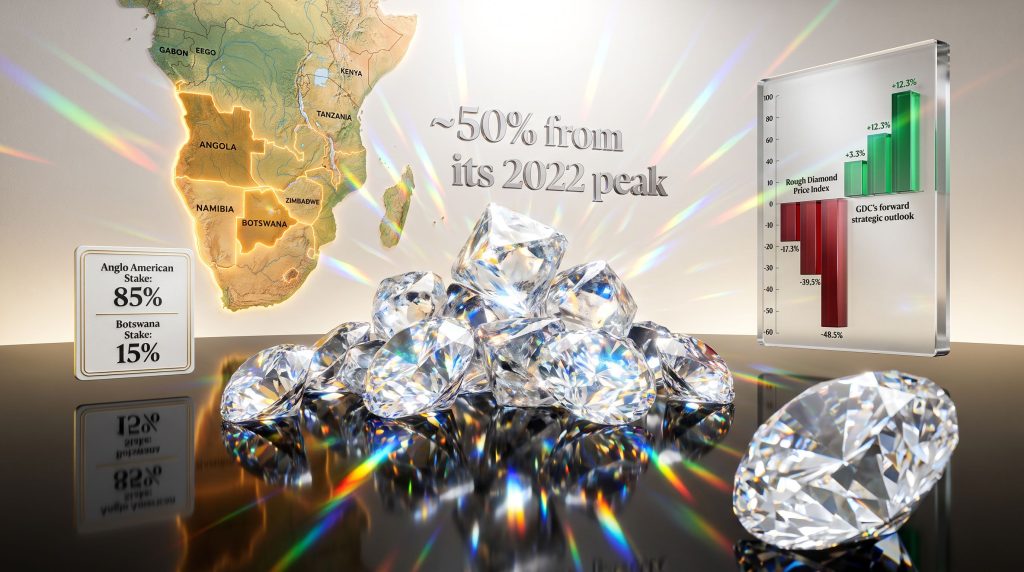
Anglo currently holds an 85% stake in De Beers, with Botswana's government owning the remaining 15%. The formal bid deadline passed on April 16, 2026, and transaction completion is targeted for the end of 2026, subject to regulatory approvals and alignment with sovereign stakeholders.
The timing of the sale is notable. De Beers is being sold into one of the weakest pricing environments the diamond sector has experienced in decades. The rough diamond price index tracked by WWW International Diamond Consultants has declined approximately 50% from its 2022 peak, driven by two converging forces: a sustained pullback in luxury spending across China, and the rapid commoditisation of lab-grown diamonds, which are now available to retail consumers at a fraction of the cost of mined equivalents. These China demand pressures have had far-reaching consequences across multiple resource sectors, not just diamonds.
| Key Transaction Metric | Detail |
|---|---|
| Anglo American Stake | 85% |
| Botswana Government Stake | 15% |
| Rough Diamond Price Decline (from 2022 peak) | ~50% |
| Formal Bid Deadline | April 16, 2026 |
| Expected Deal Completion | End of 2026 |
| Botswana's Share of De Beers Diamond Output | ~70% |
Three Bidders, Three Philosophies
The competitive process for De Beers attracted three distinct bidding groups, each representing a fundamentally different thesis about what the company is and how it should be run.
- The Global Diamond Consortium (GDC), led by Gareth Penny, combines midstream trading expertise through Antwerp-based firms Diarough and Pluczenik with envisaged sovereign equity participation from Angola and Namibia.
- The Livnat Consortium, led by Nir Livnat, executive chair of the Diacore Group, draws on established Israeli diamond industry capital with a focus on midstream efficiency and trading relationships.
- The O'Keeffe Consortium, led by Michael O'Keeffe, non-executive chair of Burgundy Diamond Mines, represents an Australian mining operator perspective oriented around operational rationalisation.
Reports from Rapaport citing Bloomberg sources indicate that the Iran conflict materially disrupted rival consortia's ability to secure financing, creating a structural financing advantage for the GDC. Botswana's Minister for State and Defence, Moeti Mohwasa, confirmed to the country's lawmakers that the GDC had been identified as Anglo American's preferred bidder, representing the first official sovereign-level acknowledgment of the deal's direction. Anglo itself declined to confirm the minister's remarks publicly, stating only that it continues to manage a competitive process.
Why Gareth Penny Stands Apart
Institutional Memory and Operational Experience
The Gareth Penny bid for De Beers carries a dimension that no competing offer can replicate: direct institutional memory. Penny served as De Beers CEO from 2006 to 2010, a period that included navigating the global financial crisis and its impact on diamond demand. His tenure gave him firsthand understanding of the company's sovereign relationships, its internal production economics, and critically, the mechanics of demand creation at a global scale.
Independent diamond analyst Paul Zimnisky, writing for MINING.COM, described Penny as someone who genuinely understands that generating consumer demand for natural diamonds must be treated as a strategic priority, not a secondary function. Zimnisky noted that De Beers occupies a unique position among mining companies precisely because it must invest in marketing its own product category, not just its brand, and that this obligation intensifies during market downturns when the economic case for natural diamonds needs active reinforcement.
The Demand Creation Challenge
This perspective points to a widely underappreciated dynamic in the diamond industry. Unlike gold, which benefits from deeply embedded cultural and financial traditions across multiple civilisations, the modern consumer diamond market was substantially constructed through deliberate marketing campaigns. The famous association between diamonds and romantic commitment was not an organic cultural evolution but a product of sustained, industry-funded demand creation, much of it originating from De Beers itself.
Sustaining and rebuilding that narrative in a world where laboratory-grown stones are chemically identical to mined diamonds at a fraction of the price represents perhaps the most difficult strategic challenge facing any incoming owner.
Botswana's Role Is More Than Symbolic
Botswana is the source of approximately 70% of De Beers' total diamond production, primarily from the Jwaneng and Orapa mines operated through Debswana, a 50-50 joint venture between De Beers and the Botswana government. This concentration of production in a single sovereign jurisdiction gives Botswana leverage that goes well beyond its 15% equity stake in De Beers itself.
The government has been consistent in signalling its desire to increase ownership participation as the ownership transition unfolds. Any deal structure that fails to accommodate Botswana's ambitions risks creating an unstable operating relationship at the foundation of De Beers' production base. Furthermore, the broader geopolitical mining landscape has shifted considerably, making sovereign alignment a critical factor in any major resource transaction.
The GDC's architecture, which envisages equity participation from Angola and Namibia alongside Botswana's existing stake, reflects a deliberate attempt to reframe the acquisition as an African-led consolidation rather than an external corporate takeover. This framing carries both strategic and political logic. For African producer nations that have historically seen the proceeds of their geological endowments flow predominantly to foreign corporate shareholders, a meaningful equity stake in the world's largest diamond producer represents a qualitatively different economic relationship.
Zimnisky observed that aligning producer governments with commercial leadership creates a coalition of advocates with genuine economic stakes in the natural diamond market's recovery, describing the combination of operational leadership, trading expertise, and sovereign participation as a constructive foundation for De Beers' next chapter.
The next major ASX story will hit our subscribers first
The Lab-Grown Diamond Challenge: Structural, Not Cyclical
One of the most consequential and underappreciated shifts in the diamond market over the past decade has been the reclassification of lab-grown diamonds from novelty to mainstream. Chemical vapour deposition (CVD) and high-pressure high-temperature (HPHT) production methods have advanced to the point where laboratory-grown stones are now physically and chemically indistinguishable from mined diamonds without specialist equipment.
The price differential has widened dramatically. Lab-grown stones that sold at modest discounts to natural equivalents in 2018 are now available at discounts exceeding 80% in some size and quality categories. This compression has been most acute among younger consumer demographics who engage most actively with price comparison and who are less attached to the historical cultural framing of mined diamonds as uniquely scarce and precious.
Three structural forces are converging to pressure the natural diamond market simultaneously:
- Lab-grown competition driving price compression across retail categories and eroding the perceived scarcity premium of mined stones.
- Chinese demand deterioration removing a growth engine that underpinned the 2020-2022 price supercycle, with luxury spending across China remaining subdued.
- Production rationalisation reflecting the economic reality that current price levels do not support full-capacity operations, with De Beers having already suspended production at South Africa's largest diamond mine.
The Supply-Side Case for De Beers
Paradoxically, the same market conditions that make De Beers a challenging acquisition also strengthen its long-term competitive position relative to smaller producers. The relationship between commodity prices and mining performance is rarely straightforward, and the diamond sector illustrates this complexity particularly well. Independent diamond miners have exited the market in significant numbers as price compression made their operations economically unviable.
Russian diamond production, which historically represented a major supply source through ALROSA, remains constrained by international sanctions following the invasion of Ukraine. These dynamics have improved De Beers' relative share of available rough diamond supply even as absolute demand has weakened.
Zimnisky characterised De Beers' supply-side positioning as genuinely strong, noting that the combination of reduced independent production, Russian sanctions, and De Beers' dominant positions across Botswana, Namibia, South Africa, and Canada creates a concentrated supply advantage that disciplined management could convert into pricing power during any demand recovery.
| Scenario | Ownership Model | Primary Strategic Focus | Likely Market Outcome |
|---|---|---|---|
| GDC Wins (Penny-Led) | Pan-African sovereign + Antwerp traders | Demand regeneration + supply discipline | Stabilising to constructive for natural diamond prices |
| Livnat Consortium Wins | Israeli diamond industry capital | Midstream efficiency + trading network | Neutral to modestly positive |
| O'Keeffe Consortium Wins | Australian mining operator | Operational cost reduction | Neutral; limited demand-side focus |
What New Ownership Must Prioritise
Near-Term Stabilisation
If the Gareth Penny bid for De Beers is ultimately formalised, the incoming management team will face a sequenced set of priorities that cannot be addressed simultaneously with equal intensity. In the near term, stabilising the balance sheet and renegotiating production economics to align output with sustainable price levels will be essential. The suspension of South African mine operations is a symptom of this challenge, not a solution to it.
Medium and Long-Term Strategy
Rebuilding the consumer narrative around natural diamonds is a medium-term imperative. This requires coordinated industry-wide investment in marketing that distinguishes mined stones from laboratory alternatives on dimensions beyond price, including provenance, geological rarity, and the cultural traditions embedded in their extraction from specific African communities and landscapes.
In the longer term, governance alignment with Botswana and any other sovereign co-owners must ensure that production decisions, dividend policies, and reinvestment priorities reflect the shared interests of a multi-stakeholder ownership structure. This kind of mining industry consolidation around sovereign partners represents a growing trend across the broader resources sector. The scale of mining M&A activity across commodities in recent years underscores how consequential ownership transitions can be for long-term market structure.
Investor Note: This article contains forward-looking analysis and scenario projections that involve assumptions about future market conditions, ownership outcomes, and strategic decisions. These projections do not constitute financial advice. Readers should conduct independent research before making any investment decisions related to the companies or commodities discussed.
A Turning Point the Diamond Market Cannot Afford to Waste
The ownership transition at De Beers arrives at a moment when the natural diamond industry's long-term trajectory is genuinely uncertain. The structural case for optimism rests on supply concentration, Russian sanctions, and the historical resilience of cultural demand for mined stones across multiple generations. The structural case for concern rests on lab-grown competition that grows more sophisticated and affordable each year, and on a Chinese consumer market that has not returned to the luxury spending patterns that defined the 2020-2022 price recovery.
What the Gareth Penny bid for De Beers represents, more than anything else, is a bet that the right combination of operational experience, demand-generation commitment, sovereign alignment, and trading expertise can navigate those competing forces more effectively than any alternative ownership structure currently on offer. Whether that bet proves correct will be visible in rough diamond price trajectories, Sightholder allocation volumes, and the cultural staying power of the natural diamond narrative over the next decade.
The institution that once told the world that diamonds are forever is itself being reinvented. The version that emerges from this transaction will carry the weight of that history into a market that looks fundamentally different from anything De Beers has faced in its 130-year existence.
Want to Know Which ASX Mining Discoveries Could Deliver the Next Major Return?
Discovery Alert's proprietary Discovery IQ model scans ASX announcements in real time, instantly identifying significant mineral discoveries and turning complex data into actionable investment insights — the same kind of market-moving events that have historically generated extraordinary returns, as showcased on Discovery Alert's dedicated discoveries page. Start your 14-day free trial today and position yourself ahead of the broader market.