
July 13, 2026
When Neighbouring Mines Make Better Business Partners Than Rivals
The history of gold mining is punctuated by cycles of fragmentation and consolidation. Junior explorers discover deposits, mid-tier producers build them into mines, and then, almost inevitably, the economics of scale begin pulling operations together. What drives this gravitational pull is rarely sentiment. It is the hard arithmetic of shared infrastructure, overlapping geological corridors, and the compounding cost advantages that flow from treating two neighbouring operations as a single system rather than two competing ones.
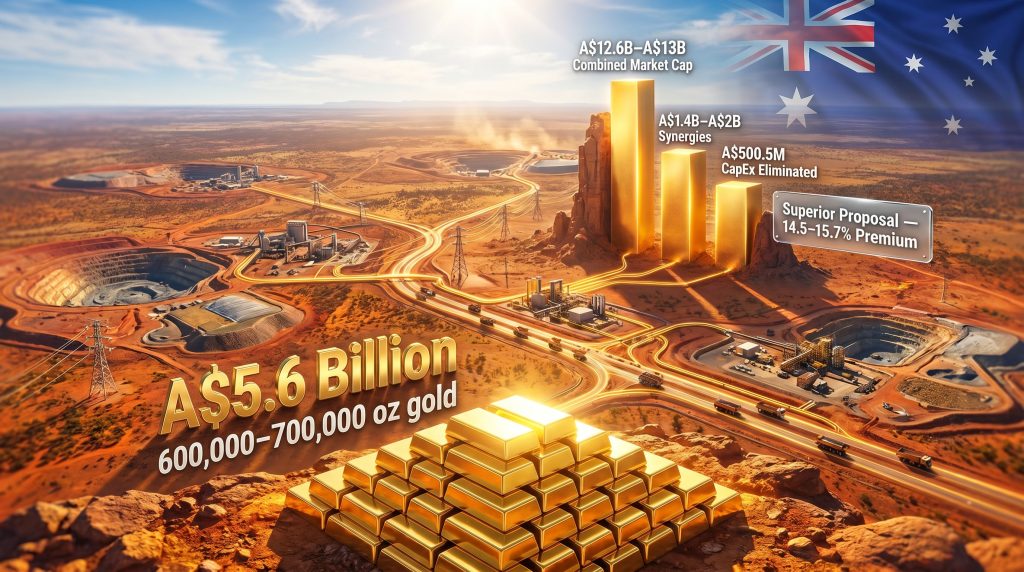
That arithmetic has rarely been more compelling than it is in mid-2026. Gold prices have climbed to levels that simultaneously make acquisitions more expensive and easier to finance, a paradox that rewards those who move decisively. The Genesis bid for Vault Minerals, valued at approximately A$5.6 billion (roughly USD $3.88 billion), is the most significant expression of this dynamic to emerge from Australia's Goldfields region in recent years. Understanding why it succeeded where a competing offer failed reveals as much about deal structure, capital discipline, and market psychology as it does about the gold sector itself.
When big ASX news breaks, our subscribers know first
The Deal Structure That Decided the Contest
When Regis Resources tabled its all-stock merger proposal for Vault Minerals in May 2026, it was following a well-worn playbook. All-scrip deals conserve cash, avoid balance sheet strain, and allow the acquirer to argue that target shareholders are gaining exposure to a larger, more capable combined entity. The logic is sound in theory. In practice, it transfers a specific and often underappreciated risk to target shareholders: the acquirer's own share price risk becomes the target shareholder's problem from the moment the offer is accepted.
Genesis Minerals took a different approach. Its competing proposal structured consideration as 60% scrip and 40% cash, translating to 0.7629 Genesis shares plus A$0.475 cash per Vault share. That cash component is not incidental. It functions as a valuation floor, providing Vault investors with a guaranteed minimum return regardless of what Genesis shares do between announcement and settlement. Furthermore, this structure reflects broader trends in Australian gold M&A, where hybrid consideration packages are increasingly favoured over pure scrip proposals.
Deal Comparison at a Glance
| Aspect | Genesis Offer | Regis Resources Offer |
|---|---|---|
| Total Deal Value | A$5.6 billion (~USD $3.88 billion) | Implied ~A$4.61/share |
| Per-Share Value | A$5.274 | ~A$4.61 |
| Premium to Regis Offer | ~14.5 to 15.7% | Baseline |
| Consideration Structure | 60% scrip + 40% cash | 100% all-stock |
| Cash Per Share | A$0.475 | Nil |
| Scrip Per Share | 0.7629 Genesis (GMD) shares | Vault shares for Regis stock |
| Pro-Forma Market Cap | ~A$12.6 to A$13 billion | N/A |
| Annual Production Target | 600,000 to 700,000 oz gold | N/A |
Vault's board unanimously determined the Genesis proposal to be a Superior Proposal under Australian scheme of arrangement rules. This is a formal legal classification, not merely an expression of preference. It triggered a five-business-day matching right window for Regis, which expired on July 10, 2026 without a revised offer being submitted. On July 13, 2026, Regis publicly confirmed it would not match the Genesis terms, and Vault indicated its intention to terminate the Regis scheme and enter into a binding agreement with Genesis.
Why Regis Stepped Away Rather Than Stretching Its Bid
The instinctive narrative around contested takeovers is that the losing bidder failed. That framing, however, misreads what Regis actually did. Its board applied the same internal value and return thresholds it uses for all capital allocation decisions and concluded that the terms required to match Genesis did not clear those benchmarks. This is capital discipline in its most literal form.
Matching Genesis would have required Regis to introduce a meaningful cash component, placing real pressure on a balance sheet that had not been structured for that kind of outlay. The company chose to protect its financial position rather than win a bidding contest at any price. As compensation for the termination of the original scheme, Regis is entitled to receive a break fee of approximately A$50.7 million from Vault.
Break fees in Australian M&A scheme structures serve a specific purpose: they compensate the original bidder for the due diligence costs, advisory fees, and opportunity costs incurred during the process. At A$50.7 million against a deal value of A$5.6 billion, the fee represents less than 1% of transaction value, a modest but meaningful consolation for a well-run process.
The decision to walk away rather than overextend is one that institutional investors tend to reward over time. According to Reuters, acquirers who stretch beyond disciplined valuation thresholds to win contested bids frequently find that the synergies required to justify the premium prove harder to capture than projected.
The Operational Logic Behind a A$12.6 Billion Gold Giant
The financial terms of the Genesis bid for Vault Minerals tell part of the story. The operational rationale tells the rest. The combined entity would operate five producing gold mines, concentrated within Western Australia's Goldfields region. The geographic proximity of these assets is not coincidental to the deal's logic. It is the deal's logic.
Synergy Estimates and Capital Efficiency
| Synergy Category | Estimated Value |
|---|---|
| Total Post-Tax Synergies | A$1.4 billion to A$2 billion |
| Capital Expenditure Eliminated | A$500.5 million (projected) |
| Primary Driver | Processing infrastructure consolidation |
When neighbouring gold operations share geological corridors, the processing infrastructure that serves one operation can frequently be optimised to handle ore from an adjacent deposit. This reduces the need for parallel investment in mills, tailings facilities, power systems, haulage networks, and water management infrastructure. The result is a lower all-in sustaining cost (AISC) per ounce across the combined portfolio, which is the single most important metric for long-term gold mining competitiveness.
Vault's King of the Hills mine is the anchor asset on the Vault side of the combination. Genesis brings its established Leonora-district operations to the merged group. The Leonora district has long been recognised as one of the more geologically endowed corridors within the Goldfields, characterised by shear-hosted gold mineralisation that tends to produce consistent, mill-friendly ore grades at depth.
What Scale Does for a Gold Producer
Scale in gold mining confers advantages that go beyond simple cost reduction. In addition, understanding the relationship between commodity prices and miners helps contextualise why these operational efficiencies matter so significantly at current gold price levels:
-
Index inclusion at a market capitalisation of A$12.6 to A$13 billion significantly broadens the institutional investor universe that can hold the stock, improving liquidity and reducing the cost of equity capital
-
Balance sheet capacity expands proportionally, enabling the combined group to fund organic growth projects or pursue further bolt-on acquisitions without immediate recourse to equity markets
-
Procurement leverage increases as a larger operation can negotiate more favourable terms with reagent suppliers, equipment manufacturers, and contractors
-
Talent retention improves as larger companies can offer more complex roles, clearer career pathways, and more competitive remuneration packages in a skills-constrained labour market
How Markets Interpreted the Genesis Bid for Vault Minerals
Share Price Movements Across All Three Parties
| Company | Price Movement | Direction |
|---|---|---|
| Vault Minerals | +11.6% at bid announcement; +0.8% to A$4.91 on July 13 | Positive |
| Genesis Minerals | -4.1% at announcement; +3% to A$5.84 on July 13 | Mixed, then recovery |
| Regis Resources | Flat on July 13 | Neutral |
Each of these price movements carries interpretive weight. Vault's appreciation at announcement reflects the market's immediate endorsement of the Genesis premium as a fair value recognition. The subsequent modest gain on July 13, when Regis confirmed it would not match, reflects the removal of deal uncertainty rather than new information about fundamental value.
Genesis's initial share price decline is textbook acquirer dilution dynamics. When a company issues new shares as part of deal consideration, near-term earnings per share dilution is arithmetically inevitable. The market prices this in immediately. The subsequent recovery to A$5.84, making Genesis one of the top gainers on the ASX 200 that session, signals growing institutional confidence that the synergy case is credible and that management can execute the integration. Consequently, the connection between gold price and mining equities becomes particularly relevant here, as elevated gold prices amplify both the appeal of scale and the market's sensitivity to integration risk.
Regis's flat performance confirms that the market had largely anticipated this outcome before the formal announcement. The A$50.7 million break fee partially offsets the opportunity cost of the failed bid without materially affecting Regis's standalone valuation.
Acquirer share price declines at deal announcement are frequently misread as market disapproval. In scrip-heavy transactions, they are often mechanical rather than judgemental. The more informative signal is what happens in the days and weeks following, as the market forms a view on synergy credibility and integration risk.
The Goldfields as a Consolidation Epicentre
Western Australia's Goldfields region has few rivals globally as a concentration of mid-tier gold assets operating in close proximity. The Kalgoorlie-Boulder hub and the surrounding districts, including Leonora, Laverton, and Southern Cross, contain multiple independently operated mines within haulage distance of one another. This geographic density creates persistent tension between the economics of independence and the economics of combination.
Several factors make the Goldfields particularly suited to consolidation-driven synergy extraction:
-
Shared geological architecture means that ore from multiple deposits frequently responds similarly to processing, reducing the metallurgical risk of centralising treatment
-
Existing road and power infrastructure connects operations that were historically developed independently, reducing greenfield capital requirements for integration
-
Western Australia's established regulatory framework for mining scheme of arrangement transactions is well understood by advisers, boards, and institutional investors, reducing execution uncertainty
-
Labour pools in regional mining centres are shared across operations, meaning workforce integration carries lower displacement risk than in geographically dispersed mergers
The next major ASX story will hit our subscribers first
What Remaining Mid-Tier ASX Gold Producers Should Be Thinking About
The Genesis bid for Vault Minerals has recalibrated the competitive landscape for every mid-tier ASX gold producer with operations in proximity to the newly combined entity. A group producing 600,000 to 700,000 ounces annually with a market capitalisation approaching A$13 billion carries structural cost advantages that standalone operators at 100,000 to 200,000 ounces per year simply cannot replicate.
For investors assessing exposure to mid-tier ASX gold equities, several considerations flow from this. As reported by the AFR, the formation of a A$12.6 billion gold major fundamentally alters the competitive dynamics for every operator in the region. Furthermore, those exploring undervalued gold stocks may find that adjacency to the Genesis-Vault footprint is an increasingly important valuation variable:
-
Strategic adjacency premium: Assets that sit within the combined Genesis-Vault operational footprint, or adjacent to it, carry implicit M&A optionality that should be reflected in valuation
-
Consolidation pressure on AISC: As larger combined entities drive their per-ounce costs lower through infrastructure sharing, standalone operators face margin compression at any given gold price, narrowing their reinvestment capacity
-
Deal structure preferences are shifting: The Genesis success with a cash-and-scrip structure, versus the Regis all-stock approach, is likely to influence how future Australian gold M&A proposals are designed
-
Capital discipline at the bidder level matters: Regis's decision to apply consistent return thresholds rather than match Genesis at any cost is the kind of governance behaviour that protects long-term shareholder value, even when it means losing a specific contest
For a broader perspective on navigating the evolving landscape, the ASX mining stocks guide provides useful context on how consolidation events like this one reshape sector positioning across the board.
This article is intended for informational purposes only and does not constitute financial advice. All figures referenced are drawn from publicly available ASX announcements and contemporaneous reporting. Readers should conduct their own due diligence before making investment decisions. Synergy estimates and production projections represent forward-looking statements that are inherently subject to uncertainty.
Want to Identify the Next Major ASX Gold Discovery Before the Market Does?
Discovery Alert's proprietary Discovery IQ model delivers real-time alerts on significant ASX mineral discoveries, instantly translating complex geological data into actionable investment insights — explore historic examples of exceptional discovery returns to understand the scale of opportunity, and begin your 14-day free trial at Discovery Alert to position yourself ahead of the next major consolidation play.