June 14, 2026
Geological Foundations Driving South America's Copper Renaissance
The Andean Copper Belt extends over 7,000 kilometers along the western spine of South America, representing one of Earth's most concentrated copper provinces. Within this geological corridor, high-altitude deposits at elevations exceeding 4,000 meters present unique opportunities for resource extraction, despite operational challenges that have historically limited development. The convergence of tectonic activity, hydrothermal processes, and mineral concentration creates conditions where copper deposits achieve both scale and grade characteristics that distinguish them from lower-elevation operations.
At these extreme altitudes, oxygen levels drop to approximately 60% of sea-level concentrations, fundamentally altering equipment performance, worker productivity, and operational methodologies. Temperature fluctuations between day and night can exceed 40 degrees Celsius, while sudden weather transitions from clear conditions to snow storms occur within minutes. These environmental factors require specialized engineering solutions, medical protocols, and infrastructure investments that significantly impact project economics.
When big ASX news breaks, our subscribers know first
What Makes the Vicuña District Argentina's Most Strategic Copper Investment?
The Vicuña copper project expansion in Argentina represents a convergence of geological abundance and strategic positioning within the global copper supply framework. Located along the Argentina-Chile border at elevations exceeding 4,200 meters above sea level, the district encompasses two distinct deposit areas that collectively contain 38 million metric tons of copper resources, with 13 million metric tons classified as measured reserves and 25 million metric tons categorized as inferred resources.
Geological Resource Assessment and Global Ranking
The resource base spans two primary deposits within the district. Filo del Sol constitutes the larger geological structure, covering an area four times greater than the companion Josemaría deposit. This size differential suggests significant exploration upside within the Filo del Sol boundaries, as current resource calculations may represent only a portion of the ultimate mineral endowment.
Beyond copper, both deposits contain substantial gold and silver co-product potential. While specific precious metals tonnage figures remain undisclosed, the multi-metal nature of these deposits provides revenue diversification opportunities that enhance project economics compared to pure copper operations. Furthermore, this polymetallic characteristic positions the district advantageously against single-commodity developments in terms of cash flow stability and market risk mitigation.
Resource quality metrics demonstrate favorable characteristics for processing and recovery operations. The integration of both deposits through a centralised processing facility located at Josemaría enables economies of scale in metallurgical treatment, potentially improving overall recovery rates compared to separate processing approaches.
Strategic Location Advantages in South American Copper Belt
The border location between Argentina and Chile provides access to established copper industry infrastructure, technical expertise, and supply chain networks developed over decades of Chilean copper operations. This proximity reduces certain logistical challenges while enabling knowledge transfer from the world's most experienced high-altitude copper mining region.
Cross-border positioning also offers operational flexibility for transportation corridors, power transmission options, and access to skilled labour pools familiar with Andean mining conditions. In addition, the established regulatory frameworks in both jurisdictions provide precedents for permitting, environmental compliance, and operational standards applicable to similar high-altitude developments.
Regional supply chain integration opportunities extend beyond immediate operational needs. The concentration of copper development projects within the broader Andean region creates potential for shared infrastructure investments, equipment procurement efficiencies, and collaborative approaches to common challenges such as high-altitude logistics and specialised technical services.
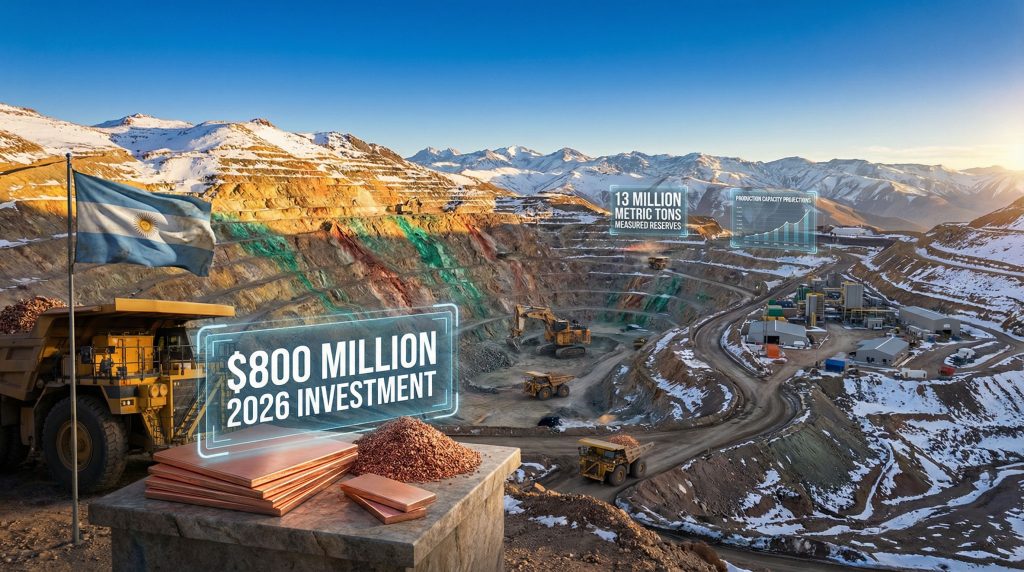
How Will the $800 Million 2026 Investment Transform Project Economics?
The Vicuña copper project expansion involves a strategic acceleration of capital deployment, with investment targets increasing from approximately $400 million in 2025 to $800 million in 2026. This doubling of annual investment reflects critical path requirements for infrastructure development, equipment procurement, and operational readiness programmes necessary to achieve the projected 2030 production timeline.
Capital Allocation Strategy Breakdown
Infrastructure development represents the primary capital allocation priority, encompassing road construction through challenging Andean terrain, power transmission line installation across international borders, and water supply systems capable of supporting processing operations at extreme altitude. These foundational investments require substantial upfront capital but enable long-term operational efficiency.
The Batidero operational camp demonstrates the scale of worker accommodation requirements, designed to house more than 1,000 personnel in a self-contained facility. Medical facilities receive particular emphasis due to mandatory high-altitude health protocols, emergency response capabilities, and specialised equipment for altitude-related health monitoring.
Technology integration investments focus on equipment modifications for extreme altitude performance, automation systems that reduce human exposure to harsh conditions, and communication infrastructure that maintains reliable connectivity despite remote location challenges. However, these technological adaptations require premium pricing but prove essential for operational safety and productivity.
Environmental compliance and sustainability initiatives represent an increasing proportion of total capital allocation. High-altitude ecosystems require specialised protection measures, while water management systems must address both operational needs and environmental conservation requirements in sensitive Andean watersheds.
Investment Timeline and Milestone Analysis
The escalation from $400 million to $800 million in annual investment reflects compressed construction timelines necessary to achieve 2030 production targets. Critical path activities include power infrastructure installation during favourable weather windows, equipment delivery through challenging transportation corridors, and construction workforce mobilisation to remote high-altitude locations.
Total project investment estimates range from $5 billion according to company projections to $15 billion based on local officials and industry sources. This wide range indicates significant uncertainty regarding final capital requirements, pending completion of integrated technical reports scheduled for release in Q1 2026.
Risk mitigation strategies for high-altitude construction emphasise weather-resistant design specifications, redundant transportation routes, and seasonal construction scheduling that maximises productive work periods while minimising exposure to extreme weather conditions.
What Are the Market Dynamics Driving This Massive Copper Bet?
Global copper market fundamentals support large-scale development projects through anticipated supply-demand imbalances emerging over the next decade. Electrification demand projections indicate substantial increases in copper consumption for electric vehicle manufacturing, renewable energy infrastructure, and global copper supply forecast programmes worldwide.
Global Copper Supply-Demand Fundamentals
Argentina's complete absence from copper production since the 2018 closure of the Alumbrera mine creates an opportunity for significant market re-entry through the Vicuña copper project expansion. This timing coincides with warnings from governments and automakers regarding looming shortages of metals critical to electrification initiatives.
Current copper spot prices of $5.8905 per pound reflect market expectations of continued demand growth outpacing new supply additions. Consequently, supply gap analysis indicates that new mine development timelines typically require 7-10 years from initial investment to production, creating potential shortages if development projects experience delays or cancellations.
The strategic significance of new copper supply sources becomes apparent when considering the time lag between increasing demand forecasts and actual production capacity additions. For instance, high-altitude projects like Vicuña, despite operational challenges, represent some of the few remaining large-scale undeveloped copper resources globally.
Argentina's Mining Investment Climate Under RIGI Framework
President Javier Milei's Large Investment Incentive Regime (RIGI) offers tax and legal benefits specifically designed to attract major export projects. The Vicuña copper project expansion has applied for participation in this framework, seeking access to preferential tax treatment and regulatory protections.
The RIGI framework addresses foreign investor concerns regarding currency stability, regulatory consistency, and tax predictability in Argentina's historically volatile economic environment. These protections become particularly important for projects with multi-billion dollar investment requirements and 25-year operational timelines.
Investment incentives under RIGI potentially improve project economics through reduced tax burdens, accelerated depreciation schedules, and foreign exchange protections. However, specific benefit quantification awaits formal program approval and detailed regulatory implementation.
How Do BHP and Lundin's Strategic Objectives Align in This Venture?
The joint venture structure between Australia's BHP and Canada's Lundin Mining through Vicuña Corp. combines complementary capabilities for large-scale project development. BHP contributes operational scale expertise and global marketing networks, while Lundin provides specialised project development experience and regional focus.
Joint Venture Structure and Risk Sharing Model
The partnership emerged from a $3 billion South American copper deal that positioned both companies to capitalise on what they characterise as potentially the most consequential copper developments globally. This strategic assessment reflects both partners' evaluation of the district's long-term value creation potential.
Capital contribution frameworks enable risk sharing across the substantial investment requirements, from the current $800 million annual deployment through total project costs potentially reaching $15 billion. The joint venture structure also facilitates access to diverse financing sources and technical expertise from both parent companies.
Operational responsibilities require coordination between the partners' technical teams, particularly for the integrated processing approach where both Filo del Sol and Josemaría deposits feed a central processing facility. This integration demands sophisticated project management and operational coordination between different corporate cultures and methodologies.
Portfolio Integration Benefits for Parent Companies
BHP's South American copper consolidation strategy positions the Vicuña copper project expansion within a broader regional portfolio approach. The company seeks to tighten its grip on South America's copper sector, suggesting additional acquisitions or partnerships may follow the Vicuña investment.
Lundin's project development expertise provides critical capabilities for navigating complex permitting processes, community engagement requirements, and technical challenges specific to high-altitude mining operations. This specialised knowledge complements BHP's operational scale advantages.
Market access strategies benefit from both companies' established relationships with copper consumers, offtake agreement capabilities, and global distribution networks. This combined market presence potentially secures favourable pricing and contract terms for future production.
What Production Scenarios Could Emerge from 2030 Operations?
Production modelling for the Vicuña copper project expansion centres on a designed processing capacity of 175,000 metric tons daily ore throughput, supporting a projected 25-year mine life beginning in 2030. This scale positions the operation among the world's largest copper mining complexes.
Base Case Production Modelling
The central processing facility at Josemaría will receive ore from both deposit areas, enabling integrated metallurgical treatment and concentrate production. This approach maximises recovery rates while achieving economies of scale in processing operations.
Phased development approaches may optimise capital deployment and operational risk management, beginning with higher-grade ore zones while developing infrastructure for accessing the broader resource base. Production ramp-up timelines typically extend 2-3 years to achieve full capacity operations.
The 25-year mine life projection assumes current resource estimates and processing technologies. However, the substantial inferred resource base of 25 million metric tons suggests potential for mine life extension through additional resource conversion and exploration within the district boundaries.
Expansion Potential and Resource Extension Opportunities
Filo del Sol's area advantage, covering four times the geographic extent of Josemaría, indicates significant exploration upside within the district. Current resource calculations may represent only initial development phases, with additional deposit discovery potential throughout the broader area.
Technology advancement impacts on resource recovery rates could extend mine life and increase total production over the project lifetime. Furthermore, improved metallurgical techniques, automation systems, and processing efficiency gains typically emerge during operational phases of large-scale mining projects.
Market conditions scenarios affecting expansion decisions include copper price trajectories, demand growth rates, and competitive supply additions from other global projects. Favourable market conditions could accelerate expansion phases, while adverse conditions might defer development of lower-grade resource areas.
The next major ASX story will hit our subscribers first
What Infrastructure Challenges Must Be Overcome at 4,200+ Meters Elevation?
High-altitude operations at the Vicuña copper project expansion site require specialised engineering solutions addressing extreme environmental conditions, reduced oxygen availability, and logistical challenges unique to Andean mining operations.
High-Altitude Operational Considerations
Oxygen levels at 4,200+ meters elevation drop to approximately 60% of sea-level concentrations, directly impacting worker productivity, equipment performance, and operational safety protocols. Personnel require medical screenings before site access, continuous health monitoring during work rotations, and specialised training for altitude-related health risks.
Equipment performance modifications become essential for diesel engines, electrical systems, and mechanical components operating in low-oxygen, high-altitude environments. Power derating, enhanced cooling systems, and pressure compensation mechanisms add complexity and cost to standard mining equipment configurations.
Weather pattern management addresses extreme temperature variations, sudden storm development, and seasonal access limitations that affect construction schedules and operational continuity. In addition, emergency response planning must account for limited access during adverse weather conditions and extended evacuation timeframes.
Transportation and Logistics Infrastructure Development
Road construction through Andean terrain requires specialised engineering for steep grades, unstable geological conditions, and extreme weather exposure. Transportation corridors must maintain year-round accessibility while accommodating heavy equipment deliveries and ongoing supply requirements.
Power transmission line installation across international borders involves complex regulatory coordination, challenging terrain navigation, and specialised high-altitude construction techniques. Reliable power supply becomes critical for processing operations and worker safety systems.
Water supply and management systems must balance operational requirements with environmental conservation in sensitive Andean watersheds. High-altitude water sources require specialised treatment and distribution systems resistant to freezing and pressure variations.
Supply chain resilience planning addresses the remote location challenges through redundant transportation routes, strategic inventory management, and local supplier development where feasible. Emergency supply protocols account for extended delivery timeframes during adverse weather conditions.
How Does This Investment Compare to Global Copper Development Projects?
Capital intensity benchmarking reveals the substantial investment requirements characteristic of large-scale copper developments in challenging environments. The copper and uranium investments such as the Vicuña copper project expansion compete for capital allocation against alternative copper projects worldwide.
Capital Intensity Benchmarking
| Project Comparison | Total Investment | Annual Production | Capital per lb Capacity |
|---|---|---|---|
| Vicuña District | $5-15 billion | TBD (2030 target) | Under evaluation |
| Quebrada Blanca 2 | $5.3 billion | 285,000 tonnes | $18,600 per tonne |
| Copper Mountain IV | $1.7 billion | 100,000 tonnes | $17,000 per tonne |
The wide range in Vicuña's total investment estimate reflects uncertainty regarding final capital requirements pending completion of integrated technical reports. High-altitude construction premiums, specialised equipment requirements, and infrastructure development needs contribute to elevated capital intensity compared to lower-altitude operations.
Timeline and Execution Risk Assessment
Construction complexity factors affecting the 2030 production target include weather-limited construction seasons, specialised equipment delivery challenges, and workforce accommodation requirements in remote high-altitude locations. These factors typically extend development timelines compared to conventional mining projects.
Regulatory approval processes require coordination between Argentine and Chilean authorities for cross-border infrastructure components. Community engagement requirements involve multiple stakeholder groups across different jurisdictions and cultural contexts.
Technology integration challenges for the integrated processing approach require coordination between two distinct deposit areas, specialised high-altitude equipment modifications, and automated systems capable of operating reliably in extreme environmental conditions. Additionally, AI in mining technology solutions may play an increasing role in optimising operations.
Market timing risks include copper price sensitivity analysis, as project economics depend heavily on long-term copper price assumptions. Extended development timelines increase exposure to market volatility and competitive supply additions from other global projects.
What Are the Long-Term Economic Implications for Argentina?
The Vicuña copper project expansion represents Argentina's strategic re-entry into global copper production after an eight-year absence, with significant implications for the country's economic diversification and international trade position.
National Economic Impact Projections
Foreign currency earnings potential from copper exports could substantially improve Argentina's trade balance, particularly given copper's status as a hard currency commodity with global demand growth prospects. Large-scale mineral exports provide natural hedging against peso devaluation while generating foreign exchange reserves.
Employment creation estimates encompass direct mining operations employment plus substantial indirect job creation through supply chain development, transportation services, and regional economic activity. The Batidero camp's capacity for more than 1,000 workers indicates the scale of direct employment opportunities.
Regional development catalyst effects in San Juan Province extend beyond immediate mining operations to include infrastructure improvements, service industry development, and increased economic activity throughout the region. High-paying mining jobs typically generate significant economic multiplier effects in surrounding communities.
Strategic Resource Diversification Benefits
Reduced dependence on traditional export commodities provides economic diversification benefits, particularly as global demand shifts toward metals critical for electrification and renewable energy infrastructure. Copper's strategic importance in the global energy transition positions Argentina advantageously for long-term export demand.
Mining sector modernisation through advanced technology adoption, international best practices implementation, and workforce skill development creates capabilities applicable to other mining projects throughout Argentina. This knowledge base development supports broader mining sector competitiveness.
Infrastructure development spillover effects benefit other potential projects in the region through shared transportation corridors, power transmission capabilities, and technical service availability. These infrastructure investments reduce development costs and timeline requirements for subsequent projects, particularly those with gold-copper exploration insights.
Position strengthening in global critical minerals supply chains aligns with international efforts to diversify mineral sources away from concentrated supply regions. Argentina's democratic governance and stable legal framework appeal to international customers seeking supply security.
Investment Risk Analysis and Market Psychology
The Vicuña copper project expansion operates within complex risk frameworks encompassing technical execution challenges, market volatility exposure, and regulatory environment uncertainties across two national jurisdictions.
Investor psychology surrounding large-scale copper developments reflects both optimism regarding electrification demand growth and concerns about execution risks in challenging operational environments. However, high-altitude mining operations historically experience higher cost overruns and timeline delays compared to conventional projects.
Market sentiment toward Argentine mining investments has improved under President Milei's pro-investment policies, particularly the RIGI framework designed to attract large-scale foreign investment. Nevertheless, Argentina's historical economic volatility continues to influence risk premiums and financing costs for major projects.
The joint venture structure between BHP and Lundin provides risk mitigation through shared capital exposure and combined technical expertise. However, partnership coordination challenges may emerge during construction and operational phases, requiring effective governance structures and dispute resolution mechanisms.
Currency risk management becomes critical given the multi-billion dollar investment requirements denominated in hard currency while operating in Argentine peso economic environment. RIGI's foreign exchange protections attempt to address these concerns but remain untested in practice.
Geological Grade Quality and Processing Implications
Resource grade characteristics significantly impact processing requirements, recovery rates, and overall project economics for the Vicuña copper project expansion. While specific grade information remains confidential pending technical report publication, the polymetallic nature suggests complex metallurgical requirements.
High-altitude processing operations require specialised equipment modifications addressing low atmospheric pressure, extreme temperature variations, and reduced oxygen availability. These environmental factors affect flotation processes, concentrate quality, and recovery efficiency compared to sea-level operations.
The integrated processing approach combining ore from both Filo del Sol and Josemaría deposits enables blending opportunities that may optimise metallurgical performance. Different ore characteristics from each deposit could complement each other in processing circuits.
Water management at high altitude presents unique challenges due to freezing temperatures, limited water sources, and environmental sensitivity of Andean ecosystems. Processing plant design must incorporate water recycling systems and freeze protection mechanisms.
Concentrate transportation from the remote high-altitude location requires specialised logistics planning, including concentrate handling systems resistant to weather extremes and transportation infrastructure capable of accommodating year-round product shipments. This differs significantly from more accessible developments such as Argentina's major copper system projects at lower elevations.
Disclaimer: This analysis incorporates forward-looking statements regarding production timelines, investment requirements, and market conditions. Actual results may differ materially from projections due to technical, regulatory, market, and operational factors. Investment decisions should consider comprehensive technical reports and professional financial advice. All financial figures are approximate and subject to revision pending completion of detailed engineering studies.
Ready to Invest in the Next Major Mineral Discovery?
Discovery Alert instantly alerts investors to significant ASX mineral discoveries using its proprietary Discovery IQ model, turning complex mineral data into actionable insights. Understand why major mineral discoveries can lead to significant market returns and begin your 14-day free trial today to position yourself ahead of the market.