June 16, 2026
The Invisible Bottleneck Slowing the Clean Energy Transition
The global push toward electrification rests on a materials paradox. Wind turbines, EV motors, and defence electronics all depend on neodymium-iron-boron (NdFeB) permanent magnets, yet the rare earth supply chains that make those magnets function are concentrated almost entirely in a single country. According to the U.S. Geological Survey's Mineral Commodity Summaries 2024, China accounts for roughly 70% of global rare earth mine production and an even greater share of separated oxide output. For manufacturers in North America and Europe, that concentration is not a theoretical risk. It is a structural vulnerability embedded in every electric motor they produce.
Primary mining alone cannot resolve this imbalance at the speed the energy transition demands. The International Energy Agency has projected that critical minerals demand from clean energy technologies could increase by three to seven times by 2040 under accelerated decarbonisation scenarios. Against that backdrop, the case for closed-loop recycling of rare earth magnet scrap has shifted from an interesting R&D concept to an operational imperative.
When big ASX news breaks, our subscribers know first
Why NdFeB Magnet Scrap Is More Valuable Than It Looks
The Chemistry Behind Permanent Magnet Superiority
NdFeB magnets are not simply strong. They possess the highest energy density of any commercially available permanent magnet material, which is why they remain irreplaceable in compact, high-torque motor applications. Their composition typically includes:
- Neodymium (Nd) and praseodymium (Pr): the primary rare earth elements providing magnetic strength
- Dysprosium (Dy): added in smaller quantities to maintain coercivity at elevated operating temperatures in EV and industrial applications
- Iron and boron: forming the crystalline matrix that locks magnetic domains in alignment
What is less widely understood is that rare earth oxides recovered from magnet scrap carry functionally equivalent value to virgin material refined from ore. The rare earth content does not degrade through the magnet manufacturing process. A kilogram of neodymium oxide extracted from industrial magnet scrap is chemically identical to a kilogram produced from a hard rock deposit, assuming equivalent purity levels are achieved in processing.
This equivalence is significant from an investment and supply chain perspective. Recycled material does not need to be sold at a discount to primary product. If process economics are competitive, it can enter the same downstream supply chains at the same price point.
Comparing Primary and Secondary Rare Earth Pathways
| Pathway | Feedstock Source | Environmental Footprint | Supply Chain Risk | Scale of Current Western Capacity |
|---|---|---|---|---|
| Primary hard rock mining | Carbonatite and other deposits | High (tailings, thorium co-production) | High (geographic concentration) | Limited outside China and Australia |
| Ionic clay leaching | Weathered granitic profiles | Moderate to high (land disturbance) | High (primarily South China) | Negligible in Western nations |
| Manufacturing scrap recycling | Industrial NdFeB scrap | Significantly lower | Diversified and potentially domestic | Nascent but growing |
| End-of-life product recovery | Consumer electronics, EV motors | Moderate (collection logistics) | Emerging, collection-limited | Early stage globally |
One dimension of this comparison that rarely receives attention is the radioactive co-production problem in primary rare earth mining. Many rare earth deposits, particularly carbonatite-hosted deposits, carry thorium and uranium as accessory minerals. Managing radioactive process streams adds regulatory complexity and cost that secondary recycling pathways largely avoid, giving recycling a regulatory durability advantage that pure economics understates. Furthermore, the rare earth processing challenges associated with conventional methods make secondary recycling increasingly attractive from both an environmental and commercial standpoint.
The Geomega Magnet Recycling Permit: A Regulatory Turning Point
What the Quebec Authorization Actually Authorises
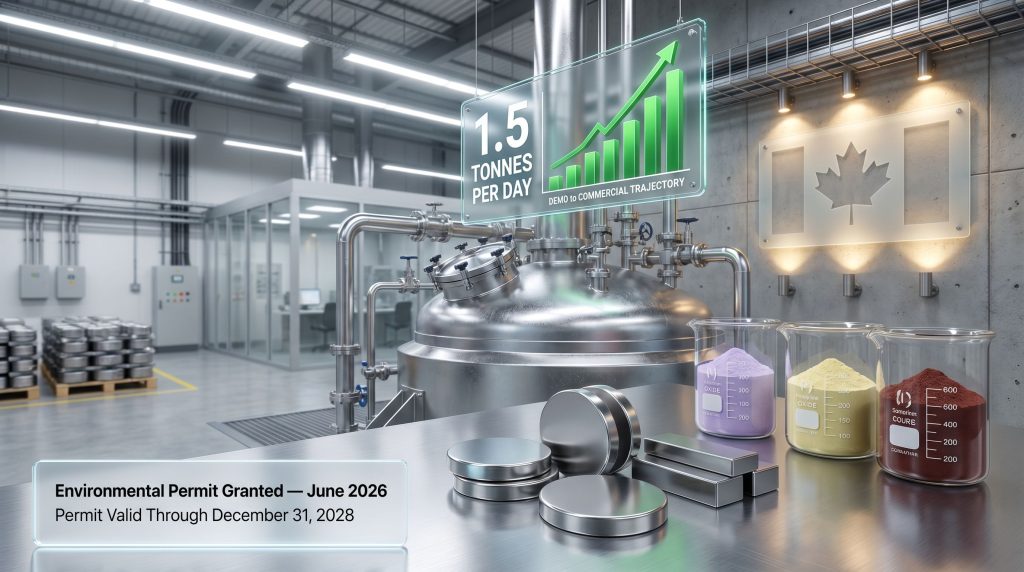
The Geomega magnet recycling permit, issued by Quebec's Ministère de l'Environnement, de la Lutte contre les Changements Climatiques, de la Faune et des Parcs (MELCCFP), is an environmental authorization allowing Geomega Resources to operate its NdFeB rare earth recycling demonstration plant in Saint-Hubert, Quebec, and collect operational and environmental performance data through December 31, 2028.
The permit's scope is specific and worth understanding precisely. It does not constitute commercial operating approval. Rather, it represents the regulatory gateway to generating the validated environmental and process performance dataset that Quebec's framework requires before a full commercial environmental permit can be granted. In this sense, the permit is both an endpoint and a starting line simultaneously.
Regulatory Context Worth Understanding: Quebec's environmental permitting framework for industrial processing facilities operates on a staged authorization model. Demonstration-phase permitting establishes that a process can be operated safely and within environmental limits at scale. The data gathered during this phase directly informs the regulator's assessment of any subsequent commercial permit application. Navigating this stage creates a defensible regulatory position that competitors who have not yet reached demonstration scale cannot replicate.
The Multi-Year Path to This Milestone
The Geomega magnet recycling permit did not emerge quickly. The trajectory from laboratory-scale research through to regulatory authorization followed a sequence that reflects the genuine complexity of scaling a novel hydrometallurgical process:
- Laboratory-scale research and process chemistry development across multiple years of R&D
- Pilot-scale testing to validate process behaviour beyond bench scale
- Engineering, procurement, and construction planning for the Saint-Hubert demonstration facility
- Permit application submission to MELCCFP, with the application under regulatory review through mid-2025 and into early 2026
- June 2026: Environmental permit granted, marking the formal regulatory inflection point
- Demonstration operations through end of 2028, generating the evidence base for commercial permit application
The extended review period between application and issuance reflects the rigour of Quebec's environmental assessment process for novel industrial chemistry operations, not any fundamental objection to the technology. That distinction matters for how investors and industry observers interpret the timeline. For further context on this milestone, Geomega's official announcement provides additional technical detail on the permit scope and process parameters.
Inside the Saint-Hubert Demonstration Plant: Process Architecture and Capacity
How the Technology Converts Magnet Scrap Into Recoverable Rare Earths
Geomega's process operates on a hydrometallurgical architecture, extracting rare earth elements from NdFeB magnet scrap feedstock through a proprietary process chemistry sequence. The demonstration plant is designed to process 1.5 tonnes per day of NdFeB magnet feed material, producing separated rare earth oxide streams, primarily neodymium oxide and praseodymium oxide, suitable for re-entry into permanent magnet supply chains.
A distinguishing feature of the process design is its orientation toward near-zero solid and liquid waste outputs. Conventional hydrometallurgical rare earth processing generates significant volumes of process residues and aqueous effluent streams that require treatment and disposal infrastructure. Minimising these outputs reduces both operating costs and the regulatory burden associated with waste management, while also addressing the primary environmental objections that have historically complicated rare earth processing facility approvals in Western jurisdictions.
Step-by-Step: From Magnet Scrap to Recovered Rare Earth Oxide
- Feedstock sourcing: NdFeB magnet scrap is acquired from industrial manufacturing waste streams, including swarf, off-specification material, and end-of-process trimmings from magnet producers
- Stockpile preparation: Feed inventory is built ahead of commissioning to ensure continuous plant operation without feedstock interruptions during the data generation phase
- Hydrometallurgical extraction: Rare earth elements are dissolved and extracted from the iron-boron matrix using the proprietary process chemistry, separating the rare earth fraction from the bulk material
- Separation and purification: Individual rare earth oxide streams are isolated and purified to meet the quality specifications required for magnet-grade re-use
- Environmental performance monitoring: Waste stream volumes, composition, and environmental parameters are continuously measured against the monitoring program requirements embedded in the permit
- Data compilation: Operational and environmental results are assembled into the evidence package that will support the commercial permit application and technology licensing discussions with magnet manufacturers
What the Near-Zero Waste Design Means in Practice
The near-zero waste design philosophy is not simply an environmental marketing claim. It has direct commercial implications. If the demonstration phase validates this performance, it means the technology can potentially be licensed for installation inside existing magnet manufacturing facilities, where waste management infrastructure may be limited and regulatory tolerance for process effluent is low.
Commercial Insight: A recycling technology that generates minimal waste can be co-located with manufacturing operations in a way that a conventional hydrometallurgical plant cannot. This co-location model would allow magnet producers to close their internal scrap loop without constructing separate waste treatment systems, which is a commercially compelling proposition.
Construction and Commissioning: Where the Plant Stands in Mid-2026
Physical Plant Progress
As of mid-2026, construction at the Saint-Hubert demonstration facility has progressed substantially, with all major process equipment delivered and installed. The remaining construction activity is concentrated in piping and control systems integration:
| Work Package | Status as of Mid-2026 |
|---|---|
| Major process equipment | Delivered and installed |
| Piping installation | In progress, target completion end of July 2026 |
| Control cable pulling | Complete |
| Control room construction | Target completion June 2026 |
| Control and automation system connection and testing | Scheduled through July 2026 |
| Overall plant construction | Target substantial completion end of summer 2026 |
| Magnet feed stockpile | Actively being built ahead of commissioning |
The Staged Commissioning Approach
Rather than attempting to bring the entire facility online simultaneously, Geomega is pursuing a staged commissioning sequence, validating individual plant sections before integrating them into full-plant operation. This approach reduces the risk of system-wide problems during initial start-up and allows the team to identify and address performance issues at the section level before full integration. It also generates more granular process data that will strengthen the eventual commercial permit application.
Magnet feed stockpile construction is running in parallel with the commissioning preparation. Building feed inventory before commissioning begins ensures that the plant can operate continuously through its initial validation runs without interruptions from feedstock supply logistics.
The Integrated R&D and Piloting Facility: Geomega's Technology Development Engine
A Different Kind of Infrastructure Investment
Alongside the magnet recycling demonstration plant, Geomega has also secured the required operational permits for an integrated research, development, and piloting facility, also located in Saint-Hubert. This facility serves a strategically distinct function from the demonstration plant. Where the demonstration plant is focused on proving a specific process at industrial scale, the integrated facility is designed to accelerate the development and validation of future process generations and adjacent technology applications.
The facility combines advanced laboratory capabilities with larger-scale piloting infrastructure under a single roof. Equipment and materials have been ordered for installation, and construction of the new multi-level piloting infrastructure is targeted for completion by end of summer 2026.
Why Co-Located Lab and Pilot Scale Capacity Matters
In conventional technology development, laboratory findings must be transferred to a separate pilot facility for scale-up validation, a step that introduces logistical delays, communication gaps, and iteration friction. By housing both capabilities in a single facility, the development cycle can be compressed significantly. A process modification identified at lab scale can be validated at pilot scale within the same physical environment, using the same team, without the time and cost of inter-facility transfer.
The integrated facility's design also explicitly targets expansion beyond NdFeB magnet scrap into more diverse industrial and mining waste streams. This broadens the potential commercial application of Geomega's core hydrometallurgical chemistry, reducing the company's dependence on a single feedstock category and opening additional licensing pathways. Federal funding announced in late 2025 supports the development of this integrated capability.
The next major ASX story will hit our subscribers first
Benchmarking the Geomega Magnet Recycling Permit Against the Broader Industry
North American Rare Earth Recycling: Still a Nascent Landscape
Despite growing policy attention, North American rare earth recycling capacity remains significantly underdeveloped relative to projected demand. The overwhelming majority of commercial-scale rare earth separation and processing continues to occur in Asia, particularly China. Moreover, China's export restrictions have further intensified the urgency for Western nations to develop independent recycling and processing capabilities. Most Western rare earth recycling activity is still at the research or early pilot stage.
Western policy frameworks are consequently creating structural incentives for domestic rare earth recycling infrastructure development:
- The EU Critical Raw Materials Act targets 15% of annual rare earth consumption to be sourced from recycled material by 2030, a target that will require substantial new recycling capacity in Europe
- U.S. Department of Energy and Department of Defense programs have allocated funding for rare earth processing and recycling technology development as part of broader critical minerals supply chain initiatives
- Canada's Critical Minerals Strategy identifies rare earth elements among the priority materials for domestic supply chain development, with rare earth recycling explicitly within scope
Against this backdrop, holding an active environmental demonstration permit for an industrial-scale NdFeB recycling plant positions Geomega as one of the few companies in North America that has moved beyond policy alignment into regulated operational activity. The broader context of green transition raw materials policy underscores why this regulatory milestone carries weight well beyond the company's immediate commercial interests.
Demonstration Scale vs. Commercial Scale: Understanding the Distinction
| Parameter | Demonstration Phase (Current) | Commercial Phase (Post-2028 Target) |
|---|---|---|
| Processing capacity | 1.5 t/day NdFeB feed | To be determined by commercial permit scope |
| Regulatory status | Environmental demonstration permit (MELCCFP) | Full commercial environmental permit required |
| Primary objective | Process and environmental data generation | Revenue-generating rare earth oxide production |
| Licensing model | Technology validation for manufacturer licensing | Direct licensing to magnet producers |
| Waste profile | Near-zero solid and liquid waste (design target) | Operationally validated performance required |
| Timeline | Operational through December 31, 2028 | Subject to satisfactory demonstration results |
The Technology Licensing Commercial Model
Rather than positioning itself as a standalone rare earth producer competing on commodity volume, Geomega's stated commercial pathway runs through direct technology licensing to magnet manufacturers. This is a structurally different business model with distinct risk and return characteristics.
Under a licensing model, magnet producers would integrate Geomega's recycling process directly into their own facilities, enabling them to recover rare earth oxides from their internal manufacturing scrap. For the magnet manufacturer, this reduces raw material purchasing costs, eliminates scrap disposal expenses, and shortens the supply chain between recycled rare earth oxide and new magnet production. For Geomega, it provides royalty or licensing revenue without requiring the capital intensity of operating large-scale processing plants independently.
The demonstration plant's environmental and operational data package is the foundational commercial asset in this model. Without validated performance evidence, no magnet manufacturer's procurement or engineering team will seriously evaluate integrating an unproven process into their production environment. Industry observers tracking comparable projects can, for instance, review Mkango's recycling approach to understand how different technical pathways are being pursued across the sector.
Frequently Asked Questions: Geomega Magnet Recycling Permit
What does the Geomega magnet recycling permit authorise?
The permit, issued by Quebec's MELCCFP, authorises Geomega Resources to operate its NdFeB rare earth magnet recycling demonstration plant at Saint-Hubert, Quebec, and collect operational and environmental performance data through December 31, 2028.
What rare earth materials are recovered by the process?
The Saint-Hubert demonstration plant processes NdFeB magnet scrap to recover rare earth oxides, with neodymium and praseodymium as the primary target materials, both critical inputs to permanent magnet manufacturing.
What is the plant's processing capacity?
The facility is designed to process 1.5 tonnes per day of NdFeB magnet feed material into separated rare earth oxides.
When is commissioning expected to begin?
Plant construction is targeted for substantial completion by end of summer 2026, with staged commissioning of individual plant sections to follow. Magnet feed stockpile construction is actively underway in parallel.
What happens after the demonstration phase?
Upon satisfactory completion of the demonstration phase by the end of 2028, Geomega intends to apply for a full commercial environmental permit, the regulatory step required before transitioning to revenue-generating commercial operations.
Why is recycling faster to scale than new mining?
Recycling infrastructure can draw on existing industrial waste streams immediately, without the exploration, resource definition, permitting, and mine construction timelines associated with greenfield rare earth mining projects, which can extend over a decade from discovery to first production. This timeline advantage is particularly relevant in a supply chain under geopolitical pressure.
Key Takeaways for Critical Minerals Market Observers
The Geomega magnet recycling permit represents a genuine regulatory milestone in a field where most Western activity remains at the conceptual or early pilot stage. Several dimensions of this development carry implications that extend beyond the company itself:
- Regulatory validation is the scarcest commodity in rare earth processing. Holding an active industrial-scale operating permit in a Western jurisdiction is a competitive differentiator that earlier-stage projects cannot replicate quickly
- The near-zero waste process design addresses the primary regulatory obstacle that has historically blocked rare earth processing facility approvals in environmentally sensitive Western jurisdictions
- The technology licensing commercial model is capital-efficient relative to standalone production, but it depends entirely on the quality and credibility of the demonstration data package generated by end of 2028
- The integrated R&D and piloting facility creates a parallel technology development capability that could expand the addressable market beyond NdFeB scrap into broader industrial and mining waste streams
- The two-year demonstration window is defined and structured, providing a clear timeline against which progress can be evaluated rather than an open-ended development horizon
Disclaimer: This article is intended for informational purposes only and does not constitute financial advice or an investment recommendation. Forward-looking statements regarding timelines, commercial outcomes, and regulatory approvals involve uncertainty and should not be relied upon as guarantees of future performance. Readers should conduct their own due diligence and consult qualified financial advisers before making investment decisions.
Want to Stay Ahead of the Next Major Critical Minerals Discovery?
Discovery Alert's proprietary Discovery IQ model delivers real-time alerts on significant ASX mineral discoveries — instantly cutting through complex data to surface actionable opportunities in critical minerals, rare earths, and beyond. Explore historic discoveries and their exceptional market returns, then start your 14-day free trial at Discovery Alert to position yourself ahead of the broader market.