June 16, 2026
The Invisible Chokepoint That Shapes Every EV Motor, Wind Turbine, and Guided Missile
Most discussions about rare earth supply chains default to familiar territory: mine locations, deposit grades, export quotas, and geopolitical tensions. What receives far less attention is the processing layer that sits between raw ore and commercially usable products. This is where the real strategic contest is being fought, and it is precisely where the recently announced cooperation framework between Ucore Rare Metals Inc. and Sumitomo Corporation of Americas (SCOA) becomes significant.
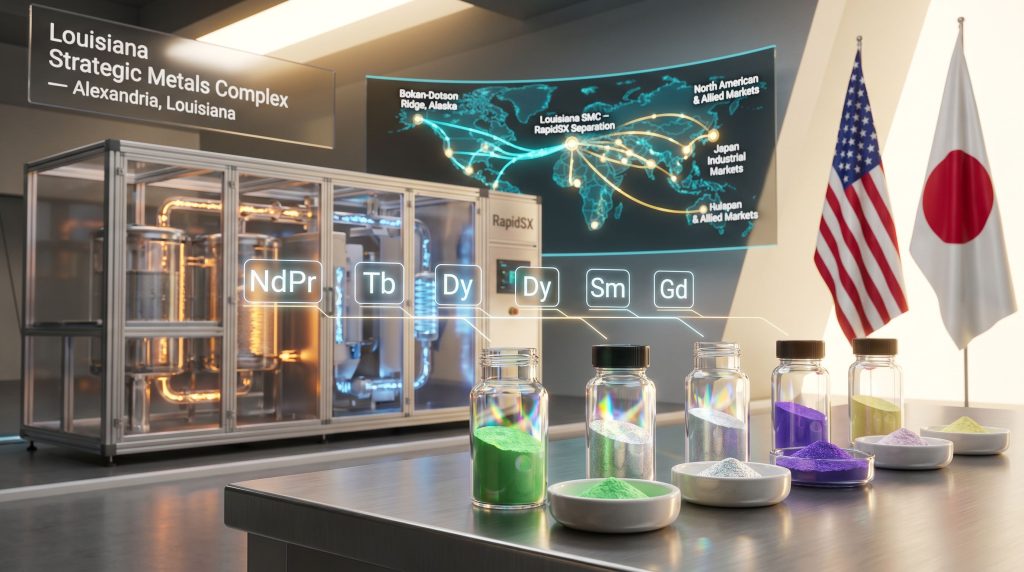
The arrangement, announced on June 15, 2026, establishes a strategic cooperation framework covering rare earth feedstock sourcing for Ucore's planned Louisiana Strategic Metals Complex (SMC) and downstream offtake development for separated rare earth products. Sumitomo to distribute Ucore rare earths across Japan and other agreed industrial markets is the commercial headline, but the deeper story is about what this framework reveals regarding where Western supply chain strategy now stands and what it still needs to accomplish.
When big ASX news breaks, our subscribers know first
The Midstream Bottleneck: Why Separation Defines Supply Chain Control
The Gap Between Ground and Application
Extracting rare earth ore from the ground and delivering commercially viable separated rare earth elements to manufacturers are two fundamentally different industrial activities separated by an extraordinarily complex processing chain. Rare earth elements share nearly identical chemical properties, particularly their ionic radii, which makes isolating individual elements from mixed concentrates exceptionally difficult compared to processing other metal groups.
The dominant industrial technique for this separation is solvent extraction, a multi-stage process that exploits subtle differences in how rare earth ions partition between aqueous and organic chemical phases. Conventional solvent extraction systems require hundreds of discrete processing stages arranged in cascades, each involving careful control of pH levels, temperature, extractant concentrations, and flow rates to achieve the purity specifications demanded by magnet manufacturers and defence contractors.
The practical result of this complexity is that traditional rare earth separation facilities are enormous, expensive, and technically demanding to operate. Capital requirements for conventional plants often reach hundreds of millions of dollars before a single commercially usable kilogram of separated oxide is produced. Furthermore, the knowledge required to run these facilities efficiently has accumulated primarily within Chinese operations over several decades of continuous commercial production.
China's Processing Dominance: The Deeper Vulnerability
China's share of global rare earth mining is significant, but its command of the separation and refining layer is far more strategically consequential. Nations and manufacturers that depend on Chinese separation facilities remain vulnerable even if they develop alternative mining sources, because raw concentrates still require processing before they can enter the manufacturing supply chain. The rare earth processing challenges associated with this bottleneck continue to constrain allied-nation industrial strategy.
The downstream consequences extend across multiple critical industries. Permanent magnet manufacturers operating outside China face persistent input supply uncertainty. Defence contractors requiring consistent supplies of high-purity terbium and dysprosium for motion control systems and guidance components have limited non-Chinese sourcing options. Advanced electronics producers dependent on gadolinium and samarium compounds face similar constraints.
"The rare earth supply chain's most critical vulnerability is not geological scarcity. It is the concentration of separation expertise and infrastructure within a single national system that can, and has, used that control as a geopolitical lever."
The 2010 rare earth crisis remains the most instructive historical example. When China temporarily restricted exports following a maritime dispute with Japan, rare earth oxide prices for critical heavy elements spiked dramatically, exposing how dependent global manufacturing had become on Chinese processing capacity. Japanese manufacturers were among the most severely affected, creating an industrial policy imperative in Tokyo that persists to this day and directly informs why Japan is the primary target market within the Ucore-SCOA framework.
What the Ucore–SCOA Strategic Framework Actually Covers
A Structured Overview of the Agreement
The cooperation framework between Ucore and SCOA covers two primary commercial functions operating in parallel. The first is collaborative support for sourcing rare earth feedstock destined for the Louisiana SMC. The second is the development of downstream offtake arrangements for separated rare earth products, with SCOA designated as Ucore's distribution partner for specific separated products sold to selected customer segments in Japan and other mutually agreed industrial markets.
The framework focuses specifically on middle and heavy rare earth elements (MHREEs), a category that includes neodymium-praseodymium (NdPr), terbium (Tb), dysprosium (Dy), samarium (Sm), and gadolinium (Gd). These are the elements that command the highest strategic premium because they are essential for high-coercivity permanent magnets used in applications where performance cannot be compromised by lower-grade substitutes.
| Agreement Element | Detail |
|---|---|
| Announcement Date | June 15, 2026 |
| Parties | Ucore Rare Metals Inc. and Sumitomo Corporation of Americas |
| Elemental Focus | Middle and heavy rare earth elements (MHREEs) |
| Primary Functions | Feedstock sourcing and separated product offtake/distribution |
| Primary Target Market | Japan |
| Processing Facility | Louisiana Strategic Metals Complex, Alexandria, Louisiana |
| Core Technology | RapidSX proprietary solvent extraction platform |
| Canadian Scope | Included via Global Partnership Initiative |
| Agreement Status | Framework stage, subject to final commercial terms |
What Distribution Partner Actually Means Here
The designation of SCOA as a distribution partner requires careful interpretation. This is not a wholesale offtake agreement in which Sumitomo acquires Ucore's entire production output. The arrangement targets designated separated products within defined customer segments, primarily those in Japan with established demand for middle and heavy rare earth materials.
Critically, the framework preserves Ucore's feedstock supply for North American and allied market processing needs alongside the Japan-focused distribution channel. This dual-market structure reflects the broader strategic objective of creating diversified end-market access rather than channelling all production through a single buyer.
It is equally important to note that the framework remains subject to mutually agreed commercial terms. Until binding agreements are executed, specific product volumes, purity specifications, pricing mechanisms, and delivery timelines remain undefined. Investors and industry analysts should consequently interpret this as a formalised statement of strategic alignment rather than an operational supply contract.
RapidSX: The Technology That Makes the Framework Commercially Viable
Modular Solvent Extraction Versus Conventional Infrastructure
The commercial logic of the Ucore-SCOA strategic collaboration rests entirely on whether the RapidSX platform can deliver commercially competitive separated rare earth products at the Louisiana SMC. Understanding what differentiates RapidSX from conventional separation infrastructure is therefore essential for assessing the framework's potential.
Traditional rare earth solvent extraction systems are designed around large, fixed-footprint facilities requiring extensive capital investment, long commissioning timelines, and significant chemical processing infrastructure before reaching commercial-scale output. The technical complexity and capital intensity of these systems have historically made it impractical for new market entrants to establish competitive separation capacity outside China's established industrial base.
RapidSX is engineered as a compact, modular alternative that targets the same separation chemistry through a different physical architecture. The system's modular design enables faster deployment and allows production capacity to scale in alignment with secured offtake commitments, which directly addresses the stranded asset risk that has deterred Western investment in rare earth separation infrastructure.
Why Modularity Carries Strategic Weight
The capital efficiency of modular processing systems like RapidSX has implications that extend beyond Ucore's specific commercial situation. Lowering the infrastructure threshold for establishing commercially viable separation capacity outside China creates conditions under which multiple processing nodes can develop across allied-nation markets, rather than requiring the concentration of capacity in a single mega-facility.
Several characteristics of modular rare earth separation deserve particular attention from an industry perspective:
- Reduced initial capital commitment lowers the financial barrier for development-stage processing companies to reach commercial production
- Scalable architecture allows capacity to expand incrementally as downstream offtake is secured, reducing the gap between capital deployment and revenue generation
- Faster deployment timelines compared to conventional plants can allow processing developers to respond more quickly to supply chain disruptions or price signals
- Modular systems are potentially more amenable to distributed deployment across multiple geographic locations, supporting multi-node supply chain architectures
Technical Note: RapidSX has been demonstrated at pilot scale but has not yet been deployed at full commercial production volumes. The transition from demonstration-scale to commercial-scale separation carries inherent execution risk, and the SCOA distribution framework's commercial value remains contingent on RapidSX achieving competitive separation yields and product purity specifications at industrial throughput.
Why Middle and Heavy Rare Earths Command the Highest Strategic Premium
The Elemental Case for MHREEs
The Ucore-SCOA framework's deliberate focus on middle and heavy rare earth elements reflects where supply chain vulnerability is most acute and where downstream industrial demand is most performance-sensitive. Understanding why these specific elements matter requires looking at their functional roles in permanent magnet technology.
Neodymium-praseodymium forms the base of neodymium-iron-boron (NdFeB) permanent magnets, the highest-energy-density magnet class commercially available. These magnets power the traction motors in electric vehicles, the direct-drive generators in offshore wind turbines, and a wide range of precision motion systems in defence applications. However, pure NdFeB magnets lose coercivity at elevated temperatures, making them susceptible to demagnetisation in demanding operating environments.
This thermal limitation is where heavy rare earths become indispensable. Terbium and dysprosium are added in small but critical quantities to NdFeB magnets specifically to improve high-temperature coercivity, extending operational performance ranges that would otherwise make these magnets unsuitable for EV motors and other thermally demanding applications. The dependency is not a matter of preference but of physics, and no commercially viable substitute currently exists.
Samarium and gadolinium serve additional roles in specialty magnet systems and advanced materials applications. Samarium-cobalt magnets offer superior temperature stability compared to NdFeB systems and are preferred in high-reliability defence and aerospace applications. Gadolinium, furthermore, finds applications in medical imaging, nuclear technology, and emerging specialty alloy development.
The Geographic Concentration Problem for Heavy Rare Earths
Heavy rare earths present a more severe supply concentration challenge than light rare earths like neodymium and praseodymium. The geological deposits that host significant terbium and dysprosium concentrations are geographically narrower, with China's ionic clay deposits in Jiangxi and neighbouring provinces historically supplying the majority of global heavy rare earth production. This geographic concentration amplifies the strategic risk for allied-nation manufacturers.
Western hard-rock rare earth deposits, which are more common in North America and Australia, typically carry lower concentrations of heavy rare earths relative to the lighter elements. This is one reason why Ucore's Bokan-Dotson Ridge project on Prince of Wales Island in Southeast Alaska commands attention within the North American rare earth development community: it is one of the few identified heavy rare earth-enriched deposits in North American jurisdiction.
Why Japan Is the Logical First Offtake Market
Japan's Industrial Dependence and Strategic Motivation
Japan's position as the primary target market for Ucore's separated rare earth products through the SCOA distribution framework is not coincidental. Japan has historically been one of the world's largest consumers of rare earth permanent magnets, hosting globally significant magnet manufacturing capacity concentrated among producers who supply critical components to Toyota, Honda, Panasonic, and Japan's extensive defence industrial base.
The 2010 rare earth crisis fundamentally reshaped Japanese industrial policy with respect to critical mineral supply chains. Following the experience of severe supply disruptions caused by China's export restrictions, Japanese manufacturers and policymakers launched aggressive efforts to diversify rare earth supply away from Chinese-controlled sources. These efforts included investments in rare earth recycling technology and direct engagement with potential non-Chinese suppliers in North America and Australia.
Despite more than a decade of diversification efforts, Japan's rare earth supply chains remain structurally exposed to Chinese processing dominance. The Ucore-SCOA framework addresses this persistent vulnerability by creating a distribution channel that connects North American separation capacity directly to Japanese industrial buyers through SCOA's established logistics infrastructure and market relationships in Japan.
SCOA's Role as a Market Access Bridge
Sumitomo Corporation of Americas brings established logistics capabilities, customer relationships, and market knowledge in Japan that would take years and substantial capital for Ucore to replicate independently. By designating SCOA as its distribution partner for Japan-targeted separated products, Ucore gains credible market access without the operational burden of building its own distribution network in a geographically and commercially complex market.
This commercial logic mirrors patterns seen in other resource sectors where upstream producers partner with established trading houses to access specific end markets. The critical difference in the rare earth context is that SCOA's participation also extends to feedstock sourcing, positioning it as an integrated supply chain partner rather than a purely transactional distribution intermediary. In this respect, the arrangement is comparable to MP Materials' collaboration with Sumitomo to strengthen rare earth supply in Japan, reflecting a broader pattern of Japanese trading houses engaging with Western processors.
The next major ASX story will hit our subscribers first
Ucore's Multi-Node North American Processing Platform
The Broader Development Roadmap
The Louisiana SMC and its SCOA distribution framework exist within a larger multi-site development strategy that Ucore has been assembling across North America. Understanding the full architecture of this platform helps contextualise the significance of the Sumitomo to distribute Ucore rare earths arrangement within Ucore's long-term commercial objectives.
The planned development sequence includes the following nodes:
- Louisiana SMC (Alexandria, Louisiana): The near-term commercial refinery anchor, housing the RapidSX platform and serving as the primary production site for separated rare earth products targeted at both Japanese and North American markets
- Canadian Processing Facility: A planned heavy and light rare earth processing operation forming part of Ucore's North American processing network, with cooperation from SCOA extending into this facility's development under the broader framework
- Alaska SMC: A subsequent Strategic Metals Complex planned for Alaska as part of the longer-term platform buildout, expanding geographic and logistical diversity within the North American network
- Bokan-Dotson Ridge Project (Prince of Wales Island, Southeast Alaska): Ucore's 100%-controlled heavy rare earth deposit, representing the company's long-term primary feedstock asset and one of the few heavy rare earth-enriched deposits in North American jurisdiction
The Canadian Dimension and Global Partnership Initiative
The SCOA framework explicitly extends beyond the Louisiana SMC to include Ucore's Canadian rare earth processing efforts. Both parties intend to formally cooperate as project partners within Ucore's previously announced Global Partnership Initiative with the Canadian government, a scope extension that positions SCOA not merely as a distribution intermediary but as a potential co-development partner across Ucore's broader North American processing ambitions.
This Canadian dimension adds strategic depth to the framework. For observers of allied-nation rare earth supply chain development, the involvement of a major Japanese trading house in both American and Canadian rare earth processing infrastructure represents a meaningful signal of confidence in North American processing capacity development. In addition, it reinforces how America's rare earth supply chain is increasingly integrating with allied partners to address structural vulnerabilities.
Comparing Emerging Western Rare Earth Midstream Partnerships
The Ucore-SCOA arrangement sits within a broader pattern of emerging partnerships pairing North American processing capacity with Asian market access. Several parallel developments provide useful context for assessing how the Sumitomo to distribute Ucore rare earths framework compares to other midstream supply chain initiatives taking shape in the Western rare earth sector.
| Partnership | Processing Technology | Target Market | Key Elements | Stage |
|---|---|---|---|---|
| Ucore + SCOA | RapidSX modular solvent extraction | Japan and North America | MHREEs: NdPr, Tb, Dy, Sm, Gd | Framework |
| ReElement + POSCO | Chromatographic separation | U.S. magnet supply chain | NdPr, HREE | Joint Venture |
| USA Rare Earth | In-house separation | U.S. defence and industrial | Yttrium, NdPr | Operational |
The common thread across these arrangements is that none of the Western-facing processing developers can succeed purely through technology or capital deployment alone. Each requires partnerships that bridge the gap between processing capability and established market access. SCOA's role in the Ucore framework fulfils exactly this function, providing the commercial pathway to Japanese industrial buyers that Ucore could not efficiently establish independently.
Key Risks and Conditions Attached to the Framework
Framework Stage Versus Binding Contract
The strategic cooperation framework between Ucore and SCOA carries genuine commercial significance, but its current status demands careful interpretation. The arrangement remains subject to mutually agreed commercial terms and existing business arrangements, meaning that feedstock volumes, product purity specifications, pricing mechanisms, and delivery schedules have not yet been formally defined or legally committed to by either party.
Observers and investors should therefore distinguish clearly between a strategic intent framework, which establishes direction and aligns priorities, and a binding commercial agreement, which creates enforceable obligations. Until definitive agreements are executed, the operational and financial implications of the SCOA relationship remain uncertain.
Feedstock Sourcing: The Critical Unresolved Variable
The Louisiana SMC's commercial viability depends fundamentally on securing reliable, cost-competitive rare earth feedstock at sufficient volumes and in appropriate chemical form for processing through the RapidSX platform. This remains one of the most significant unresolved challenges for Ucore's development timeline.
The number of commercially operational, non-Chinese sources for separation-grade rare earth feedstock is severely limited. Furthermore, the specific origin, volume, chemical form, and price of the feedstock that Ucore intends to process at the Louisiana SMC has not been publicly disclosed in detail. SCOA's involvement in feedstock sourcing as part of the framework's scope is significant, as it potentially provides access to Sumitomo's global commodity sourcing network, but the practical mechanics of this feedstock supply arrangement remain to be defined.
Technology Commercialisation Risk
RapidSX has been demonstrated at pilot scale, establishing proof of concept for the modular solvent extraction approach. However, the transition from demonstration-scale operation to full commercial-scale production represents a technically and financially significant step that carries meaningful execution risk.
Commercial-scale rare earth separation requires achieving consistent separation yields, meeting stringent product purity specifications, maintaining process stability across extended production runs, managing chemical inputs and waste streams at industrial volumes, and doing all of this at unit costs that allow Ucore's separated products to compete commercially with Chinese-produced equivalents. Each of these requirements presents challenges that pilot-scale demonstration does not fully resolve.
Frequently Asked Questions
What rare earth elements does the Ucore–SCOA framework cover?
The framework targets middle and heavy rare earth elements, specifically neodymium-praseodymium (NdPr), terbium (Tb), dysprosium (Dy), samarium (Sm), and gadolinium (Gd). These materials are critical inputs for high-performance permanent magnets used in electric vehicle drivetrains, wind turbine generators, and defence-grade motion systems.
Is Sumitomo Corporation of Americas purchasing Ucore's production output?
No. SCOA has been designated as Ucore's distribution partner for specific separated rare earth products within defined customer segments, primarily in Japan. This is a targeted distribution arrangement, not a wholesale acquisition of Ucore's production volumes.
Where will Ucore's rare earth separation take place?
The primary commercial separation facility is planned for Alexandria, Louisiana, where Ucore's Strategic Metals Complex will house the RapidSX modular solvent extraction platform.
Is this agreement legally binding?
As of June 2026, the arrangement is a strategic cooperation framework subject to mutually agreed commercial terms. It represents a formal statement of strategic intent rather than a binding offtake or distribution contract.
Why is Japan the primary target market?
Japan is one of the world's largest consumers of rare earth permanent magnets and has a well-established strategic interest in diversifying rare earth supply away from Chinese-controlled sources following the 2010 export restriction crisis. SCOA's logistics infrastructure and commercial relationships in Japan provide Ucore with an efficient route to Japanese industrial buyers.
Does the framework include Canada?
Yes. The SCOA cooperation framework extends to Ucore's Canadian rare earth processing efforts, with both parties intending to cooperate as project partners within Ucore's Global Partnership Initiative with the Canadian government.
Key Takeaways: What This Framework Signals for Allied Rare Earth Supply Chains
The Ucore-SCOA cooperation framework carries implications that extend well beyond the specific commercial details of a single processing company's distribution arrangement. Several broader signals emerge from its structure and scope, reflecting wider shifts in rare earth geopolitics and allied-nation supply chain strategy:
- Midstream is the strategic battleground: The framework confirms that Western supply chain rebuilding efforts are now focused squarely on separation and distribution capacity, where Chinese dominance is deepest and allied vulnerability is most acute
- Allied market integration is deepening: Japan's participation as the primary offtake market for North American separated rare earths reflects a structural shift toward allied-nation collaboration in supply chain development that goes beyond policy declarations
- Modular processing is enabling new entrants: RapidSX's compact architecture lowers the capital threshold for establishing commercially viable separation capacity, potentially enabling a distributed network of processing nodes across allied-nation jurisdictions
- Framework agreements are the new first step: Across the Western rare earth sector, strategic cooperation frameworks are emerging as the mechanism through which processing developers, logistics partners, and industrial buyers align commercial intent before binding contracts are executed
- Heavy rare earths remain the highest-priority target: The framework's focus on terbium, dysprosium, and samarium reflects where supply chain exposure is most severe and where allied-nation industrial demand pressure is most concentrated
This article is intended for informational purposes only and does not constitute financial or investment advice. The Ucore-SCOA strategic cooperation framework is at the non-binding stage and remains subject to mutually agreed commercial terms. Readers should conduct independent due diligence before making any investment decisions related to companies or projects discussed herein.
Want to Know When the Next Major Rare Earth Discovery Hits the ASX?
Discovery Alert's proprietary Discovery IQ model scans ASX announcements in real time, instantly identifying significant mineral discoveries — including critical and rare earth elements — and delivering actionable insights directly to subscribers before the broader market reacts. Explore historic examples of major mineral discoveries and their market returns, then start your 14-day free trial at Discovery Alert to position yourself ahead of the next significant find.