June 16, 2026
The Chemistry-First Reality of Rare Earths: Why Processing Defines the Prize
Most conversations about rare earths begin and end with mining. Which country has the deposits, how large they are, what grades they return. But this framing misses the more consequential variable entirely. The real battleground in the global rare earth supply chains is not in the ground. It is in the processing plant, the separation circuits, and the chemical infrastructure required to convert raw ore into a market-ready oxide. That is where value is created, where geopolitical leverage is exercised, and where China has constructed an advantage that took decades to build and remains extraordinarily difficult to replicate.
Understanding this dynamic is essential context for evaluating the Arafura Nolans rare earths ore-to-oxide mine, which is positioned not merely as an Australian mining project but as a deliberate attempt to construct a fully sovereign, chemistry-complete alternative to Chinese rare earths processing within a single site boundary in the Northern Territory.
When big ASX news breaks, our subscribers know first
What the Ore-to-Oxide Model Actually Means
Moving Beyond Concentrate: The Full Processing Chain Explained
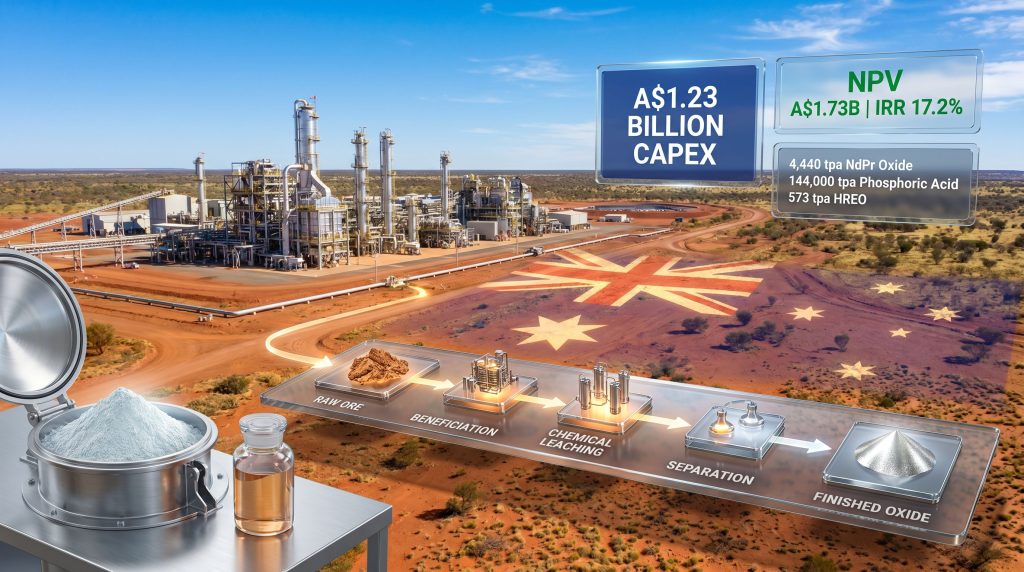
The term ore-to-oxide carries significant technical weight that is frequently lost in mainstream coverage. In practical terms, it describes a processing architecture where every transformation stage occurs within the same project boundary: open-cut mining, crushing and beneficiation to produce a concentrate, hydrometallurgical leaching to extract rare earth elements from the concentrate, and finally the chemical separation steps that yield individual, purified rare earth oxides.
The final product, a separated rare earth oxide, is what magnet manufacturers in South Korea, Germany, and Japan actually need as a feedstock. It is the input material for NdPr metal production, which in turn feeds the permanent magnet industry supplying electric vehicle motors and wind turbine generators.
The dominant global model does not work this way. Most rare earths projects outside China produce either a mixed carbonate or a concentrate, which are intermediate products requiring further downstream processing before they can be used by magnet manufacturers. Critically, that final processing step must occur somewhere with the industrial infrastructure to handle radioactive co-products, specifically thorium and uranium, which are chemically inseparable from rare earth concentrates during the earlier processing stages.
That constraint quietly but powerfully limits where concentrates can actually be shipped for final refining, and China's processing ecosystem has been built precisely to manage this challenge at scale. The rare earth processing challenges involved in handling these radioactive co-products are a key reason why so few Western operations have successfully built end-to-end separation capability.
At the Nolans project, the oxide processing and separation infrastructure accounts for approximately 90% of the project's total capital expenditure of A$1.23 billion — a figure that makes clear where rare earths economics are genuinely determined.
This capital weighting is not an anomaly. It reflects the fundamental reality that rare earths are a chemistry business wearing a mining project's identity. The ore extraction component is relatively straightforward. The chemical plant is where the complexity, the cost, and the competitive differentiation actually reside.
Where Nolans Sits: Geography, Logistics, and Strategic Context
Infrastructure Requirements in a Remote Operating Environment
The Nolans project is located approximately 135 kilometres north of Alice Springs and roughly 1,140 kilometres southeast of Darwin in Australia's Northern Territory. Its remoteness creates tangible logistical requirements that Arafura Rare Earths (ASX: ARU) is already addressing ahead of a targeted September 2026 construction commencement.
Pre-construction activities currently underway include:
- Recommissioning of the onsite accommodation camp
- Rehabilitation of the site's water supply infrastructure and pipelines
- Upgrades to access roads connecting the site to regional transport networks
- Preparatory approvals work associated with expanding container handling capacity at Darwin Port
The Darwin Port capacity expansion is a logistically material milestone for the project's operational phase, as oxide product export will depend on it. That expansion represents the kind of enabling infrastructure that must be developed in parallel with construction, not sequentially after it.
The Sovereign Processing Argument
Australia's critical minerals strategy has become increasingly prominent in global policy discussions, though it is important to distinguish between national-level policy frameworks and project-specific regulatory arrangements. What is unambiguous is the commercial logic: China currently controls not only the majority of global rare earths mining output but, more critically, the overwhelming share of global processing and separation capacity.
Projects that mine rare earths but still require Chinese processing infrastructure to produce a finished oxide have not actually escaped the dependency. They have merely relocated its expression to a different point in the supply chain. The Arafura Nolans rare earths ore-to-oxide mine directly addresses this structural gap by completing the full transformation from run-of-mine ore to separated oxide within Australian jurisdiction, removing the offshore processing dependency entirely.
How Nolans Compares to the Global Rare Earths Oxide Landscape
The Western Oxide Trio: A Structural Comparison
Outside China, the number of operations capable of producing a separated rare earth oxide is vanishingly small. The following table illustrates the current competitive set:
| Project | Operator | Location | Processing Model | Key Output |
|---|---|---|---|---|
| Mountain Pass | MP Materials (NYSE: MP) | California, USA | On-site processing | NdPr oxide |
| Mount Weld | Lynas Rare Earths (ASX: LYC) | Western Australia | Mine in WA; separation in Malaysia | NdPr oxide |
| Nolans | Arafura Rare Earths (ASX: ARU) | Northern Territory, AU | Fully integrated on-site | NdPr oxide + HREOs + phosphoric acid |
While Lynas Rare Earths operates at significantly higher production volumes than Nolans will at nameplate capacity, its processing and separation facility is located in Malaysia rather than on Australian soil. From a pure supply chain sovereignty standpoint, this represents a structural limitation: finished oxide production occurs outside the mining country's jurisdiction.
The radioactive waste management dimension adds a further layer of complexity to this comparison. Because rare earth concentrates contain co-occurring thorium and uranium, the number of jurisdictions with both the technical capability and regulatory approval to receive and process them is extremely limited. Projects that produce concentrate rather than oxide therefore face a quietly constrained set of processing destinations, with China's infrastructure remaining the path of least resistance for many.
Structural Insight: Nolans is engineered to complete the full transformation from run-of-mine ore to separated oxide within Australian jurisdiction, bypassing the radioactive waste logistics challenge that constrains concentrate-based projects.
Core Project Economics: The Numbers Behind the Investment Case
Key Financial and Production Metrics
The project economics underpinning Arafura's Final Investment Decision (FID), reached on 21 May 2026, were updated in July 2024 as part of the debt financing package process. The latest project update outlines the full scope of development activity and milestones achieved to date.
| Metric | Value |
|---|---|
| Total Capital Expenditure | A$1.23 billion |
| Post-Tax Net Present Value (NPV) | A$1.73 billion |
| Internal Rate of Return (IRR) | 17.2% |
| Annual NdPr Oxide Production (Nameplate) | 4,440 tonnes |
| Estimated Global NdPr Market Share | ~4% |
| Annual Phosphoric Acid Production | 144,000 tonnes |
| Annual Heavy Rare Earth Oxide Production | 573 tonnes |
| Mine Operating Life | 38 years |
| Global Cost Quartile Ranking | First quartile |
| Targeted Commercial Production Start | Late 2029 |
A post-tax NPV of A$1.73 billion against a total capital expenditure of A$1.23 billion reflects a value creation multiple that is meaningful but not speculative. The 17.2% IRR sits comfortably above typical project finance thresholds for resource developments of this scale and complexity.
First-quartile cost positioning is materially driven by the phosphoric acid byproduct, which generates revenue that offsets operating expenditure across the life of mine. This is not a marginal contributor. The phosphoric acid economics are structurally embedded in Nolans' competitive cost position, which has direct implications for the project's ability to withstand NdPr price cycles without requiring price support mechanisms.
How the Project Was Financed: A Multi-Layered Capital Structure
Equity Financing: Reaching the A$887 Million Milestone
Total equity financing reached A$887 million at the time of FID in May 2026. The catalytic capital event enabling FID was a A$350 million equity raise completed in May 2026, which brought cumulative equity financing to the threshold required to satisfy project finance conditions.
Key equity financing components include:
- A$430 million in binding equity commitments from three institutional parties: the German Raw Materials Fund, Export Finance Australia, and Australia's National Reconstruction Fund Corporation, pending shareholder approval at the time of FID
- Hancock Prospecting, controlled by Gina Rinehart, holding a 17.5% stake as the largest single shareholder, contributing A$125 million in a late 2025 financing round and a further A$85 million in the May 2026 raise, for a total contribution of A$210 million
Debt Financing: A$1.01 Billion Across Nine International Lenders
The debt package of approximately A$1.01 billion was secured in 2024 across lenders from Australia, Canada, Germany, Singapore, and South Korea, reflecting multi-jurisdiction institutional confidence in the project's risk-adjusted economics.
| Financing Layer | Amount |
|---|---|
| Total Equity Financing (at FID) | A$887 million |
| May 2026 Equity Raise | A$350 million |
| Debt Financing Package | ~A$1.01 billion |
| Pending Binding Equity Commitments | A$430 million |
| Hancock Prospecting Total Contribution | A$210 million |
Additionally, the U.S. Export-Import Bank issued a non-binding letter of intent in October 2025 indicating potential financing of up to US$300 million for the separate heavy rare earths separation project, though this remains non-binding and subject to further process.
The next major ASX story will hit our subscribers first
The Offtake Architecture: Who Is Buying Nolans Oxide and on What Terms
Contracted Volumes and Counterparties
Meeting an 80% contracted offtake threshold was a key condition of Arafura's financing arrangements. That threshold was achieved prior to FID, with the following contracted positions in place:
| Offtake Partner | Volume (tpa) | Region | End Use |
|---|---|---|---|
| Hyundai and Kia | 1,500 | South Korea | EV permanent magnets |
| Siemens Gamesa RE | 520 | Germany | Wind turbine magnets |
| Traxys Europe | 300 | Europe | Metals distribution |
| Traxys North America | 500 | North America | Metals distribution |
| Australia CMSR | 500 | Australia | Strategic reserve |
| German Offtakers (in negotiation) | 250-500 | Germany | TBC |
At the time of FID, contracted volumes totalled approximately 3,320 tonnes per year, rising to a potential 3,820 tonnes per year upon finalisation of the pending German agreements. Furthermore, the Arafura-Traxys supply deal and the broader Arafura offtake agreement framework underscore the strategic importance of locking in non-Chinese downstream buyers across multiple geographies. Negotiations with multiple layers of the European supply chain, covering both raw oxide pricing and magnet manufacturing economics, were ongoing.
Pricing Architecture: Why Nolans Is Rejecting Price Floors
One of the more strategically significant aspects of the Nolans offtake structure is its deliberate rejection of price floor mechanisms in its contracts with Australia's Critical Mineral Strategic Reserve and Traxys North America. Instead, these contracts are indexed to rare earth benchmarks that explicitly exclude Chinese domestic pricing, including indices established by Benchmark Minerals Intelligence and S&P Global Platts for North American markets.
This position is commercially credible precisely because of the phosphoric acid byproduct economics. First-quartile cost positioning means that Nolans can generate acceptable returns without the pricing insurance that higher-cost producers require. It also reflects a broader strategic objective: by anchoring contracts to non-Chinese pricing indices, Arafura is actively participating in the construction of a transparent Western-market price discovery mechanism for rare earth oxides, which is a foundational requirement for long-term supply chain independence from Chinese benchmark pricing.
This contrasts directly with the approach taken at Mountain Pass in the United States, where a government-backed pricing mechanism was introduced to support domestic rare earth production economics, as reported in coverage of MP Materials' operations.
Beyond NdPr: The Underappreciated Value in Phosphoric Acid and Heavy Rare Earths
Phosphoric Acid: A Cost-Curve Differentiator with Hidden Upside
Nolans' annual production target of 144,000 tonnes of phosphoric acid was modelled in the feasibility study on the basis of fertilizer-grade acid sold into Indian agricultural markets, for which pricing benchmarks have been established. This conservative baseline creates a meaningful but underappreciated optionality.
The acid produced at Nolans will be materially higher in purity than standard fertilizer-grade material. However, it does not currently reach the threshold required for lithium iron phosphate (LFP) battery manufacturing without additional processing steps. Arafura has indicated it is engaging with LFP battery manufacturers to explore whether any parties would undertake the additional processing required to upgrade the acid to battery-grade specification, which would unlock significantly higher pricing.
This potential upside has not been incorporated into the current project economics, representing a genuine source of revenue optionality that investors and analysts should monitor as LFP battery demand continues to grow.
Heavy Rare Earths: The Critical but Underweighted Output
Nolans' projected annual production of 573 tonnes of samarium-europium-gadolinium and heavy rare earth oxide contains approximately:
- ~25 tonnes of dysprosium oxide per year
- ~8 tonnes of terbium oxide per year
These are not footnote quantities. Dysprosium and terbium are critical additions to NdFeB permanent magnets, enhancing their thermal stability and coercivity at operating temperatures relevant to electric motors and wind turbine generators. Magnet manufacturing operations outside China require proportionally higher heavy rare earth inputs because differing manufacturing techniques do not yet replicate the efficiency with which Chinese processes incorporate these elements.
This drives disproportionate demand for dysprosium and terbium from non-Chinese magnet producers, at a time when their pricing has risen sharply as magnet manufacturing capacity relocates away from China. Nolans would consequently become one of a very small number of non-Chinese production sources for these specific heavy rare earths, a distinction that carries meaningful strategic and pricing significance independent of the NdPr production story.
Construction Timeline and Expansion Pathway
Stage One: From Ground-Break to First Production
- FID achieved: 21 May 2026
- Pre-construction activities: Underway (camp recommissioning, water line upgrades, road preparation)
- Construction commencement target: September 2026
- Primary construction scope: Oxide processing plant and associated infrastructure (~90% of capital)
- Targeted commercial production start: Late 2029
Stage Two: Targeting 10,000 Tonnes NdPr Per Year
The Stage One FID simultaneously opens a formal pathway for prefeasibility study work on a Stage Two expansion targeting more than double the nameplate NdPr oxide output, from 4,440 tonnes per year to 10,000 tonnes per year. The prefeasibility study is targeted for completion in early 2027, with environmental and regulatory approvals to be pursued concurrently with Stage One construction, enabling Stage Two construction to commence while Stage One is generating revenue.
Heavy Rare Earths Separation Project (Parallel Track)
A separate heavy rare earths separation initiative is being advanced in parallel with Stage One, with the intention of achieving operational status by the time NdPr oxide production commences in late 2029. The capital requirement for this project has been described as relatively modest compared to the main oxide plant. The U.S. EXIM Bank non-binding letter of intent for up to US$300 million in potential financing remains a noteworthy indicator of international institutional interest in this component, though it is not a binding commitment.
Frequently Asked Questions: Arafura Nolans Rare Earths Project
What does ore-to-oxide mean at Nolans?
It means that ore mined at the Arafura Nolans rare earths ore-to-oxide mine undergoes every processing and separation stage on-site in the Northern Territory, yielding a separated rare earth oxide deliverable directly to magnet manufacturers. No intermediate product is shipped offshore for further refining.
When will Nolans start producing NdPr oxide?
Commercial production is targeted to commence in late 2029, following a construction start in September 2026.
What makes Nolans different from Lynas Rare Earths' operation?
Lynas processes and separates its rare earths at a facility in Malaysia rather than on Australian soil. Nolans completes all processing within Australia, providing a higher degree of supply chain sovereignty and eliminating the need to route radioactive intermediate materials through a third-party jurisdiction.
Why does Nolans not require price floors in its contracts?
First-quartile cost positioning, supported materially by phosphoric acid byproduct revenues, means that Nolans can operate economically without price floor protection. This allows the project to instead index contracts to non-Chinese benchmarks, contributing to transparent Western price discovery for rare earth oxides.
Who are the major shareholders and financiers of Arafura?
Hancock Prospecting, associated with Gina Rinehart, holds a 17.5% stake as the largest shareholder. Institutional equity commitments have been secured from the German Raw Materials Fund, Export Finance Australia, and Australia's National Reconstruction Fund Corporation. Debt financing of approximately A$1.01 billion was arranged across nine international lenders from five countries.
This article contains forward-looking statements and financial projections derived from Arafura Rare Earths' published feasibility study and project financing disclosures. All project economics, timelines, and production forecasts are subject to change and carry inherent uncertainty. This content is for informational purposes only and does not constitute financial advice. Readers should conduct their own due diligence before making any investment decisions.
Want to Spot the Next Major Rare Earth Discovery Before the Market Does?
Discovery Alert's proprietary Discovery IQ model scans ASX announcements in real time, instantly identifying significant mineral discoveries across rare earths and over 30 other commodities — turning complex exploration data into clear, actionable opportunities for both traders and long-term investors. Explore how historic mineral discoveries have generated extraordinary returns on Discovery Alert's dedicated discoveries page, and begin your 14-day free trial today to position yourself ahead of the broader market.