June 15, 2026
The Arctic Beneath the Ice: Understanding Greenland's Complex Mining Landscape
The global scramble for critical minerals has exposed a fundamental contradiction at the heart of modern resource economics: the world's most geologically significant deposits are often located in the most operationally and politically complex environments. Greenland is the most vivid illustration of this paradox. Beneath its ice sheet lies one of the most mineralogically diverse landmasses on Earth, yet only two mines are currently producing anything at all. The story of Greenland mining projects is not simply about what exists underground; it is about the layered forces, from Arctic logistics to domestic sovereignty, that determine whether any of it ever reaches a global supply chain.
When big ASX news breaks, our subscribers know first
A Geological Formation Unlike Any Other
Greenland's mineralogical richness traces back to its Precambrian shield, a geological basement among the oldest on the planet. Over billions of years, tectonic and magmatic processes concentrated rare earth elements, graphite, molybdenum, gold, zinc, and copper into formations that modern exploration is only beginning to fully characterise.
What makes Greenland particularly unusual from a geological standpoint is the co-occurrence of multiple strategic minerals within relatively close geographic proximity in its southern regions, particularly around the Gardar igneous province, where alkaline intrusions created ideal conditions for rare earth element concentration.
This geological context matters because it shapes how investors and governments think about risk. Furthermore, unlike single-commodity frontiers, Greenland offers portfolio exposure to several critical mineral classes simultaneously, which is partly why strategic interest from Western governments has moved well beyond diplomatic rhetoric into project-level financial engagement. Greenland critical minerals have consequently attracted significant attention from resource economists and policymakers alike.
Greenland Mining Projects: Two Operating, Many Waiting
The gap between Greenland's mineral endowment and its actual production output is stark. As of mid-2026, only two commercial mining operations are running on the island:
- Nalunaq Gold Mine in southern Greenland, an underground operation with a history stretching back to earlier development cycles and now focused on operational optimisation
- White Mountain Anorthosite Mine, which produces a calcium-rich feldspar used in glass, ceramics, and industrial filler applications
These two operations represent the entirety of Greenland's active extraction economy. Everything else, including deposits that rank among the world's most significant accumulations of their respective minerals, sits in various stages of exploration, permitting, feasibility, or political limbo.
Nalunaq: Recovery Rates as the Defining Metric
For underground gold operations in remote Arctic environments, metallurgical recovery rate is arguably the single most important operational variable. Unlike open-pit operations where throughput scale can compensate for processing inefficiencies, underground mines with high fixed costs and constrained logistics need to extract maximum value from every tonne of ore processed.
Recent operational work at Nalunaq has focused on improving these recovery rates, a technically demanding task that involves optimising crush sizes, reagent chemistry, and gravity-leach circuit design under conditions where resupply of consumables is expensive and seasonally constrained.
Incremental recovery improvements in remote operations can disproportionately improve project economics. A recovery rate increase of even a few percentage points translates directly into additional gold ounces without requiring additional mining activity, which matters enormously when operating costs per tonne are elevated by Arctic logistics.
The Rare Earth Equation: Tanbreez, Kvanefjeld, and the Uranium Complication
Among all Greenland mining projects, the rare earth element (REE) story attracts the most geopolitical attention, and for good reason. Neodymium, praseodymium, dysprosium, and terbium, the so-called magnet metals, are irreplaceable in electric motors and permanent magnet wind turbines. China dominates both the mining and processing of these materials, and Western supply chain planners have spent years searching for credible alternative sources.
Indeed, rare earth supply chains have become a defining geopolitical concern for governments across the Western Hemisphere. Greenland's southern REE belt contains two of the most discussed deposits on Earth:
| Project | Primary Minerals | Key Feature | Current Constraint |
|---|---|---|---|
| Tanbreez | REE (light and heavy) | One of world's largest REE deposits | Offtake agreements, financing |
| Kvanefjeld | REE + Uranium | Globally significant REE concentration | Greenland's 2021 uranium mining ban |
Tanbreez: US Financial Institutions Enter the Picture
The Tanbreez REE project, operated by Critical Metals Corp, stands as one of the largest known rare earth accumulations globally. In 2025, the project received a letter of interest from the US Export-Import Bank, which is a meaningful development in project finance terms. Export credit agency interest does not constitute committed funding, but it signals that a project has cleared preliminary due diligence thresholds within a government financing institution.
For a frontier-jurisdiction project, this kind of engagement reduces perceived sovereign risk and can unlock conversations with commercial lenders who look for government-aligned capital as a co-investment signal. Drill rigs have been assembled on site, and ground-level exploration work is progressing. The critical near-term milestone for Tanbreez remains securing offtake agreements, which in REE project development is typically a prerequisite for moving from feasibility into project financing.
Kvanefjeld: When Policy Overrides Geology
The Kvanefjeld deposit presents a different challenge entirely. It hosts one of the highest concentrations of rare earth elements known anywhere on the planet, however uranium occurs as an inseparable co-mineral within the ore body. When Greenland's parliament, the Inatsisartut, reinstated a zero-tolerance policy on uranium mining in 2021, it effectively severed the development pathway for Kvanefjeld under current regulatory conditions.
This decision is instructive for understanding how Greenland's governance framework operates. The Greenlandic government has demonstrated a clear willingness to prioritise community values and environmental sovereignty over resource extraction opportunity, even when the foregone economic value is substantial. For investors evaluating any Greenland mining project, this precedent establishes that the regulatory environment can and will override geological merit when community concerns are sufficiently strong.
The uranium mining ban at Kvanefjeld has created an unexpected secondary effect: uranium grade has become a project viability criterion for REE deposits across Greenland's southern mineral belt. Low-uranium REE deposits now command a meaningful regulatory and social licence premium over geologically richer but uranium-bearing alternatives.
The Low-Uranium Advantage: A New Grading Dimension
Within the Greenland REE development landscape, a new category of geological due diligence has emerged. Historically, REE project assessment focused on total rare earth oxide grades, the proportion of magnet metals within the total REE basket, and mineralogical processing characteristics. Post-2021, uranium content in the host rock has become equally important as a commercial variable.
Projects that can demonstrate low uranium content, or processing flowsheets that avoid uranium concentration in any product stream, gain a measurable advantage in Greenland's regulatory environment. This is a development that is not widely appreciated outside of Greenland-specific technical circles, but it materially reshapes how the southern REE belt's deposits should be comparatively ranked.
Graphite and the Amitsoq License: A 30-Year Commitment
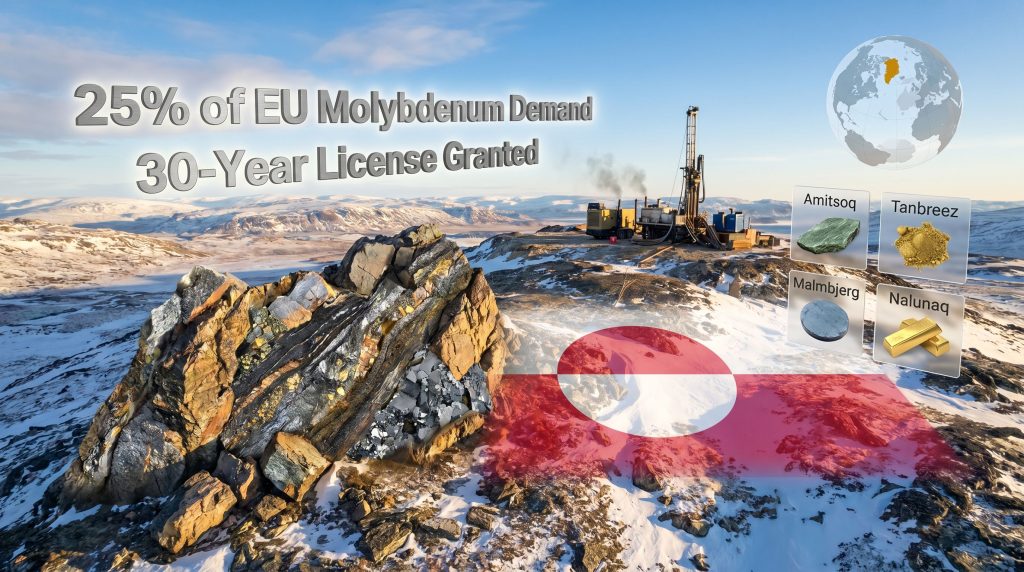
In December 2025, Greenland's government granted GreenRoc Mining a 30-year exploitation license for the Amitsoq graphite deposit in southwest Greenland. This is among the most significant regulatory milestones in the current development cycle for Greenland mining projects, for several reasons.
First, a 30-year license horizon is long even by global mining standards. It reflects the scale of upfront infrastructure investment required to bring an Arctic graphite project into production and provides the kind of tenure security that institutional project lenders require before committing capital.
Second, the strategic backdrop for graphite has intensified considerably. Battery-grade graphite, specifically the spherical purified graphite used as anode material in lithium-ion cells, is currently produced at meaningful commercial scale in very few locations outside of China. These graphite supply challenges are driving Western battery cell manufacturers to actively seek alternative supply sources, particularly those supplying European and North American electric vehicle production.
Why Battery-Grade Graphite Is More Complex Than It Appears
A technical point worth understanding: natural graphite from the mine is not directly usable in battery anodes. It requires a transformation process, including micronising (grinding to fine particle sizes), spheronisation (shaping particles into spheres for optimal packing density), and purification to high carbon content, typically above 99.95%.
The processing knowhow for this transformation is concentrated in China, which creates a secondary challenge for projects like Amitsoq: securing not just mine-gate offtake, but downstream processing partnerships that can deliver battery-qualified material. This is an underappreciated complexity in the Western graphite supply chain narrative. Licensing a mine is one step; building or accessing the processing technology to convert natural flake graphite into battery-grade spherical product is a separate and substantial challenge.
Malmbjerg: Molybdenum's Strategic Underappreciation
The Malmbjerg Molybdenum Project, being advanced by Greenland Resources in east-central Greenland, occupies an unusual position in the critical minerals conversation: it is one of the most strategically significant projects that receives the least public attention relative to its potential impact.
Project proponents estimate Malmbjerg could supply approximately 25% of European Union molybdenum demand at planned production rates, with a designed mine life of 20 years. Molybdenum's primary use as a strengthening alloy in high-performance steel means it has relevance across defence manufacturing, energy infrastructure, and industrial machinery. Its growing application in hydrogen fuel cell components and wind turbine technology adds a clean energy dimension to an already strategically important material.
Magnesium: The By-Product That Doubles the Strategic Value
Malmbjerg carries a magnesium by-product potential that is rarely discussed in project coverage. Magnesium is classified as a critical raw material by the European Commission, and its supply is heavily concentrated in China. A Greenlandic source of magnesium would simultaneously address two EU supply chain vulnerabilities from a single project, a feature that could prove attractive to European development finance institutions evaluating strategic mineral investments.
The next major ASX story will hit our subscribers first
The Four Barriers That Define Arctic Mining Economics
Understanding why so few Greenland mining projects have reached production requires examining the structural constraints that Arctic mining imposes:
-
Logistics and climate: Seasonal sea ice restrictions compress shipping windows, and the absence of road infrastructure between most mine sites and coastal ports means that construction logistics require purpose-built solutions, often including helicopter lifts for early-stage equipment delivery.
-
Energy costs: Remote Arctic mining sites lack grid power access. Diesel generation, the default early-stage solution, can account for 20 to 35% of total operating costs in isolated Arctic operations. This cost structure narrows the margin of viable ore grades considerably compared to operations in more accessible jurisdictions.
-
Permitting complexity: Greenland's governance structure involves both the Naalakkersuisut (Greenland's self-government) and the Kingdom of Denmark, creating a layered regulatory environment. Environmental impact assessments in Arctic ecosystems face heightened scrutiny given the ecological sensitivity of tundra and marine environments, and community consultation with Inuit populations adds process depth that extends development timelines.
-
Policy risk: The uranium mining ban and the separate ban on fossil fuel exploration and extraction demonstrate that Greenland's policy environment can shift in ways that directly affect project viability. Investors must model this sovereign risk into their project valuations, and the cost of that risk premium is not trivial in a jurisdiction with limited operational history.
Greenland's Regulatory Architecture: What Investors Need to Understand
The Greenlandic Bureau of Minerals and Petroleum serves as the primary licensing body for extractive projects. License terms have demonstrated flexibility, as the 30-year Amitsoq graphite license illustrates, when projects align with Greenland's policy priorities around environmental compliance, community engagement, and the avoidance of politically sensitive mineral outputs.
The strategic implication for project developers is clear: projects that minimise environmental footprint, avoid uranium co-products, and invest meaningfully in community relationships are demonstrably better positioned for regulatory success. This is not merely a compliance observation; it is a project design principle that should inform resource development strategy from the earliest stages.
Western Government Engagement: Concrete vs. Rhetorical
The most useful analytical distinction for evaluating Western government interest in Greenland mining projects is the difference between rhetorical support and project-level financial engagement. Political statements about Greenland's strategic importance have circulated since at least 2019. However, what is more significant in practical terms is when government financing institutions move from general policy positions to specific project due diligence.
The US Export-Import Bank's letter of interest in Tanbreez is an example of the latter. Export credit agency involvement signals that a project has been assessed as viable enough to warrant structured financing consideration, which carries meaningful signal value for commercial lenders evaluating the same opportunity.
Similarly, the EU's Critical Raw Materials Act has created new institutional pathways for Greenlandic projects to access European development finance. As the Brookings Institution notes, however, the translation from policy framework to project-specific capital commitment remains a process that operates on its own timeline.
A Comparative Snapshot of Active Greenland Mining Projects
| Project | Mineral Focus | Status (2026) | Strategic Market | Key Risk |
|---|---|---|---|---|
| Nalunaq | Gold | Active production | Global gold market | Arctic operating cost base |
| Tanbreez | Rare earth elements | Active development | Western REE supply chains | Offtake and financing timeline |
| Amitsoq | Graphite | 30-year license granted | Battery anode supply chain | Processing technology access |
| Malmbjerg | Molybdenum + Magnesium | Feasibility/permitting | EU industrial and clean energy | Remote logistics and timeline |
| Kvanefjeld | REE + Uranium | Effectively stalled | Uncertain | Uranium mining ban |
Scenarios for Greenland's Mining Sector Through 2030
Three distinct development trajectories are plausible over the remainder of this decade:
Scenario 1: Coordinated Western Capital Mobilisation
Multiple projects, particularly Tanbreez, Amitsoq, and Malmbjerg, secure a combination of US and European development finance concurrently. Greenland's regulatory process accommodates an accelerated but environmentally compliant development pathway, and first production from new operations is achievable by 2030 to 2031. This scenario requires sustained political will from multiple Western governments and successful offtake negotiations across all three projects simultaneously.
Scenario 2: Sequential, Project-by-Project Advancement
Individual projects advance on their own merits and timelines without coordinated external support. Amitsoq, already holding a 30-year exploitation license, is the most likely first mover given its advanced regulatory position. Tanbreez progresses toward offtake completion. Malmbjerg continues environmental permitting with a longer development horizon. This is consequently the most probable near-term outcome.
Scenario 3: Structural Stall
A combination of community opposition, tightening environmental standards, and project economics that cannot absorb Arctic cost structures results in the development pipeline stagnating. The gap between Greenland's geological potential and its operational reality persists through the decade, and Western supply chain planners are forced to seek critical mineral alternatives elsewhere. In addition, considerations around global uranium reserves and broader energy security could further complicate decision-making frameworks in this scenario.
The most defensible near-term assessment is that Scenario 2 plays out, with selective project advancement driven by individual project teams navigating a complex but navigable regulatory and logistical environment. Western government financing can play a catalytic role, but it is unlikely to compress development timelines dramatically in a jurisdiction where community consent and environmental process are non-negotiable prerequisites.
Furthermore, as the BBC has reported, the broader scramble for Greenland's rare earths reflects how fundamentally the global critical minerals landscape has shifted in recent years, with sovereign governments increasingly treating mineral access as a matter of national security rather than purely commercial opportunity.
Frequently Asked Questions: Greenland Mining Projects
How many active mines does Greenland have?
As of 2026, Greenland has two operational mines: the Nalunaq gold mine and the White Mountain anorthosite mine. The broader pipeline contains multiple projects in development, but commercial production from new operations has not yet commenced.
Why is Kvanefjeld not being developed despite its REE significance?
Kvanefjeld's rare earth resources are co-mingled with uranium mineralisation in a way that makes separation impractical under conventional processing. Greenland's 2021 reinstatement of a zero-tolerance uranium mining policy has effectively blocked the project's development under current law, regardless of its geological significance.
What makes the Amitsoq graphite license significant?
The 30-year license duration granted to GreenRoc Mining in December 2025 provides the kind of long-term tenure security that project finance requires. Combined with graphite's strategic importance as a battery anode material, this license positions Amitsoq as one of the most advanced non-Chinese graphite development opportunities in the Western Hemisphere.
What is the significance of uranium grade in Greenland REE projects?
Following the 2021 uranium mining ban, uranium content in REE ore bodies has become a critical project viability determinant in Greenland, separate from its metallurgical implications. Deposits with demonstrably low uranium grades have a significant regulatory and social licence advantage over uranium-bearing alternatives, reshaping comparative project rankings across the southern REE belt.
What are the primary cost drivers in Arctic mining?
Energy supply, logistics, and workforce deployment are the three dominant cost drivers. Energy alone, typically diesel-generated at remote sites, can represent 20 to 35% of operating expenditure. Seasonal shipping constraints add further complexity and cost to both construction and ongoing concentrate export.
Disclaimer: This article is intended for informational purposes only and does not constitute financial or investment advice. Forecasts, development scenarios, and project timelines discussed herein are based on publicly available information and analytical assessment. Readers should conduct independent due diligence before making investment decisions. Mining project development involves significant uncertainty, and actual outcomes may differ materially from projections.
Want to Track the Next Major Mineral Discovery Before the Market Does?
Discovery Alert's proprietary Discovery IQ model delivers real-time alerts on significant ASX mineral discoveries — instantly converting complex mineral data into actionable insights across critical commodities like rare earths, graphite, and molybdenum. Explore historic examples of major discovery returns and start your 14-day free trial at Discovery Alert to position yourself ahead of the broader market.