June 15, 2026
The Processing Paradox: Why Geological Wealth Alone Cannot Break China's Rare Earth Grip
The global rare earth supply chain is built on a fundamental asymmetry that most investors and policymakers consistently underestimate. Geological reserves, no matter how vast, represent nothing more than latent potential until they can be extracted, concentrated, separated, and refined into commercially usable forms. The nation that controls processing controls the supply chain, and that distinction sits at the very heart of the Brazil rare earths and China dependence debate unfolding across commodity markets today.
Brazil's emergence as the world's second-largest rare earth reserve holder has generated significant excitement among Western governments and institutional investors looking to reduce structural exposure to Chinese supply chains. Yet beneath the headline figures lies a far more complicated industrial reality, one that industry participants describe candidly as embryonic, constrained by processing challenges, human capital shortfalls, and a regulatory environment that has yet to earn the confidence of international capital.
When big ASX news breaks, our subscribers know first
Brazil's Geological Endowment: The Numbers Behind the Narrative
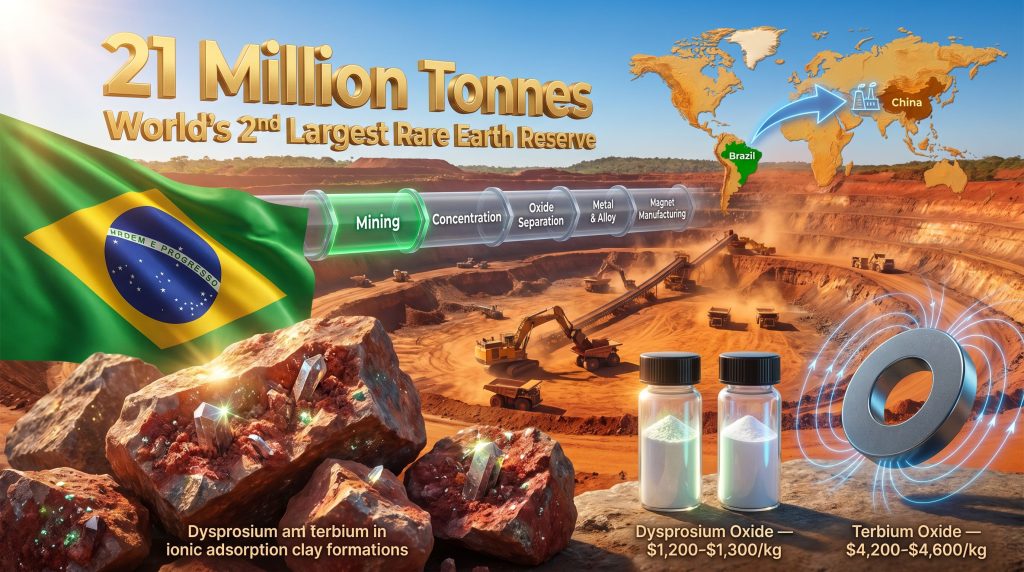
Brazil holds approximately 21 million tonnes of rare earth reserves according to the United States Geological Survey, placing it second globally behind China's 44 million tonnes. Depending on the classification methodology applied, Brazil's share of total global rare earth resources is estimated at between 23% and 28%, a figure that has attracted intensifying Western attention in recent years.
What makes Brazil's reserves particularly strategically significant is their composition, not merely their scale. The country's deposits include substantial ionic adsorption clay formations, a deposit type that is disproportionately enriched in heavy rare earth elements. These clay-hosted deposits yield elevated concentrations of dysprosium and terbium, two elements that command significant pricing premiums and serve as essential inputs for high-performance neodymium-iron-boron (NdFeB) permanent magnets used in EV drivetrains, wind turbine generators, aerospace systems, and defence hardware.
Why Ionic Adsorption Clays Matter More Than Most Analysts Acknowledge
Ionic adsorption clay deposits represent a distinct geological category that is frequently misunderstood in mainstream coverage of rare earth markets. Unlike hard-rock carbonatite deposits, which tend to be enriched in light rare earth elements such as cerium and lanthanum, ionic clays host elements in an ion-exchangeable form adsorbed onto clay mineral surfaces. This makes them:
- Cheaper and less energy-intensive to process at the leaching stage
- Disproportionately enriched in the heavy rare earth elements most critical to magnet performance
- Particularly well-suited to producing the specific element mix that Western magnet manufacturers urgently need
The critical point for supply chain analysts is that the magnet industry's tightest supply constraints are concentrated precisely in dysprosium and terbium, the elements that Brazil's ionic clay deposits naturally deliver. This geological alignment with Western demand requirements is one of the primary reasons that Brazil is now being prioritised within global critical minerals diversification strategies.
China's Processing Dominance: A Five-Decade Industrial Achievement
Understanding why Brazil rare earths and China dependence remain structurally intertwined requires grasping the sheer depth of China's processing advantage. China controls an estimated 90% of global rare earth refining and separation capacity, a position built through approximately five decades of deliberate industrial policy, state investment, and the accumulation of extraordinarily specialised technical knowledge.
Rare earth metallurgy is widely regarded by sector specialists as among the most technically complex disciplines in the entire commodities industry. The separation of individual rare earth elements from mixed concentrates involves intricate solvent extraction chemistry, where hundreds of stages of liquid-liquid extraction must be precisely engineered and controlled to achieve the purity specifications required by magnet manufacturers. This is not a process that can be replicated by simply building a facility and hiring engineers without deep prior expertise.
Furthermore, China's rare earth strategy has been reinforced through deliberate policy mechanisms over decades, creating barriers to entry that are as much institutional as they are technical. As a consequence, outside China, meaningful rare earth separation expertise is concentrated in only a handful of entities globally, including Iluka Resources in Australia and a select group of European processors.
Outside China, meaningful rare earth separation expertise is concentrated in only a handful of entities globally, including Iluka Resources in Australia and a select group of European processors. This scarcity of technical knowledge is not incidental but reflects decades of barriers to entry that China's industrial system deliberately reinforced.
The Structural Paradox: China as Both Competitor and Customer
The geopolitical framing around Brazil's rare earth sector often obscures an inconvenient commercial reality. Despite Western pressure to diversify rare earth supply chains away from Chinese dependency, China remains the dominant destination for Brazilian rare earth exports, absorbing more than 60% of Brazil's rare earth shipments in the first half of 2025. Without domestic processing infrastructure, Brazilian material must travel to Chinese refineries regardless of the national identity of the mine's investor or owner.
This creates a structural paradox at the core of the Western diversification strategy: capital deployed into Brazilian upstream mining assets does not automatically produce supply chain independence if the mined concentrate continues flowing eastward for processing. The gap that truly matters is not at the mining stage but at the midstream separation and refining stage.
| Supply Chain Stage | Brazil's Current Status | China's Position |
|---|---|---|
| Mining and Extraction | Emerging, first modern projects from 2024 | Dominant global producer |
| Concentration | Limited operational capacity | Fully developed |
| Oxide Separation | Near-absent at commercial scale | Global leader, approx. 90% share |
| Metal and Alloy Production | Not yet established | Vertically integrated |
| Magnet Manufacturing | Minimal | World's largest producer |
The Mine-to-Magnet Ambition: Aspirational Vision vs. Industrial Reality
The concept of a mine-to-magnet supply chain, encompassing every stage from geological extraction through to finished permanent magnet fabrication, has become the organising framework for Western rare earth investment strategies. Brazil's exceptional geological endowment makes it a natural candidate for anchor positioning within such a strategy. The reality of executing that vision is, however, considerably more complex.
Renato Gonzaga, president of Brazilian Rare Earths in Brazil, has articulated the developmental challenge with notable candour in commentary to Fastmarkets. He described the existing public discourse in Brazil as somewhat superficial in its assumption that the leap from geological resource to refined product can be made quickly. His framing positions the realistic development pathway as a sequential progression:
- Scaled-up mining and concentrate production
- Domestic oxide separation facilities
- Metal and alloy production capability
- Magnet manufacturing integration
Gonzaga pointed out that China required approximately 50 years to build its current rare earth processing ecosystem, and that Brazil faces additional structural obstacles including skilled labour shortfalls and limited access to domestic capital. According to industry analysts, it could take between 15 and 20 years for Brazil to develop meaningful domestic refining capacity at commercial scale, even under favourable conditions.
The Human Capital Problem: The Constraint Nobody Fully Prices
The scarcity of rare earth processing expertise is a supply chain bottleneck that receives far less attention than it deserves. According to Ronaldo Lasmar, executive manager at Mineração Taboca, in commentary to Fastmarkets, the West entered the rare earth processing race late as countries were generally slow to recognise the strategic importance of this capability, and China's accumulated lead is now formidable.
The engineering knowledge required to operate commercial-scale rare earth separation facilities, particularly the solvent extraction circuits needed for heavy rare earth separation, does not exist in sufficient concentrations outside China to staff meaningful new operations rapidly. Building this workforce requires sustained investment in technical education programmes, international knowledge transfer initiatives, and competitive compensation structures capable of retaining scarce specialised talent over multi-decade project timelines.
Key Projects Advancing Brazil's Rare Earth Pipeline
Despite the structural challenges, several Brazilian companies are making tangible progress across different stages of the rare earth value chain.
Mineração Taboca has committed $100 million over three years to expand resource development and modernise existing processing infrastructure, with initial focus on tin and ferro-niobium-tantalum production. Rare earth development occupies a subsequent phase of its investment roadmap, with feasibility and technological route studies underway in 2026. The company is specifically evaluating more sustainable processing methodologies for its rare earth development programme.
Brazilian Rare Earths is pursuing a differentiated strategic position by targeting domestic oxide separation capability rather than stopping at concentrate production. This ambition, if realised, would represent a meaningful step up the value chain and capture significantly more economic value per tonne of material processed.
Viridis has taken perhaps the most concrete step toward domestic processing capability, inaugurating a rare earth carbonate separation demonstration plant in May 2026. The company has also signed a Letter of Intent with Solvay to supply critical rare earth feedstocks from Brazil to Solvay's La Rochelle facility in France, establishing an early but tangible Western supply chain linkage. Viridis corporate manager Marcia Cunha has emphasised to Fastmarkets that regulatory predictability and legal security are essential preconditions for attracting the international funding and offtake agreements required to scale operations.
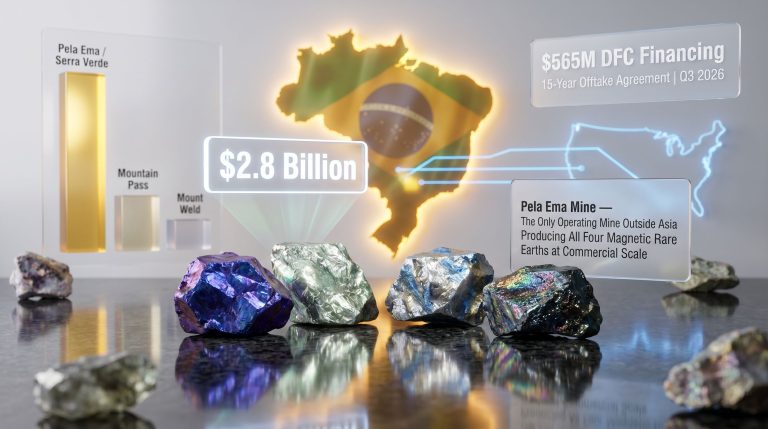
USA Rare Earth's $2.8 billion equity acquisition of Serra Verde, announced in April 2026, represents the most high-profile signal of Western capital commitment to Brazil's rare earth sector. However, as sector analysts consistently note, this effort to build a non-Chinese supply chain requires more than upstream investment alone, and mined material risks continuing to flow to China for oxide separation unless parallel refining infrastructure investment accompanies mining expansion.
The Lithium Sector as a Cautionary Mirror
Brazil's rare earth processing challenge finds a parallel cautionary tale in its lithium sector. Vinicius Alvarenga, chief executive officer of lithium producer Companhia Brasileira de Litio (CBL), stated plainly at the International Seminar on Critical and Strategic Minerals, organised by the Brazilian Mining Association (Ibram), that attracting foreign investment into domestic lithium carbonate or hydroxide refining is currently economically unviable without a pricing premium for non-Chinese certified supply.
He argued that the only viable commercial pathway to domestic refining investment is the establishment of a verifiable market premium for non-Chinese provenance, a structure that does not yet fully exist at meaningful scale. This framing applies with equal force to rare earths: Chinese refining operations benefit from decades of process optimisation, embedded scale economies, integrated supply chains, and technical expertise that Western or Brazilian competitors cannot replicate within investment timeframes that satisfy commercial return requirements.
Current Rare Earth and Lithium Price Benchmarks
| Commodity | Specification | Price (June 11, 2026) | Trend |
|---|---|---|---|
| Terbium oxide | 99.99%, CIP global | $4,200-$4,600/kg | Stable since March 19 |
| Dysprosium oxide | 99.5%, CIP global | $1,200-$1,300/kg | Stable since April 2 |
| Spodumene | Min 6% Li₂O, spot CIF China | $2,450-$2,540/t | Up 2.67% day-on-day |
| Lithium hydroxide | 56.5% LiOH min, battery grade CIF CJK | $19.50-$22.00/kg | Stable |
| Lithium carbonate | 99.5% Li₂CO₃ min, battery grade CIF CJK | $21.00-$22.00/kg | Widened upward |
Source: Fastmarkets price assessments, June 11, 2026. Prices are market assessments and subject to change. This data is provided for informational purposes only and does not constitute investment advice.
The next major ASX story will hit our subscribers first
Brazil's Policy Environment: The Regulatory Friction Point
Brazil's legislative debate around PL2780/2024, the proposed National Policy for Critical and Strategic Minerals (PNMCE), has introduced a layer of uncertainty that international investors are watching closely. The base text was approved by the Chamber of Deputies and awaits further analysis and voting in the Federal Senate.
Industry participants, including Gonzaga of Brazilian Rare Earths, have characterised the bill as excessively interventionist in its current form, with the potential to deter the very foreign capital Brazil urgently needs. His publicly stated concern is that the Senate needs to refine the text to avoid inadvertently isolating Brazil from the international rare earths debate at a moment when Western capital is actively seeking deployment opportunities in the sector.
In addition, China's export restrictions have intensified urgency among Western governments to secure alternative supply sources, making Brazil's regulatory environment a matter of considerable geopolitical as well as commercial interest. What international investors have consistently stated they require from Brazil's regulatory environment includes:
- Regulatory predictability, ensuring consistent and transparent licensing processes
- Legal security, with enforceable contracts and stable investment terms
- Infrastructure adequacy, covering logistics, energy, and processing support systems
- Bankable offtake structures, providing commercial frameworks that underpin project financing
Simultaneously, Brazil's government published its Critical Minerals: A Guide for Foreign Investors 2026 document, articulating an ambition to become an integrated supplier of processed inputs for batteries, solar panels, wind turbines, and electric motors. The document cites Brazil's combination of mineral reserves, renewable energy abundance, and trainable workforce as competitive advantages for building an integrated value chain. The gap between this aspirational positioning and the current infrastructure and technical reality remains the central challenge for Brazilian policymakers to bridge.
Two Futures: Brazil in 2040
The strategic question for Brazil rare earths and China dependence ultimately resolves into two divergent long-term scenarios, the outcome of which will be determined largely by decisions made in the next five years.
Scenario A: Coordinated Development Path. Brazil successfully attracts sustained Western capital into both mining and midstream processing, builds domestic oxide separation capacity through partnerships with established European and Australian processors, develops a technical workforce through targeted education investment, and achieves a stable and investor-friendly regulatory framework. By 2040, Brazil operates as a credible non-Chinese supplier of separated rare earth oxides, capturing significant value at the midstream stage and substantially reducing the structural flow of Brazilian material to Chinese refineries.
Scenario B: Structural Stagnation. Policy uncertainty deters long-term foreign investment in midstream infrastructure, human capital development programmes fail to achieve sufficient scale, and rare earth concentrate continues flowing to Chinese refineries indefinitely. Brazil's geological wealth generates export revenue at the raw material level but minimal domestic value-add, and the country's rare earth sector remains structurally dependent on China as both processor and primary customer well beyond 2040.
The geological foundation for Scenario A undeniably exists. What remains genuinely unresolved is whether Brazil can assemble the institutional, financial, and human capital architecture required to execute it at the pace that the global energy transition's demand timeline actually demands.
Disclaimer: This article contains forward-looking statements, market forecasts, and scenario projections that are inherently uncertain. Price data referenced reflects Fastmarkets assessments as of June 11, 2026, and is subject to change. Nothing in this article constitutes financial or investment advice. Readers should conduct independent research and consult qualified advisors before making investment decisions.
Want to Track the Next Major Rare Earth Discovery Before the Market Moves?
Discovery Alert's proprietary Discovery IQ model delivers real-time alerts the moment significant ASX mineral discoveries are announced, transforming complex geological data into actionable investment insights — explore historic examples of exceptional discovery returns to understand the opportunity, then begin your 14-day free trial at Discovery Alert to position yourself ahead of the broader market.