June 1, 2026
Geopolitical Crossroads in Critical Mineral Supply Chains
The global transition toward renewable energy technologies and electric vehicle manufacturing has exposed fundamental vulnerabilities in critical mineral supply networks. Over 80% of rare earth element processing capacity remains concentrated within Chinese facilities, creating systemic risks for Western technology sectors dependent on these materials. This concentration has prompted urgent diversification efforts across NATO alliance networks, seeking alternative supply nodes that can reduce dependency on single-nation production systems.
Against this backdrop, industrial developments in geographically strategic locations carry significance far beyond their immediate production metrics. Nations positioned between major demand centers and resource deposits find themselves uniquely positioned to serve as processing hubs, provided they can acquire the sophisticated separation technologies required for commercial-grade material production. The technical barriers to entry remain substantial, yet the strategic incentives for developing alternative supply chains continue intensifying amid US‑China trade war impacts on global supply networks.
When big ASX news breaks, our subscribers know first
Strategic Positioning of the Beylikova Development
The Türkiye rare earth facility planned for Beylikova represents more than a domestic mining initiative. Located approximately 300 kilometers west of Ankara in Eskişehir Province, the site positions Türkiye within 2,000-2,500 kilometres of major European rare earth oxide demand centres, including Germany's automotive sector and Poland's electronics manufacturing hubs. This geographic advantage could reduce logistics costs by an estimated 20-30% compared to shipping from Southeast Asian processing facilities.
Furthermore, the facility's development aligns with broader NATO supply chain resilience objectives. As a founding NATO member since 1952, Türkiye occupies a strategic position bridging European and Asian supply networks. The European Union imported approximately 70,000 tonnes of rare earth oxides equivalent in 2023, with over 60% sourced directly or indirectly from Chinese facilities. Developing alternative processing capacity within NATO territory addresses critical infrastructure vulnerabilities identified in the alliance's 2023 Critical Materials Task Force recommendations.
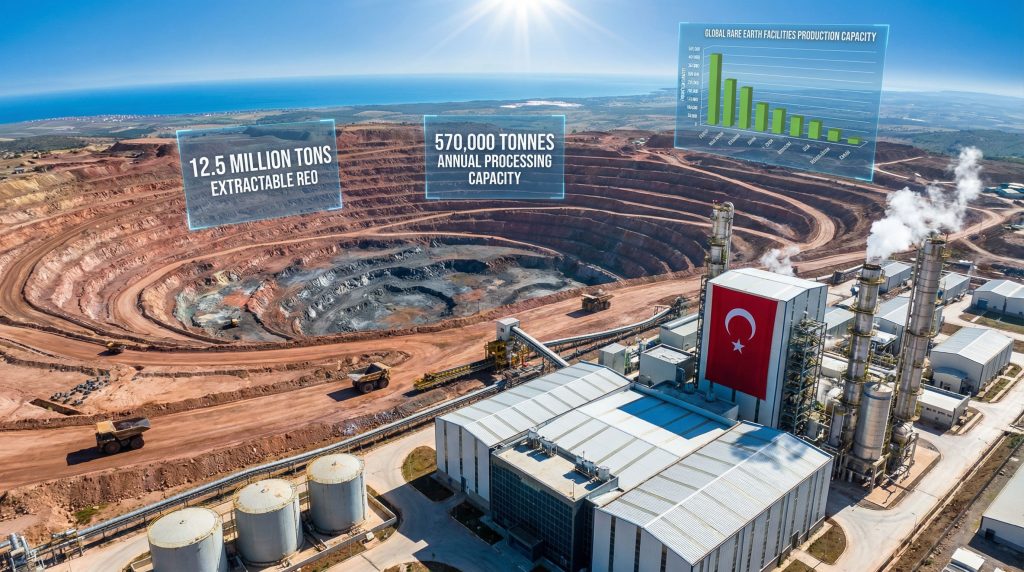
Current pilot operations at Beylikova process 1,200 tonnes of ore annually, achieving 92-93% purity levels. While falling short of commercial requirements for high-technology applications, these baseline operations provide the foundation for industrial scaling. The proposed expansion to 570,000 tonnes annual ore processing capacity represents a 475-fold increase from current operations, requiring substantial capital investment and technical expertise acquisition.
Resource Scale and Global Reserve Context
The Beylikova deposit contains an estimated 694 million tonnes of ore at approximately 1.8% rare earth oxide grade, yielding 12.5 million tonnes of extractable rare earth oxides. This positions the deposit as the second-largest known reserve globally after China's Bayan Obo complex, which contains approximately 37 million tonnes of identified rare earth oxide resources.
However, ore grade significantly impacts operational economics and processing requirements. In addition, Beylikova's 1.8% grade necessitates higher processing volumes compared to deposits like Mountain Pass (USA) at 8-10% grade or Bayan Obo at 5-6% grade. The facility must process approximately 1,561 tonnes of raw ore daily to achieve the targeted 570,000 tonnes annually, requiring substantial beneficiation infrastructure.
Global Reserve Comparison
| Location | Identified REO Resources | Ore Grade | Development Status |
|---|---|---|---|
| Bayan Obo, China | 37 million tonnes | 5-6% | Active Production |
| Beylikova, Türkiye | 12.5 million tonnes | 1.8% | Development Phase |
| Mountain Pass, USA | 2.2 million tonnes | 8-10% | Active Production |
| Mussau, Papua New Guinea | 1.3 million tonnes | 0.7% | Undeveloped |
| Kvanefield, Greenland | 1.0 million tonnes | 2.5% | Development Stage |
The deposit's thorium content presents both challenges and opportunities. Annual thorium oxide production of approximately 250 tonnes at full production scale requires specialized handling protocols and nuclear waste disposal standards. However, thorium's potential applications in nuclear energy sectors could provide additional revenue streams, offsetting processing complexity costs.
Processing Capacity and Technical Challenges
Industrial-scale rare earth processing requires distinct infrastructure components beyond basic ore beneficiation. The proposed Türkiye rare earth facility faces the fundamental challenge of developing separation chemistry capabilities from a baseline of zero operational commercial-scale plants domestically. Achieving commercial-grade purity specifications demands sophisticated solvent extraction systems, precipitation units, and quality control processes typically requiring 7-12 years to develop and optimise.
Current Global Processing Landscape
| Facility | Location | Annual Ore Processing | REO Output | Operational Status |
|---|---|---|---|---|
| Beylikova (Planned) | Türkiye | 570,000 tonnes | 10,000 tonnes | Development Phase |
| Mountain Pass | USA | 50,000 tonnes | 40,000 tonnes | Operational Since 2012 |
| Kuantan | Malaysia | 22,000 tonnes | 22,000 tonnes | Operational Since 2011 |
| Browns Range | Australia | 6,000 tonnes | 2,000 tonnes | Pilot Phase |
The purity gap between current Beylikova output (92-93%) and commercial requirements (99.5%+ for permanent magnets) represents a critical technical hurdle. Neodymium-iron-boron magnets, essential for electric vehicle motors and wind turbine generators, require 99.8% neodymium purity minimum. Achieving these specifications typically requires investment in advanced separation infrastructure costing $1-2 billion for facilities of Beylikova's proposed scale.
For instance, processing complexity varies significantly by rare earth element category. Light rare earth elements (lanthanum, cerium) are generally easier to separate but command lower market prices. Heavy rare earth elements, while more valuable, present greater technical challenges in separation chemistry. Beylikova's deposit composition skews toward light rare earth elements, with estimated distribution of 50-55% lanthanum and cerium content.
Investment Risk Assessment and Market Dynamics
The Türkiye rare earth facility development presents a complex risk-reward profile influenced by technical, regulatory, and market factors. Consequently, capital requirements of $2-3 billion for full industrial development create substantial financing hurdles, particularly given the specialised nature of rare earth processing equipment and limited global supplier base for separation technology.
Technical Risk Factors
Processing Infrastructure Requirements:
• Primary beneficiation systems: $200-400 million
• Separation chemistry facilities: $1-2 billion
• Environmental controls and thorium management: $300-500 million
• Workforce training and technical expertise acquisition: $50-100 million
Timeline Dependencies:
• Environmental permitting: 2-3 years
• Technology transfer negotiations: 12-24 months
• Construction and commissioning: 4-6 years
• Production optimisation: 2-4 years
The absence of domestic separation plant infrastructure creates dependency on international technology partnerships. China dominates global rare earth separation expertise, potentially creating conflicts between technology acquisition and supply chain diversification objectives. Alternative technology sources include established Western producers like MP Materials and Lynas, though licensing agreements typically involve substantial ongoing royalty commitments.
Market Positioning Opportunities
Despite technical challenges, the facility offers strategic advantages within European supply chains. Current rare earth transportation from Chinese facilities to European end-users involves 15,000-20,000 kilometre shipping distances with associated cost and timing vulnerabilities. Beylikova's positioning could reduce European supply chain complexity while providing NATO alliance nations with greater supply security through their critical minerals strategy.
Government backing through Türkiye's Ministry of Energy and Natural Resources provides project continuity advantages compared to purely private ventures. Political commitment spanning multiple election cycles reduces regulatory uncertainty, though execution capabilities remain unproven at industrial scales.
Rare Earth Element Distribution and Revenue Optimisation
The economic viability of the Türkiye rare earth facility depends heavily on optimising extraction and purification of higher-value rare earth elements despite their lower concentrations in the deposit. Market pricing for individual rare earth oxides varies dramatically, with heavy rare earth elements commanding premiums of 10-50 times light rare earth element prices.
Element Pricing and Market Applications
| Element | 2025 Price (USD/tonne) | Beylikova Presence | Key Applications |
|---|---|---|---|
| Lanthanum | $2,800 | High | Battery electrodes, catalysts |
| Cerium | $3,200 | High | Glass polishing, UV protection |
| Neodymium | $78,000 | Moderate | Permanent magnets, speakers |
| Praseodymium | $82,000 | Moderate | Permanent magnets, lasers |
| Dysprosium | $320,000 | Low | High-temperature magnets |
| Terbium | $1,200,000 | Very Low | Phosphors, solid-state lighting |
Revenue optimisation requires maximising recovery rates for neodymium and praseodymium despite their lower natural concentrations. Advanced processing techniques, including selective precipitation and multi-stage solvent extraction, could potentially increase recovery rates for these critical magnet materials by 15-25% above baseline processing methods.
The facility's light rare earth element dominance presents both challenges and opportunities. While lanthanum and cerium command lower unit prices, their applications in catalytic converters, battery technologies, and glass manufacturing create steady demand volumes. Developing integrated supply agreements with European automotive and electronics manufacturers could provide revenue stability during production ramp-up phases.
The next major ASX story will hit our subscribers first
International Partnership Requirements and Technology Transfer
Türkiye's rare earth ambitions necessitate extensive international collaboration due to the absence of domestic separation chemistry expertise. Furthermore, the complexity of achieving commercial-grade purity specifications requires technology partnerships with established producers or specialised engineering firms capable of designing and commissioning separation plants.
Technology Partnership Opportunities
Separation Technology Providers:
• Western-aligned options: MP Materials (USA), Lynas (Australia), Rainbow Rare Earths (UK)
• European engineering firms: Metso Outotec, FLSmidth, ANDRITZ
• Specialised chemistry consultants: SGS Minerals Services, Wood Group
Collaboration Framework Requirements:
• Licensing agreements for proprietary separation processes
• Technical training programmes for local workforce development
• Quality assurance systems meeting international standards
• Environmental management protocols for thorium-bearing materials
The geopolitical dimensions of technology partnerships create both opportunities and constraints. NATO alliance relationships facilitate collaboration with Western technology providers, potentially including government-backed financing through development finance institutions. However, the most advanced separation technologies remain closely guarded intellectual property, requiring substantial licensing fees and ongoing royalty commitments. Meanwhile, developments in the European CRM facility network could provide additional collaboration opportunities.
China's cooperation memorandum with Türkiye, signed in 2024, represents an alternative technology pathway despite broader Western diversification objectives. Chinese firms possess the most extensive rare earth separation expertise globally, though such partnerships could complicate the facility's positioning within NATO supply chains. According to recent analysis of Türkiye's rare earth potential, the country's strategic position offers unique advantages for developing alternative processing capabilities.
Environmental and Regulatory Compliance Framework
The Türkiye rare earth facility faces substantial environmental compliance requirements due to thorium content and the scale of proposed operations. Thorium, while less radioactive than uranium, requires specialised handling protocols and long-term storage solutions meeting international atomic energy agency standards.
Thorium Management Requirements
Annual Thorium Production Estimates:
• Thorium oxide (ThO₂): ~250 tonnes annually
• Storage infrastructure: Reinforced concrete containment systems
• Monitoring systems: Continuous radiation detection networks
• Worker protection: Specialised training and equipment protocols
Regulatory Compliance Pathways:
• International Atomic Energy Agency guidelines adherence
• Turkish Nuclear Regulatory Authority licensing
• European Union REACH regulation compliance for exports
• NATO security protocols for dual-use materials
Environmental impact assessments typically require 18-36 months for projects of this magnitude, particularly when radioactive materials are involved. The facility's water usage requirements, estimated at 2-4 cubic metres per tonne of ore processed, necessitate comprehensive water management systems and potential desalination infrastructure given the region's water scarcity challenges.
Waste tailings management presents additional complexity due to the low ore grade requiring high-volume processing. Approximately 560,000 tonnes of tailings annually must be safely stored or processed for secondary material recovery. Modern tailings management systems, including filtered dry stacking and perpetual care protocols, add $200-300 million to project capital requirements.
Production Timeline and Commercial Viability Assessment
Achieving commercial-scale production at the Türkiye rare earth facility requires coordinated development across multiple technical and regulatory domains. Historical precedent from similar projects suggests 8-12 year timelines from current pilot operations to full commercial production, assuming adequate capital availability and regulatory approval processes.
Development Phase Progression
2025-2027: Foundation Phase
• Technology partnership negotiations and agreements
• Environmental impact assessments and regulatory approvals
• Pilot plant optimisation targeting 97-98% purity levels
• Workforce development and training programme implementation
2028-2030: Construction Phase
• Industrial facility construction and equipment installation
• Separation plant commissioning and process optimisation
• Quality control systems development and certification
• Initial production trials and customer qualification
2031-2035: Production Scaling Phase
• Gradual capacity increases from 100,000 to 570,000 tonnes annually
• Process optimisation for higher-value element recovery
• Market penetration and long-term supply agreement development
• Potential downstream processing facility development
Critical Success Metrics
"Industry analysts emphasise that rare earth project success requires three fundamental elements: proven separation technology capabilities, sustained capital investment commitments, and consistent political support across multiple election cycles."
The facility's commercial viability depends on achieving specific performance benchmarks within projected timelines. Purity levels must reach 99.5% minimum for magnet-grade applications, requiring sophisticated quality control systems and potential product certification from international standards organisations.
Cost competitiveness against established producers presents ongoing challenges. Chinese rare earth oxide pricing reflects decades of infrastructure amortisation and process optimisation. New facilities typically require 5-7 years of production experience to achieve comparable cost structures, assuming adequate economies of scale.
Global Supply Chain Impact and Strategic Implications
The successful development of the Türkiye rare earth facility could significantly alter global supply chain dynamics for specific rare earth element categories. Current non-Chinese production capacity totals approximately 180,000 tonnes of rare earth oxides annually. Beylikova's proposed 10,000 tonne contribution represents 5.6% of existing non-Chinese capacity, providing meaningful diversification for European manufacturers.
Market Share Analysis
Current Global Production Distribution (2025):
• China: ~700,000 tonnes REO (79.5% market share)
• Rest of World: ~180,000 tonnes REO (20.5% market share)
• Proposed Beylikova Addition: 10,000 tonnes REO (1.1% global market)
Strategic Value Proposition:
• European supply chain proximity reducing logistics costs 15-25%
• NATO alliance alignment supporting supply security objectives
• Potential technology transfer benefits for broader Turkish mining sector
• Regional processing hub potential for Balkans and Central Asian deposits
The facility's strategic significance extends beyond production volumes to supply chain resilience considerations. European manufacturers currently face 3-6 month lead times for rare earth materials from Chinese suppliers, including potential disruption risks from geopolitical tensions or transportation bottlenecks. Domestic or near-domestic supply sources could reduce lead times to 2-4 weeks while providing greater supply security within the broader energy security transition.
Integration with European electric vehicle manufacturing clusters could create synergistic value propositions. Germany's automotive sector consumes approximately 15,000 tonnes of rare earth oxides annually for electric motor and battery applications. Developing dedicated supply agreements could provide revenue stability for the facility while ensuring supply security for critical European industries.
Investment Monitoring Framework and Risk Indicators
Evaluating the Türkiye rare earth facility's progression requires monitoring both technical achievements and financial commitments across multiple development phases. Traditional mining investment metrics may not adequately capture the specialised requirements of rare earth processing facility development.
Technical Performance Indicators
Production Quality Metrics:
• Purity level improvements: Target progression from 93% to 99.5%+
• Element recovery rates: Optimisation for higher-value neodymium/praseodymium
• Processing efficiency: Ore throughput per unit of energy consumed
• Environmental compliance: Thorium management and emissions control
Operational Capacity Indicators:
• Pilot plant utilisation rates and consistency
• Workforce development and retention metrics
• Equipment reliability and maintenance requirements
• Quality control certification from international standards bodies
Financial and Strategic Milestones
Capital Investment Validation:
• Technology partnership agreements with established producers
• Government funding commitments and disbursement schedules
• International development finance institution participation
• Pre-production sales agreements with European customers
Market Positioning Developments:
• Customer qualification processes with major manufacturers
• Supply chain integration with European industrial clusters
• Export licensing and regulatory framework establishment
• Downstream processing capability development plans
"Key Risk Warning: Rare earth project development typically requires 8-12 years from pilot operations to commercial production. Investors should evaluate concrete technical and financial progress rather than political announcements when assessing project viability."
The facility's ultimate success depends on Türkiye's ability to bridge the gap between political ambition and technical execution. While the resource base provides a solid foundation, achieving commercial competitiveness requires sustained investment in human capital, technology acquisition, and operational excellence over multiple years. According to research on rare earth element reserves in Türkiye, the country's geological potential extends beyond Beylikova, suggesting broader strategic implications for global supply chains.
Investment Disclaimer: This analysis contains forward-looking statements and projections based on current available information. Rare earth facility development involves substantial technical, regulatory, and market risks. Projected timelines, production targets, and financial estimates should not be considered guaranteed outcomes. Potential investors should conduct independent due diligence and consider consulting with qualified financial advisors before making investment decisions related to rare earth sector opportunities.
Looking to Capitalise on Critical Mineral Supply Chain Developments?
Discovery Alert's proprietary Discovery IQ model delivers real-time notifications on significant ASX mineral discoveries, including critical minerals essential for energy transition technologies. With global supply chains undergoing major restructuring and strategic developments like Türkiye's Beylikova facility reshaping rare earth markets, subscribers gain actionable insights into emerging opportunities ahead of broader market awareness. Begin your 30-day free trial today to position yourself strategically within this rapidly evolving sector.