June 12, 2026
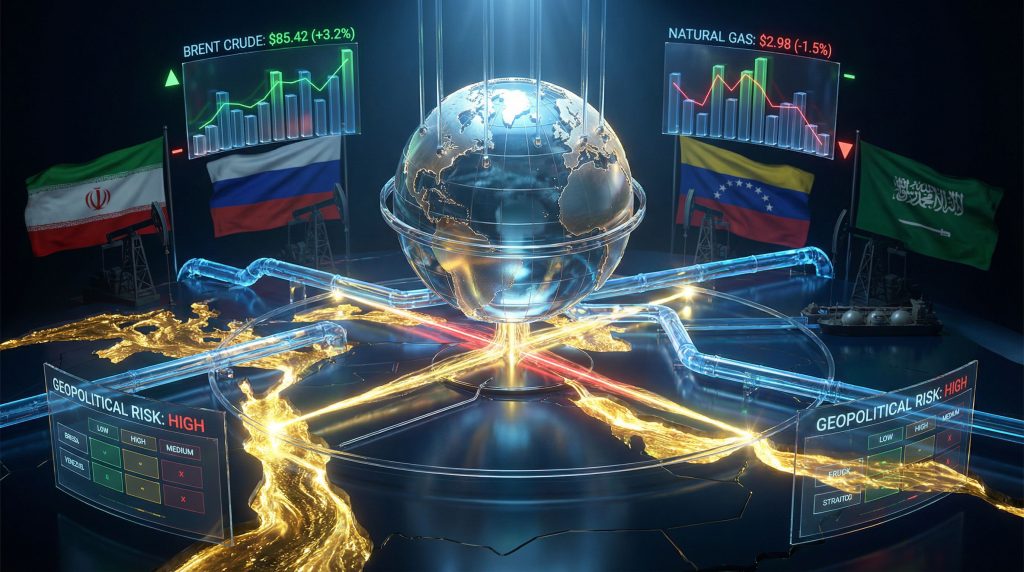
What Are the Primary Geopolitical Risk Factors Affecting Energy Markets Today?
Energy markets operate within a complex web of geographic vulnerabilities that can transform regional conflicts into global price shocks. The geopolitical impact on oil and gas prices extends far beyond the immediate regions of conflict, creating ripple effects across global supply chains and financial markets. Understanding these pressure points requires examining how physical infrastructure intersects with political instability across multiple dimensions.
Critical Chokepoint Analysis
Maritime energy transportation concentrates massive volumes through strategically vulnerable corridors, creating systemic risk points that amplify geopolitical tensions into market volatility. The Strait of Hormuz represents the most critical of these passages, with approximately 21-27 million barrels per day of crude oil and refined products transiting through this narrow waterway, accounting for roughly 20-25% of global petroleum traded by sea.
This concentration creates asymmetric leverage for regional actors, where localised disruptions can trigger worldwide supply concerns. Furthermore, alternative routing through longer sea lanes increases transportation costs and delivery times, while pipeline diversification projects require years of development and billions in infrastructure investment.
The Suez Canal serves as another critical vulnerability, particularly for European energy security. Blockages or security threats in this passage force tankers around the Cape of Good Hope, adding weeks to journey times and significantly increasing freight costs during periods of elevated tension.
State Actor Risk Assessment Matrix
Regional powers possess varying degrees of capacity to disrupt energy flows, creating different risk profiles that markets must continuously evaluate. Iran's position controlling access to the Persian Gulf gives it outsized influence relative to its actual energy exports to many Western markets.
Recent data from Germany's Federal Statistical Office illustrates this dynamic: while German crude oil imports from the Middle East totalled only 6.1% of total imports in 2025 (4.6 million tons out of 75.7 million tons), the geopolitical impact on oil and gas prices affects all market participants regardless of their direct supply exposure.
Germany's Middle East crude suppliers in 2025:
- Iraq: 4.2% of total German imports
- United Arab Emirates: 1.1%
- Saudi Arabia: 0.8%
- Iran, Oman, Qatar, Kuwait: 0%
This contrasts sharply with EU-wide dependency, where Middle Eastern sources represented 13% of total crude imports in 2025, highlighting differentiated vulnerability across European economies. Additionally, OPEC oil market influence remains significant in shaping global pricing dynamics.
Regional Conflict Spillover Effects
Energy infrastructure networks create interconnected vulnerability patterns where conflicts in one region can cascade across multiple supply chains. North African production facilities face security risks from regional instability, while West African offshore operations remain exposed to piracy and territorial disputes.
The interconnected nature of global energy markets means that even countries with diversified supply sources experience price impacts from geopolitical tensions. Germany's relatively diversified import structure includes Norway (16.6%), USA (16.4%), and Libya (13.8%) as top suppliers, yet domestic fuel prices still reflect global market volatility driven by Middle Eastern conflicts. However, Saudi energy licenses continue to play a crucial role in global supply stability.
When big ASX news breaks, our subscribers know first
How Do Supply Disruption Scenarios Impact Price Discovery Mechanisms?
Price formation in energy markets involves complex interactions between physical supply realities, financial market speculation, and geopolitical risk assessments. During periods of heightened tension, these mechanisms can become distorted, leading to price volatility that exceeds fundamental supply-demand imbalances.
Market Structure Vulnerability Analysis
Financial energy markets often disconnect from physical market conditions during geopolitical crises, creating arbitrage opportunities and price distortions. Futures contracts embed risk premiums that may persist long after immediate threats subside, while inventory management becomes increasingly complex as traders balance supply security against storage costs.
Strategic petroleum reserves serve as policy tools for managing supply disruptions, though their effectiveness depends on coordination between major consuming nations and the scale of potential shortfalls. Reserve deployment decisions involve complex calculations about market timing, political signalling, and long-term supply security.
Key considerations for inventory management:
- Storage capacity constraints during high-volatility periods
- Drawdown rates versus anticipated disruption duration
- Refinery utilisation impacts on product availability
- Transportation bottlenecks in distribution networks
Price Elasticity Under Geopolitical Stress
Consumer and industrial demand responses to energy price increases vary significantly based on economic conditions, available substitutes, and time horizons. Short-term elasticity remains low for most energy products, meaning price increases translate directly into higher costs for end users without immediate demand destruction.
Natural gas markets exhibit particularly complex substitution dynamics, where industrial users may switch between fuels based on relative pricing, while residential consumers face limited short-term alternatives. These patterns influence how geopolitical tensions transmit through different segments of energy markets. Moreover, the natural gas price forecast indicates continued volatility ahead.
Demand response mechanisms:
- Industrial fuel switching capabilities and timelines
- Transportation behaviour modifications at different price points
- Power generation dispatch order changes
- Chemical industry production adjustments
Speculation vs. Fundamental Pricing Drivers
Distinguishing between speculative activity and fundamental supply concerns becomes challenging during geopolitical events. Risk premiums embedded in futures pricing reflect market assessments of disruption probabilities, though these calculations often prove inaccurate in hindsight.
Hedge fund positioning and algorithmic trading can amplify price movements beyond levels justified by actual supply disruptions. Central bank policies affecting currency values add another layer of complexity, particularly for countries whose energy trade occurs in foreign currencies.
What Are the Cascading Economic Effects of Energy Price Volatility?
Energy price shocks propagate through economic systems via multiple transmission mechanisms, affecting production costs, consumer spending patterns, and international trade flows. Understanding these cascading effects helps explain why localised geopolitical events can trigger broader economic disruptions.
Industrial Sector Impact Assessment
Energy-intensive industries face immediate margin compression when fuel costs spike unexpectedly. Chemical and petrochemical producers, which use hydrocarbons both as feedstock and fuel, experience particularly severe impacts from oil and gas price volatility.
Transportation and logistics sectors must balance absorbing higher fuel costs versus passing them through to customers. Airlines, trucking companies, and shipping firms employ various hedging strategies, though these provide only partial protection against sustained price increases. Consequently, oil rally under tariffs could significantly impact these sectors.
Industrial vulnerability rankings:
- Petrochemical manufacturing – dual exposure to feedstock and energy costs
- Aluminium smelting – extremely energy-intensive production process
- Steel production – coal and natural gas dependency
- Cement manufacturing – high fuel requirements for kilns
- Transportation services – direct fuel cost exposure
Inflationary Transmission Mechanisms
Energy costs influence both core and headline inflation through direct and indirect channels. Direct effects appear immediately in transportation fuel and heating costs, while indirect effects emerge gradually as higher production costs spread throughout supply chains.
Regional price differentials create trade flow disruptions, particularly affecting energy-importing developing nations whose currencies may depreciate under pressure from higher import costs. These currency effects can amplify the domestic inflation impact of global energy price increases.
Inflation transmission pathways:
- Direct consumer costs (petrol, heating, electricity)
- Production input costs across manufacturing sectors
- Transportation costs embedded in goods pricing
- Currency depreciation effects in energy-importing nations
Policy Response Scenario Modelling
Government responses to energy price volatility range from market interventions to strategic reserve releases to accelerated renewable energy deployment. The effectiveness of these measures depends on coordination between nations and the duration of underlying supply disruptions.
Emergency reserve releases can provide temporary price relief but may reduce strategic stockpiles needed for longer-term security. Renewable energy acceleration requires sustained investment over multiple years, limiting its effectiveness for addressing immediate crises.
How Do Different Geopolitical Scenarios Affect Long-term Energy Security?
Long-term energy security planning must account for evolving geopolitical alignments, infrastructure development timelines, and technology adoption rates. Different scenarios produce varying implications for investment priorities and policy frameworks.
Alliance Structure Evolution Analysis
NATO energy security cooperation has evolved beyond traditional military considerations to encompass critical infrastructure protection and coordinated emergency response capabilities. Member nations increasingly view energy independence as a national security priority rather than purely an economic consideration.
OPEC+ production coordination faces sustainability challenges as member countries balance revenue maximisation with geopolitical objectives. Russia's role within this framework has become particularly complex following recent conflicts, potentially reshaping global oil market governance structures.
China-Russia energy partnerships represent a significant geopolitical realignment with long-term implications for global energy trade flows. These relationships create alternative markets for sanctioned producers while potentially reducing Western influence over global energy pricing.
Infrastructure Resilience Planning
LNG terminal capacity expansion has accelerated across Europe and Asia as nations seek alternatives to pipeline-dependent gas supplies. These infrastructure investments require massive capital commitments with multi-decade payback periods, creating path dependencies in energy system evolution.
Pipeline route diversification projects face geographic constraints and political complications that can delay implementation for years. The economic viability of alternative routes often depends on sustained political will and international cooperation agreements.
Infrastructure priority rankings:
- LNG import terminals – flexibility and supplier diversification
- Renewable energy grid integration – reducing fossil fuel dependency
- Energy storage systems – managing intermittent renewable supply
- Cross-border interconnections – regional energy sharing capabilities
Technology Adoption Acceleration Factors
Geopolitical energy disruptions can accelerate technology adoption timelines as governments and businesses seek alternatives to vulnerable supply chains. Electric vehicle adoption rates show sensitivity to sustained periods of high petrol prices, while industrial hydrogen development receives additional policy support during gas supply crises.
Energy storage deployment becomes economically attractive at higher price volatility levels, as batteries can capture arbitrage opportunities between peak and off-peak pricing periods. These market dynamics can justify earlier commercial deployment of emerging technologies. Furthermore, energy security challenges emphasise the importance of securing critical mineral supply chains.
What Investment Strategies Emerge from Geopolitical Energy Risk Analysis?
Investment strategies must balance return optimisation with risk management across multiple scenarios involving different levels of geopolitical stability. Portfolio construction requires considering correlations between energy assets, currency exposures, and regional economic conditions.
Portfolio Risk Management Frameworks
Energy sector allocation optimisation involves complex tradeoffs between growth potential, dividend yields, and geopolitical risk exposure. Traditional oil and gas companies offer different risk-return profiles compared to renewable energy developers, while integrated energy companies provide diversification within the sector.
Commodity hedging strategies for institutional investors range from direct futures positions to structured products that provide exposure to energy price movements without operational complexity. ESG integration adds another layer of consideration as investors balance financial returns with environmental and social objectives.
Investment framework components:
- Geographic diversification across producing and consuming regions
- Technology mix optimisation between conventional and renewable assets
- Currency hedging for international energy investments
- ESG screening criteria for sustainable investing mandates
Regional Market Opportunity Identification
Emerging markets offer higher growth potential for energy infrastructure investment but require careful assessment of political stability and regulatory frameworks. Developed markets provide more stable returns but may offer limited growth opportunities in mature energy systems.
Cross-border energy project development requires understanding multiple regulatory regimes, currency risks, and political relationships between countries. These complexities create barriers to entry that can provide competitive advantages for experienced developers.
Strategic Asset Valuation Adjustments
Oil and gas reserve valuations must incorporate probability-weighted scenarios for different geopolitical outcomes affecting long-term price assumptions. Renewable energy project IRR calculations require modelling various policy support mechanisms and their political sustainability over project lifetimes.
Energy storage system valuations benefit from higher price volatility environments, as these systems can capture arbitrage opportunities between different time periods. Grid-scale storage projects particularly benefit from renewable energy integration requirements that create predictable revenue streams.
How Can Businesses and Investors Prepare for Future Geopolitical Energy Disruptions?
Preparation for energy market disruptions requires systematic monitoring of geopolitical developments, operational flexibility in energy procurement, and financial risk management tools. Organisations must balance preparation costs against potential disruption impacts.
Early Warning System Development
Geopolitical intelligence integration requires combining traditional market analysis with political risk assessment and real-time monitoring of international developments. Supply chain vulnerability mapping helps identify critical dependencies that could face disruption during various conflict scenarios.
Real-time price impact assessment tools enable rapid response to developing situations, though distinguishing between temporary volatility and sustained disruptions remains challenging. Machine learning approaches increasingly supplement human analysis in processing large volumes of news and market data.
Monitoring system components:
- Political risk databases with quantitative scoring methodologies
- Satellite imagery analysis of critical infrastructure
- Social media sentiment tracking in key regions
- Market correlation analysis during historical disruption events
Operational Flexibility Enhancement
Multi-source procurement strategies reduce dependency on any single supplier or region but require maintaining relationships with multiple vendors and potentially accepting higher baseline costs for supply security. Energy efficiency investments provide permanent cost reductions that buffer against future price volatility.
Alternative fuel capability development involves infrastructure modifications and operational procedure changes that enable switching between different energy sources based on availability and pricing. These capabilities require advance planning and capital investment.
Financial Risk Mitigation Strategies
Energy cost hedging programmes use financial instruments to lock in fuel costs over specific time periods, though perfect hedging proves impossible given basis risk and contract limitations. Insurance coverage for supply disruptions remains limited and expensive, particularly for extended interruption periods.
Emergency funding facilities provide financial flexibility during periods of elevated energy costs but require pre-negotiation with lenders and may carry restrictive covenants. Credit facilities specifically designed for energy price volatility offer specialised terms for qualifying borrowers.
The next major ASX story will hit our subscribers first
What Does the Future Hold for Geopolitical Energy Market Dynamics?
Future energy market evolution will likely feature continued geographic diversification of supply sources, accelerated renewable energy deployment, and increasing importance of energy storage technologies. The geopolitical impact on oil and gas prices will continue to shape investment decisions alongside purely economic factors.
Structural Market Evolution Trends
Decentralised energy systems offer enhanced resilience against geopolitical disruptions by reducing dependence on large-scale centralised infrastructure that presents attractive targets for hostile actors. Distributed generation, storage, and demand response capabilities create more robust overall system architecture.
Digital technology integration in energy trading enables more sophisticated risk management and rapid response capabilities, though it also creates new cybersecurity vulnerabilities. Blockchain-based energy trading platforms could reduce settlement risks in international transactions.
Evolution drivers:
- Microgrids and distributed generation reducing system vulnerability
- Artificial intelligence optimising complex energy system operations
- Blockchain technology enabling peer-to-peer energy trading
- Advanced materials improving storage and transmission efficiency
Emerging Risk Factor Analysis
Cyber warfare targeting energy infrastructure represents a growing threat vector that can disrupt operations without physical attacks. Critical control systems increasingly require protection against sophisticated state-sponsored hacking attempts that could manipulate operations or cause equipment damage.
Climate change effects on traditional energy production create new sources of supply uncertainty independent of geopolitical factors. Extreme weather events can disrupt extraction, refining, and transportation operations, while changing precipitation patterns affect hydroelectric generation capacity. According to Vanguard's analysis, these impacts create "systemic risks that extend beyond traditional geopolitical considerations."
Space-based solar power development, while still experimental, could eventually reduce dependence on terrestrial energy sources and associated geopolitical risks. These technologies remain decades away from commercial viability but represent potential game-changing developments.
Long-term Strategic Planning Considerations
Energy independence versus economic efficiency tradeoffs will intensify as nations balance supply security against cost optimisation. Complete energy independence may prove economically inefficient, requiring careful analysis of acceptable risk levels versus premium costs for domestic production.
International cooperation framework adaptation must address evolving geopolitical alignments while maintaining functional energy trade relationships. New multilateral agreements may emerge to govern energy security cooperation outside traditional alliance structures.
Planning horizon factors:
- Technology maturation timelines for emerging energy solutions
- Infrastructure development cycles spanning multiple decades
- Political stability assessments across key producing regions
- Climate policy evolution affecting long-term energy demand patterns
Next-generation energy technology deployment strategies must consider both technical performance and geopolitical implications of supply chain dependencies. Rare earth mineral requirements for renewable energy technologies create new sources of strategic vulnerability that require careful management. Furthermore, JPMorgan's commodities research suggests that "diversification strategies will become increasingly critical as traditional supply sources face mounting political pressure."
The intersection of energy security and national security will likely deepen, with governments taking more active roles in energy system planning and critical infrastructure protection. Public-private partnerships may evolve to address security requirements while maintaining economic efficiency in energy markets. In addition, the geopolitical impact on oil and gas prices will remain a central consideration for both policymakers and investors as they navigate an increasingly complex global energy landscape.
Investment Disclaimer: This analysis is for educational purposes only and does not constitute investment advice. Energy markets involve substantial risks, including geopolitical factors that can cause significant price volatility. Investors should conduct thorough due diligence and consult qualified professionals before making investment decisions. Past performance does not guarantee future results, and all investments carry the risk of loss.
Looking for Investment Opportunities in Energy Market Volatility?
Discovery Alert's proprietary Discovery IQ model delivers real-time alerts on significant ASX mineral discoveries, instantly empowering subscribers to identify actionable opportunities ahead of the broader market. Begin your 14-day free trial today and secure your market-leading advantage in navigating geopolitical energy market disruptions.