August 13, 2026
The Refining Chokepoint: Why Processing Power Defines Supply Chain Supremacy
The global scramble for raw materials often dominates headlines, with governments racing to secure mining rights across Africa, South America, and Central Asia. Yet the more consequential battle is playing out not in open-pit mines or exploration corridors, but in the industrial heartland of eastern and central China, where raw ore is transformed into the specification-grade materials that power electric vehicles, semiconductor fabs, and precision defence systems. The distinction between who mines a mineral and who refines it represents one of the most underappreciated strategic asymmetries in modern industrial geopolitics, and it lies at the heart of the debate around critical minerals demand and long-term industrial security.
Understanding this asymmetry requires separating two fundamentally different activities. Mining extracts ore from the earth, but ore is rarely usable in its raw form by the manufacturers who actually need it. Refining and processing convert that raw material into a consistent, purified, specification-grade input that technology companies can deploy in production. It is at this midstream processing stage that genuine supply chain leverage resides, because no amount of mine ownership translates into industrial capacity unless the refining infrastructure exists to transform ore into usable materials.
China has spent several decades systematically building dominance at precisely this stage of the value chain, creating what is now the world's most comprehensive and consequential China critical mineral refining network.
When big ASX news breaks, our subscribers know first
How China Constructed Vertical Integration Across the Entire Value Chain
China's position in critical mineral processing did not emerge from natural resource geography alone. The country built its midstream dominance through deliberate industrial strategy combining state-directed investment, subsidised energy provision, systematic acquisition of processing technologies, and favourable domestic regulatory conditions that lowered the cost of building and operating refining facilities.
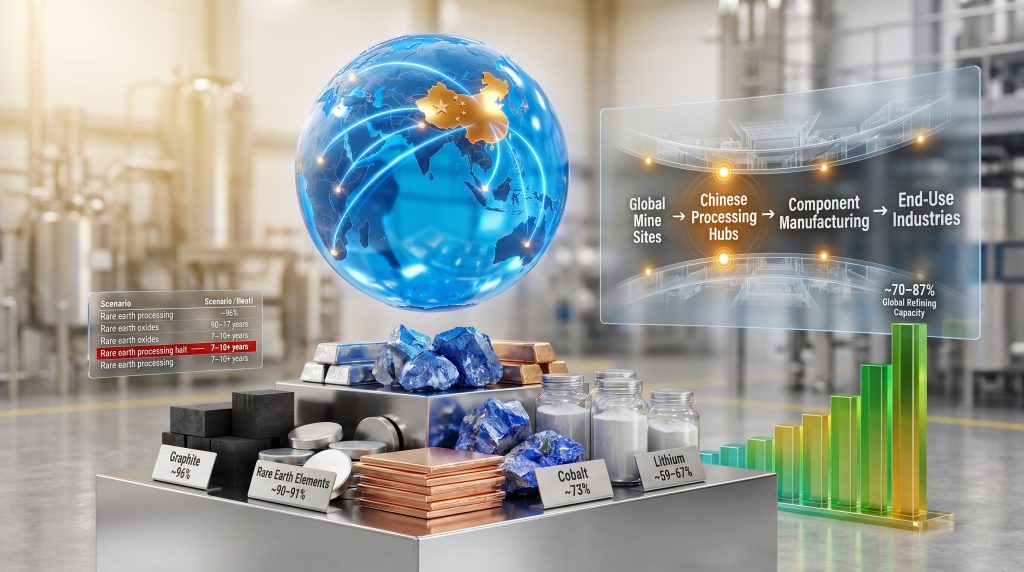
The architecture of this system is genuinely end-to-end. Raw materials flow in from domestic mines and overseas assets, pass through separation and purification facilities concentrated in specific provincial industrial clusters, and emerge as refined metals, battery-grade chemicals, and processed alloys that feed directly into component manufacturing. Those components then supply the global technology, automotive, and defence industries.
The Belt and Road Initiative plays a structural role in the feedstock dimension of this system. Chinese investment in African and Asian mining assets, port infrastructure, and logistics corridors has created supply pipelines that channel raw mineral output toward Chinese processing facilities rather than building refining capacity in the resource-producing nations themselves. This means that countries hosting significant mineral deposits frequently remain dependent on Chinese facilities to convert their own resources into industrially usable materials. Furthermore, as detailed analysis from the Africa Center for Strategic Studies illustrates, this dynamic is particularly pronounced across the African continent.
Beyond physical infrastructure, China has developed and in some cases restricted the export of specialised processing technologies, particularly in rare earth separation chemistry. This creates a compound form of leverage: not only does China possess the refining capacity, but in several mineral categories it controls the technical knowledge required to build competing capacity elsewhere.
The Numbers Behind the Dominance: China's Global Refining Market Share
The scale of China's processing position across critical minerals is difficult to overstate. Published industry data indicates that China dominates refined production across 19 of the world's 20 key critical minerals, a breadth of midstream control with no historical precedent in industrial supply chains.
The following table illustrates the depth of that concentration across the minerals most critical to clean energy, digital infrastructure, and defence manufacturing:
| Critical Mineral | China's Estimated Global Refining Share | Primary End-Use Sector |
|---|---|---|
| Graphite | ~96% | EV batteries, energy storage |
| Manganese | ~95% | EV batteries, steel alloys |
| Rare Earth Elements | ~90-91% | Permanent magnets, wind turbines, EVs |
| Cobalt | ~73% | Lithium-ion batteries, aerospace |
| Nickel | ~68% | Battery cathodes, stainless steel |
| Lithium | ~59-67% | EV batteries, grid storage |
| Copper | ~40% | Electrical infrastructure, EVs |
| Gallium, Germanium, Indium | Majority share | Semiconductors, fibre optics, power electronics |
| Molybdenum, Tungsten, Vanadium | Significant share | Defence alloys, aerospace, industrial machinery |
Key structural insight: Across all critical mineral categories, China's refining concentration reflects decades of targeted industrial policy rather than natural resource endowment. Many of the minerals China dominates in processing are primarily mined in Africa, Australia, and South America, with the raw material subsequently shipped to Chinese facilities for conversion into usable industrial inputs.
Why These Percentages Translate Into Real Geopolitical Leverage
High market concentration in refining creates two distinct forms of leverage that are qualitatively different from ordinary trade dependence. The first is supply timing control: the ability to influence when materials reach global markets, which can affect production schedules for manufacturers operating on just-in-time inventory models. The second, more serious form is supply denial: the capacity to restrict or halt the flow of processed materials entirely, forcing downstream manufacturers to either find alternative sources or reduce production.
China has progressively demonstrated its willingness to use this leverage through export licensing regimes applied to gallium, germanium, and graphite, among other materials. China's rare earth export restrictions since 2023 have served as a signal of intent rather than a full restriction, but the downstream effects on semiconductor supply chains and battery material procurement have already been measurable.
Crucially, export controls on the technology used to process minerals represent an even more durable form of leverage than controls on the minerals themselves. Physical mineral deposits can in principle be found elsewhere, but the technical knowledge to build consistent, specification-grade processing facilities in rare earth separation chemistry has taken China decades to accumulate and is not easily replicated from scratch.
Which Technology Sectors Carry the Deepest Exposure
Electric Vehicles and Battery Supply Chains
The structural dependency of global EV manufacturing on China's China critical mineral refining network is most acute in three material categories. Graphite, which functions as the anode material in virtually all commercial lithium-ion batteries, has no commercially viable substitute at scale, and approximately 96% of global refined graphite production flows through Chinese facilities. Manganese refining, at roughly 95% of global capacity, becomes progressively more critical as manufacturers adopt manganese-rich LMFP battery chemistries that reduce cobalt and nickel dependency.
Rare earth permanent magnets present perhaps the deepest single-point vulnerability. With China controlling approximately 90-91% of global rare earth processing and a comparable share of finished magnet manufacturing, EV motors, wind turbine generators, and a wide range of defence applications all trace their supply chains back to Chinese processing facilities. There are currently no commercially deployable short-term substitutes for rare earth permanent magnets in high-performance electric motors. The broader vulnerabilities embedded in global rare earth supply chains have consequently become a central concern for policymakers across allied nations.
Artificial Intelligence Infrastructure and Semiconductor Fabrication
The build-out of data centre infrastructure supporting AI deployment creates structural demand for precisely the minerals where China's refining concentration is highest among advanced materials. Gallium and germanium are essential inputs for compound semiconductors used in high-frequency electronics, power management chips, and fibre optic systems. China controls the majority of global refined output for both materials and has already demonstrated the use of export licensing as a policy lever in this sector.
Silicon metal refining underpins both photovoltaic panel manufacturing and semiconductor substrate production. Indium, critical for display technologies and thin-film solar applications, similarly flows predominantly through Chinese processing facilities. As AI infrastructure investment accelerates, demand for these materials is growing at precisely the moment when supply chain security concerns are intensifying.
Defence, Aerospace, and Advanced Manufacturing
Western defence procurement chains contain multiple hidden dependencies on Chinese mineral processing. Tungsten and molybdenum, both essential for high-temperature alloys used in jet engine components and military hardware, are processed predominantly in China. Titanium and zirconium, required for aerospace-grade structural materials, similarly face concentrated Chinese refining positions. Vanadium serves a dual function in both defence-grade steel production and grid-scale vanadium redox flow batteries, adding an energy storage dimension to its strategic profile.
The Physical Architecture of China's Processing Network
The geographic concentration of China's refining infrastructure within specific provincial industrial clusters creates a system with internal redundancy but external single-point-of-failure risks for global buyers. The key processing hubs operate as follows:
- Jiangxi Province functions as the global centre of heavy rare earth separation, processing a disproportionate share of the world's dysprosium, terbium, and other heavy rare earth elements essential for high-performance permanent magnets
- Inner Mongolia hosts dominant capacity in light rare earth processing, including neodymium and praseodymium used in standard EV motor magnets, alongside significant graphite refining operations
- Yunnan and Sichuan serve as the primary processing corridors for lithium and cobalt, positioned to receive feedstock from both domestic sources and imported African concentrates
- Shandong Province hosts substantial capacity across multiple mineral categories, including aluminium refining and speciality chemical processing
The critical leverage point in this architecture sits not at the mine but at the separation and purification stage, where raw ore concentrates are transformed into consistent, specification-grade materials that technology manufacturers can actually incorporate into production processes. This is precisely the stage China has most systematically developed, protected through technology controls, and concentrated within its domestic industrial ecosystem. Independent analysis from the Center for Strategic and International Studies helps explain why Western nations have repeatedly struggled to secure alternative processing assets.
Can Western Nations Realistically Build Competing Refining Capacity?
The Gap Between Mining Ambition and Processing Reality
A persistent misconception in policy discussions about critical mineral supply chains is that securing mine ownership or exploration rights is equivalent to achieving supply chain security. It is not. A nation can possess abundant rare earth deposits and remain entirely dependent on Chinese processing facilities to convert those deposits into usable materials, which is precisely the situation facing several Western nations and their resource-rich allies.
The capital and time requirements for building greenfield refining infrastructure are substantially greater than those for mine development. Industry analysts consistently estimate timelines of 10 to 15 years for greenfield rare earth separation facilities and 7 to 12 years for most battery material refining operations. These timelines reflect not just construction but the lengthy process of achieving consistent specification-grade output, navigating environmental permitting, and developing the specialised workforce that separation chemistry requires.
Current Diversification Efforts and Their Realistic Timelines
Western governments have significantly escalated policy responses to Chinese refining concentration; however, the gap between policy announcement and operational capacity remains wide:
- The United States Inflation Reduction Act created significant incentives for domestic critical mineral processing, stimulating investment in battery material refining clusters, but operational scale capacity for most minerals remains years away
- Australia has articulated downstream processing ambitions supported by its substantial resource base, but the infrastructure investment required to realise that potential has only partially materialised
- The European Union's European critical raw materials strategy established a target of achieving at least 10% domestic processing of strategic minerals by 2030, a target that represents meaningful progress but still implies continued heavy dependence on non-European processing for the majority of supply
- Canada is developing emerging refining projects across several mineral categories, with realistic production timelines suggesting meaningful capacity could come online in the late 2020s to early 2030s for select materials
Reality check: Even under optimistic scenarios, analysts estimate the mid-2030s as the earliest point at which Western refining capacity could meaningfully reduce structural dependence on Chinese processing for most critical minerals. The remainder of the 2020s represents a period of acute exposure during which demand growth from EV adoption and AI infrastructure is simultaneously accelerating.
A Framework for Building Genuine Alternative Refining Capacity
For nations seeking to reduce exposure to the China critical mineral refining network, a sequenced approach addresses the most critical bottlenecks:
- Identify mineral-specific processing bottlenecks by urgency and substitutability, prioritising rare earth permanent magnets and battery anode materials where no near-term alternatives exist
- Establish government-backed offtake agreements to de-risk private investment in refining facilities, addressing the fundamental market failure where private capital is reluctant to fund long-lead-time processing infrastructure without demand certainty
- Accelerate permitting reform specifically for processing facilities, not just mines, recognising that refining infrastructure faces distinct and often more complex environmental review processes
- Invest in processing chemistry research and workforce development, particularly in rare earth separation, where technical knowledge gaps outside China are as significant as infrastructure gaps
- Build allied-nation refining clusters through bilateral industrial agreements that pool feedstock supply, processing investment, and offtake demand across multiple allied economies
- Develop strategic stockpiling programmes as a bridge strategy during the transition period, providing buffer time for new refining capacity to come online
The next major ASX story will hit our subscribers first
Export Controls, Technology Bans, and the Geopolitics of Refining Leverage
China's progressive expansion of export licensing requirements for critical minerals and processing technologies represents a sophisticated use of midstream industrial power as a geopolitical instrument. The progression from broad mineral controls to more targeted restrictions on processing technology exports is particularly significant, as it addresses the underlying mechanism through which competing nations might eventually develop alternative refining capacity.
The scenario implications for different restriction types vary considerably in their severity and recovery timelines:
| Scenario | Affected Sectors | Estimated Supply Impact | Recovery Timeline |
|---|---|---|---|
| Graphite export restriction | EV battery manufacturing globally | Severe short-term disruption | 3-5 years for alternative supply |
| Rare earth processing halt | EV motors, wind turbines, defence magnets | Critical, no near-term substitutes | 7-10+ years |
| Gallium/Germanium licensing tightening | Semiconductor fabrication, defence electronics | Significant, limited alternative sources | 5-8 years |
| Cobalt refining restriction | Battery supply chains, aerospace alloys | Moderate to severe | 4-6 years |
Multiple Western government assessments now classify Chinese refining concentration as a national security issue rather than a conventional trade concern. This framing reflects the recognition that the dependency is structural rather than situational, and that market mechanisms alone will not correct it within timeframes relevant to defence planning or critical minerals and energy security transition schedules.
The Strategic Outlook: Three Forces Shaping the Decade Ahead
Three structural dynamics are converging to define how the global competition over critical mineral refining capacity will evolve through the 2030s:
1. Accelerating demand concentration: EV adoption trajectories, AI data centre buildouts, and defence modernisation programmes are simultaneously increasing demand for the exact minerals where Chinese refining concentration is highest. This demand acceleration is occurring faster than alternative processing capacity can come online, deepening structural dependency in the near term even as diversification policy intensifies.
2. Policy response intensification with execution lag: Western governments are moving from strategic awareness to active industrial policy, but the distance between policy announcement and operational refining capacity is measured in years to decades. The 2020s will consequently be defined by this execution gap, during which announced intentions substantially exceed operational reality.
3. Chinese position consolidation: Ongoing domestic investment in next-generation processing technology, progressive expansion of export control architecture, and continued overseas feedstock security through infrastructure investment are reinforcing rather than weakening China's midstream position in the near term.
The global competition over critical mineral refining capacity is not a future risk on the horizon but an active structural reality reshaping investment flows, industrial policy, and geopolitical relationships in the present. For the minerals powering the clean energy transition and digital infrastructure buildout, the decisive question is not where materials are mined but where they are refined, and for most of the world's most consequential critical minerals, the answer to that question currently points toward a single country's industrial heartland.
This article is intended for informational purposes only and does not constitute financial, investment, or policy advice. Statistics regarding market shares and processing capacities represent estimates from publicly available sources and industry analysis; actual figures may vary depending on methodology, measurement period, and data source. Forecasts and timeline projections involve inherent uncertainty and should not be relied upon as definitive predictions.
Want to Know Which ASX Discoveries Could Benefit From the Critical Minerals Supply Chain Shift?
As Western nations scramble to reduce dependence on Chinese refining infrastructure, early identification of significant ASX mineral discoveries has never carried greater strategic or investment importance. Discovery Alert's proprietary Discovery IQ model delivers real-time alerts the moment major mineral discoveries are announced on the ASX, transforming complex geological data into actionable investment insights — explore historic discoveries and their market returns, then begin your 14-day free trial to position yourself ahead of the market.