August 13, 2026
The Structural Forces Rewriting the Rules of Global Steel
Few industrial sectors reveal the tension between physical necessity and systemic fragility quite like steel. Over centuries, it has underpinned civilisations, funded industrialisation, and now sits at the intersection of two of the most consequential forces shaping the global economy: the energy transition and the reconfiguration of international trade. Yet the near-term picture for steel producers is defined less by opportunity than by compounding structural pressures that are testing the resilience of even the most established players.
Understanding the market trends and regulatory shifts in the steel industry requires moving beyond price charts and tonnage figures. The deeper story involves diverging regional demand trajectories, an accelerating regulatory architecture across Western markets, and a technology transition that is simultaneously decarbonising production and reshaping workforce requirements. These forces are not operating sequentially; they are colliding in real time.
When big ASX news breaks, our subscribers know first
Global Demand: Why Volume and Value Tell Different Stories
The current steel cycle is defined by three simultaneous structural forces pulling the industry in competing directions: demand deceleration in mature and key emerging markets, supply expansion outpacing consumption growth, and an escalating regulatory environment adding compliance costs across the value chain.
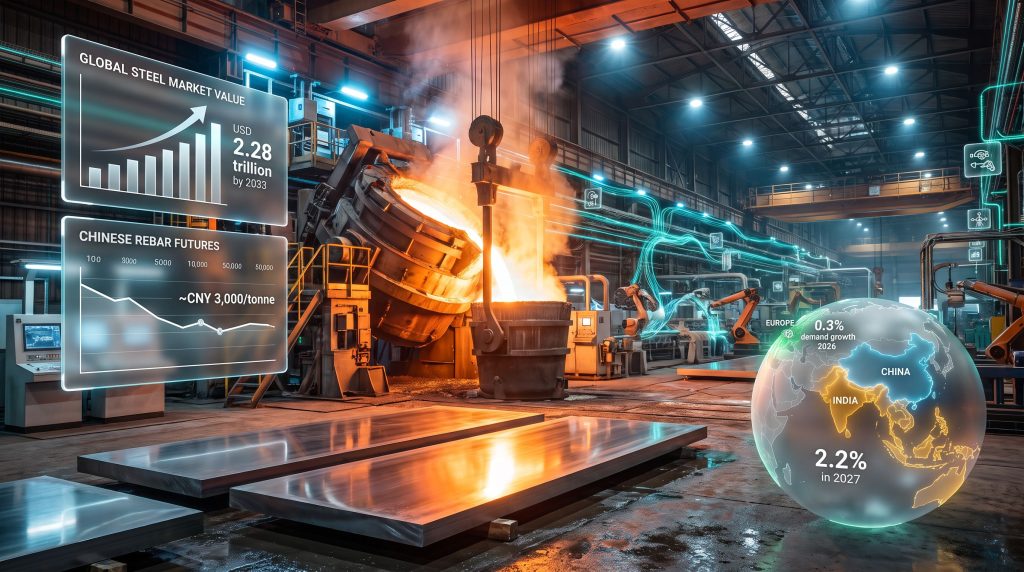
On the demand side, the headline figures require careful interpretation. Worldsteel forecasts global steel demand growth of just 0.3% in 2026, recovering modestly to 2.2% in 2027, while the OECD projects average annual growth of less than 1% through 2030. These figures reflect persistent weakness in Chinese construction and a broadly cautious global investment environment.
Yet a separate set of projections points to the global steel market reaching a value of approximately USD 2.28 trillion by 2033, at a compound annual growth rate of 5.9%, according to Grand View Research. To many, this appears contradictory. It is not.
Key Insight: Volume-based and value-based forecasts measure fundamentally different things. While physical tonnage growth may remain subdued, the embedded carbon content, product grade, compliance cost, and traceability requirements associated with each tonne of steel are rising. The market is not shrinking in value terms; it is being repriced around quality, sustainability credentials, and regulatory compliance.
Steel Prices: Where the Floor Has Settled
Steel prices declined materially through 2024 and have since stabilised near levels not seen since 2021. Chinese rebar futures fell to approximately CNY 3,000 per tonne in early August 2025, reflecting sustained mill-level losses and subdued domestic sentiment driven by property sector contraction.
| Metric | 2021 Peak | 2024 Trend | 2025-2026 Stabilisation |
|---|---|---|---|
| Global steel price trajectory | Elevated post-pandemic | Declining | Near 2021 lows |
| Chinese rebar futures (CNY/tonne) | High | Falling | ~3,000 |
| Global capacity utilisation | Moderate | Under pressure | Declining |
Regional Demand Divergence: Where Growth Is and Is Not
China's Construction Overhang and Its Global Consequences
The China steel and iron ore market remains among the most consequential developments reshaping global steel demand. OECD data confirms declining apparent steel consumption in China, driven by the maturation of its construction cycle and an extended correction in the property sector. McKinsey analysis projects that Chinese finished-steel demand will continue contracting through at least 2035.
The downstream effect is significant. Chinese mills, facing deteriorating domestic margins, are redirecting output to export markets across Southeast Asia, South Asia, Europe, and the Middle East. This export surplus intensifies pricing pressure in third markets and creates a structural headwind for producers competing on cost in those regions.
India and Southeast Asia: The New Centre of Gravity
Against the backdrop of Chinese demand contraction, India and Southeast Asia have emerged as the primary engines of long-run global steel consumption growth. McKinsey analysis identifies this corridor as likely to absorb the majority of incremental global demand over the next decade.
The demand drivers in these markets are structural rather than cyclical:
- Large-scale infrastructure investment pipelines spanning roads, rail networks, ports, and energy infrastructure
- Urbanisation rates significantly above OECD averages, sustaining multi-decade construction demand
- Manufacturing relocation out of China driven by the "China+1" supply chain diversification strategy adopted by multinationals
- Rising middle-class consumption supporting residential construction and consumer durables demand
For steel producers evaluating geographic portfolio strategy, exposure to India and ASEAN is increasingly a prerequisite for long-run relevance rather than an optional diversification play.
Developed Markets: Flat in Volume, Shifting in Product Mix
Demand across OECD economies remains broadly flat in volume terms, but the composition of that demand is evolving in ways that create differentiated competitive outcomes. High-grade, low-carbon steel is attracting growing demand across automotive lightweighting programmes, aerospace structural components, and green energy infrastructure.
Furthermore, producers supplying commodity-grade steel face continued margin compression, while those investing in advanced product grades are operating in a structurally different competitive environment. The green steel pricing trends emerging across Europe and North America are increasingly influencing procurement decisions and reshaping supplier qualification criteria.
The Oversupply Architecture: Why Excess Capacity Is Deepening
Capacity Growth Outrunning Demand
S&P Global data indicates that global steel capacity expanded at its fastest rate since 2009 during 2025. The OECD has warned that planned capacity additions risk entrenching structural overcapacity across the industry, suppressing utilisation rates and compressing margins for an extended period.
Structural Tension: When capacity grows faster than end-use demand, the historical outcome is prolonged price weakness, accelerated consolidation, and plant closure activity. The current trajectory exhibits characteristics consistent with that pattern.
The indicators that signal structurally impaired industry profitability follow a recognisable sequence:
- Capacity utilisation falling below the 75-80% threshold that underpins break-even economics for most producers
- Spot prices declining below the cash cost of production for marginal producers
- Sustained mill-level losses triggering voluntary output curtailments
- Consolidation announcements and accelerating M&A activity as weaker operators exit
China has proposed regulatory measures targeting new plant approvals and capacity transfers in an effort to manage output quality and volume. However, enforcement timelines remain uncertain, and the near-term effect on global supply balances is unlikely to be material.
Regulatory Architecture: How Trade Policy Is Redrawing the Map
U.S. Section 232 Tariffs: Market Distortion in Both Directions
Section 232 tariffs, currently set at 50%, have fundamentally restructured the U.S. steel import landscape. Import volumes have declined materially, and domestic price premiums have emerged that benefit U.S. integrated producers. The broader consequences of US steel and aluminium tariffs extend well beyond domestic markets, reshaping trade flows across Asia, Europe, and Latin America.
However, the analysis of these measures requires acknowledging a counterintuitive dynamic: elevated input costs for downstream manufacturers, including automotive, construction, and machinery sectors, generate a demand headwind that partially offsets the supply-side protection the tariffs provide. Stout analysis characterises the current U.S. tariff environment as producing significant headwinds for domestic steel consumption.
The European Union's New Import Control Framework
The EU's existing safeguard regime is scheduled to expire in 2026, and a replacement permanent framework is being designed to succeed it. The structural changes under the proposed framework are significant:
- Tariff-free quota volumes are set to be reduced
- Out-of-quota duties are rising to 50%, aligning more closely with the U.S. tariff posture
- Melt-and-pour traceability requirements are being introduced to verify the true origin of imported steel
The melt-and-pour requirement deserves particular attention because its operational implications are frequently underestimated by market participants. The compliance pathway works as follows:
- Imported steel must be traceable to the specific furnace and heat in which it was originally produced
- Documentation requirements increase compliance costs substantially for non-EU producers, particularly those operating through intermediaries
- Steel transshipped through third-country hubs faces heightened regulatory scrutiny and potential duty liability
- EU buyers must adapt their procurement due diligence and supplier qualification processes to accommodate these new verification requirements
CBAM: Carbon as a Trade Instrument
The EU's Carbon Border Adjustment Mechanism is progressively embedding carbon pricing into the cost structure of imported steel. For producers operating in high-carbon-intensity jurisdictions, this creates a measurable competitive disadvantage relative to lower-carbon EU producers. In addition, the global commodity tariff impacts of these carbon-linked trade measures are increasingly influencing supply chain configuration decisions among multinational steel buyers.
CBAM in Practice: Steel importers into the EU must account for the embedded carbon emissions of their products. For high-emission producers, this carbon cost layer functions as a tariff-on-top-of-a-tariff, materially affecting landed cost calculations and procurement decisions by EU buyers.
The Ecodesign Regulation: Product-Level Environmental Governance
The EU's Ecodesign Regulation represents a qualitative shift in regulatory philosophy, moving from trade-based measures toward product-level environmental governance. Steel is under examination for requirements that could include:
| Ecodesign Requirement | Likely Scope | Operational Impact |
|---|---|---|
| Carbon footprint disclosure | All steel products sold in the EU | Increased lifecycle assessment costs and data infrastructure investment |
| Minimum recycled-content rules | Construction and industrial steel grades | Sourcing reconfiguration and process adaptation |
| Performance and durability thresholds | Structural and automotive grades | Product reformulation risk for some producers |
| Digital Product Passport | Broad product categories | IT infrastructure, data management, and traceability investment |
India and ASEAN: Bilateral Defences Against Chinese Export Surges
India has implemented stricter import licensing requirements specifically targeting Chinese steel, reflecting a pattern of bilateral trade defence measures being deployed across Asia in response to Chinese export volume increases. Several ASEAN markets are also actively examining or implementing safeguard and anti-dumping mechanisms. This dynamic is creating a more fragmented global trade environment in which regional market access increasingly depends on compliance with jurisdiction-specific origin and quality requirements.
Technology Transformation: Decarbonisation and Digitalisation Converge
The Decarbonisation Pathway Menu
The primary low-carbon production pathways available to steel producers each carry distinct economic and strategic characteristics:
- Electric Arc Furnaces (EAF): Lower energy intensity per tonne, highly compatible with scrap input, and increasingly favoured in markets with affordable renewable electricity. EAF conversion is the most commercially proven decarbonisation route for producers with access to scrap supply
- Direct Reduced Iron with Hydrogen (DRI-H2): Advances in hydrogen iron ore reduction are opening a near-zero-emissions pathway for primary steelmaking. Capital-intensive and dependent on green hydrogen cost trajectories, but strategically critical for producers seeking to eliminate blast furnace dependency
- Carbon Capture, Utilisation, and Storage (CCUS): Applied to existing blast furnace operations as a transitional bridging measure while longer-term decarbonisation investments mature
- Induction Furnace Technology: Highly energy-efficient for scrap-based production at smaller scale, reducing electricity consumption compared to conventional blast furnace operations
Strategic Note: Technology selection is not purely a technical decision. It is determined by access to affordable renewable energy, domestic scrap availability, capital structure, the carbon pricing environment in the producer's home market, and the regulatory timeline for compliance requirements.
Digital Integration: From Efficiency Tool to Competitive Requirement
Automated robotic systems, AI-driven quality monitoring, and real-time sensor networks are reducing defect rates and improving yield consistency across modern steelmaking operations. IoT-enabled predictive maintenance is reducing unplanned downtime, one of the largest cost variables in continuous casting and rolling operations where production stoppages carry significant economic penalties.
Advanced materials science research in high-strength alloys, corrosion-resistant steels, and composite materials is enabling steel to maintain competitiveness against alternative materials in weight-sensitive applications. Three-dimensional printing and additive manufacturing are simultaneously creating demand for precision-formed specialty steel products and enabling faster, lower-cost prototyping for new grades.
The next major ASX story will hit our subscribers first
Workforce Transition: The Skills Gap Is Structural
As automation replaces routine manual tasks, the demand profile for steel industry workers is shifting toward competencies in digital systems operation, data interpretation, robotics maintenance, and process engineering. Many producers face a structural mismatch between existing workforce profiles and emerging operational requirements. The transition strategies being adopted across the industry include:
- Internal upskilling programmes targeting frontline operators for digital process roles
- Formal partnerships with technical colleges and vocational training institutions
- Apprenticeship structures linking new entrants directly to automated manufacturing environments
- Cross-functional workforce deployment across both automated and manual process areas to preserve operational flexibility
Robotics integration is materially reducing worker exposure to high-risk tasks including heavy lifting, high-temperature environments, and hazardous chemical handling. New safety considerations, however, are emerging around human-machine collaboration zones and the cybersecurity integrity of operational technology systems.
Investment Flows and M&A: Capital Following Structural Logic
In periods of sustained overcapacity and margin compression, M&A activity typically accelerates as producers pursue scale efficiencies, geographic diversification, and technology acquisition. The current cycle exhibits precisely these dynamics. Key acquisition motivations include:
- Acquiring low-carbon production assets ahead of tightening carbon regulation in major markets
- Gaining exposure to faster-growing regional demand in India and ASEAN
- Consolidating capacity to improve utilisation rates and restore pricing discipline in oversupplied markets
- Absorbing digital and decarbonisation technology capabilities that would take years to develop organically
| Investment Theme | Geographic Focus | Primary Driver |
|---|---|---|
| EAF capacity expansion | Europe, North America | CBAM, carbon pricing regimes |
| DRI-H2 pilot projects | Europe, Middle East | Green steel procurement mandates |
| Scrap processing infrastructure | India, ASEAN | Circular economy policy frameworks |
| Digital plant upgrades | Global | Efficiency, compliance, and quality requirements |
| Greenfield capacity | India, MENA | Structural demand growth |
Risk Framework: Strategic Vulnerabilities Through 2030
| Risk Category | Probability | Impact | Strategic Response |
|---|---|---|---|
| Prolonged overcapacity | High | High | Capacity discipline and consolidation |
| Escalating carbon compliance costs | High | Medium-High | Decarbonisation investment prioritisation |
| Geopolitical trade disruption | Medium | High | Supply chain and geographic diversification |
| Sustained Chinese demand contraction | High | High | Regional portfolio rebalancing toward India and ASEAN |
| Workforce skills shortage | Medium | Medium | Structured upskilling programmes |
| Energy price volatility | Medium | High | Renewable energy procurement and long-term supply agreements |
Producers with lower-carbon asset bases, EAF operational flexibility, and meaningful commercial exposure to India and Southeast Asia are structurally better positioned than those dependent on high-carbon blast furnace operations serving mature markets. The ability to demonstrate carbon traceability and product-level environmental credentials is transitioning from a reputational consideration to a hard procurement requirement across EU and increasingly U.S. supply chains.
Frequently Asked Questions: Market Trends and Regulatory Shifts in the Steel Industry
What is the global steel demand outlook for 2026?
Worldsteel projects 0.3% demand growth in 2026, with a recovery to 2.2% in 2027. The OECD forecasts less than 1% average annual growth through 2030, reflecting persistent oversupply and structural demand contraction in China. These volume figures coexist with stronger value-based growth projections driven by premium product grades and compliance-related pricing.
How do Section 232 tariffs affect U.S. steel market dynamics?
Section 232 tariffs at 50% have significantly reduced import volumes and created domestic price premiums that benefit U.S. producers. However, they simultaneously generate input cost pressures for downstream manufacturers, creating a demand headwind that partially offsets the protective effect for the broader domestic steel industry.
What does the EU's melt-and-pour traceability rule mean in practice?
Melt-and-pour traceability requires imported steel to be traceable to the specific furnace and heat in which it was produced, eliminating the ability to obscure origin through transshipment or processing in third countries. This rule significantly increases documentation costs for non-EU producers and requires EU buyers to implement more rigorous supplier verification processes.
Which regions represent the strongest steel demand growth prospects?
India, ASEAN, and parts of MENA represent the primary growth markets through 2030-2035, driven by infrastructure investment, rapid urbanisation, and manufacturing expansion. Chinese demand is expected to continue declining structurally through at least 2035 according to McKinsey projections.
What are the main decarbonisation technology pathways for steel producers?
The primary pathways are Electric Arc Furnaces using scrap and renewable electricity, Direct Reduced Iron using green hydrogen, Carbon Capture and Storage applied to existing blast furnace operations, and induction furnace technology for smaller-scale scrap processing. Technology selection depends on energy access, scrap availability, capital structure, and the carbon pricing environment in each producer's jurisdiction.
The Three Strategic Imperatives for Steel Producers
The analysis of market trends and regulatory shifts in the steel industry converges on three imperatives that will determine which producers are competitively viable through 2030 and beyond. Consequently, producers that fail to act decisively across each dimension risk being structurally disadvantaged as regulatory and market forces accelerate:
- Decarbonise with urgency and specificity – Carbon compliance costs are rising across all major markets, and the lead times for EAF conversion or DRI investment mean that decisions made now will determine competitive positioning five years from now
- Rebalance geographic exposure toward growth markets – The structural shift in global demand gravity toward India and Southeast Asia is irreversible over the medium term; producers without exposure to these markets face a compounding strategic disadvantage
- Treat digital operations as infrastructure, not enhancement – Automation, AI-driven quality systems, and data analytics are becoming prerequisites for cost competitiveness and product quality compliance, not optional efficiency investments
Steel remains foundational to the infrastructure of the energy transition itself, from wind tower structures and power grid components to EV platform architecture and battery storage enclosures. The industry's long-term relevance is not under question. What is being determined, right now, is which producers will be positioned to supply that demand at competitive cost and with the environmental credentials that procurement standards increasingly demand. For those tracking the broader market trends and regulatory shifts in the steel industry, the steel industry trends for 2025 and the OECD steel market outlook offer valuable institutional context for understanding how these structural forces are expected to evolve.
This article contains forward-looking statements, forecasts, and market projections sourced from third-party research organisations including worldsteel, the OECD, McKinsey, S&P Global, and Grand View Research. These projections are subject to material uncertainty and should not be relied upon as financial advice. Readers should conduct independent research before making investment or operational decisions based on the information presented.
Want to Capitalise on the Resource Discoveries Driving the Next Wave of Industrial Demand?
The structural forces reshaping global steel — from green hydrogen iron ore reduction to EAF expansion across India and ASEAN — are creating significant upstream opportunities in mineral exploration and discovery. Discovery Alert's proprietary Discovery IQ model delivers real-time alerts the moment significant ASX mineral discoveries are announced, translating complex geological data into actionable investment insights for both short-term traders and long-term investors — start your 14-day free trial today, or explore historic discovery returns to understand the scale of opportunity these moments can generate.