
August 13, 2026
The Quiet Contradiction at the Heart of Global Energy Planning
Energy transitions rarely follow a straight line. History shows that the most consequential shifts in how nations power themselves unfold not through clean breaks from the past, but through overlapping, often contradictory strategies that serve immediate demands while hedging against an uncertain future. Today, that dynamic is playing out most visibly in the world's most populous nation, where India's planned coal mining capacity has surged to levels that are reshaping the entire global mine development pipeline.
Understanding why this is happening, and what it means for investors, policymakers, and energy markets, requires more than a surface reading of the numbers. Furthermore, the implications extend well beyond India's borders, touching on coal supply challenges that reverberate across international commodity markets.
When big ASX news breaks, our subscribers know first
India's Planned Coal Mining Capacity: The Numbers That Changed the Global Picture
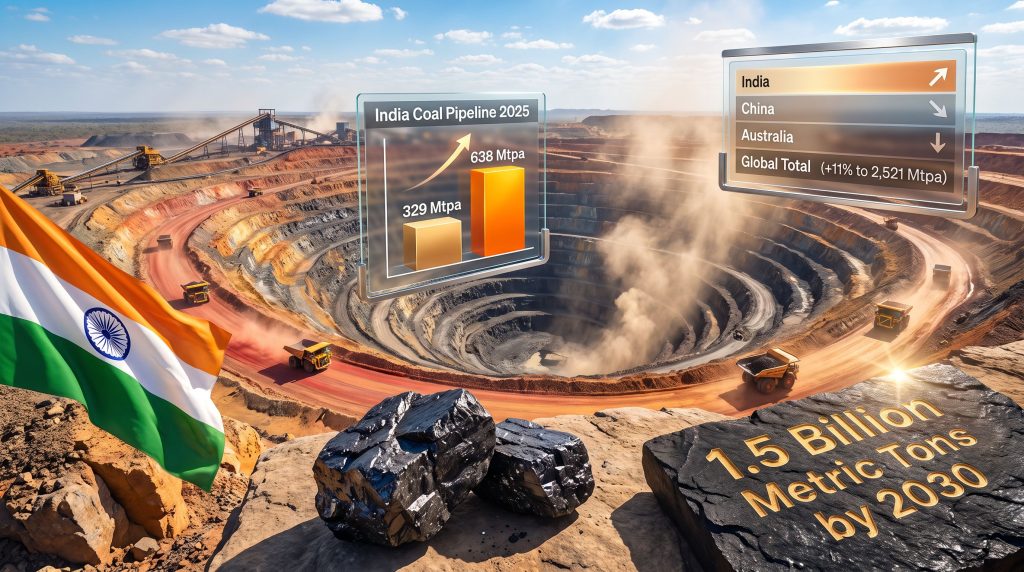
According to data published by Global Energy Monitor, India's proposed coal mine development pipeline reached 638 million metric tons per annum (Mtpa) in 2025, rising sharply from 329 Mtpa recorded the prior year. That near-doubling within a single reporting cycle is not a gradual trend; it is a structural acceleration that places India at the commanding height of the global coal development landscape.
To appreciate the scale, consider the broader context. The global coal project pipeline expanded by 11% year-on-year, reaching a total of 2,521 Mtpa in proposed capacity. India's contribution to that growth was not merely significant; it accounted for almost the entirety of the global increase. Every other major coal-producing nation, taken together, added only a marginal net contribution.
Global Pipeline Comparison: Who Is Building and Who Is Pulling Back?
| Country/Region | Pipeline Direction | Primary Driver |
|---|---|---|
| India | Sharply expanding | Government-led domestic supply push |
| China | Contracting (new additions) | Domestic capacity saturation |
| Australia | Declining new capacity | ESG pressure, regulatory headwinds |
| Global Total | +11% to 2,521 Mtpa | Almost entirely India-driven |
This divergence matters profoundly. While the headline global pipeline figure looks expansionary, actual new capacity additions fell nearly 40% in 2025 to just 113 Mtpa, with sharp declines in both China and Australia. The global coal mine pipeline is growing on paper while real-world commissioning is contracting, a structural tension that carries meaningful implications for capital allocation and asset risk.
What Is Actually Driving India's Expansion Push?
The instinct is to frame India's coal strategy as a contradiction — a developing economy simultaneously chasing renewable energy targets while doubling down on fossil fuel infrastructure. The reality is more nuanced and rooted in domestic political economy rather than ideological incoherence.
India's electricity consumption continues to climb at a pace that few other economies can match. Industrial output expansion, accelerating urbanisation, and rising cooling demand tied to population growth and climate warming are all compounding simultaneously. Coal-fired power generation currently provides the backbone of grid reliability, and India's government has made a clear calculation that domestic production is preferable to import dependency when global commodity prices are volatile. The India coal market reflects this strategic orientation at every level of policy planning.
Against this backdrop, the government has set a coal production target of approximately 1.15 billion metric tons for fiscal year 2025/26, scaling toward 1.5 billion metric tons by 2030. To bridge the gap between current output and those targets, the coal ministry has outlined plans to commission 100 new mines aimed at adding 500 Mtpa of production capacity by FY2030. In FY2026 alone, more than 20 mines with combined proposed capacity exceeding 80 Mtpa have been advanced.
A separate but overlapping ministerial framework references 45 new coal projects over a five-year horizon, reflecting the reality that multiple policy tracks are operating in parallel rather than as a single coordinated programme. According to coal production data from India's Ministry of Coal, output has steadily increased year-on-year, underscoring the government's commitment to its domestic supply targets.
Geographic Concentration: Eastern India as the Production Hub
The majority of new capacity proposals are geographically clustered in the eastern states of Jharkhand and Odisha. These states contain the country's most significant coal-bearing geological formations — the Gondwana-age coalfields that represent India's primary high-quality thermal and coking coal reserves. The concentration provides logistical advantages but also intensifies environmental, land acquisition, and community resettlement risks in a relatively narrow geographic corridor.
One underappreciated dimension of this geographic clustering is that Jharkhand and Odisha are also home to some of India's most complex land rights frameworks involving tribal communities and scheduled areas. Projects in these regions frequently encounter delays tied to community consent requirements under the Forest Rights Act and the Panchayats (Extension to Scheduled Areas) Act, legal structures that operate independently of commercial mining approvals.
The Utilisation Gap: A Faster Path to Output Than New Mines
A critical piece of context often absent from discussions of India's planned coal mining capacity is the existing utilisation rate of already-installed capacity.
| Metric | Approximate Value |
|---|---|
| Existing installed coal mining capacity | ~1.1 billion tonnes per year |
| Actual annual production (recent years) | ~900 million tonnes |
| FY2025/26 production target | ~1.15 billion tonnes |
| 2030 production target | 1.5 billion tonnes |
| Approximate utilisation rate | ~82% of installed capacity |
The gap between what India's mines can produce and what they actually produce suggests that operational improvements, fleet upgrades, and logistics de-bottlenecking could deliver near-term output gains faster than new mine development. The push for 100 new mines may therefore reflect, in part, the need to replace ageing, lower-productivity operations at Coal India Limited rather than purely additive greenfield capacity.
Coal India, which accounts for the overwhelming majority of domestic production, operates mines across a wide productivity spectrum, and the oldest assets drag significantly on system-wide efficiency.
The IEA's Demand Plateau and What It Means for a 638 Mtpa Pipeline
The timing of India's expansion creates a structural tension that investors and policymakers cannot afford to ignore. The IEA's coal demand outlook for India projects that global coal demand will plateau by 2030, precisely the year India targets peak domestic production of 1.5 billion tonnes. In 2025, wind and solar energy collectively surpassed coal in the global electricity generation mix for the first time, a milestone the IEA described as structurally significant rather than cyclical.
If India's 638 Mtpa pipeline is constructed against a backdrop of plateauing or declining global demand, a material share of that capital could be exposed to stranded asset outcomes, particularly the approximately 163 Mtpa currently classified as early-stage planning.
India's parallel pursuit of 500 GW of non-fossil energy capacity adds further complexity. Rapid deployment of utility-scale solar, increasingly supported by battery storage economics that are improving faster than most forecasts assumed five years ago, could compress the demand window for coal-based baseload power. The broader energy transition demand dynamic is accelerating these shifts in ways that introduce real uncertainty for long-dated coal assets.
Most analysts currently expect coal to remain essential for Indian grid stability through the early 2030s, but the confidence interval around that projection is widening. Consequently, the intersection of India's planned coal mining capacity and global clean energy momentum is becoming one of the most watched fault lines in commodity markets.
How a Proposed Mine Becomes a Producing Asset: The Six-Stage Reality
Understanding the pipeline requires understanding how few proposed projects actually reach full production within a declared timeline.
- Project Registration and Geological Survey — Coal blocks are identified through geological surveys and registered in the planning database.
- Government Auction or Allocation — Blocks are auctioned to commercial operators or allocated to entities such as Coal India Limited.
- Environmental and Forest Clearances — Projects require approval under the Environment Protection Act and Forest Conservation Act. This phase typically spans two to five years and represents the most common source of delay.
- Land Acquisition and Community Resettlement — Often the most time-intensive and politically sensitive phase, particularly in scheduled tribal areas.
- Mine Development and Infrastructure Construction — Physical site development, access roads, coal handling and preparation plants, and safety systems are commissioned.
- First Production and Ramp-Up — Output scales from initial extraction toward nameplate capacity over two to four years post-commissioning.
The early-planning tier of India's pipeline, representing approximately 163 Mtpa, faces the longest and most uncertain journey through these stages. Historical patterns in Indian mining consistently show that the gap between proposed and commissioned capacity is substantial, with many projects requiring a decade or more from registration to sustained output.
The next major ASX story will hit our subscribers first
Key Risks Embedded in India's Coal Capacity Strategy
- Demand erosion risk: Faster-than-expected renewable deployment or battery raw materials cost improvements could bring forward the peak in coal-based power demand, leaving newer mines commercially unviable before they fully amortise capital investment.
- Execution and regulatory risk: Environmental clearances and land acquisition processes remain the principal bottlenecks. The Forest Conservation Act amendments have added complexity rather than removing it for many eastern-state projects.
- ESG and capital access risk: International lenders and institutional investors are progressively restricting coal-linked financing. Domestic public sector financing can fill the gap, but at the cost of opportunity capital that could otherwise accelerate the energy security transition.
- Geological risk in new blocks: Many of the coal blocks newly entering the auction pipeline are in areas with less established geological data than legacy Coal India fields, introducing uncertainty around recoverable reserves and seam quality.
The Strategic Logic: Rational Hedge or Structural Overextension?
India's coal expansion strategy is best understood as a sovereignty-driven energy security calculation rather than a purely economic one. Domestic production insulates the economy from imported coal price volatility, reduces the current account deficit pressure that comes with large energy imports, and preserves grid reliability during a period when renewable energy, despite rapid growth, has not yet achieved the storage depth needed for full baseload substitution.
The strategic logic holds so long as the demand window remains open through 2030. What makes India's planned coal mining capacity a genuinely complex analytical challenge is that the safety margin between the optimistic scenario and the downside scenario is narrowing as renewable costs fall and the IEA's plateau projections gain credibility.
Disclaimer: This article contains forward-looking analysis and references to demand projections sourced from the International Energy Agency and Global Energy Monitor. These projections involve inherent uncertainty and should not be interpreted as investment advice. Energy market conditions, regulatory frameworks, and technology cost trajectories are subject to material change.
For ongoing coverage of India's coal sector developments and energy transition dynamics, ET EnergyWorld at energy.economictimes.indiatimes.com provides detailed reporting across coal, renewables, and power markets.
Want to Stay Ahead of the Next Major Mineral Discovery on the ASX?
While India's coal expansion reshapes global commodity markets, Discovery Alert's proprietary Discovery IQ model scans ASX announcements in real time, instantly identifying significant mineral discoveries and translating complex data into actionable opportunities for traders and investors alike — explore historic discoveries and the returns they generated, then begin your 14-day free trial to position yourself ahead of the broader market.