August 13, 2026
The Quiet Commodity Reshaping Clean Energy Supply Chains
Most conversations about the materials powering the global energy transition focus on lithium, cobalt, or rare earths. Silica sand rarely commands the same attention, yet it sits at the foundation of solar glass manufacturing, semiconductor fabrication, and advanced electronics production. Without high-purity silica, solar panels cannot be made at scale, and chip fabrication facilities cannot function. This industrial invisibility has long kept silica sand undervalued in public discourse, even as critical minerals demand from clean energy and advanced manufacturing sectors has been quietly accelerating for years.
That dynamic is beginning to shift, and nowhere more visibly than in Far North Queensland, where a coordinated cluster of silica sand projects is moving toward large-scale international export. The Mourilyan Silica Sands Project, operated by Silica Resources Australia (SRA), represents the sharpest leading edge of this transition, with a Queensland silica sand mine to double output within a five-year horizon and the first international shipment scheduled to depart from the Port of Mourilyan in the second half of 2026.
When big ASX news breaks, our subscribers know first
Why Silica Sand Is Not a Simple Bulk Commodity
Understanding why this matters requires appreciating a distinction that many outside the minerals industry miss: not all silica sand is equal. The commodity exists on a broad quality spectrum, and the difference between construction-grade material and high-purity export-grade product is measured in fractions of a percentage point of silicon dioxide (SiO2) content, along with the presence or absence of trace contaminants including iron, aluminium, and titanium oxides.
For solar glass manufacturing, silica must typically achieve SiO2 purity levels exceeding 99.5%, with iron oxide content kept extremely low to ensure optical clarity. Semiconductor-grade silica demands even tighter specifications. These purity thresholds create meaningful market segmentation:
- Construction and foundry grade: Lower purity, higher volume, lower price per tonne
- Glass manufacturing grade: Moderate to high purity, large volume demand from flat glass and container industries
- Solar glass grade: High purity, rapidly growing demand tied to photovoltaic panel production
- Semiconductor and electronics grade: Ultra-high purity, lower volumes, premium pricing, technically complex to produce
Far North Queensland's silica deposits have attracted attention precisely because the regional geology supports the production of material capable of meeting the higher tiers of this quality spectrum. That geological advantage, combined with direct port access and proximity to Asian shipping lanes, creates a genuinely competitive value proposition. Furthermore, Queensland's silica sand geology underpins much of this competitive advantage.
The Global Silica Sand Market: Scale, Growth, and Structural Demand Drivers
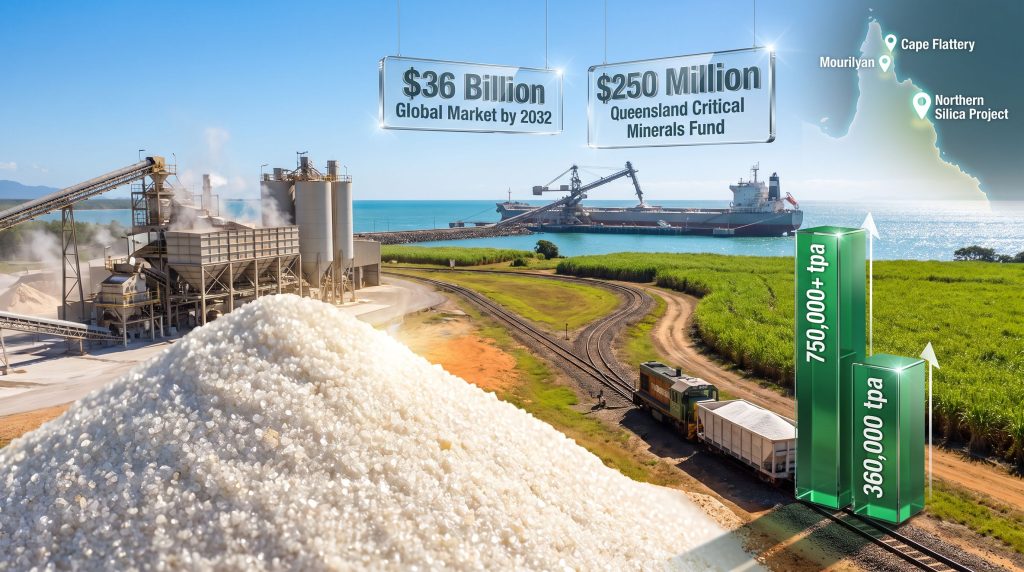
The global silica sand market is projected to surpass $36 billion in value by 2032, according to industry forecasting, underpinned by demand growth that is structurally linked to the critical minerals energy transition rather than driven by cyclical construction activity.
The Asia-Pacific region is the dominant consumption centre, accounting for the largest share of demand growth due to its concentration of solar panel manufacturers, flat glass producers, and semiconductor assembly facilities. China, Vietnam, South Korea, and Japan collectively represent a market of enormous scale. In addition, China industrial demand for high-purity materials continues to shape global supply chain dynamics.
The convergence of solar manufacturing expansion and semiconductor supply chain diversification across Asia is generating durable, long-cycle demand for high-purity silica, a pattern that differs fundamentally from the boom-bust dynamics associated with construction-linked commodities.
Several demand vectors are reinforcing each other simultaneously:
-
Solar energy buildout: Each gigawatt of solar panel capacity requires substantial volumes of high-purity silica for the glass covering that protects photovoltaic cells.
-
Semiconductor reshoring: Geopolitical pressures are driving significant investment in semiconductor fabrication capacity across Asia, the United States, and Europe, all of which requires refined silica as a base material input.
-
Electronics miniaturisation: Advanced electronics increasingly rely on ultra-pure silica substrates and compounds, sustaining demand at the premium end of the market.
-
Supply chain diversification: Asian industrial buyers are actively seeking alternatives to established silica suppliers, creating an opening for new entrants with proven quality and logistics infrastructure.
The Mourilyan Project: Infrastructure, Resource Scale, and the Path to Export
The Mourilyan Silica Sands Project is situated in Far North Queensland, a region whose combination of geology, existing port infrastructure, and proximity to Asia makes it logistically attractive for bulk mineral export. The project's resource base exceeds 50 million tonnes of mineable silica sand, providing the foundation for a long-duration extraction and processing operation rather than a short-cycle development.
The production expansion plan represents one of the most significant capacity scaling programs in Queensland's silica sector:
| Production Phase | Annual Output Target | Timeline |
|---|---|---|
| Current / Near-Term | ~360,000 tonnes per annum | Established |
| Expansion Target | 750,000+ tonnes per annum | Within five years |
| Growth Multiple | Approximately 2x output increase | Five-year horizon |
The Port of Mourilyan, operated by Ports North, provides the critical maritime export gateway. A long-term port lease between Ports North and SRA has been formalised, providing operational certainty and underpinning the project's export logistics strategy. The port's position on Australia's northeast coast reduces vessel transit times to key Asian markets compared to ports located further south along the Queensland coastline.
The projected employment impact of 180 jobs is a meaningful contribution for the Cassowary Coast region, which has historically depended on sugarcane farming and tourism as its primary economic pillars. Consequently, the Mourilyan project introduces a third structural industry to the regional economy.
Queensland's Critical Minerals Fund: How Public Capital Is Accelerating Private Production
A $30 million investment from the Queensland Critical Minerals Fund, managed by Queensland Investment Corporation (QIC), has financed the plant, equipment, and land acquisitions required to scale the Mourilyan operation. The fund itself has now reached $250 million in total capitalisation following an additional $100 million allocation in Queensland's 2026 State Budget.
The investment model reflects a deliberate approach to deploying public capital at the point where private projects require infrastructure funding to bridge the gap between exploration and commercial production. Rather than providing grants, the fund takes an equity or structured investment position, aligning government returns with project success.
Queensland's Minister for Finance, Trade, Employment and Training, Ros Bates, stated publicly that the investment into SRA was designed to unlock large-scale export opportunities and support regional employment growth, describing the fund's purpose as channelling capital toward Queensland's natural mineral endowment. This approach forms a core part of Australia's critical minerals strategy to strengthen sovereign supply chain capabilities.
| Fund Mechanism | Total Capital | Primary Focus |
|---|---|---|
| Queensland Critical Minerals Fund (QIC) | $250 million | Silica and broader critical minerals portfolio |
| Federal Government (Speewah DFS, WA) | $3 million (project-specific) | Fluorite critical minerals development |
Logistics Innovation: The Sugarcane Rail Network as a Potential Cost Advantage
One of the lesser-discussed but strategically important aspects of the Mourilyan project's development pathway involves a memorandum of understanding between SRA and MSF Sugar, one of the region's established sugar producers, to investigate using the local cane rail network for transporting silica sand to the Port of Mourilyan.
This is not a trivial consideration. In bulk commodity export economics, transport cost per tonne to port is frequently the difference between a project that generates strong margins and one that struggles to compete internationally. For a commodity like silica sand, which is high in volume but relatively moderate in per-tonne value compared to metals, logistics efficiency is a primary competitive lever.
The sugarcane rail network in Far North Queensland represents existing infrastructure that was built and maintained for agricultural purposes but physically connects inland production areas to the coast. Repurposing it for mineral transport, if operationally viable, would:
- Reduce dependence on heavy vehicle road haulage over comparable distances
- Lower per-tonne transport costs, improving export price competitiveness
- Reduce road wear and associated community and environmental impacts
- Extend the productive economic life of existing regional infrastructure
The feasibility of this arrangement remains under investigation, and no confirmed operational timeline has been announced. However, the strategic logic is compelling and could meaningfully support broader Australia resource exports competitiveness in Asian markets.
The next major ASX story will hit our subscribers first
Queensland's Silica Sand Cluster: A Multi-Project Export Landscape
The Mourilyan project does not exist in isolation. Far North Queensland is emerging as a geographically concentrated cluster of silica sand export development, with several other projects advancing simultaneously.
| Project | Location | Key Scale Metric | Primary Market |
|---|---|---|---|
| Mourilyan Silica Sands (SRA) | Far North Queensland | 750,000+ tpa target | Asia-Pacific export |
| Cape Flattery Silica Sand | Far North Queensland | Up to 4 million tpa run-of-mine | Export-oriented |
| Northern Silica Project (Diatreme) | Far North Queensland | 632.8 million tonnes total resource | Export-oriented |
The Cape Flattery Silica Sand project is advancing with production ambitions of up to 4 million tonnes per year of run-of-mine silica sand destined for export markets, positioning it as one of the largest single silica sand export operations under development in Australia. Diatreme's Northern Silica Project has reported a combined resource base of 632.8 million tonnes across its Far North Queensland tenements, a scale that supports multi-decade supply commitments to Asian industrial buyers.
The geographic concentration of these projects within Far North Queensland creates potential for shared infrastructure, collective logistics solutions, and regional branding as a reliable, high-quality silica supply origin. These factors can meaningfully improve competitiveness against established global suppliers.
Risks That Investors and Observers Should Weigh Carefully
The expansion trajectory is compelling, but several risks warrant clear-eyed assessment:
-
Market concentration exposure: A heavy reliance on Asian demand means project economics are sensitive to regional economic cycles, trade policy shifts, and currency fluctuations. Diversification of buyer geography would reduce this vulnerability over time.
-
Port capacity and logistics constraints: The Port of Mourilyan has finite throughput capacity, and the rate at which production can be scaled is partly dependent on port infrastructure investment keeping pace with mining output growth.
-
Rail feasibility outcomes: The sugarcane rail partnership remains a memorandum of understanding, not a confirmed logistics solution. If the rail option proves operationally unviable, road haulage costs could constrain the project's margin profile.
-
Regulatory and community approvals: Expansion in Far North Queensland is subject to environmental assessment processes and community consultation requirements that can influence both timelines and operating conditions.
-
Purity consistency at scale: Maintaining the SiO2 purity and low-contaminant specifications required for premium-grade solar glass and electronics markets across higher volumes of production is a technical challenge that requires investment in processing and quality control infrastructure.
This article contains forward-looking statements and projections sourced from publicly available information. Readers should conduct independent research before making any investment or commercial decisions related to the silica sand sector or specific projects mentioned.
Frequently Asked Questions: Queensland Silica Sand Mining Expansion
What is silica sand used for in modern industry?
Silica sand is a primary input in glass manufacturing, solar panel production, semiconductor fabrication, and construction materials. High-purity grades are increasingly critical for clean energy and advanced electronics supply chains.
How much is the global silica sand market worth?
The global silica sand market is projected to surpass $36 billion by 2032, driven by demand from solar glass, electronics, and industrial manufacturing sectors.
What is the Queensland Critical Minerals Fund?
The Queensland Critical Minerals Fund is a state government investment vehicle managed by Queensland Investment Corporation (QIC), now capitalised at $250 million, designed to accelerate the development of critical mineral projects across Queensland.
How many jobs will the Mourilyan Silica Sands expansion create?
The expansion program at the Mourilyan Silica Sands Project is expected to support approximately 180 jobs in the Cassowary Coast and Far North Queensland region.
When will Queensland silica sand begin exporting internationally?
The first international silica sand shipment from the Port of Mourilyan is anticipated to occur in the second half of 2026.
Why does purity matter so much for silica sand pricing?
Silica sand for solar glass and semiconductor applications requires SiO2 purity above 99.5% with tightly controlled trace element content. Material that meets these thresholds commands substantially higher prices than standard construction-grade product, making purity the primary value determinant in export markets.
Key Takeaways: Queensland's Silica Sand Sector at a Glance
-
$30 million in Queensland Critical Minerals Fund capital is enabling the Mourilyan project's production scaling program
-
Output is planned to grow from 360,000 to 750,000+ tonnes per annum within five years, representing a Queensland silica sand mine to double output within the decade
-
The $250 million Queensland Critical Minerals Fund is the central investment instrument driving the state's mineral diversification agenda
-
The global silica market's $36 billion projected value by 2032 provides the commercial rationale underpinning Queensland's expansion ambitions
-
Far North Queensland is consolidating as a multi-project silica sand export cluster, with Cape Flattery and Diatreme's Northern Silica Project adding substantial scale alongside the Mourilyan operation
-
Logistics innovation, including potential utilisation of the sugarcane rail network, could further strengthen Queensland's cost competitiveness in Asian export markets
-
Purity specifications, not just volume, will ultimately determine which Queensland projects capture premium pricing in solar glass and semiconductor supply chains
Want to Catch the Next Major Mineral Discovery Before the Market Does?
Discovery Alert's proprietary Discovery IQ model scans ASX announcements in real time, instantly identifying high-potential opportunities across silica, critical minerals, and more than 30 other commodities — turning complex data into clear, actionable insights for investors at every experience level. Explore historic discoveries and the returns they generated, then start your 14-day free trial at Discovery Alert to position yourself ahead of the broader market.