August 13, 2026
When Chokepoints Become Crisis Points: Understanding the Strait of Hormuz Supply Shock
Global energy markets are built on assumptions of continuity. Traders model supply curves, refiners plan procurement schedules months in advance, and governments stockpile strategic reserves as insurance against disruption. Yet the architecture of the modern oil market contains a single physical vulnerability so acute that when it fails, no amount of financial hedging can fully absorb the shock. The Strait of Hormuz oil flows crisis unfolding through 2026 and into 2027 is not simply a geopolitical flare-up. It is a live stress test of every contingency assumption the global energy system has ever made about the Persian Gulf.
When big ASX news breaks, our subscribers know first
The Arithmetic of Dependency: Why Hormuz Has No Real Substitute
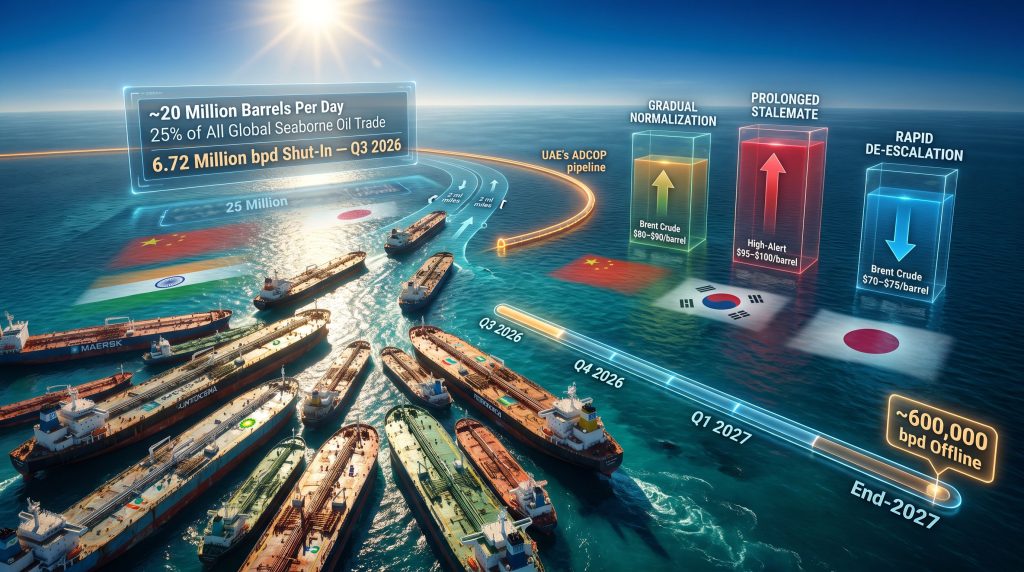
The numbers alone explain why disruptions to Strait of Hormuz oil flows cascade so rapidly across global markets. Under normal operating conditions, approximately 20 million barrels per day (bpd) of crude oil, condensate, liquefied natural gas, and refined petroleum products transit this narrow waterway, representing roughly 25% of all global seaborne oil trade. The navigable shipping channel measures just 2 miles wide in each direction, concentrating an extraordinary share of world energy security into a corridor that can be observed from shore with the naked eye.
Furthermore, what makes this chokepoint structurally different from other vulnerable shipping lanes is its destination profile. According to EIA data on world oil transit chokepoints, approximately 84% of crude oil and condensate transiting Hormuz flows toward Asian markets, alongside 83% of LNG volumes. A prolonged closure does not merely inconvenience the Middle East's producers. It rewires the energy economics of the entire Asia-Pacific region, with consequences for global LNG supply chains that extend well beyond the immediate disruption.
| Country | Role in Hormuz Trade | Estimated Exposure |
|---|---|---|
| China | Largest single buyer of Gulf crude | Very High |
| India | Major importer of Middle East oil | Very High |
| South Korea | Heavily reliant on Gulf LNG and crude | High |
| Japan | Long-term Gulf supply dependency | High |
| Europe | Partial exposure via LNG and refined products | Moderate |
| United States | Net exporter; indirect price exposure | Low-Moderate |
"The Strait of Hormuz is not simply a trade route. It is the load-bearing column of Asian energy security, and when it buckles, the structural consequences extend far beyond any single bilateral dispute."
From March to August 2026: How the Crisis Evolved
Understanding the current disruption requires mapping its trajectory rather than treating it as a single event. The March–May 2026 period represented the most acute phase of the supply shock, with shut-ins among Middle East producers peaking at an estimated 10.1 million bpd on average. By July 2026, offline volumes had approximately halved to around 5.5 million bpd, a meaningful improvement that briefly raised market hopes for accelerated normalisation.
However, those hopes proved premature. As diplomatic negotiations stalled through late July and into August, Hormuz traffic deteriorated again, falling to as few as six vessels per day at its weakest point. Renewed tensions pushed the EIA's Q3 2026 shut-in estimate back upward to an average of 6.72 million bpd, higher than the agency's July projection.
The Gap Between Official Statements and Observed Data
One of the more analytically significant features of this disruption has been the persistent gap between official statements and observed shipping data. U.S. officials at various points cited evidence of normalisation, referencing approximately 20 million barrels and 72 ships transiting within a 24-hour window during late June 2026. Tanker tracking data, however, told a more complicated story, with vessel traffic remaining well below pre-conflict baselines on a sustained basis.
"This divergence between official narrative and observed AIS data is not a minor discrepancy. It reflects the fundamental challenge of assessing a fluid geopolitical situation through any single information channel. Cross-referencing vessel tracking data, port call records, and cargo manifests has become the minimum analytical standard for serious market participants."
Country-by-Country: Where Production Stands and Why the UAE Is an Exception
Not all Gulf producers have been equally affected. As of July 2026, the offline volumes breakdown among major producers looked as follows:
- Saudi Arabia: approximately 2.3 million bpd of production curtailed
- Iraq: approximately 1.96 million bpd offline
- Kuwait: approximately 1.05 million bpd shut in
- UAE: fully restored to pre-crisis production levels as early as June 2026
The UAE's divergence from its neighbours is the most analytically instructive feature of the current crisis. Having formally exited OPEC on May 1, 2026, ADNOC deployed a sophisticated multi-channel export strategy that combined several distinct operational approaches simultaneously:
- Spot market tendering at scale, with eight or more crude tenders issued since June and nearly 100 million barrels offered in aggregate
- Onshore pipeline maximisation via the Abu Dhabi Crude Oil Pipeline (ADCOP), routing crude from west to east across the UAE entirely, bypassing Hormuz
- Dark mode tanker transits, operating vessels through the strait with AIS transponders disabled to reduce interdiction risk
- Lightering operations, using smaller vessels to shuttle crude through the narrowest part of the strait before transferring it onto larger tankers positioned safely outside the chokepoint
This operational playbook demonstrates that partial Hormuz workarounds are achievable for producers with pre-existing pipeline infrastructure. However, it is not a model that scales. The UAE's bypass capability is fundamentally a function of ADCOP's approximately 1.5 million bpd capacity and the country's unique coastal geography, neither of which can be replicated by Saudi Arabia, Iraq, or Kuwait within any practical timeframe.
The EIA's Recovery Roadmap: What the STEO Actually Projects
The U.S. Energy Information Administration's August 2026 Short-Term Energy Outlook (STEO) establishes the most detailed publicly available recovery timeline for Strait of Hormuz oil flows. Its central scenario assumes a phased, multi-quarter normalisation process rather than any rapid reopening.
| Period | Estimated Shut-In Volume | Key Assumption |
|---|---|---|
| Q3 2026 (average) | ~6.72 million bpd | Hormuz severely constrained through August |
| Q4 2026 | Gradual easing | Flows slowly increasing from September |
| Q1 2027 | ~1.68 million bpd | Near-normalisation for most producers |
| End of 2027 | ~600,000 bpd | Residual offline production persists |
The EIA's projection contains two critical embedded assumptions that deserve close scrutiny. First, it presumes that Hormuz traffic begins a genuine recovery from September 2026 onward. Second, it treats the Houthi threat environment around the Bab el-Mandeb Strait as not yet generating additional production shut-ins. Both assumptions carry meaningful downside risk given the five-and-a-half month pattern of repeated escalation and de-escalation cycles observed since the crisis began.
Crucially, the EIA explicitly acknowledges that not all Middle East producers will recover fully within the forecast window. The ~600,000 bpd of residual offline production projected through end-2027 represents a structural, permanent withdrawal from global supply, with lasting implications for inventory balances and long-run price discovery.
Oil Price Dynamics: How Markets Are Repricing the Supply Shock
The pricing response to the Hormuz disruption has been substantial and, in some respects, still catching up to the physical reality. The EIA raised its Q3 2026 Brent crude price forecast by $11 per barrel compared to its July STEO, placing the revised estimate at approximately $85 per barrel. By mid-August 2026, however, Brent was already trading near $89 per barrel in Asian trade as diplomatic progress stalled. Understanding broader crude oil price trends is essential context for interpreting these recent movements.
Iran's publicly stated conditions for reopening the strait, described as a set of six sweeping demands directed at the United States, have remained unmet as of writing. This diplomatic impasse has been a primary driver of the sustained price premium observable in forward curves. In addition, Brent and WTI futures have reflected heightened volatility as traders price in continued supply uncertainty through late 2026.
Bank of America's research team concluded that the Strait of Hormuz would need approximately 10 times more vessel capacity than was operationally available to stabilise global oil market flows. Meanwhile, the IEA projected a global oil supply deficit of 1.8 million bpd for Q3 2026, compounding the inventory depletion dynamic already visible in weekly crude stock data.
The next major ASX story will hit our subscribers first
Three Scenarios for Hormuz Oil Flows Through 2027
Given the volatility of the political environment, a scenario-based framework offers more analytical utility than any single point forecast.
Scenario 1: Gradual Normalisation (Base Case)
- Hormuz traffic recovers incrementally from September 2026 onward
- Most Gulf producers approach pre-conflict output levels by early 2027
- Residual shut-ins of approximately 600,000 bpd persist through end-2027
- Brent stabilises in the $80–$90/barrel band as supply gradually returns
- Probability: Moderate, conditional on diplomatic progress and no fresh escalation
Scenario 2: Prolonged Stalemate (Bearish Supply Case)
- Negotiations remain deadlocked past Q3 2026, with Hormuz severely constrained into Q4
- Shut-ins hold above 4–5 million bpd through year-end
- Global inventory drawdowns accelerate; Brent tests $95–$100/barrel
- Asian importers accelerate procurement diversification toward West African, U.S., and Russian crude
- Probability: Elevated, given current diplomatic impasse and Iran's stated demands
Scenario 3: Rapid De-escalation (Upside Supply Case)
- A diplomatic breakthrough reopens Hormuz to near-full capacity within weeks
- Middle East producers rapidly restore shut-in volumes
- Brent corrects sharply toward $70–$75/barrel as supply floods back
- OPEC+ faces renewed internal cohesion pressure as spare capacity is released simultaneously
- Probability: Low-to-Moderate near term; more plausible by Q1 2027
The Bypass Infrastructure Gap: Why Alternative Routes Cannot Fill the Void
| Route or Infrastructure | Estimated Capacity | Key Limitation |
|---|---|---|
| ADCOP (UAE onshore pipeline) | ~1.5 million bpd | UAE-specific; inaccessible to other Gulf producers |
| Saudi East-West Pipeline (Petroline) | ~5 million bpd | Red Sea terminus faces Bab el-Mandeb risk |
| Bab el-Mandeb Strait | Variable | Active Houthi threat environment |
| Overland routes via Turkey or Mediterranean | Limited | Insufficient scale for Gulf-volume flows |
Collectively, existing bypass infrastructure can offset only a fraction of the approximately 20 million bpd that normally transits Hormuz. No combination of currently operational alternatives comes close to replacing the strait's function. Moreover, geopolitical trade tensions across the region continue to complicate any near-term infrastructure development. Developing new pipeline capacity at the required scale would require years of planning, engineering, and capital deployment.
How Asian Importers Are Restructuring Their Procurement Strategies
The demand-side response to the Hormuz disruption has been most visible among Asia-Pacific importers, who collectively represent the primary destination for Hormuz crude flows.
China has positioned its independent teapot refining sector to increase purchases of Iranian crude, which moves through alternative channels outside conventional Hormuz-dependent shipping. Strategic Petroleum Reserve releases have also been used as a buffer during peak disruption periods.
India has responded with aggressive spot market activity. Indian refiners have issued procurement tenders covering up to 6 million barrels in single-round exercises, actively seeking non-Gulf cargoes from Russian, West African, and U.S. sources.
South Korea and Japan, which maintain minimal domestic production and high structural dependency on Gulf crude and LNG, have deployed emergency reserve releases and accelerated LNG substitution as short-term mitigation tools. Both economies remain among the most exposed to a prolonged disruption scenario, and OPEC's market influence on replacement supply options continues to shape their procurement decisions.
Frequently Asked Questions: Strait of Hormuz Oil Flows
How much oil flows through the Strait of Hormuz under normal conditions?
Approximately 20 million barrels per day of crude oil, condensate, and refined products transit the strait under normal operating conditions, accounting for roughly 25% of all global seaborne oil trade. Recent reports on oil flows through Hormuz highlight just how dramatically those volumes have fluctuated since early 2026.
Which countries face the greatest exposure to a prolonged Hormuz closure?
China, India, South Korea, and Japan bear the most direct exposure, given that approximately 80–84% of Hormuz crude flows are destined for Asian markets. European economies face secondary exposure through LNG pricing and refined product market contagion.
Can alternative routes meaningfully substitute for Hormuz transit capacity?
Only marginally. The UAE's ADCOP pipeline offers approximately 1.5 million bpd of bypass capacity, and Saudi Arabia's Petroline can deliver up to 5 million bpd to Red Sea terminals. Together, these alternatives cannot come close to replacing the strait's normal throughput volume.
What is the EIA's official forecast for Middle East production recovery?
The EIA's August 2026 STEO base case projects that most production will return to near pre-conflict levels by early 2027, but approximately 600,000 bpd is expected to remain permanently offline through end-2027 even under the recovery scenario.
Disclaimer: This article is intended for informational and educational purposes only and does not constitute financial, investment, or trading advice. Price forecasts, scenario probabilities, and supply estimates referenced herein are drawn from publicly available agency reports and analyst research and are subject to rapid change given the evolving geopolitical environment. Readers should conduct independent due diligence before making any investment decisions.
Want to Stay Ahead of the Commodity Disruptions Reshaping Global Markets?
When geopolitical shocks like the Strait of Hormuz crisis ripple through energy and resource markets, timing is everything — Discovery Alert's proprietary Discovery IQ model delivers real-time alerts on significant ASX mineral discoveries, instantly translating complex market signals into actionable investment opportunities for traders and long-term investors alike. Explore how historic discoveries have generated substantial returns on Discovery Alert's dedicated discoveries page, and begin your 14-day free trial today to position yourself ahead of the next major market move.