
August 13, 2026
The Fragility Hidden Inside Global Food Security
Every season, the world's farmers depend on a supply chain most consumers never think about. Nitrogen fertilisers, and urea in particular, are the invisible engine behind the grain yields that feed billions of people. Yet the infrastructure delivering these inputs to some of the planet's largest agricultural economies is far more exposed to geopolitical shocks than most market participants appreciate.
India's experience in the first quarter of the current financial year illustrates this vulnerability with uncomfortable clarity. When shipping disruptions rippled through the Strait of Hormuz, the narrow waterway connecting the Persian Gulf to the Arabian Sea, New Delhi did not have the luxury of waiting. Within weeks, procurement teams redirected billions of dollars in fertiliser contracts toward suppliers that had received zero orders from India just twelve months earlier.
The countries that stepped into that gap were not the usual names in the fertiliser trade. They were Egypt, Algeria, Nigeria, and Georgia. India urea imports from Egypt Algeria and Nigeria represent one of the most dramatic procurement pivots in recent agricultural commodity history, and the scale and speed of this shift raises questions that extend well beyond one disrupted shipping season.
When big ASX news breaks, our subscribers know first
Why India's Urea Dependency Creates Systemic Risk
India is one of the world's most consequential agricultural markets. Its two primary cropping seasons, kharif and rabi, require enormous quantities of nitrogen-based fertilisers to sustain yields across hundreds of millions of hectares. Urea is the cornerstone input for both cycles, accounting for the dominant share of India's total fertiliser consumption each year.
The country operates 33 urea manufacturing plants with a combined nameplate capacity of 26.9 million tonnes per annum. On paper, that sounds substantial. In practice, domestic output still falls short of total consumption requirements, leaving approximately 20% of annual urea demand dependent on international procurement. That residual import gap is where the strategic vulnerability lives.
How Does Hormuz Concentration Risk Amplify the Problem?
Historically, more than 40% of India's urea and phosphatic fertiliser imports have originated from Gulf nation suppliers, with shipments transiting through the Strait of Hormuz. Unlike crude oil markets, which benefit from strategic petroleum reserves and diversified pipeline networks, fertiliser supply chains have almost no equivalent buffer mechanisms. The broader pattern of supply chain disruptions affecting global commodity flows has made this structural fragility more visible than ever.
Furthermore, the India LNG import structure offers a useful parallel — both energy and fertiliser procurement are deeply exposed to the same maritime chokepoints, making diversification a policy imperative rather than merely a commercial preference.
"Fertiliser supply chains lack the strategic reserves and alternative infrastructure that partially insulate oil markets from geopolitical shocks, making maritime route disruptions immediately consequential for agricultural economies."
Africa Steps Into the Breach: The Q1 Procurement Pivot
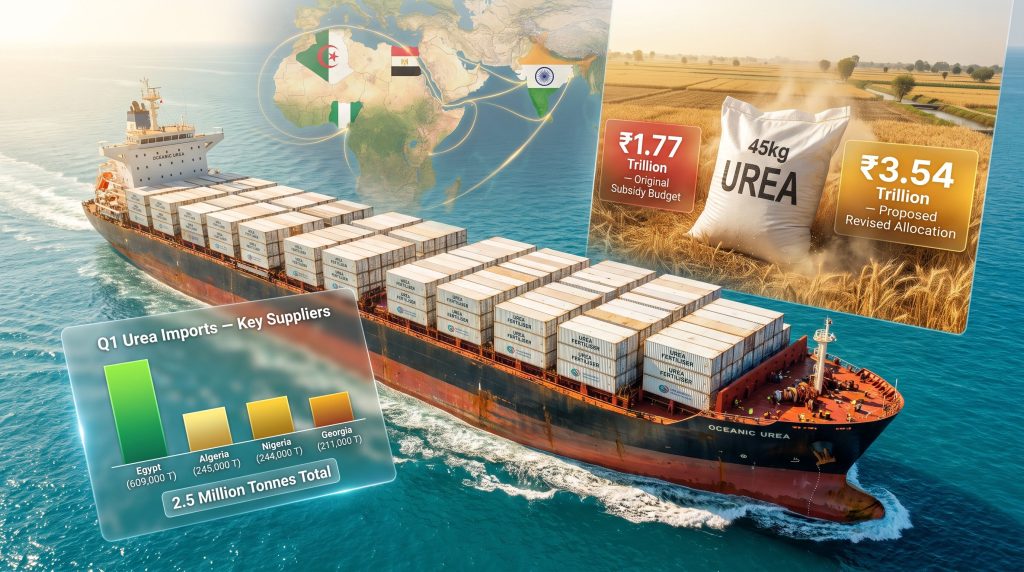
The data from India's Commerce Ministry, as cited by Mint, tells a story that would have seemed implausible at the start of the financial year. During Q1 of the current financial year, India imported a total of 2.5 million tonnes of urea. Egypt, Algeria, Nigeria, and Georgia collectively accounted for 52% of that total volume, despite India having imported precisely zero tonnes from any of these four nations during the equivalent quarter of the prior financial year.
The individual country contributions break down as follows:
| Supplier Country | Q1 Volume (Current FY) | Share of Total Imports |
|---|---|---|
| Egypt | 609,000 tonnes | ~24% |
| Algeria | 245,000 tonnes | ~10% |
| Nigeria | 244,000 tonnes | ~10% |
| Georgia | 211,000 tonnes | ~8% |
| Combined (4 nations) | ~1.31 million tonnes | ~52% |
| Total Indian Urea Imports | 2.5 million tonnes | 100% |
Source: India Commerce Ministry data, as cited by Mint, August 2026
The combined African contribution alone, from Egypt, Algeria, and Nigeria, reached approximately 1.1 million tonnes in a single quarter. To contextualise that figure, Nigeria's entire contribution during the full 2025–26 financial year was 447,090 tonnes, Algeria's was 217,059 tonnes, and Egypt's was 194,830 tonnes. The acceleration into the current year is therefore not incremental — it is a structural step-change in procurement geography.
Breaking Down Africa's Three Pillars of Urea Export Capacity
Egypt: North Africa's Export Infrastructure Proves Its Scale
Egypt's emergence as India's single largest alternative supplier in Q1 is not accidental. The country's nitrogen fertiliser production base is anchored by natural gas feedstock from domestic reserves, giving Egyptian producers a cost structure competitive with Gulf-origin urea on a freight-adjusted basis for buyers in South Asia. Egypt's geographic positioning provides shipping access via both the Red Sea and Mediterranean corridors, offering routing flexibility that landlocked or West African suppliers cannot match.
The 609,000 tonnes shipped to India during Q1 of the current financial year represents more than three times Egypt's entire urea export volume to India during the full 2025–26 financial year. That compression of timeline suggests Egyptian producers were already operating with spare export capacity waiting for demand signals from large buyers willing to move away from Gulf-origin supply.
Algeria: A Hydrocarbon-Linked Fertiliser Base Finds a New Market
Algeria's fertiliser manufacturing sector is structurally linked to its hydrocarbon production infrastructure. The country's substantial natural gas reserves provide a low-cost feedstock for urea synthesis, and Algerian export capacity has historically been directed toward European and regional markets rather than South Asia.
The 245,000 tonnes delivered to India in Q1 of the current financial year, compared to 217,059 tonnes across the entire prior financial year, signals a rapid reorientation of Algerian export flows. For Algeria, India represents not just an emergency buyer but potentially a structural long-term destination given the scale and predictability of Indian fertiliser demand.
Nigeria: West Africa's Urea Export Momentum Builds
Nigeria's position as the largest African contributor to India's urea imports in the 2025–26 financial year, at 447,090 tonnes, established a baseline that the current year is already surpassing on a quarterly basis. June shipment data recorded approximately 138,000 tonnes in a single month, indicating sustained export momentum rather than a one-time opportunistic sale.
Nigeria's urea production capacity has expanded meaningfully in recent years as domestic producers have invested in gas-to-fertiliser conversion infrastructure. The country's ability to absorb and respond to sudden demand from a buyer as large as India within a single quarter is a meaningful demonstration of export readiness that the market may have previously underestimated. Indeed, India seeks fertilizer supplies from Africa as Gulf routes face mounting pressure, a trend that is now playing out with considerable force.
The Comparative Shift: Before and After Hormuz Disruption
The year-on-year contrast in India's sourcing geography is stark enough to warrant direct comparison:
| Metric | Prior Year Q1 | Current Year Q1 |
|---|---|---|
| Imports from Egypt | 0 tonnes | 609,000 tonnes |
| Imports from Algeria | 0 tonnes | 245,000 tonnes |
| Imports from Nigeria | 0 tonnes | 244,000 tonnes |
| Combined African share | 0% | ~44% of total |
| Total urea imports | Not specified | 2.5 million tonnes |
During the full 2025–26 financial year, the four countries including Georgia collectively represented just 8.8% of India's 11.2 million tonnes of total urea imports. The trajectory from 8.8% on an annual basis to 52% in a single quarter illustrates how rapidly procurement geographies can shift when geopolitical conditions force the hand of a large sovereign buyer. This mirrors broader geopolitical trade tensions that are reshaping commodity flows across multiple sectors simultaneously.
The Fiscal Consequence: India's Subsidy Bill Under Pressure
Supply chain diversification carries a cost, and India is absorbing it in real time. The shift toward African and alternative suppliers has coincided with a sharp rise in both retail fertiliser prices and the government subsidy burden required to shield farmers from the full price impact.
The price of a standard 45kg fertiliser bag has risen from approximately ₹2,900 ($30) to ₹4,300 ($45), representing a 48% retail price increase. To contain the impact on agricultural productivity and rural incomes, India's fertiliser ministry has proposed revising the annual subsidy allocation from the originally budgeted ₹1.77 trillion ($18.6 billion) to a proposed ₹3.54 trillion ($37.1 billion), more than doubling the initial commitment within a single procurement cycle.
| Fiscal Reference Point | Subsidy Amount |
|---|---|
| Original FY2026-27 Budget Allocation | ₹1.77 trillion (~$18.6 billion) |
| Proposed Revised Allocation | ₹3.54 trillion (~$37.1 billion) |
| Actual 2025-26 Expenditure | ₹2.17 trillion (~$22.8 billion) |
| Retail price (45kg bag), prior period | ₹2,900 (~$30) |
| Retail price (45kg bag), current period | ₹4,300 (~$45) |
"A subsidy commitment that has doubled within a single procurement cycle raises serious questions about fiscal sustainability, particularly if the underlying geopolitical conditions driving higher procurement costs persist beyond the current agricultural season."
Disclaimer: Subsidy figures and price data cited above are drawn from Commerce Ministry data as reported by Mint and Business Insider Africa. Forward-looking fiscal projections are subject to change based on policy decisions and market conditions.
The next major ASX story will hit our subscribers first
Demand Reduction Meets Cost Escalation: The Paradox Facing Indian Farmers
In an unusual coincidence of timing, India has simultaneously revised its fertiliser demand forecast downward for the current kharif season. Weaker than expected monsoon rainfall has prompted planners to reduce overall fertiliser requirements from 39.05 million tonnes to 38.39 million tonnes, with urea-specific demand trimmed by approximately 400,000 tonnes to a projected 19 million tonnes.
The paradox this creates is notable:
- Demand is falling modestly due to weather conditions.
- Prices are rising sharply due to supply chain disruption.
- The subsidy burden is escalating regardless of the demand reduction.
- Farmers face higher input costs even as production expectations are tempered by poor rainfall.
The interaction of these forces is a reminder that fertiliser market economics do not operate through simple supply-demand mechanics alone. Geopolitical shocks can decouple price from demand in ways that create fiscal stress for large importing governments, regardless of seasonal agricultural conditions. For context, the wider picture of natural gas price trends is also influencing fertiliser production costs upstream, compounding pressure on buyers and sellers alike.
Is This a Structural Shift or a Temporary Emergency Response?
The central question for fertiliser market observers is whether India's pivot toward Africa represents a durable reorientation of procurement strategy or simply an emergency response that will reverse once Gulf shipping lanes normalise. In addition, the question of fertiliser import reliance is not unique to India — other major agricultural economies face analogous structural vulnerabilities that this episode has thrown into sharp relief.
Several factors suggest the shift has structural dimensions:
- Commercial relationship establishment: When buyers and sellers execute contracts at this scale, distribution infrastructure, payment arrangements, and logistical partnerships are built that persist beyond the immediate emergency.
- Supplier capacity validation: African producers have now demonstrated to Indian buyers that they can absorb large-volume orders at short notice, removing a key barrier to future procurement.
- Risk management imperative: India's fertiliser ministry and procurement agencies will have documented the vulnerability of Gulf concentration risk in ways that are likely to influence future tender specifications.
- Freight economics: On a freight-adjusted basis, North African suppliers like Egypt offer genuinely competitive landed costs into Indian ports, particularly relative to Gulf suppliers when Hormuz transit risk premiums are incorporated.
Against these structural arguments, the countercase rests on the established depth of Gulf supplier relationships, the generally lower base prices available from Gulf producers in normal market conditions, and the logistical challenge of sustaining West African supply chains at scale over the long term.
Scenario Analysis: Three Pathways Forward
Scenario 1: Short-Term Disruption (3–6 Months)
African and Georgian suppliers retain elevated market share through the current kharif season. India's subsidy bill stabilises near the revised ₹3.54 trillion ceiling. Gulf suppliers resume partial deliveries as geopolitical tensions ease, and African market share moderates but does not return to zero as commercial relationships persist.
Scenario 2: Extended Disruption (12+ Months)
India accelerates long-term procurement agreements with Egyptian, Algerian, and Nigerian producers. African fertiliser export infrastructure attracts new investment in response to sustained and predictable Indian demand signals. Domestic Indian urea production expansion becomes a policy priority to reduce the structural import dependency below 20%.
Scenario 3: Escalation and Full Hormuz Closure
Global urea prices spike sharply across all markets. India's subsidy bill breaches ₹4 trillion. African producers face capacity constraints relative to the full scale of Indian demand, and New Delhi activates emergency procurement from non-traditional markets including Russia, Malaysia, and Indonesia at elevated freight premiums.
Frequently Asked Questions: India Urea Imports from Egypt, Algeria and Nigeria
How Much Urea Did India Import from Egypt, Algeria, and Nigeria in Q1?
India imported approximately 1.1 million tonnes from the three African nations combined. Egypt contributed 609,000 tonnes, Algeria 245,000 tonnes, and Nigeria 244,000 tonnes, according to Commerce Ministry data cited by Mint.
Why Did India Shift Urea Imports Toward African Suppliers?
Geopolitical tensions and vessel movement disruptions affecting the Strait of Hormuz, a critical maritime corridor for Gulf-origin fertiliser exports, compelled India to identify and activate alternative procurement sources rapidly. Egypt, Algeria, and Nigeria were the primary beneficiaries.
What Share of India's Total Urea Imports Came from African and Alternative Suppliers?
Egypt, Algeria, Nigeria, and Georgia together accounted for 52% of India's 2.5 million tonnes of urea imports during Q1 of the current financial year, a dramatic shift from zero imports from these four nations during the equivalent quarter of the prior year.
How Has the Hormuz Disruption Affected Fertiliser Prices in India?
The retail price of a standard 45kg fertiliser bag has climbed from approximately ₹2,900 to ₹4,300. India's proposed fertiliser subsidy allocation has more than doubled from ₹1.77 trillion to ₹3.54 trillion to absorb higher global procurement costs.
Does India Produce Enough Urea Domestically to Reduce Import Reliance?
India operates 33 urea manufacturing facilities with combined annual capacity of 26.9 million tonnes. However, domestic output still leaves approximately 20% of annual urea consumption dependent on imports, creating the structural vulnerability that Hormuz disruptions have now exposed.
Is Africa Likely to Remain a Meaningful Urea Supplier to India Beyond the Current Disruption?
The transition from zero imports to over 1.1 million tonnes in a single quarter indicates that African suppliers have established meaningful commercial footholds in the Indian market. Whether this becomes a permanent structural feature of India's import mix will depend on the duration of Gulf disruptions and the competitiveness of African supply on a freight-adjusted basis over time.
What This Episode Tells Us About Supply Chain Resilience in Agricultural Commodity Markets
India urea imports from Egypt Algeria and Nigeria in the first quarter of the current financial year are not simply a story about fertiliser procurement. They represent a live case study in how geopolitical shocks propagate through agricultural supply chains, force rapid institutional adaptation, and create lasting shifts in trade geography.
For African fertiliser producers, the episode opens a strategic window. India is not a small or easily satisfied buyer — it is one of the world's largest and most price-sensitive agricultural importers, and its procurement decisions set benchmarks for South Asian fertiliser markets more broadly. Establishing durable export relationships with Indian buyers, even at the cost of short-term logistical complexity, could prove commercially significant for North and West African producers for decades.
For market observers and policymakers, the episode reinforces a broader truth: in commodity supply chains with limited buffer capacity, a single chokepoint is sufficient to fundamentally restructure the sourcing geography of an entire importing economy within a matter of weeks. The Strait of Hormuz has made that lesson impossible to ignore.
This article is intended for informational purposes only and does not constitute financial advice. All figures are sourced from India's Commerce Ministry data as reported by Mint and Business Insider Africa. Forward-looking scenarios involve inherent uncertainty and actual market outcomes may differ materially from those described.
Want to Profit From the Next Major Commodity Disruption Before the Market Catches On?
When geopolitical shocks reshape global supply chains overnight — as India's dramatic urea procurement pivot has demonstrated — the investors who act first capture the greatest returns. Discovery Alert's proprietary Discovery IQ model delivers real-time alerts on significant ASX mineral discoveries, transforming complex commodity data into actionable insights so subscribers can position themselves ahead of the broader market — start your 14-day free trial today or explore historic discovery returns to understand just how transformative early positioning can be.