August 13, 2026
Europe's Industrial Sovereignty Bet: Understanding the Architecture Behind Clean-Tech State Aid
The energy transition has quietly evolved into something far more strategic than an environmental programme. Across the European Union, governments are increasingly treating clean-technology manufacturing capacity the way they once treated defence procurement: as a matter of national security. The EU approves Danish scheme for clean-tech and critical raw materials production as part of this broader strategic push, and the policy logic is straightforward, even if its implications are profound.
When the materials and components that power wind turbines, battery storage systems, and solar installations are sourced predominantly from outside the bloc, the EU's ability to hit its own climate targets becomes hostage to external supply chains, geopolitical relationships, and trade dynamics it cannot control.
Against that backdrop, the European Commission's approval of an €84 million (approximately USD 96.87 million) Danish state aid scheme for clean-tech manufacturing and critical raw material production is not simply an administrative footnote. It is a precise expression of a carefully constructed industrial policy architecture that is simultaneously reshaping how EU member states deploy public capital and how manufacturers position themselves for the decade ahead.
When big ASX news breaks, our subscribers know first
Why Critical Raw Material Supply Chains Are a Security Question
The term "critical raw materials" carries specific regulatory meaning within the EU's policy framework. These are not merely scarce or valuable commodities. They are inputs whose supply disruption would directly impair the EU's capacity to manufacture net-zero technologies at the scale required to meet its 2050 climate commitments.
The list encompasses materials embedded across the clean-tech value chain: lithium for battery cells, rare earth elements for permanent magnets in wind turbines, silicon for solar photovoltaic panels, and aluminium for structural and thermal applications across virtually every clean-energy system. Furthermore, critical minerals demand continues to accelerate as the net-zero transition gains momentum across member states.
What makes the EU's current approach distinctive is the recognition that supply chain resilience requires intervention at multiple points simultaneously. It is not enough to secure access to primary extraction. The EU's Critical Raw Materials Act explicitly extends its strategic focus to recovered and recycled material streams, acknowledging that circular economy pathways can reduce geopolitical exposure just as effectively as new mining projects, and often faster.
A systems-level understanding of CRM supply chains reveals that a single point of failure, whether at the mine, the processing facility, or the refinery, can cascade through an entire clean-tech manufacturing sector. Circular recovery pathways provide structural redundancy that primary supply alone cannot deliver.
This dual focus on extraction and recovery is not incidental. It reflects a genuine shift in how European policymakers model supply chain risk. Recovered critical raw materials, sourced from end-of-life batteries, aluminium dross processing operations, and rare earth reclamation facilities, represent a domestically controllable material stream with far lower geopolitical risk than primary imports from third-country suppliers.
What CISAF Actually Does and Why It Matters
The Clean Industrial Deal State Aid Framework (CISAF), adopted by the European Commission in June 2025, is the regulatory instrument that makes schemes like Denmark's legally possible. Before CISAF, EU state aid rules applied relatively blunt general frameworks to clean-technology support, creating uncertainty for member states about what forms of industrial subsidy would pass Commission scrutiny.
CISAF changed that by establishing a dedicated, harmonised legal basis for targeted clean-tech manufacturing subsidies. Its core architecture rests on several operational principles:
- Aid must be directed toward technologies listed under Annex II, which defines eligible net-zero technology categories and their primary components
- Support must be the minimum necessary to incentivise investment activity that would not otherwise occur at the same scale or within the same timeframe
- The scheme must not produce material competitive distortion between EU member states
- Grant eligibility under CISAF standardises at 31 December 2026, creating a uniform investment activation horizon across national programmes
The table below contrasts CISAF with the prior EU state aid landscape for clean technology:
| Feature | Pre-CISAF Frameworks | CISAF (2025) |
|---|---|---|
| Primary focus | Broad industrial support | Clean-tech manufacturing specificity |
| CRM recovery eligibility | Limited or absent | Explicitly included |
| Circular economy integration | Incidental | Structural design element |
| Alignment with EU industrial strategy | Partial | Direct alignment with Clean Industrial Deal |
| Aid timeline standardisation | Variable by member state | Harmonised to 31 Dec 2026 |
This structural clarity matters for manufacturers making multi-year capital allocation decisions. CISAF removes much of the guesswork about whether a proposed investment in, for instance, a secondary aluminium processing facility or a battery-grade lithium recovery operation would qualify for grant support.
Denmark's €84 Million Scheme: What the Structure Reveals
The Danish scheme, approved under CISAF, delivers funding as direct grants rather than loans, guarantees, or tax incentives. That distinction carries practical significance. Direct grants provide immediate capital certainty, removing the repayment risk and balance sheet complexity that debt-based instruments introduce. For manufacturers evaluating capacity expansion decisions, grant funding reduces the effective cost of capital for qualifying investments.
Eligible investments fall into three distinct operational categories:
- Manufacturing capacity expansion for net-zero technologies and their principal components, covering production lines, equipment upgrades, and facility buildouts aligned with Annex II technologies
- New critical raw material production, supporting primary material output for clean-tech manufacturing applications
- Recovered critical raw material production, covering investments in recycling, reprocessing, and secondary recovery infrastructure that transforms end-of-life materials back into usable manufacturing inputs
The third category deserves particular attention. The inclusion of recovered CRM production signals that Danish policymakers, operating within the CISAF framework, are treating material recovery infrastructure with the same strategic seriousness as primary manufacturing capacity. This is practically significant for operators in aluminium dross processing, critical minerals recycling, and rare earth reclamation, all of which generate recovered CRMs that feed back into clean-tech supply chains.
An often-overlooked dimension of aluminium dross processing is its direct relevance to CRM supply chains. Aluminium dross, the oxidised layer generated during primary and secondary smelting, contains recoverable aluminium metal and other compounds that, when properly processed, re-enter manufacturing streams as secondary raw materials. Under CISAF's eligibility criteria, investment in advanced dross processing infrastructure could plausibly qualify as recovered CRM production.
The Commission's proportionality assessment concluded that competitive distortion between EU member states from Denmark's scheme would be limited. That reflects both the scheme's targeted scope and Denmark's relatively contained industrial manufacturing base compared to Germany or Italy. The EU cleantech manufacturing scheme has been broadly welcomed as a proportionate and well-structured intervention.
Comparing National Schemes: Scale, Focus, and Strategic Intent
Denmark's scheme sits within a rapidly expanding field of EU member state clean-tech aid approvals. The table below contextualises the Danish programme against two of the largest national schemes approved in the same period:
| Member State | Approved Scheme Value | Primary Focus | Approval Period |
|---|---|---|---|
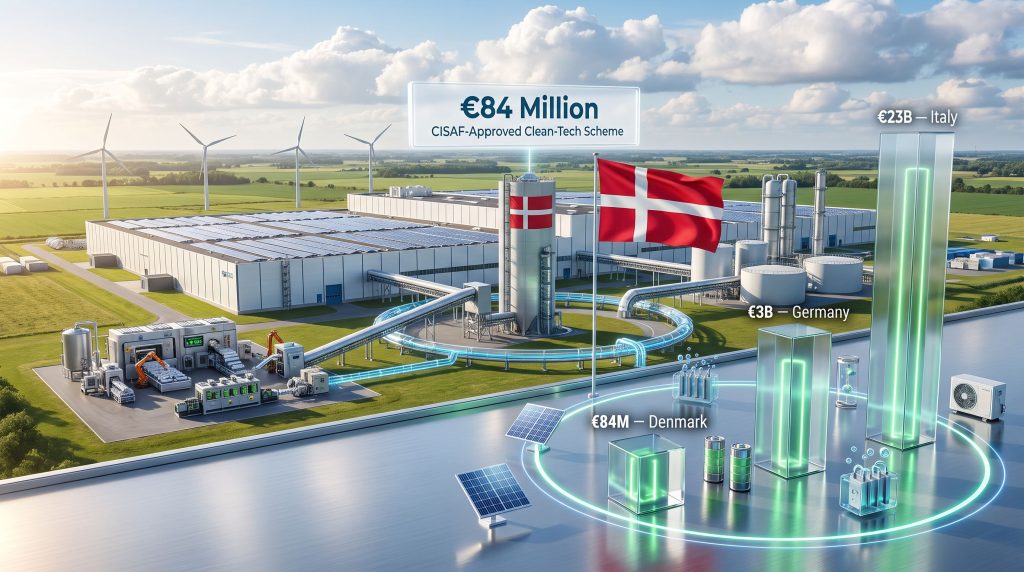
| Denmark | €84 million (~USD 96.87M) | Clean-tech manufacturing, CRM production and recovery | Until Dec 2026 |
| Germany | €3 billion (~USD 3.55B) | Solar panels, batteries, electrolysers | 2026 (February approval) |
| Italy | €23 billion (~USD 26.5B) | Renewable energy deployment (37.15+ GW capacity) | 2026 (June approval) |
The scale differential is striking but not analytically straightforward. Germany's €3 billion programme targets production-tier manufacturing, positioning the country as a European hub for electrolyser and battery cell fabrication. Italy's €23 billion scheme operates primarily at the deployment tier, targeting renewable capacity installation rather than manufacturing.
Denmark's programme, despite its smaller absolute size, occupies a distinct strategic position: it is explicitly designed to build manufacturing capacity and material recovery capability simultaneously, embedding circular economy logic directly into its funding architecture. For smaller EU member states observing this landscape, Denmark's scheme may represent a more replicable policy model than Germany's or Italy's larger programmes.
The Industrial Accelerator Act: Demand-Side Complement to Supply-Side Grants
Supply-side grant schemes like Denmark's do not operate in isolation. The Industrial Accelerator Act, adopted by the EU in March 2026, introduced "Made in EU" manufacturing criteria for strategic clean-tech sectors including solar photovoltaic panels and battery systems. These criteria function as demand-side levers, creating procurement preferences for products that meet defined EU manufacturing thresholds.
The interaction between these two policy instruments creates a compounding incentive structure:
- Manufacturers who access CISAF grant funding to expand EU-based production capacity reduce their capital expenditure burden on new facilities
- Those same manufacturers, by virtue of producing within the EU, become eligible for preferential treatment in public procurement processes under the Industrial Accelerator Act
- The combined effect accelerates the economics of EU-based clean-tech manufacturing relative to non-EU alternatives, without relying solely on tariff barriers
This architecture is deliberately layered. Policymakers appear to have concluded that supply-side subsidies alone are insufficient to shift manufacturer location decisions at the required pace. Demand-side preferences, consequently, create a durable market advantage for EU-manufactured products that persists beyond the grant funding window.
The next major ASX story will hit our subscribers first
The T-MED Programme and Pan-European Investment Mobilisation
Alongside national schemes and the Industrial Accelerator Act, the EU launched the T-MED programme in June 2026. Targeting €25 billion (USD 28.9 billion) in clean energy investment by 2035, T-MED supports the development of 15 GW of renewable energy capacity across participating regions.
T-MED operates at a supranational level, complementing rather than replacing national grant schemes. Where programmes like Denmark's €84 million initiative address manufacturing-side gaps, T-MED focuses on mobilising investment capital for deployment-scale renewable infrastructure. The two instruments address different points in the clean-tech value chain and are designed to operate in parallel.
Circular Economy Integration: The Underappreciated Policy Innovation
Perhaps the most analytically significant aspect of CISAF, and by extension Denmark's scheme, is the deliberate embedding of circular economy principles into industrial funding architecture. Traditional clean-tech supply chain policy focused almost exclusively on upstream activities: securing access to newly mined materials and building primary processing capacity.
The CISAF framework's explicit inclusion of recovered critical raw materials represents a meaningful departure from that linear model. It reflects several converging realities:
- Primary extraction timelines are long and geopolitically exposed, while material recovery from existing waste streams can be scaled more rapidly
- End-of-life clean-tech equipment, particularly spent batteries and solar panels, represents a growing domestic material reservoir within EU borders
- Advanced recovery processes, including hydrometallurgical techniques for battery material reclamation and thermal processing for aluminium dross, are reaching commercial maturity at a point where policy support can meaningfully accelerate deployment
For manufacturers operating in secondary material processing, the policy signal embedded in CISAF is direct. Furthermore, the battery recycling process is now treated as strategically equivalent to investment in primary production capacity, marking a genuine shift in how industrial funding is structured across the EU.
What This Means for Manufacturers, Investors, and Supply Chain Strategists
The convergence of CISAF grant approvals, the Industrial Accelerator Act, and the T-MED programme creates a policy environment with concrete implications for capital allocation decisions across the clean-tech manufacturing and materials sectors.
For manufacturers, the December 2026 grant deadline under CISAF creates a compressed decision window. Capacity expansion investments that might otherwise be deferred face a genuine opportunity cost if grant eligibility expires before investment decisions are formalised.
For material recovery specialists, the explicit CISAF eligibility for recovered CRM production opens a funding pathway that did not exist under previous EU state aid frameworks. Operators in battery recycling, rare earth reclamation, and secondary aluminium processing should assess their investment pipelines against CISAF's Annex II criteria.
For non-EU manufacturers, the layered combination of supply-side grants and demand-side procurement preferences signals a structural shift in EU market access dynamics. The economics of supplying clean-tech products into the EU market are changing in ways that cannot be fully offset by cost advantages in non-EU production locations. Indeed, Europe's critical minerals supply chain is becoming an increasingly decisive factor in long-term industrial competitiveness.
Disclaimer: This article is intended for informational and analytical purposes only. It does not constitute financial or investment advice. Readers should conduct independent due diligence and consult qualified advisers before making any investment or business decisions based on the information presented.
Key Takeaways: Denmark's Scheme as a Policy Case Study
Denmark's €84 million CISAF-approved clean-tech scheme illustrates how proportionate, targeted state aid can be deployed within EU competition law constraints to achieve strategic industrial objectives. The EU approves Danish scheme for clean-tech and critical raw materials production as a model that other smaller member states may well seek to replicate. Several dimensions of the scheme's design warrant particular attention:
- The dual eligibility for new and recovered CRM production integrates circular economy logic directly into industrial funding architecture, a structural innovation relative to prior EU state aid regimes
- The direct grant mechanism provides capital certainty that debt-based instruments cannot match, lowering the effective barrier to investment for qualifying manufacturers
- The December 2026 grant window creates a genuine urgency for manufacturers evaluating qualifying investments, compressing decision timelines that might otherwise extend across multiple planning cycles
- The scheme's proportionality design demonstrates that smaller EU member states can deploy meaningful industrial policy within CISAF's framework without triggering disproportionate competition concerns
The broader European policy environment surrounding this scheme — CISAF, the Industrial Accelerator Act, T-MED, and parallel national programmes in Germany and Italy — now constitutes a sufficiently developed strategic architecture. The critical raw materials facility investments enabled by these frameworks represent a turning point in how the EU manages supply chain sovereignty. However, the EU approves Danish scheme for clean-tech and critical raw materials production as just one part of this architecture, and manufacturers face a real and time-sensitive decision: invest in EU-based production and recovery capacity within the current incentive window, or risk operating at a structural disadvantage as "Made in EU" preferences become embedded in procurement norms across the bloc. For further context on the Commission's formal position, the official approval announcement provides detailed regulatory background on the decision.
Want to Identify the Next Major Mineral Discovery Before the Market Does?
As Europe's critical raw materials strategy reshapes global supply chains, the race to secure exposure to the commodities powering this transition has never been more urgent. Discovery Alert's proprietary Discovery IQ model delivers real-time ASX mineral discovery alerts, transforming complex geological announcements into actionable investment insights — explore the historic returns major discoveries have generated or start your 14-day free trial today to position yourself ahead of the market.