August 13, 2026
The Illusion of Containment: Why Western Sanctions Have Failed to Starve Russia's War Economy
For more than a decade, Western policymakers have deployed economic sanctions against Russia with the implicit assumption that financial pressure would eventually force a strategic recalculation in Moscow. That assumption has repeatedly collided with a more uncomfortable reality. Russian oil and gas export revenues have demonstrated remarkable resilience, not because sanctions lack teeth in principle, but because the global energy trade has proven far more adaptive than Western enforcement architecture.
Understanding why the new Russia oil exports and shadow fleet sanctions bill introduced in July 2026 represents a structural departure from what came before requires first understanding where previous frameworks broke down, and why the gap between sanctions imposed and sanctions enforced has been so persistently wide.
When big ASX news breaks, our subscribers know first
Why Russia's Energy Revenue Has Proven Immune to Earlier Pressure
Russian hydrocarbon exports form the financial backbone of the Kremlin's capacity to sustain its military campaign in Ukraine. Oil and gas revenues feed directly into the federal budget, and by extension, into defence procurement, weapons manufacturing, and the operational costs of a protracted ground war. Cutting that revenue stream has therefore been the stated objective of Western sanctions strategy since 2022.
The problem is that prior frameworks created more friction than they removed revenue. Dr. Mamdouh Salameh, an international oil economist and global energy expert, has noted that sanctions on Russian oil trading dating back to 2014 failed to prevent Russian oil and gas exports from continuing at scale, and did not stop Russia's economy from surpassing both Japan and Germany to become the world's fourth-largest by purchasing power parity, according to IMF methodology. That context matters enormously when evaluating whether any new legislative instrument can achieve what a decade of prior measures could not.
The answer, according to policy architects behind the 2026 bill, lies in the specificity and comprehensiveness of the new approach rather than simply adding more pressure to an already leaky system.
The Shadow Fleet: A Parallel Logistics System Engineered for Evasion
To understand the scale of the enforcement problem, the shadow fleet deserves closer examination than it typically receives in mainstream coverage. This is not simply a collection of old tankers sailing under obscure flags. It is a deliberately constructed parallel logistics infrastructure, built to monetise sanctioned energy at commercial scale while remaining largely outside the reach of Western regulatory frameworks.
How the Shadow Fleet Actually Operates
Shadow fleet vessels typically share several operational characteristics that make them difficult to sanction effectively:
- Ownership is layered through multiple shell companies across jurisdictions with minimal transparency requirements
- Vessels are registered under flags of convenience in states that do not cooperate with Western enforcement agencies
- Insurance is arranged outside the P&I clubs that dominate Western maritime coverage, removing a critical enforcement lever
- Cargo documentation is frequently falsified or obscured through ship-to-ship transfers at sea, which erase origin records
- Third-party facilitators, including brokers, logistics firms, and financial intermediaries, sit between the vessel and the sanction target, creating legal distance
The economic logic driving shadow fleet growth is straightforward. Russian crude typically trades at a discount to Brent, meaning buyers in Asia receive a price incentive to absorb the reputational and compliance risk. Shadow fleet operators, in turn, charge risk premiums that Western-standard shipping companies would reject outright, but which remain profitable at the volumes being moved. For a fuller picture of how this illegal maritime ecosystem has evolved, independent analysis provides important context.
The Numbers Behind the Enforcement Gap
| Metric | Estimated Figure |
|---|---|
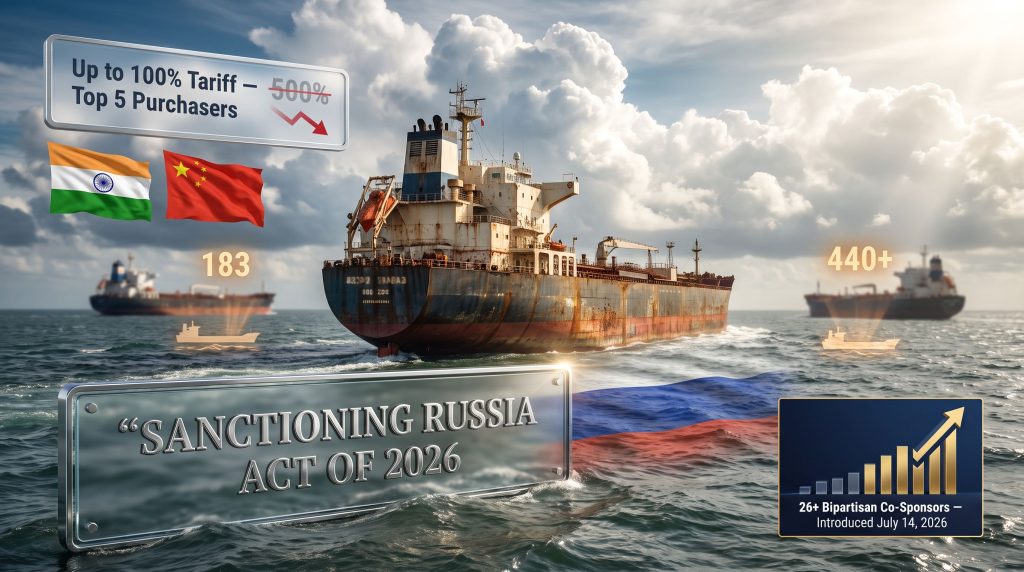
| Vessels sanctioned in single U.S. Treasury action | 183 tankers |
| Total tankers under combined UK and EU restrictions (mid-2025) | 440+ vessels |
| Shadow fleet share of Russian Baltic crude exports | Substantial (Brookings Institution) |
| Shadow fleet growth rate following sanctions intensification | Modestly decelerated only |
The Brookings Institution has documented that shadow fleet tankers continue to carry a significant portion of Russian crude departing from Baltic export terminals, suggesting that European-led restrictions have not materially constrained export volumes. By mid-2025, more than 440 tankers faced combined UK and EU vessel restrictions, yet the network had not collapsed. It had adapted.
"The shadow fleet's persistence reveals a fundamental flaw in vessel-level sanctioning: when only the ship is targeted, operators simply cycle in replacement tonnage. Effective enforcement requires capturing the entire enabler network, including owners, insurers, brokers, and financiers."
The Sanctioning Russia Act of 2026: Four Pillars of a New Architecture
Introduced on July 14, 2026, with more than 26 bipartisan co-sponsors in the Senate, the Sanctioning Russia Act of 2026 is architecturally distinct from every prior legislative attempt to restrict Russian energy revenues. Its four core pillars each address a specific gap identified in previous frameworks.
Pillar One: Targeted Energy Tariffs Replacing the Discredited 500% Proposal
The bill's most visible revision from its predecessor is the abandonment of a blanket 500% tariff on all countries purchasing Russian energy, a provision that had drawn sharp criticism from U.S. allies who feared collateral economic damage. Furthermore, the replacement mechanism is considerably more surgical:
- Tariffs of up to 100% apply exclusively to the top five purchasers of Russian oil and natural gas
- Countries importing less than 15% of Russia's annual natural gas exports qualify for exemptions, provided they can demonstrate measurable progress toward reducing Russian energy dependency
- The design concentrates economic pressure on the buyers whose purchasing decisions most directly sustain Kremlin revenue, while creating a diplomatic off-ramp for smaller importers
This approach also draws lessons from the broader tariff impact on supply chains observed in other geopolitical contexts, where overly broad measures frequently produced unintended economic consequences among allied trading partners.
Pillar Two: Mandatory Sanctions Within 30 Days
Unlike previous frameworks where sanctions were applied selectively and over extended timelines, the 2026 bill mandates that within 30 days of enactment, sanctions must be imposed against:
- Russian President Vladimir Putin and senior political and military leadership
- State-owned enterprises and financial institutions
- Russian energy sector projects
- Oligarchs and high-net-worth individuals identified as Kremlin enablers
- Foreign companies providing material support to Russia's defence industrial base
Pillar Three: Expanding Shadow Fleet Liability Beyond the Vessel
This pillar represents the most technically significant innovation in the bill. By incorporating provisions from the SHADOW Fleet Sanctions Act of 2026, the legislation extends sanctions liability to the full enabler network:
- Shadow fleet vessel owners and operators, not just the vessels themselves
- Insurers providing coverage to sanctioned or shadow fleet ships
- Third-party facilitators, brokers, and financial intermediaries enabling sanctions evasion
This structural change directly addresses the enforcement gap that has allowed the shadow fleet to rebuild capacity after each round of vessel-level restrictions. The geopolitical mining landscape analysis similarly highlights how targeting enabler networks, rather than individual assets, proves far more effective across commodity sectors.
Pillar Four: Decoupling Sanctions from Peace Negotiations
Previous versions of sanctions legislation contained language making penalties contingent on Russia's participation in ceasefire or peace talks, giving Moscow an implicit lever to delay enforcement through the appearance of diplomatic engagement. The 2026 bill removes this conditionality entirely, making most penalties mandatory rather than discretionary.
The China and India Dimension: Secondary Pressure on Asia's Largest Russian Crude Buyers
Following the European import restrictions enacted after Russia's 2022 invasion of Ukraine, China and India emerged as the dominant alternative buyers of Russian crude. Indian refiners significantly expanded their capacity to process Russian grades, while Chinese state refiners and independent teapot operators absorbed volumes previously destined for European markets. This demand-side substitution is precisely what allowed Russian export revenues to remain relatively stable despite Western restrictions.
Consequently, the dynamics of the US-China trade war add another layer of complexity to how Beijing may respond to secondary tariff pressure on its Russian crude purchases.
Comparative Exposure of Key Buyers to Proposed Tariffs
| Country | Role in Russian Oil Trade | Tariff Exposure Under Bill |
|---|---|---|
| China | Largest alternative buyer; state and independent refiners | High, likely within top 5 |
| India | Major buyer; refinery expansion ongoing | High, likely within top 5 |
| Turkey | Regional intermediary and re-exporter | Possible inclusion |
| EU members (residual volumes) | Declining; transition underway | Likely exemption-eligible |
| Smaller Asian buyers | Below threshold volumes | Potentially exempt |
A 100% tariff on goods from countries purchasing Russian oil would create substantial secondary economic pressure on bilateral trade relationships with the United States. Beijing and New Delhi face a genuine structural dilemma: absorb the tariff costs, renegotiate Russian crude pricing to offset the penalty, or accelerate diversification away from Russian supply altogether. Each pathway carries significant economic and diplomatic consequences.
Section 113: The Provision That Policy Analysts Consider the Bill's Operational Core
Among the bill's provisions, the energy export sanctions mechanism contained in Section 113 has attracted the most substantive analysis from policy experts. Daniel Fried, a former U.S. Assistant Secretary of State for European and Eurasian Affairs who served across seven administrations, identified this section as the legislation's most practically meaningful element, while acknowledging that implementation will require substantial coordinated effort across multiple government agencies and allied partners.
Fried noted that Section 113 is more operationally realistic than earlier iterations of the bill, but cautioned that translating the provision into measurable revenue impact on the Kremlin will be a significant implementation challenge. His assessment, reported by RFE/RL, reflects a broader expert consensus that the bill's design is sound but its real-world effectiveness will depend heavily on enforcement capacity and allied coordination.
Enforcement of energy export sanctions at the scale contemplated by Section 113 requires:
- Coordinated action across the U.S. Treasury, State, and Commerce departments
- Intelligence-sharing frameworks with allied nations to identify shadow fleet movements
- Cooperation from port states, flag registries, and P&I insurance clubs globally
- Secondary sanctions pressure on financial institutions processing payments for Russian crude
For a detailed breakdown of what this bill means for Russia, China, India, and Iran, the Atlantic Council's analysis provides valuable independent perspective on likely geopolitical outcomes.
The next major ASX story will hit our subscribers first
The Legislative Pathway: Senate Momentum Against House Resistance
The bill's political trajectory following its July 14 introduction has been shaped by both institutional momentum and significant loss. Senator Lindsey Graham of South Carolina, one of the bill's primary architects, had confirmed White House agreement on key provisions just one day before his death, having returned from a visit to Ukraine expressing confidence that the administration was prepared to support the legislation.
Senator Richard Blumenthal of Connecticut, Graham's principal Democratic partner on the bill, confirmed that administration support had been secured prior to Graham's passing and expressed confidence that sufficient votes exist for passage. Senate Democratic Leader Chuck Schumer called for immediate floor consideration, and Senate Majority Leader John Thune indicated optimism about securing a floor vote.
Legislative Risk Assessment by Chamber
| Factor | Senate | House |
|---|---|---|
| Bipartisan co-sponsors | 26+ | Contested |
| Primary objection raised | None significant | Presidential tariff authority overreach |
| Path to floor vote | Likely near-term | Uncertain |
| White House position | Supportive, with waiver provisions | N/A |
| Principal obstacle | Procedural timing | Partisan disagreement on scope |
Representative Gregory Meeks of New York, the senior House Democrat on foreign policy matters, has raised substantive concerns about the bill's architecture. His argument is that the legislation functions more as a vehicle for expanding presidential tariff authority than as a genuine automatic sanctions instrument, with penalties remaining subject to executive discretion rather than being triggered automatically. House critics have pointed to the Ukraine Support Act as a preferable alternative framework.
"The bill's compromise structure grants the executive branch waiver authority while requiring formal congressional notification and written justification for any sanctions suspension. Supporters argue this creates adequate oversight; opponents contend it leaves too much room for the president to deploy tariff threats as diplomatic leverage without ever enforcing the underlying sanctions."
Comparing the 2026 Bill Against Previous Russia Sanctions Frameworks
| Feature | Pre-2026 Sanctions Regime | Sanctioning Russia Act of 2026 |
|---|---|---|
| Tariff rate applied to Russian energy buyers | Up to 500% (proposed, broad) | Up to 100% (targeted, top 5 only) |
| Buyer targeting scope | All buyers | Top 5 purchasers only |
| Peace negotiation conditionality | Yes | Removed entirely |
| Shadow fleet liability | Vessels only | Vessels, owners, operators, insurers, facilitators |
| Presidential waiver authority | Limited | Granted with congressional notification requirement |
| Exemption mechanism | None | Countries below 15% gas import threshold |
| Sanctions timeline | Discretionary | Mandatory within 30 days |
Scenario Analysis: Three Possible Futures for Russian Energy Sanctions
Scenario A: Full Enforcement
The bill passes both chambers, tariff pressure forces China and India to meaningfully reduce Russian crude purchases, shadow fleet economics deteriorate as insurer and facilitator liability expands, and Kremlin revenue faces genuine fiscal constraint. The timeline for meaningful budget impact on Russian military spending is estimated at 12 to 24 months post-enactment under optimistic enforcement assumptions.
Scenario B: Selective Enforcement with Presidential Waivers
Tariff authority is exercised selectively as diplomatic leverage rather than enforcement. Shadow fleet sanctions create friction but not collapse. Russian exports decline modestly. The bill's deterrent effect is real but its revenue impact on Moscow is limited.
Scenario C: Legislative Stall or Significant Dilution
House opposition prevents passage or strips the bill's most consequential provisions. Russia continues export operations with minimal additional disruption. Shadow fleet infrastructure continues to evolve in response to vessel-level restrictions while the broader enabler network remains outside sanction perimeter.
"The scenario projections above represent analytical frameworks based on publicly available legislative text and expert commentary. They are not investment advice and should not be interpreted as predictions of specific policy or market outcomes. Sanctions implementation involves substantial legal, diplomatic, and geopolitical variables that cannot be forecast with precision."
The Broader Significance for Global Energy Markets and Sanctions Policy
If the Russia oil exports and shadow fleet sanctions bill is enforced at the scale its architects intend, the implications extend well beyond the Russia-Ukraine conflict. A functioning secondary tariff mechanism targeting the world's largest buyers of sanctioned crude would establish a precedent for how the United States addresses sanctions-evasion infrastructure globally.
For energy markets, the prospect of meaningful reductions in Russian export volumes would place upward pressure on global crude prices, particularly if enforcement coincides with OPEC's market influence and existing production discipline. The 15% natural gas import threshold for exemptions is also significant for European energy security policy, as it creates a measurable benchmark that Central and Eastern European nations still managing energy transition timelines will need to demonstrate progress against.
The shadow fleet provisions, if consistently enforced, could fundamentally alter the economics of parallel logistics networks used not only for Russian crude but for other sanctioned commodities globally. Extending liability to insurers and facilitators rather than vessels alone removes the economic model's most critical enabling layer, and that structural change would reverberate across the maritime insurance industry regardless of the specific geopolitical context in which it is applied.
Want to Stay Ahead of the Commodity Shifts Driving the Next Major Mineral Discovery?
Geopolitical disruptions to global energy markets — from shadow fleet sanctions to shifting crude trade flows — regularly reshape commodity prices and create significant exploration and investment opportunities on the ASX. Discovery Alert's proprietary Discovery IQ model delivers real-time alerts the moment significant ASX mineral discoveries are announced, turning complex market signals into actionable insights for both short-term traders and long-term investors — start your 14-day free trial today, or explore how historic discoveries have generated exceptional returns for those positioned ahead of the market.