
August 13, 2026
How Oil Market Chokepoints Reshape the Global Economy
Energy markets have long operated under a structural vulnerability that economists call chokepoint risk: the concentration of enormous volumes of trade through a handful of narrow maritime passages. When those passages function normally, the risk is theoretical. When they do not, the consequences radiate through every sector of the global economy with a speed and breadth that few other shocks can match.
The events of 2026 have moved this theoretical risk firmly into reality. The Strait of Hormuz, a waterway that most people would struggle to locate on a map, has become the defining variable in global energy pricing, industrial output planning, and central bank decision-making across multiple continents. Understanding why the IEA oil demand forecast and Strait of Hormuz closure has caused such alarm requires examining not just the headline numbers but the structural mechanics driving them, including how oil price trends have shifted so dramatically in such a short window.
When big ASX news breaks, our subscribers know first
The Forecast Deterioration: A Three-Month Collapse in Confidence
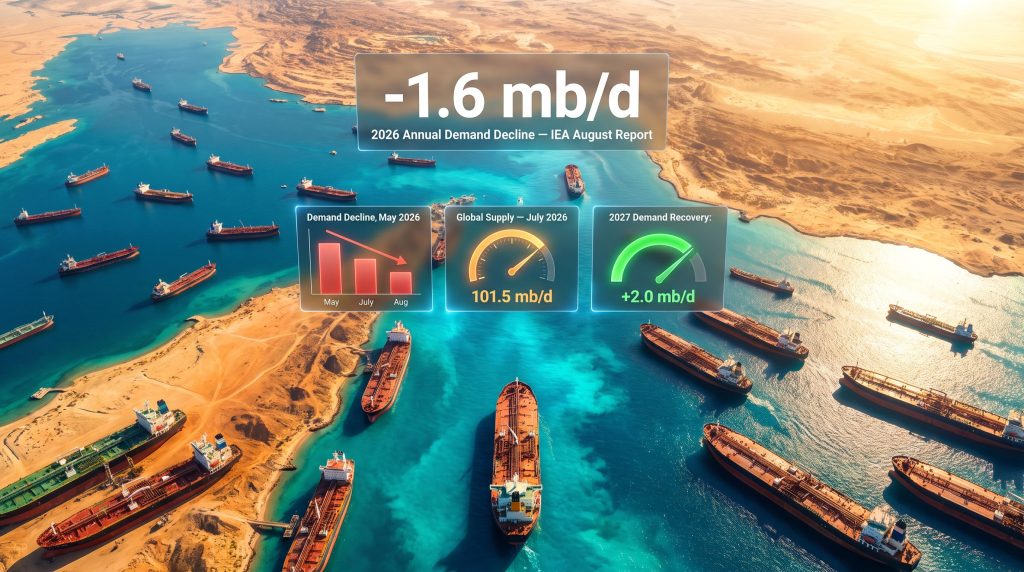
The pace at which the IEA's 2026 oil demand forecast has worsened is, in itself, analytically significant. Forecasting agencies rarely revise their core demand projections by material amounts in a single reporting cycle. The fact that the IEA's annual demand outlook has shifted from a 420,000 barrel per day decline in May 2026 to a 1.6 million barrel per day contraction by August 2026 represents a deterioration of roughly 280% in outlook within three months.
This progression is not simply a reflection of worsening conditions on the ground. It signals something more concerning: that the analytical community has progressively lost confidence in a near-term diplomatic resolution.
IEA 2026 Demand Forecast Revision Timeline
| Report Month | Projected 2026 Demand Change | Primary Assumption |
|---|---|---|
| May 2026 | -420,000 b/d | Early-stage disruption modelled |
| July 2026 | -1.0 mb/d | Partial Hormuz closure scenario |
| August 2026 | -1.6 mb/d | Sustained closure, elevated prices |
The IEA's August 2026 Oil Market Report now projects that global oil demand will register only the second annual contraction since 2020, when COVID-19 lockdowns erased demand across entire sectors of the global economy simultaneously. That comparison matters because it contextualises how severe a 1.6 mb/d decline truly is: the only recent precedent is a once-in-a-generation pandemic.
The acceleration of forecast downgrades reflects a market in which analysts are no longer anchoring their models to a near-term resolution of the Hormuz disruption. Each revision embeds a longer disruption duration into the base case.
Understanding the Strait of Hormuz: Anatomy of a Chokepoint
Why This Waterway Carries Irreplaceable Strategic Weight
The Strait of Hormuz connects the Persian Gulf to the Gulf of Oman and onward to the Arabian Sea. Under normal operating conditions, approximately one-fifth of all oil traded globally passes through this passage, along with a substantial portion of the world's liquefied natural gas exports. The producing nations whose export routes depend on this waterway include Saudi Arabia, Iraq, the United Arab Emirates, Kuwait, and Iran, collectively representing some of the highest-volume crude exporters on the planet.
What makes the strait uniquely difficult to replace is the absence of adequate alternative routing at scale. While some pipeline capacity exists to bypass the passage, notably the Abqaiq-Yanbu pipeline in Saudi Arabia and the Habshan-Fujairah pipeline in the UAE, the combined capacity of these alternatives falls dramatically short of the volumes normally transiting Hormuz. The infrastructure gap means that any sustained closure cannot be routed around; it must be absorbed as an outright supply reduction. Furthermore, the LNG supply outlook has been materially affected, given how much liquefied natural gas ordinarily passes through this corridor.
The 2026 Disruption in Historical Context
Placing the 2026 Hormuz disruption into historical perspective reveals just how unprecedented its scale is:
- The 1973 Arab Oil Embargo removed approximately 4 to 5 mb/d from global markets, triggering a global recession and reshaping energy policy for a generation
- The 1990-91 Gulf War disrupted approximately 4.3 mb/d of supply at peak, with markets recovering relatively quickly once conflict resolution became probable
- The 2022 Russia-Ukraine conflict removed an estimated 2 to 3 mb/d of effective Russian supply from Western markets over an extended period
- The 2026 Hormuz closure has been associated with estimates of 11 to 14 million barrels per day of disrupted or shut-in supply at peak, two to three times the scale of the 1973 embargo in volume terms
The U.S. Energy Information Administration modelled Gulf producer shut-ins of 7.5 mb/d in March 2026, escalating to 9.1 mb/d in April 2026 under its closure scenario assumptions. These are not fringe estimates; they reflect the mathematical reality of removing the world's most trafficked oil corridor from operation.
At peak disruption, the volume of oil removed from global markets through the Hormuz closure in a single month exceeded the entire annual output of several OPEC member nations combined. There is no historical template for managing a supply shock of this magnitude.
Global Supply Response: Recovery Numbers That Obscure Structural Damage
What the July 2026 Supply Data Actually Reveals
On its surface, the July 2026 global supply data offers a degree of reassurance. The IEA reported that total global oil supplies rose by 2.4 mb/d in July, bringing aggregate output to 101.5 mb/d. Production increases from non-Gulf exporters, emergency rerouting of available cargoes, and the partial passage of a small number of vessels through the strait contributed to this monthly recovery.
The more telling figure, however, sits beneath that headline number. Despite the July rebound, global supply remained 6.3 mb/d below year-ago levels, a deficit that no amount of month-on-month recovery can mask. The gap between where supply sits and where it would have been absent the Hormuz disruption represents the structural damage that only a genuine restoration of shipping access can begin to close.
Emergency Reserve Mobilisation: Bridging a Gap, Not Closing It
The IEA's recommendation to release approximately 400 million barrels from member nations' strategic petroleum reserves represents one of the largest coordinated emergency reserve responses in the agency's history. For context, this is comparable in ambition to the reserve release coordinated in response to the 2022 Russia-Ukraine supply disruption.
Strategic petroleum reserves serve a specific and finite function: they are bridging instruments designed to absorb temporary supply shocks while market or diplomatic mechanisms work to restore normal flows. They are not substitutes for structural supply restoration. At current consumption rates, even a 400-million-barrel release represents only a few weeks of the supply gap created by the closure, underscoring why diplomatic resolution remains the critical variable.
| Supply Metric | Value | Context |
|---|---|---|
| July 2026 global supply | 101.5 mb/d | +2.4 mb/d month-on-month |
| Year-on-year supply deficit | -6.3 mb/d | Structural gap from peak disruption |
| IEA SPR release recommendation | 400 million barrels | Emergency buffer, not structural fix |
| EIA-modelled Gulf shut-ins (April 2026) | 9.1 mb/d | Scenario-based peak estimate |
The Demand Destruction Mechanism: Price Elasticity at Work
How Elevated Prices Suppress Consumption Across Different Markets
The IEA has identified two concurrent forces weighing on global oil consumption: the physical supply disruption created by the Hormuz closure, and the demand suppression effect of elevated fuel prices. These two forces are not independent; they interact and amplify each other in ways that make demand recovery harder to achieve even if supply conditions improve marginally.
Price elasticity of demand for oil varies significantly across market segments and geographies. In energy-intensive industrial applications, high prices compress margins and incentivise substitution or efficiency measures wherever technically feasible. In transport, elevated fuel costs reduce discretionary travel and accelerate the economic case for electric alternatives in markets where that option exists.
In price-sensitive emerging economies, where fuel subsidies are fiscally constrained, elevated prices translate directly into reduced consumption as households and businesses cut discretionary energy use. Consequently, this oil market disruption is creating ripple effects well beyond the immediate supply shock, compounding pre-existing pressures on global trade flows.
The Demand Trough and the Recovery Pathway
Global oil demand reached its cyclical low in May 2026, from which point the IEA reports a recovery of more than 8 mb/d. Despite this rebound from the trough, the annual average for 2026 remains in deeply negative territory relative to 2025 levels, which is what drives the -1.6 mb/d annual demand change figure in the August report.
The forward outlook, while constructive in direction, carries significant conditionality:
- The IEA projects that demand should return to above 2025 levels by October 2026, contingent on Hormuz access normalisation and price moderation
- The 2027 outlook projects a 2.0 mb/d demand rebound, which would partially offset the 2026 contraction
- Both projections assume a gradual reopening of the strait; a scenario in which closure extends into Q1 2027 would materially revise these numbers downward
The 2027 rebound forecast of 2.0 mb/d represents the constructive base case, but it embeds a resolution timeline that the diplomatic record to date has not validated. Investors and energy planners should treat this figure as scenario-dependent, not as a baseline certainty.
Diplomatic Signalling Versus Physical Market Reality
Why Ceasefire Claims Have Failed to Move Shipping Traffic
A distinctive and analytically important feature of the 2026 Hormuz crisis is the persistent gap between diplomatic announcements and conditions on the water. Despite repeated claims of imminent deals to reopen the strait and a purported ceasefire framework, actual tanker and cargo traffic through the passage has remained severely restricted. The IEA's characterisation of these episodes as rapid diplomatic pivots that fail to materialise reflects the agency's growing scepticism about the translation of political announcements into operational shipping access.
This pattern has significant market implications beyond its immediate effect on supply volumes. Each announcement that fails to restore shipping access erodes the market credibility of subsequent announcements. Risk premiums embedded in oil prices therefore rise not just in response to current supply conditions, but in response to the declining probability that any given diplomatic development will produce durable change. Indeed, geopolitical trade tensions of this nature have historically proven among the hardest disruptions for markets to price with precision.
The resulting feedback loop operates as follows:
- Diplomatic announcement raises probability of Hormuz reopening
- Oil prices temporarily decline on improved supply expectations
- Shipping access fails to materially improve
- Prices recover to previous levels or higher
- Market credibility of future diplomatic signals declines
- Risk premium embedded in prices rises structurally
- Demand destruction from elevated prices accelerates
This cycle is self-reinforcing, and breaking it requires not a diplomatic announcement but a demonstrated and sustained restoration of shipping access over a period long enough to rebuild market confidence.
The next major ASX story will hit our subscribers first
IEA and EIA Forecast Comparison: Where the Agencies Align and Diverge
Reading the Analytical Gaps Between Institutions
The IEA and the U.S. Energy Information Administration have independently modelled the Hormuz disruption using different methodological frameworks, arriving at conclusions that are broadly directionally consistent but diverge on specific quantitative assumptions. However, both institutions agree on the scale of the challenge, as detailed analysis of Middle East energy market dynamics makes clear.
| Forecast Dimension | IEA Position | EIA Position |
|---|---|---|
| 2026 annual demand change | -1.6 mb/d (August 2026 report) | Demand growth suppressed; elevated price scenario |
| Hormuz disruption assumption | Gradual reopening modelled | Closure scenario with shut-in modelling |
| Gulf producer shut-ins at peak | Not explicitly quantified | 9.1 mb/d (April 2026 estimate) |
| 2027 demand recovery | +2.0 mb/d projected | Normalisation contingent on Hormuz access |
| Emergency reserve response | 400 mb SPR release recommended | SPR drawdown incorporated in price models |
The range of plausible outcomes across both agencies' scenario analyses is wider than at any point since the early stages of the COVID-19 demand collapse. This reflects a fundamental analytical challenge: the primary variable governing 2026-2027 oil market outcomes is a geopolitical development, and geopolitical developments are not amenable to quantitative modelling in the same way that demand elasticities or production capacity curves are.
Macroeconomic Transmission: Which Economies Face the Deepest Exposure
The consequences of sustained oil price elevation move well beyond the energy sector itself. Elevated crude prices function as a regressive tax on economic activity, with the incidence falling most heavily on energy-import-dependent economies and lower-income consumers within those economies.
The transmission channels are multiple and interconnected:
- Inflationary pressure through elevated transport, heating, and industrial energy costs, complicating central bank rate decisions in economies already navigating post-cycle policy transitions
- Agricultural input costs, particularly fertiliser prices which are closely linked to natural gas feedstocks, affecting food production economics globally
- Freight and logistics costs, which embed oil price directly into the cost structure of global supply chains
- Petrochemical feedstock pricing, affecting plastics, synthetics, and manufacturing inputs across consumer goods sectors
- Current account deterioration in large oil-importing economies, putting pressure on currency valuations and sovereign financing costs
The economies with the greatest structural exposure to the 2026 price shock include:
- India, whose refinery infrastructure is configured around Middle Eastern crude grades and which ranks among the world's largest crude importers by volume. Sustained price elevation creates significant current account pressure and complicates the country's industrial growth trajectory
- China, the world's largest oil importer in absolute volume terms, where elevated energy costs compress industrial margins across an economy already managing a complex post-pandemic stabilisation
- European manufacturing economies, particularly Germany and Italy, operating under accumulated energy cost pressures that have eroded industrial competitiveness since the 2022 gas crisis
- Sub-Saharan African and Southeast Asian emerging markets, where fuel subsidy fiscal capacity is limited and price pass-through to consumers is high
Counterbalancing these pressures, non-Gulf oil exporters including the United States, Canada, Brazil, and Norway benefit from elevated price environments that improve revenue positions and project economics, partially redistributing economic impact across the global system. In addition, OPEC's market influence on production strategy from member states outside the Gulf corridor has become increasingly consequential as markets adapt to the new supply reality.
Frequently Asked Questions: IEA Oil Demand Forecast and Strait of Hormuz Closure
What is the IEA's current 2026 oil demand forecast?
The IEA's August 2026 Oil Market Report projects that global oil demand will fall by 1.6 million barrels per day compared to 2025 levels. This represents the most pessimistic annual demand outlook the agency has published since the COVID-19 contraction of 2020, and reflects a significant worsening from the 1.0 mb/d decline projected in July 2026. The IEA oil demand forecast and Strait of Hormuz closure remain closely intertwined in the agency's analysis.
How much oil normally flows through the Strait of Hormuz?
Under normal conditions, approximately 20% of global oil supply transits the Strait of Hormuz, along with a material share of global LNG trade. This makes it the world's most consequential single maritime chokepoint for energy, and there is no infrastructure alternative capable of replacing its throughput volume at scale.
When is global oil demand expected to recover?
The IEA projects a return to above-2025 demand levels by October 2026, with a broader 2027 recovery of 2.0 mb/d contingent on Hormuz normalisation and fuel price moderation. These projections carry meaningful downside risk if the diplomatic resolution is delayed.
How has the IEA responded to the supply shock?
The IEA has recommended the release of approximately 400 million barrels from member nations' strategic petroleum reserves as a bridging buffer designed to moderate price volatility during the disruption period.
What was the lowest point for global oil demand during the 2026 crisis?
Global demand reached its trough in May 2026, with the IEA reporting a recovery of more than 8 mb/d from that low point. Despite the recovery from trough, the annual average for 2026 remains materially below 2025 levels.
How does the 2026 Hormuz disruption compare to previous oil supply shocks?
The 2026 disruption is considered among the largest oil supply shocks on record, with estimates of 11 to 14 mb/d or more of disrupted supply at peak. This is approximately two to three times larger in volume terms than the 1973 Arab Oil Embargo, which removed around 4 to 5 mb/d from global markets. The IEA oil demand forecast and Strait of Hormuz closure together represent an unprecedented combination of demand and supply pressures in modern energy market history.
Disclaimer: This article is intended for informational purposes only and does not constitute financial, investment, or energy market advice. Forecasts cited from the IEA and EIA are subject to revision and carry inherent uncertainty, particularly given the geopolitical nature of the primary disruption variable. Readers should consult primary sources and qualified advisers before making decisions based on the information presented.
Want to Stay Ahead of Market-Moving Resource Discoveries Amid Global Energy Disruptions?
As geopolitical shocks reshape global commodity markets, positioning ahead of significant ASX mineral discoveries has never been more critical — Discovery Alert's proprietary Discovery IQ model delivers real-time alerts the moment major discoveries are announced, giving subscribers an immediate edge in volatile conditions. Explore how historic discoveries have generated substantial returns on Discovery Alert's dedicated discoveries page, and begin your 14-day free trial today to ensure you're first to act on the next transformative find.