July 29, 2026
The Transmission Premium Reshaping Federal Geothermal Land Economics
For most of the past two decades, federal geothermal lease auctions operated with quiet predictability. Parcels moved at or near minimum bid thresholds, developer interest was modest, and the Bureau of Land Management's competitive internet auction format rarely lived up to its name. The assumption embedded in that system was straightforward: geothermal acreage value was primarily a function of underground heat, and where the geology was uncertain, the price reflected that uncertainty.
That assumption is now being dismantled in real time. The June 2026 New Mexico geothermal lease sale did not just break records. It signalled that the variables driving federal geothermal acreage valuations have fundamentally changed, and that infrastructure access has become a pricing force powerful enough to compete with, and in some cases override, geological merit.
When big ASX news breaks, our subscribers know first
Why Federal Geothermal Auctions Are No Longer a Predictable Market
BLM geothermal lease sales have historically followed a pattern that made them relatively easy to anticipate. A parcel's geological profile, primarily its heat flow characteristics, subsurface temperature gradient, and estimated reservoir depth, determined whether developers showed up and how aggressively they bid. Parcels located over known hydrothermal systems attracted competition. Everything else largely cleared at the floor price.
That dynamic created a structural inefficiency. Federal geothermal acreage was chronically underpriced relative to its development optionality because bidders were not fully pricing in infrastructure variables. The implicit logic was: if the geology works, we will figure out the interconnection problem later.
What has changed is the grid. The United States power system is under demand pressure it has not experienced in decades. Data centre construction tied to artificial intelligence workloads, large-scale industrial electrification, and the broader reshaping of electricity consumption patterns have combined to create a premium on firm, dispatchable generation capacity. Geothermal power, with capacity factors typically ranging between 80% and 95%, delivers exactly the kind of around-the-clock output that intermittent renewables cannot replicate. However, this advantage only materialises if projects can reach the grid.
Interconnection queues across the western United States now stretch to seven years or longer for many projects. Transmission constraints have become a genuine bottleneck that can determine whether a project proceeds or stalls entirely. When developers model project economics, the cost and timeline risk associated with grid connection has grown large enough to reshape land acquisition behaviour. Furthermore, renewable energy solutions are increasingly competing for the same limited transmission infrastructure, intensifying this dynamic.
Breaking Down the June 2026 New Mexico BLM Geothermal Lease Sale Results
The numbers from the New Mexico geothermal lease sale conducted on June 16, 2026 are striking in isolation, but they become more meaningful when measured against historical benchmarks.
Auction Performance at a Glance
| Metric | June 2026 New Mexico Sale | Nevada October 2025 Sale |
|---|---|---|
| Total winning bids | ~$16.3 to $16.5 million | Lower baseline (undisclosed) |
| Average price per acre | ~$107/acre | ~$33/acre (implied) |
| Record single-parcel value | $3.14 million (4,479 acres at $701/acre) | No comparable record set |
| Parcels leased vs. offered | 47 of 68 (69% take-up rate) | Not directly comparable |
| Total acreage leased | ~152,381 acres of ~197,851 offered | Not directly comparable |
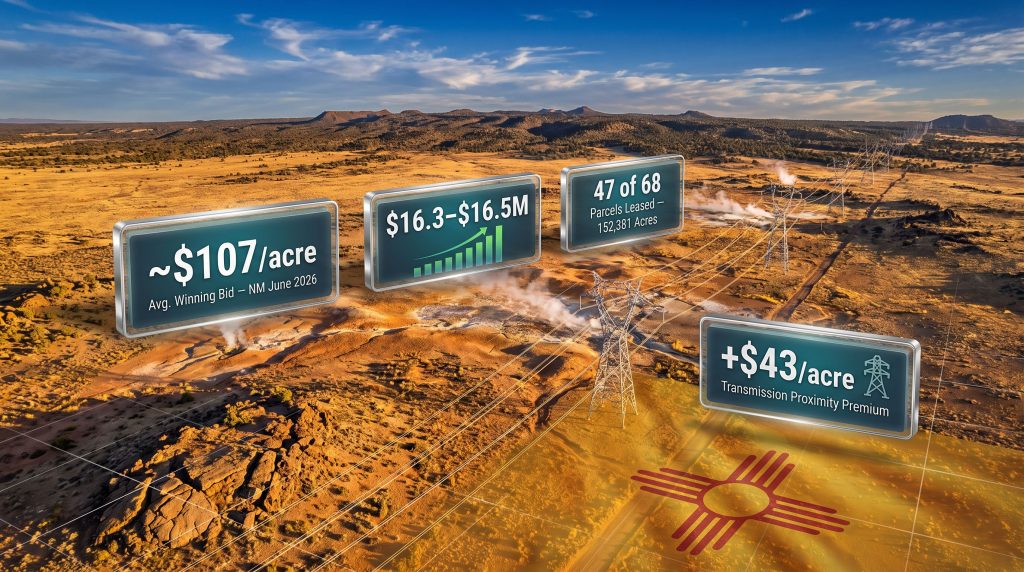
The $16.3 million aggregate total represents the highest winning bid sum ever recorded across any BLM geothermal auction. The $107 per acre average is more than three times what Nevada's October 2025 sale achieved, and the top-performing parcel, a 4,479-acre tract that cleared at $701 per acre for a total of approximately $3.14 million, set simultaneous records for both per-acre pricing and single-parcel total value in the federal geothermal leasing programme.
Revenue Distribution and Lease Structure
Federal geothermal leases carry a fiscal structure worth understanding for both state and county stakeholders. Under the applicable federal framework, revenues from BLM geothermal lease sales are divided as follows:
- 50% flows to the state in which the leased parcel is located
- 25% is directed to the relevant county
- 25% is allocated to the U.S. Treasury
This revenue-sharing arrangement creates meaningful fiscal incentives at the sub-federal level, and helps explain why state governments have a structural interest in competitive, high-value auction outcomes rather than minimum-bid clearances. Leases are initially issued for a 10-year primary term, after which continued tenure requires evidence of diligent development activity.
Transmission Proximity: The New Variable Reshaping Geothermal Land Valuations
Quantifying the Infrastructure Premium
The most analytically significant finding to emerge from the New Mexico geothermal lease sale is not the headline dollar figure. It is the $43 per acre premium attributable specifically to transmission infrastructure proximity. Analysis conducted by Enverus Intelligence Research identified access to high-voltage transmission lines with available interconnection capacity as the single strongest economic driver of bid values in the New Mexico auction, outperforming geological quality as a standalone differentiator.
This finding has structural implications for how developers, investors, and policymakers should model geothermal acreage value going forward. It suggests that the traditional geological scoring approach to pre-auction analysis is now incomplete without a transmission layer. In addition, the critical minerals demand tied to geothermal infrastructure build-out is adding another dimension to project economics that cannot be ignored.
Infrastructure access is no longer a secondary consideration in geothermal land acquisition strategy. It has become a primary pricing input, and developers who fail to map transmission corridor proximity before auction are likely leaving money on the table or, more precisely, paying too much for parcels where interconnection risk has not been properly discounted.
Why Transmission Has Become the Binding Constraint
Several interconnected factors explain why grid access has ascended to this level of pricing influence:
-
Interconnection queue congestion across western grid regions means that projects without proximity to existing high-capacity lines face multi-year delays and substantial capital uncertainty before they can sign a power purchase agreement.
-
Available capacity on existing corridors is not uniform. A transmission line's physical proximity matters less than whether it carries usable headroom for new generation injection. Parcels adjacent to constrained lines may offer less value than parcels further from the backbone but near lines with available capacity.
-
Power purchase agreement bankability depends heavily on interconnection certainty. Developers pursuing project financing need to demonstrate a credible path to grid connection, and proximity to uncongested high-voltage infrastructure is one of the most legible signals a lender can evaluate.
-
Development timeline compression is worth real dollars. Shaving years off the interconnection timeline translates directly into earlier revenue generation, reduced carrying costs, and stronger project-level internal rates of return.
Three Factors Now Driving Federal Geothermal Bid Premiums
Based on the New Mexico auction results and broader market trends, geothermal acreage pricing now reflects a three-variable framework:
-
Transmission corridor proximity including distance to high-voltage lines and available interconnection capacity at those points
-
Competitive bidder density reflecting the number of active, qualified developers pursuing geothermal acreage in a specific region at a given auction cycle
-
Geological resource quality including heat flow intensity, subsurface temperature gradients, and reservoir permeability, now functioning more as a baseline qualifier than as the primary price differentiator
This shift in the pricing hierarchy is subtle but consequential. Geology has not stopped mattering. It is simply no longer sufficient on its own to explain why one parcel clears at $700 per acre while a neighbouring tract settles near the minimum bid.
Geothermal vs. Other Renewables: Why the Baseload Advantage Is Now Monetarily Visible
Understanding why developers are bidding more aggressively for federal geothermal acreage requires appreciating what geothermal power offers that wind and solar cannot. Furthermore, the broader energy transition and security agenda is elevating baseload renewables as a strategic priority for governments and utilities alike.
| Attribute | Geothermal | Wind | Solar |
|---|---|---|---|
| Typical capacity factor | 80 to 95% | 25 to 45% | 15 to 30% |
| Dispatchability | Fully dispatchable | Intermittent | Intermittent |
| Land footprint | Low | High | Moderate to high |
| Transmission dependency | High (siting-constrained) | High | High |
| Development timeline | 5 to 10 years | 3 to 7 years | 2 to 5 years |
Geothermal's capacity factor advantage is substantial. A facility producing at 90% capacity factor delivers roughly twice the annual energy output of a high-performing wind installation on equivalent nameplate capacity. For grid operators managing reliability requirements, and for buyers of renewable energy certificates tied to round-the-clock delivery, this distinction carries real commercial value.
The accelerating deployment of enhanced geothermal systems (EGS) and closed-loop geothermal configurations is also expanding the addressable resource base beyond traditional hydrothermal zones. This technology evolution matters for acreage valuation because it increases the number of parcels that could plausibly support commercial development, even where conventional hydrothermal indicators are absent. Bidders applying an EGS lens to acreage assessment may be willing to pay premiums on parcels that a purely conventional geological screen would dismiss.
Regional Benchmarking and the Idaho November 2026 Auction
How Western U.S. States Compare
| State | Sale Date | Average Price per Acre | Notable Outcome |
|---|---|---|---|
| Nevada | October 2025 | ~$33/acre (implied) | Pre-inflection baseline |
| New Mexico | June 2026 | ~$107/acre | All-time BLM record |
| Idaho | November 2026 | TBD | 21 of 35 parcels near major transmission corridors |
The Nevada-to-New Mexico step-change is the kind of data point that recalibrates expectations industry-wide. When a single auction cycle produces a three-times price increase at the average level, every subsequent auction gets repriced against that new reference point. Consequently, industry trends and innovation in geothermal technology are now intersecting with land economics in ways that were not anticipated even two years ago.
Scenario Modelling for Idaho's November 2026 Sale
Idaho's upcoming auction offers 35 parcels, of which 21 (approximately 60%) sit within 25 kilometres of the Gateway West and Boardman-to-Hemingway transmission corridors. These are among the most strategically significant high-voltage lines in the Pacific Northwest, which means their proximity to geothermal parcels carries real developer interest. Three plausible outcome scenarios emerge:
Scenario A: Transmission-Led Demand (Base Case)
- Corridor-adjacent parcels attract competitive bids averaging $90 to $130 per acre
- Remaining 14 parcels clear closer to minimum bid levels
- Total auction receipts fall in the estimated $8 to $14 million range
Scenario B: New Mexico Momentum Carries (Optimistic)
- Heightened developer appetite following New Mexico's record results drives broad participation across all 35 parcels
- Average per-acre pricing approaches or exceeds $107 per acre on corridor-proximate tracts
- Potential emergence of a new single-parcel record if a high-value corridor-adjacent tract generates concentrated bidding
Scenario C: Geology-Constrained Outcome (Conservative)
- Idaho's subsurface resource quality limits developer conviction outside of the transmission-adjacent subset
- Competitive bids concentrate on the 21 corridor-proximate parcels only
- Aggregate receipts remain below New Mexico's $16.3 million total
The Idaho sale will function as a natural experiment. If transmission-adjacent parcels command premiums consistent with the New Mexico $43-per-acre infrastructure model, it confirms that a durable, replicable pricing framework has taken hold in federal geothermal auctions rather than a one-off result driven by New Mexico-specific conditions.
The next major ASX story will hit our subscribers first
The Declining Minimum Bid: A Leading Indicator Worth Tracking
One of the less-discussed but analytically important trends running beneath the headline New Mexico figures is the declining proportion of parcels clearing at the minimum bid floor. For many years, minimum-bid clearances dominated BLM geothermal auctions. This was, in effect, a market signal that developers assigned little option value to geothermal leases beyond their geological fundamentals, and only when those fundamentals were obvious.
The shift away from minimum-bid dominance indicates something more fundamental: developers are now assigning speculative option value to geothermal acreage even before project feasibility studies are complete. They are bidding above the floor not because they have confirmed a resource, but because they want to hold the position while they evaluate it. They also expect competition to make that position harder to acquire in the future.
This behavioural change in bidder psychology mirrors patterns seen in oil and gas lease sales during periods of heightened price expectations. When participants expect future scarcity of quality acreage, they front-run that scarcity by paying premiums in the present. The same dynamic now appears to be taking hold in federal geothermal land markets. Moreover, green transition materials required for geothermal plant construction are also attracting similar speculative positioning across supply chains.
Frequently Asked Questions: New Mexico Geothermal Lease Sale
What Was the Total Value of the June 2026 New Mexico BLM Geothermal Lease Sale?
The June 16, 2026 BLM competitive internet lease sale generated approximately $16.3 to $16.5 million in total winning bids, the highest aggregate total ever recorded for a federal geothermal auction. Of the 68 parcels offered, 47 were successfully leased, covering approximately 152,381 acres at an average winning price of around $107 per acre.
What Made the New Mexico Auction a Record-Setting Event?
Three converging factors produced the record outcome: a higher-than-usual density of competitive bidders, strong proximity to existing high-voltage transmission infrastructure (estimated to contribute approximately $43 per acre in incremental value), and growing institutional appetite for baseload renewable energy assets with firm capacity characteristics.
How Are BLM Geothermal Lease Revenues Distributed?
Under the applicable federal revenue-sharing framework, proceeds are allocated as follows: 50% to the host state, 25% to the relevant county, and 25% to the U.S. Treasury.
What Is the Primary Term of a Federal Geothermal Lease?
BLM geothermal leases are initially granted for a 10-year primary term. Extensions beyond the initial term are subject to demonstrated progress toward commercial development. For further context, New Mexico's geothermal rulemaking framework outlines additional state-level requirements that developers must navigate alongside federal lease conditions.
How Does Transmission Access Affect Geothermal Lease Valuations?
Proximity to high-capacity transmission infrastructure reduces interconnection risk, shortens the development timeline, and improves the bankability of project financing. The New Mexico auction quantified this effect at approximately $43 per acre in additional bid value, making it the strongest single economic variable identified in the sale analysis.
When Is the Next Major BLM Geothermal Lease Sale?
BLM's Idaho geothermal lease sale is scheduled for November 2026, offering 35 parcels. Twenty-one of those parcels are situated within 25 kilometres of major Pacific Northwest transmission corridors, positioning infrastructure access as the central variable to watch.
Key Takeaways for Developers and Investors
The New Mexico geothermal lease sale has established a new pricing reference point that will anchor expectations across upcoming western U.S. BLM auctions. Several strategic implications follow:
-
Pre-auction transmission mapping has become a competitive necessity. Developers who systematically overlay BLM parcel boundaries against high-capacity transmission corridor data before auction are better positioned to identify high-value acquisition targets and avoid overpaying for infrastructure-constrained acreage.
-
Minimum bid reliance as a strategy is eroding. Participants who relied on minimum-bid clearances to assemble geothermal land positions at low cost will find that window narrowing as competitive bidder density increases across the western U.S.
-
EGS optionality is being quietly priced in. As enhanced geothermal technology matures, parcels outside of traditional hydrothermal zones are increasingly attracting interest from developers who believe that future EGS viability will eventually justify today's acquisition cost.
-
The Idaho November 2026 auction will serve as the first major test of whether the New Mexico pricing dynamics represent a durable structural shift or a regionally specific event driven by New Mexico's particular combination of geology and grid access.
This article contains forward-looking scenario projections and market analysis based on publicly available auction data and independent research. Scenario outcomes are illustrative and should not be construed as investment advice. Actual auction results may differ materially from projections depending on developer participation, geological assessments, and grid conditions at the time of sale.
Want to Stay Ahead of the Next Major Resource Discovery?
Discovery Alert's proprietary Discovery IQ model delivers real-time alerts on significant ASX mineral discoveries, transforming complex resource data into actionable investment insights — explore the historic returns major discoveries have generated and begin your 14-day free trial to position yourself ahead of the broader market.