
August 22, 2026
Understanding Ghana's Strategic Pivot in Resource Revenue Optimization
The global mining industry evolution faces unprecedented volatility as commodity markets swing between extreme highs and devastating lows, creating fiscal planning nightmares for resource-dependent nations. This economic turbulence has forced governments across Africa to fundamentally reconsider how they extract value from their mineral wealth, balancing the delicate equation between attracting international investment and maximizing domestic revenues.
West Africa's mining powerhouse Ghana exemplifies this strategic pivot, implementing comprehensive Ghana mining royalties reform that signals a broader continental shift toward more aggressive resource revenue optimization. The nation's approach represents a sophisticated attempt to create counter-cyclical revenue mechanisms that automatically adjust to market conditions while maintaining competitive positioning in the global mining investment landscape.
When big ASX news breaks, our subscribers know first
What Economic Pressures Drive Ghana's Mining Revenue Transformation?
Commodity Price Volatility Creates Fiscal Planning Challenges
Ghana's existing flat-rate royalty system has proven inadequate for capturing optimal state revenues during periods of extreme commodity price fluctuations. The current 3% to 5% revenue-based structure fails to account for market dynamics that can see gold values reach extraordinary heights, with current gold price surge insights showing spot prices trading around $4,590 per ounce.
This volatility creates substantial fiscal planning challenges for a nation where mining contributes significantly to GDP, foreign exchange earnings, and government revenues. The inability to capture enhanced value during commodity booms represents lost opportunities for infrastructure development, education funding, and economic diversification initiatives.
State Revenue Optimization Versus Investment Climate Balance
The government's push for enhanced resource capture reflects broader macroeconomic pressures facing developing nations dependent on commodity exports. Ghana's position as the world's sixth-largest gold producer and Africa's top gold producer means that mining sector performance directly influences national economic stability.
These pressures have intensified as African governments increasingly recognize the need to maximize returns from finite natural resources while maintaining competitive positioning relative to other mining jurisdictions. The challenge lies in implementing Ghana mining royalties reform that doesn't trigger significant capital flight toward alternative investment destinations.
How Does the New Sliding-Scale Royalty Framework Function?
Progressive Rate Structure Based on Market Performance
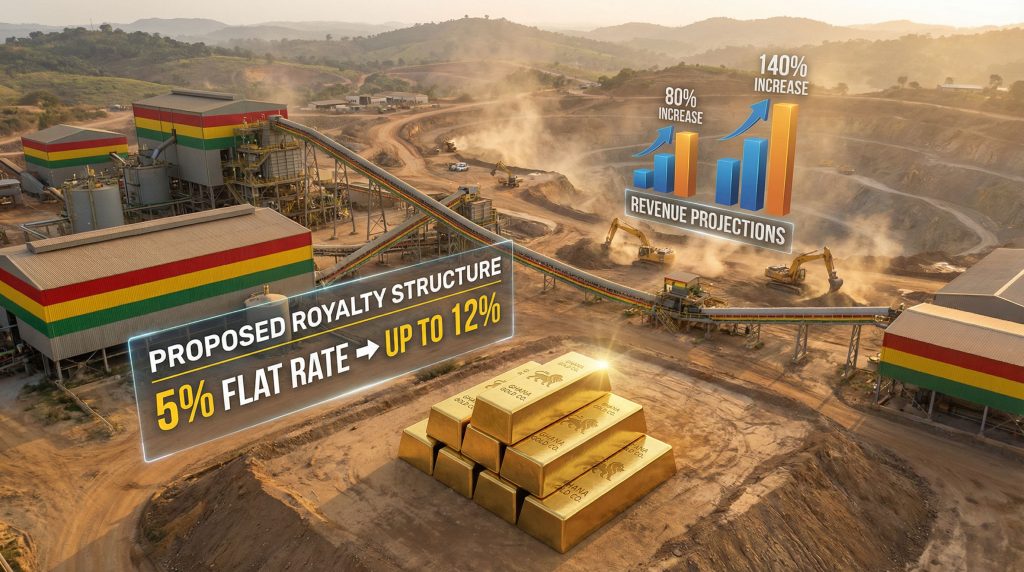
Ghana's proposed sliding-scale mechanism represents a fundamental departure from traditional flat-rate royalty systems. The framework establishes 9% as the base royalty rate, rising to 12% when gold reaches $4,500 per ounce or higher.
Proposed Royalty Structure Comparison:
| Price Threshold | Current Rate | Proposed Rate | Revenue Impact |
|---|---|---|---|
| Standard Market Prices | 3% to 5% | 9% base rate | 80-200% increase |
| High Price Scenarios ($4,500/oz+) | 3% to 5% | Up to 12% | 140-300% increase |
| Maximum Effective Rate | 5.6% (forest areas) | 12%+ | 114% increase |
This mechanism allows the state to capture enhanced value during boom periods while creating automatic adjustments based on commodity market conditions. However, the framework's provisions for downward adjustments during market downturns remain unclear in current proposals.
Market-Responsive Revenue Mechanisms
The sliding-scale approach creates sophisticated counter-cyclical revenue streams that respond automatically to global commodity markets. This system aims to address the historical challenge of missing revenue opportunities during price spikes while potentially offering relief during market contractions.
Furthermore, the technical implementation requires advanced monitoring capabilities to track commodity prices, production volumes, and revenue calculations in real-time. Ghana's Minerals Commission must develop enhanced administrative systems to manage this complexity effectively through data-driven operations.
What Are the Broader Implications for Mining Investment Flows?
Regional Competitiveness Analysis
Ghana's reforms occur within a continental context where African governments are tightening mining rules to capitalize on high commodity prices, often raising royalties and implementing enhanced local-content demands. This trend reflects the broader geopolitical mining landscape where nations periodically trigger conflicts with global miners over increased costs and contract certainty concerns.
Key Competitive Considerations:
- Continental mining policy alignment trends
- Infrastructure and regulatory stability factors
- Geological advantages versus fiscal burden trade-offs
- Regional tax competition dynamics
- Investment migration patterns across African jurisdictions
Capital Allocation Decision Frameworks
International mining companies evaluate investment opportunities through comprehensive risk-return matrices that weigh fiscal terms against operational advantages. Ghana's enhanced fiscal burden must be offset by superior geology, infrastructure access, regulatory certainty, or operational efficiency gains.
In addition, the reforms force mining companies to recalibrate project economics and potentially influence future expansion decisions. Companies with existing operations must evaluate whether enhanced fiscal terms justify continued investment or trigger capital reallocation strategies.
How Do Stability Agreement Terminations Affect Long-Term Investment Planning?
Contract Sanctity Versus Sovereign Flexibility
The elimination of mining stability agreements represents a fundamental shift from contractual certainty toward dynamic fiscal regimes. According to Reuters reporting, Ghana pioneered stability agreements in the early 2000s, helping unlock billions of dollars in foreign investment that enabled the nation to overtake South Africa as Africa's leading gold producer.
Major Operators Affected:
- Newmont: Ahafo stability agreement expired December 2025, renewal denied
- AngloGold Ashanti: Agreement phases out when it lapses in 2027
- Gold Fields: Agreement phases out when it lapses in 2027
These agreements typically locked in tax and royalty terms for 5 to 15 years in exchange for investments of approximately $300 million to $500 million for mine builds and expansions.
Investment Recovery and Future Project Economics
Companies structured their investment decisions around predictable fiscal terms spanning extended periods. Newmont's Ahafo agreement, for example, established a 32.5% corporate tax rate and sliding royalty of 3% to 5% (rising to 3.6% to 5.6% in forest reserve areas), with duty and VAT relief on qualifying inputs.
However, the phase-out forces recalibration of project economics and may influence future expansion decisions. Companies must now evaluate whether existing operations remain economically viable under enhanced fiscal terms or require operational adjustments to maintain profitability.
Renewal Conditions and Compliance Requirements
For companies seeking renewals under the previous system, Ghana established specific criteria:
- Extend mine life by at least 3 years
- Increase output by more than 10%
- Meet minimum investment thresholds of $300 million
- Fulfill local employment and development obligations
What Revenue Diversification Strategies Emerge from These Reforms?
Local Content Requirements as Economic Multipliers
Beyond royalty adjustments, Ghana mining royalties reform emphasizes domestic value addition through enhanced local procurement mandates and support for Ghanaian firms. This approach seeks to create economic multiplier effects that extend mining benefits throughout the domestic economy.
The government aims to phase out development agreements in favor of broader rules that indigenize more value domestically and enforce stricter compliance with local obligations. This includes ensuring companies fulfill basic requirements such as contributions to district assemblies.
Mineral Beneficiation and Value Chain Development
The government's focus on preventing revenue extraction for overseas investments reflects a broader strategy to retain more mining-generated capital within Ghana's borders. This approach addresses situations where companies use revenue from Ghanaian operations to finance mining acquisitions elsewhere while neglecting domestic obligations.
Consequently, enhanced local content requirements could accelerate downstream processing capabilities and related industrial development, creating sustainable economic benefits beyond direct mining employment. This aligns with the big pivot strategy toward more integrated resource value chains.
The next major ASX story will hit our subscribers first
How Do These Changes Affect Global Supply Chain Risk Assessment?
Resource Security Considerations for End Users
Ghana's position as a major global gold producer means that fiscal policy changes can influence supply chain planning for industries dependent on consistent mineral flows. Higher production costs may translate to increased commodity prices or trigger supply diversification strategies among consuming industries.
The reforms create potential supply chain risk considerations for manufacturers and investors who rely on stable gold supplies at predictable costs. These stakeholders must evaluate whether enhanced fiscal terms will significantly impact global gold availability or pricing structures.
Investment Migration Patterns
Significant fiscal regime changes historically trigger capital reallocation as companies seek jurisdictions offering optimal risk-adjusted returns. Ghana mining royalties reform may accelerate investment flows toward alternative African mining destinations or established producers with more stable fiscal frameworks.
However, mining industry executives argue that companies operate under challenging conditions globally while maintaining profitability. The key factor remains whether Ghana's enhanced fiscal terms correspond with improved regulatory efficiency and infrastructure development that benefits all mining sector participants.
What Implementation Challenges Could Affect Reform Success?
Administrative Capacity and Compliance Monitoring
Sliding-scale royalty systems require sophisticated monitoring capabilities to track commodity prices, production volumes, and revenue calculations accurately. Ghana's Minerals Commission must develop enhanced administrative systems to manage this complexity while ensuring transparent and efficient implementation.
The technical requirements include real-time price tracking mechanisms, production verification systems, and revenue calculation protocols that maintain accuracy across multiple mining operations simultaneously. For instance, implementing effective monitoring systems requires substantial investment in technological infrastructure.
Industry Consultation and Stakeholder Alignment
The implementation timeline includes a draft bill expected to reach Parliament by March 2026, indicating the government's commitment to formalizing these changes through legislative channels. However, effective implementation requires balancing government revenue objectives with industry operational realities.
Furthermore, the government has indicated willingness to listen to concerns from smaller and new projects about the proposed royalty increases, aiming for formulas that preserve investment while lifting revenue during high-price periods.
How Might These Reforms Influence Continental Mining Policy Trends?
African Resource Governance Evolution
Ghana's comprehensive approach to mining fiscal reform may establish precedents for other African nations seeking to optimize resource revenues. The continent-wide trend toward tightening mining rules reflects broader recognition that traditional fiscal frameworks inadequately capture value during commodity boom cycles.
The success or failure of Ghana's measures will likely influence policy development across Africa's mining jurisdictions, particularly regarding sliding-scale mechanisms and stability agreement phase-outs. This trend is detailed in comprehensive mining sector analysis that highlights similar reforms across the continent.
Sovereign Wealth Fund Development Implications
Enhanced mining revenues could accelerate Ghana's sovereign wealth fund development through the Minerals Income Investment Fund (MIIF), potentially creating long-term economic stabilization mechanisms and intergenerational wealth preservation strategies.
The additional fiscal revenues generated through enhanced royalty capture could fund infrastructure development, education initiatives, and economic diversification programs that reduce long-term dependence on commodity exports.
What Long-Term Economic Scenarios Could Emerge?
Scenario 1: Successful Revenue Optimization
If reforms achieve intended revenue increases without significantly deterring investment, Ghana could accelerate infrastructure development, education funding, and economic diversification initiatives while maintaining mining sector growth trajectory.
This scenario would demonstrate that developing nations can successfully recalibrate fiscal terms without compromising long-term investment attractiveness, potentially encouraging similar reforms across resource-rich African countries.
Scenario 2: Investment Displacement Effects
Higher fiscal burdens could trigger capital flight toward competing jurisdictions, potentially reducing overall mining sector contribution to the economy despite higher per-unit revenue capture rates.
This outcome would highlight the challenges of balancing resource nationalism with investment attraction, particularly in competitive global mining markets where companies maintain multiple development options.
Scenario 3: Hybrid Adaptation Model
Market forces may drive negotiated compromises that blend profit-based adjustments with revenue royalties, creating sophisticated fiscal frameworks that balance state and investor interests more effectively than pure sliding-scale mechanisms.
This evolution could produce innovative fiscal models that other resource-rich nations adopt, creating new standards for mining sector governance globally.
Balancing Resource Nationalism with Investment Attraction
Ghana's mining royalty reforms represent a critical test of whether resource-rich developing nations can successfully recalibrate fiscal terms without compromising long-term investment attractiveness. The outcomes will provide valuable insights for other African nations navigating similar challenges in optimizing natural resource governance while maintaining competitive investment climates.
The success of these reforms depends largely on implementation quality, stakeholder engagement effectiveness, and the government's ability to demonstrate that enhanced fiscal terms correspond with improved regulatory efficiency and infrastructure development. The mining industry's response will ultimately determine whether Ghana's approach becomes a model for continental resource governance evolution or a cautionary tale about the delicate balance between resource revenue optimization and investment attraction.
Disclaimer: This analysis involves forecasts and speculation about future mining sector developments. Market conditions, policy implementations, and investment decisions remain subject to numerous variables and uncertainties. Readers should conduct independent research before making investment decisions based on this information.
Ready to Capitalise on Major Mineral Discovery Opportunities?
Discovery Alert's proprietary Discovery IQ model delivers real-time alerts on significant ASX mineral discoveries, instantly empowering subscribers to identify actionable opportunities ahead of the broader market. Understand why historic discoveries can generate substantial returns by exploring Discovery Alert's dedicated discoveries page, showcasing exceptional outcomes from major mineral finds, then begin your 30-day free trial today to position yourself ahead of the market.