August 9, 2026
The Chemistry Shift That Battery Markets Can No Longer Ignore
For most of the past decade, the dominant question in electrochemical energy storage was not whether lithium-ion would win, but which variant of it would. Lithium iron phosphate versus nickel manganese cobalt. Cylindrical versus prismatic. High nickel versus high manganese. The competitive battles were essentially fought within a single elemental framework, with sodium-ion chemistry treated as an academic curiosity rather than a credible industrial challenger.
That framing is now breaking down with remarkable speed. The CATL sodium battery capacity expansion announced in May 2026 is not simply a manufacturing investment. It is the most tangible evidence yet that a fundamental chemistry transition is underway in global energy storage, one that carries implications extending far beyond a single company's balance sheet.
Understanding why this moment matters requires looking at the technical, economic, and strategic forces that converged to make it happen, rather than treating it as an isolated corporate decision. Furthermore, the battery raw materials market dynamics of recent years have created the precise conditions under which an alternative chemistry could credibly challenge lithium-ion's dominance.
When big ASX news breaks, our subscribers know first
What the Record-Breaking HyperStrong Deal Actually Signals
A 60 GWh Order in Context
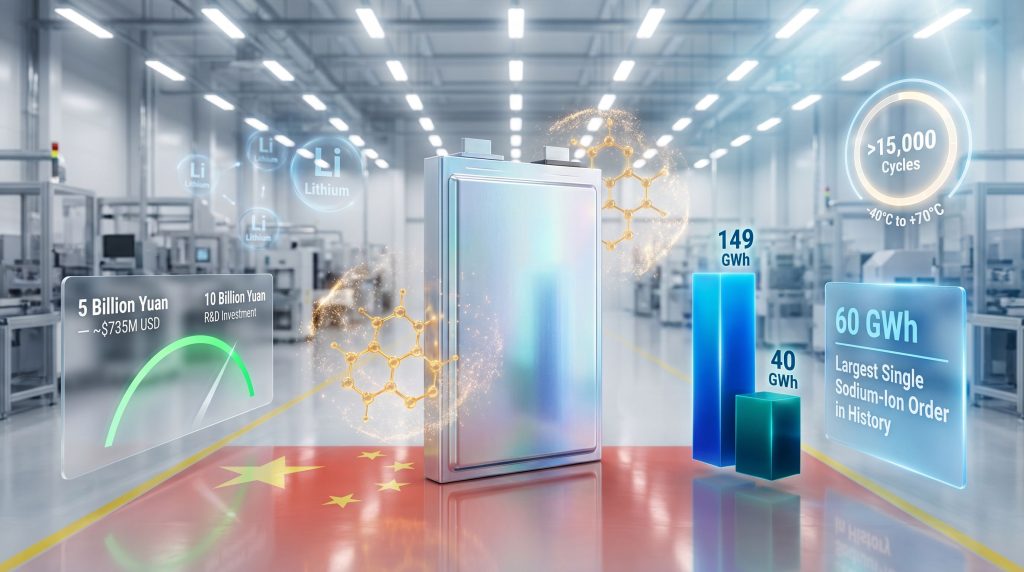
On April 27, 2026, CATL formalised a three-year supply agreement with Chinese energy storage integrator HyperStrong covering 60 GWh of sodium-ion batteries, the largest single order for sodium-ion chemistry ever publicly disclosed. The scale of this commitment requires some unpacking to appreciate its significance.
A 60 GWh procurement across three years averages 20 GWh per year in sodium-ion battery deliveries to a single buyer. For perspective, that volume would have represented a substantial share of the entire global stationary energy storage market just a few years earlier. The fact that one energy storage integrator is now contracting at this scale reflects how dramatically deployment rates have accelerated in China's grid storage sector.
This deal did not emerge in isolation. It follows a broader framework agreement signed in November 2025 under which HyperStrong committed to sourcing 200 GWh of CATL battery cells across the 2026 to 2035 period, establishing a long-term commercial relationship that gives both parties significant planning certainty. The April 2026 sodium-ion contract represents the first major tranche of that framework being operationalised at scale.
Industry observers have described this agreement as a potential inflection point comparable to major disruptive moments in adjacent technology sectors, where a single contract crystallises a shift that has been building for years and forces competitors to rapidly reassess their assumptions about market timing.
Why Stationary Storage Is Sodium-Ion's Natural Entry Point
The application targeting here is deliberate and strategically logical. Stationary energy storage systems are evaluated primarily on total lifecycle cost, not gravimetric energy density. This distinction matters enormously for sodium-ion's competitive positioning:
- Grid storage operators care about cost per kWh delivered over a 20-year asset life, not weight
- Cycle durability drives long-term economics more than initial cell performance metrics
- Thermal stability across wide temperature ranges reduces system cooling costs and increases deployable geographic range
- Simplified system architecture reduces balance-of-plant costs
All four of these dimensions represent structural advantages for sodium-ion chemistry relative to conventional lithium iron phosphate in stationary applications, which explains why large-scale energy storage integrators are emerging as the technology's first major commercial champions. Consequently, the broader sodium-ion battery storage trends of 2025 laid important commercial groundwork for the agreements now being formalised.
The Fuding Shidai Facility: What 149 GWh Actually Looks Like
Breaking Down the Sixth-Phase Expansion
CATL's 5 billion yuan (~$735 million USD) investment is designated as the sixth phase of development at the Fuding Shidai production base, a wholly-owned subsidiary located in Fujian province and separate from CATL's primary manufacturing infrastructure. This standalone operational structure is more significant than it might initially appear.
By constructing and operating the sodium-ion facility entirely independently from existing lithium-ion production lines, CATL is able to engineer every aspect of the production environment specifically for sodium-ion chemistry, from electrode processing parameters to formation cycling protocols to quality assurance workflows. This is a different approach from co-locating new chemistry production alongside established lines, and it reflects a maturity of strategic intent that pilot-stage operations typically cannot achieve.
The construction timeline is estimated at 24 months, covering the following functional areas:
| Facility Component | Primary Function |
|---|---|
| Battery Cell Production Lines | Core electrochemical manufacturing at scale |
| Electrode Manufacturing | Cathode and anode material processing and coating |
| Capacity Testing Infrastructure | Performance validation and quality assurance |
| Module Assembly | Cell-to-module integration for end-use configurations |
| Auxiliary Infrastructure | Utilities, logistics, safety, and environmental systems |
Upon completion, the Fuding Shidai base will reach a total planned capacity of 149 GWh, positioning it as one of the most significant single-site battery manufacturing complexes for any chemistry globally. The 40 GWh sixth-phase addition is the largest individual increment in the facility's development history.
The 24-month construction window aligns closely with the delivery schedule implied by the HyperStrong agreement, suggesting the new facility has been sized and timed with specific contracted demand in mind rather than being speculative capacity built ahead of proven orders.
Technical Performance: Where Sodium-Ion Is Rewriting Industry Assumptions
Energy Storage Product Specifications
The technical profile of CATL's sodium-ion energy storage product represents a meaningful departure from earlier-generation sodium-ion cells, which struggled with energy density limitations that made them uncompetitive with LFP in most real-world applications. CATL's official announcements confirm current specifications for the stationary storage sodium-ion product include:
- Gravimetric energy density: approximately 160 Wh/kg, with prototype cells reaching 175 Wh/kg
- Cell format: large-format 300+ Ah prismatic configuration
- Round-trip efficiency: 97% at system level
- Cycle durability: greater than 15,000 charge-discharge cycles at 80% capacity retention
- Operating temperature range: -40°C to +70°C
- Form factor: dimensionally compatible with existing CATL lithium-ion products
The cycle life figure deserves particular attention. At greater than 15,000 cycles, CATL's sodium-ion energy storage cells offer a durability profile that is materially superior to conventional LFP, which typically operates in the 3,000 to 6,000 cycle range under comparable conditions. For a grid storage operator cycling a battery daily, this translates to a fundamental difference in asset lifespan and replacement economics.
Sodium-Ion vs. LFP: A Direct Technical Comparison
| Performance Metric | Sodium-Ion (CATL 2026) | LFP Benchmark |
|---|---|---|
| Energy Density (Wh/kg) | 160 to 175 | 150 to 180 |
| Cycle Life | greater than 15,000 cycles | 3,000 to 6,000 cycles |
| Operating Temperature | -40°C to +70°C | -20°C to +60°C |
| Raw Material Supply Risk | Low (sodium abundant globally) | Moderate (lithium supply-constrained) |
| Cost Trajectory | Declining rapidly | Mature, incremental reduction |
| Cold-Climate Performance | Superior retention | Moderate degradation |
The Naxtra Brand and EV Integration
For automotive applications, CATL launched the Naxtra brand in April 2025 as its dedicated sodium-ion identity for the electric vehicle market. Second-generation Naxtra cells achieve up to 175 Wh/kg at mass production scale, with Cell-to-Pack integration enabling pure-electric range exceeding 400 km from a sodium-ion pack.
The development roadmap extends toward 500 to 600 km range capability in future iterations. CATL's internal assessment is that this performance threshold would make sodium-ion viable for more than half of current passenger EV market use cases, a projection that, if realised, would dramatically expand the technology's addressable market beyond grid storage and into mainstream vehicle segments. Mass production of the next-generation Naxtra platform is targeted for the end of 2026.
One underappreciated aspect of the Naxtra Cell-to-Pack architecture is its implications for battery swapping networks, where standardised sodium-ion packs could enable cross-platform compatibility at a lower cost base than lithium equivalents, potentially accelerating swapping infrastructure economics in markets like China where this model has gained significant traction.
A Decade of Financial Commitment: The R&D Foundation Beneath the Headlines
Understanding the Intellectual Property Moat
The CATL sodium battery capacity expansion announced in 2026 did not materialise from a standing start. By the end of 2025, CATL's cumulative investment in sodium-ion battery research and development had approached 10 billion yuan (~$1.47 billion USD), representing nearly a decade of sustained commitment dating back to the company's early-stage sodium-ion research programmes initiated around 2016.
This scale of R&D expenditure creates competitive barriers that extend well beyond patent counts or product specifications. Deep manufacturing process knowledge, materials sourcing expertise, formation cycling optimisation, and quality yield improvement across large-scale production runs are accumulated through years of operational iteration. These are capabilities that cannot be replicated quickly regardless of capital availability.
CATL's chairman and founder Robin Zeng has communicated to investors his expectation that sodium-ion technology will ultimately displace between 30% and 40% of the existing global battery market over the long term. This projection is not presented as near-term guidance but rather as a directional thesis about where the technology's cost and performance trajectory leads over a multi-year horizon.
Importantly, this framing positions sodium-ion as a major market force rather than a niche application, and it comes from the executive who has arguably the deepest operational insight into what sodium-ion can realistically achieve at scale. The company is currently developing its sixth-generation sodium battery platform, a signal that product iteration is continuous and that the current commercial generation represents an intermediate stage of a longer development curve rather than a finished product category.
The Dual-Chemistry Strategy: Complementary Rather Than Competitive
Why CATL Is Not Cannibalising Its Own Business
A common misframing of the sodium-ion opportunity treats it as a direct threat to CATL's existing lithium-ion revenue base. CATL's own strategic architecture explicitly rejects this interpretation through what the company describes as a complementary dual-chemistry approach, assigning each technology to the applications where it holds structural advantages.
Where sodium-ion holds structural advantages:
- Long-duration grid energy storage (lifecycle economics and cycle durability)
- Cold-climate deployment geographies (operating temperature resilience)
- Entry-level electric vehicles (cost competitiveness at lower energy density requirements)
- Applications requiring simplified system architecture and lower thermal management complexity
Where lithium-ion retains structural advantages:
- High-energy-density premium electric vehicles requiring maximum range
- Fast-charging performance applications where lithium chemistry's kinetics excel
- Established supply chain ecosystems with mature procurement and manufacturing infrastructure
This framework allows CATL to expand total addressable market rather than substitute one revenue stream for another. Customers who previously could not justify lithium-ion economics for certain applications become viable sodium-ion buyers, growing the overall opportunity without directly cannibalising existing lithium-ion volume.
The next major ASX story will hit our subscribers first
Supply Chain Geopolitics: The Hidden Strategic Dimension
Why Sodium Abundance Is a Structural Advantage
Beyond performance metrics and cost trajectories, the CATL sodium battery capacity expansion carries significant implications for global supply chain risk management, a dimension that deserves more analytical attention than it typically receives in product-focused coverage. In addition, the lithium market's ongoing oversupply and demand challenges have further accelerated interest in sodium-ion as a credible alternative.
Lithium's geographic concentration is a well-documented vulnerability in the clean energy transition. The so-called Lithium Triangle of Argentina, Bolivia, and Chile contains a disproportionate share of global brine-based lithium reserves, while hard-rock spodumene production is concentrated in Australia. This geographic concentration, combined with the processing dominance of Chinese refining capacity, creates multiple layers of supply chain risk for battery manufacturers and energy storage operators globally.
Sodium does not carry this vulnerability. It is one of the most abundant elements in the Earth's crust and oceans, with no comparable geographic concentration. Large-scale sodium-ion adoption would:
- Reduce exposure to lithium price volatility, which has historically moved by more than 80% within single calendar years
- Eliminate cobalt dependency entirely (sodium-ion cathodes do not require cobalt)
- Reduce nickel requirements that introduce their own supply complexity
- Enable domestically manufacturable energy storage for countries that currently lack access to critical mineral supply chains
For energy-importing nations and emerging market economies, this last point represents a particularly significant strategic opportunity. A battery chemistry that can be manufactured from locally available materials rather than imported critical minerals changes the economics of domestic energy storage deployment in ways that go beyond unit cost comparisons. Furthermore, advances in direct lithium extraction technology are also reshaping how the industry thinks about material sourcing and processing efficiency across all battery chemistries.
The Competitive Landscape at Scale
| Company | Country | Development Stage | Primary Focus |
|---|---|---|---|
| CATL | China | Commercial mass production | EV and grid energy storage |
| BYD | China | Advanced development | EV integration |
| HiNa Battery | China | Pilot to commercial | Stationary storage |
| Faradion (acquired by Reliance) | UK and India | Pilot to commercial scale | EV and stationary |
| Northvolt | Sweden | Early-stage research | European supply chain |
| KORE Power | USA | Development stage | Grid storage |
CATL's combination of sustained R&D investment approaching 10 billion yuan, planned manufacturing capacity of 149 GWh at a single facility, and secured demand anchored by a 60 GWh order creates a first-mover position in sodium-ion commercialisation that competitors at earlier development stages will find structurally challenging to close within the current decade. However, as detailed analysis of CATL's expansion plans notes, the competitive response is already forming across multiple geographies.
What the HyperStrong Agreement Proves About Commercial Readiness
Reading the Deal Structure, Not Just the Headline Volume
The commercial significance of the HyperStrong agreement extends beyond its record-breaking scale. The structure of the contract, a firm three-year supply commitment rather than a memorandum of understanding or a framework with optional volumes, carries specific implications for how the market should interpret sodium-ion's commercial maturity.
A three-year supply commitment of this magnitude requires the buyer to have conducted rigorous technical due diligence. Energy storage integrators do not commit to 60 GWh procurement agreements on the basis of product specifications and prototype data alone. They require demonstrated manufacturing consistency, quality validation at scale, commercial pricing that enables viable project economics, and delivery reliability across the contracted period.
The fact that HyperStrong made this commitment in early 2026 implies that CATL had already satisfied these requirements through earlier deliveries or pilot programmes, suggesting the technology's commercial maturity is further advanced than the recent headline announcements might imply to observers unfamiliar with the chemistry's development history.
CATL characterised the agreement as representing the beginning of an explosive, large-scale growth phase for the sodium-ion industry broadly, not just for CATL specifically. This framing suggests internal confidence that demand pull will extend well beyond this anchor order as other energy storage integrators and grid operators evaluate sodium-ion for their own procurement pipelines.
Market Penetration Scenarios Through 2030
Three Trajectories for Sodium-Ion Adoption
Note: The following scenarios represent analytical projections based on current available data and industry trends. They are not investment advice or formal forecasts. Actual market outcomes will depend on numerous variables that cannot be predicted with certainty.
Scenario 1: Conservative (10 to 15% energy storage market share by 2030)
Sodium-ion establishes a durable niche in long-duration grid storage and cold-climate applications. Lithium-ion retains dominance across most EV segments. CATL's Fuding capacity operates at moderate utilisation rates, with the 60 GWh HyperStrong commitment representing a significant portion of total sodium-ion market volume.
Scenario 2: Base Case (20 to 25% energy storage market share by 2030)
Continued cost reduction drives broader adoption across grid storage and entry-level EVs. Multiple competitors reach meaningful commercial scale, expanding total market size. CATL maintains approximately 35 to 45% global sodium-ion market share, with the 149 GWh Fuding base operating at strong utilisation levels by the end of the forecast period.
Scenario 3: Accelerated Disruption (30%+ of combined EV and storage market by 2030)
The displacement thesis begins to materialise ahead of schedule as sodium-ion achieves cost parity with LFP across a broader range of applications. Early capacity investments by CATL generate significant margin advantages as later-moving competitors encounter equipment procurement and materials processing bottlenecks. This scenario aligns with the upper range of Robin Zeng's long-term market displacement projection. Moreover, breakthroughs in Chinese battery recycling could further reduce lifecycle costs, accelerating adoption timelines across all three scenarios.
Key Metrics at a Glance
| Metric | Value |
|---|---|
| New Capacity Being Added | 40 GWh per annum |
| Total Investment Committed | 5 billion yuan (~$735 million USD) |
| Construction Timeline | 24 months |
| Fuding Shidai Total Planned Capacity | 149 GWh |
| Record Sodium-Ion Order (HyperStrong) | 60 GWh over 3 years |
| Cumulative R&D Investment (to end 2025) | approximately 10 billion yuan (~$1.47 billion USD) |
| Energy Density (Current Storage Product) | 160 to 175 Wh/kg |
| Cycle Life (Stationary Applications) | greater than 15,000 cycles |
| Operating Temperature Range | -40°C to +70°C |
| Long-Term Market Displacement Target | 30 to 40% of global battery market |
| CATL Global EV Battery Market Share (Q1 2026) | 40.7% |
Frequently Asked Questions
What is the CATL sodium battery capacity expansion and where is it located?
The expansion refers to the sixth-phase development at the Fuding Shidai production base, a wholly-owned CATL subsidiary in Fujian province, China. The project adds 40 GWh of annual sodium-ion battery production capacity at a total investment of 5 billion yuan (~$735 million USD), bringing the facility's total planned capacity to 149 GWh.
What triggered the decision to expand sodium-ion production at this scale?
The immediate catalyst was CATL's agreement with HyperStrong on April 27, 2026, for the supply of 60 GWh of sodium-ion batteries over three years, the largest sodium-ion battery order ever publicly recorded. This contracted demand provided the commercial basis for committing to large-scale dedicated production infrastructure. In addition, the global lithium market's shifting investment patterns have further reinforced the strategic case for sodium-ion as a complementary chemistry.
How does sodium-ion battery technology differ from lithium-ion in practice?
Sodium-ion batteries use sodium ions as the electrochemical charge carrier rather than lithium ions. The practical consequences include superior cold-temperature performance (retaining function down to -40°C where lithium cells degrade), significantly longer cycle life in stationary applications (greater than 15,000 cycles versus 3,000 to 6,000 for LFP), and substantially lower raw material costs given sodium's global abundance relative to lithium's constrained supply geography.
Is CATL abandoning lithium-ion in favour of sodium-ion?
No. CATL operates a deliberate dual-chemistry strategy that assigns each technology to the applications where it holds structural advantages. Sodium-ion targets grid storage, cold-climate deployments, and entry-level EVs, while lithium-ion retains its position in high-energy-density premium applications and fast-charging segments. The two chemistries are positioned as complementary rather than competitive within CATL's product portfolio.
What does Robin Zeng's 30 to 40% displacement projection mean for the market?
CATL's founder and chairman has communicated to investors his view that sodium-ion technology is positioned to ultimately address between 30% and 40% of the existing global battery market over the long term. This is a directional leadership thesis rather than a near-term forecast, but it reflects the confidence of the individual with arguably the deepest operational knowledge of sodium-ion's realistic commercial ceiling. If even a fraction of this displacement materialises, it would represent a fundamental restructuring of global battery material demand chains.
This article is intended for informational purposes only and does not constitute financial or investment advice. Forward-looking statements, market projections, and scenario analyses involve inherent uncertainty and should not be relied upon as predictions of actual outcomes.
Want to Catch the Next Major Battery Minerals Discovery Before the Market Does?
As sodium-ion technology reshapes global battery demand and raw material supply chains, the ASX exploration sector is responding in real time — and Discovery Alert's proprietary Discovery IQ model instantly identifies significant mineral discoveries as they hit the exchange, turning complex data across 30+ commodities into clear, actionable opportunities. Explore historic discoveries and the returns they generated, then start your 14-day free trial to ensure you're positioned ahead of the market when the next major find is announced.