July 21, 2026
The global energy storage landscape stands at a pivotal inflection point where traditional lithium-ion dominance faces emerging challenges from alternative battery chemistries. Understanding the fundamental mechanisms behind next-generation energy storage technologies requires examining not just performance metrics, but the underlying electrochemical processes that determine long-term viability. As grid operators worldwide grapple with increasing renewable penetration rates exceeding 40%, the limitations of current storage solutions become increasingly apparent through thermal management complexities, supply chain vulnerabilities, and cost volatility patterns that directly impact infrastructure investment decisions. Furthermore, the recent CATL sodium-ion battery upgrade represents a significant advancement in addressing these challenges.
Understanding the Technical Breakthrough Behind CATL's Enhanced Energy Storage Platform
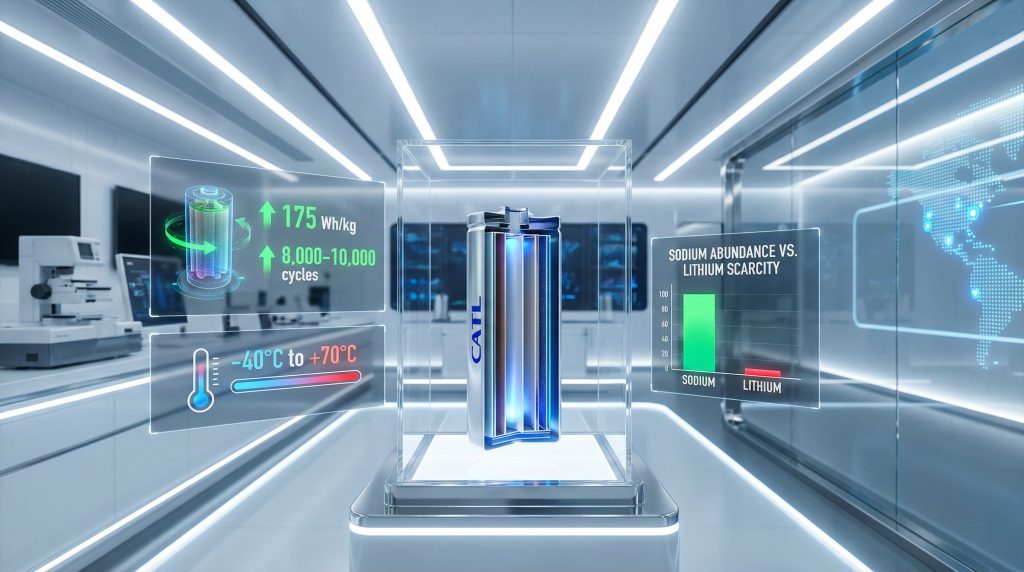
The recent advancement in sodium-ion battery technology represents a fundamental shift in energy storage chemistry that addresses critical limitations plaguing traditional lithium-based systems. CATL's upgraded platform achieves 175 Wh/kg energy density, positioning this technology within striking distance of lithium iron phosphate alternatives while maintaining distinct operational advantages across temperature extremes. This development aligns with broader trends in renewable energy transformations across multiple industrial sectors.
Performance Specifications That Redefine Grid Storage Capabilities
The -40°C to +70°C operational temperature range fundamentally changes deployment economics for utility-scale installations. Traditional LFP systems require substantial auxiliary heating and cooling infrastructure when ambient temperatures exceed their optimal 20-45°C window, creating ongoing operational expenses that compound over 20-year asset lifecycles.
Industry testing data indicates that maintaining LFP battery performance at -30°C requires approximately 150-200 kW of continuous auxiliary heating for a 10 MW installation. This auxiliary load represents 1.5-2% of total system capacity, translating to $180,000-$240,000 annually in additional energy costs for northern European deployments.
The cycle life performance targeting 8,000-10,000 cycles with 80% capacity retention establishes sodium-ion as a legitimate competitor to established technologies. When evaluated against the industry standard of one cycle per day, this specification supports 20+ year operational lifecycles without major capacity degradation, aligning with typical power purchase agreement durations.
Electrochemical Advantages in Stationary Applications
Sodium-ion chemistry demonstrates superior thermal stability characteristics compared to lithium alternatives, with thermal runaway initiation temperatures approximately 50-70°C higher than comparable LFP cells. This safety margin reduces fire suppression system requirements and enables higher packing densities in utility-scale installations.
The inherent non-flammability of sodium electrolyte systems eliminates the need for specialized fire suppression infrastructure required by lithium installations. A typical 100 MWh LFP installation requires approximately $800,000-$1.2 million in fire suppression equipment, while equivalent sodium-ion systems can utilize conventional sprinkler systems, reducing safety infrastructure costs by 60-75%.
Round-trip efficiency performance of 92-95% for sodium-ion systems compares favourably to the 94-97% achieved by premium LFP installations. While this 2-3% efficiency differential appears marginal, it translates to approximately $25,000-$40,000 annually in additional energy costs for a 50 MW system cycling daily, demonstrating the importance of application-specific technology selection.
When big ASX news breaks, our subscribers know first
Economic Analysis: Sodium-Ion versus Established Storage Technologies
The projected cost trajectory for sodium-ion technology fundamentally alters energy storage economics across multiple market segments. Current cell-level costs of $55-$75/kWh position sodium-ion at a premium to lead-acid alternatives but substantially below premium lithium chemistries, creating opportunities in price-sensitive applications. Additionally, this economic shift connects with broader decarbonisation benefits across industrial applications.
Material Cost Structure and Supply Chain Independence
Sodium abundance in the Earth's crust measures approximately 28,000 parts per million compared to lithium's 20 ppm, providing a 1,400:1 ratio in elemental availability. This translates directly to raw material cost differentials, with battery-grade sodium compounds costing approximately $50-$100 per metric ton versus lithium carbonate's historical range of $8,000-$18,000 per metric ton.
The International Renewable Energy Agency projects sodium-ion cell costs could decline to $40/kWh by 2030, representing a 45-50% cost advantage over projected lithium-ion pricing. However, these projections assume successful manufacturing scale-up without major supply chain disruptions or technological setbacks.
Manufacturing infrastructure compatibility provides additional economic advantages. Sodium-ion production utilises 70-80% of existing lithium-ion equipment, reducing capital investment requirements for facility conversion. New gigafactory construction costs approximately $500-$800 million, while sodium-ion retrofits could reduce this by $150-$250 million per facility.
Comparative Total Cost of Ownership Analysis
| Cost Component | Sodium-Ion (2026) | LFP (Current) | Lead-Acid |
|---|---|---|---|
| Cell Cost ($/kWh) | $60-75 | $55-70 | $25-35 |
| Pack Integration ($/kWh) | $25-30 | $15-25 | $15-20 |
| Installation Labour ($/kWh) | $35-45 | $35-45 | $30-40 |
| Total System Cost | $120-150 | $105-140 | $70-95 |
| Cycle Life (years) | 15-20 | 12-18 | 3-5 |
| Annual Maintenance (% of capex) | 0.5-1.0% | 0.3-0.5% | 2.0-3.5% |
| 20-Year Lifecycle Cost ($/kWh) | $180-220 | $170-210 | $350-450 |
The lifecycle cost analysis reveals that despite higher upfront costs, sodium-ion technology achieves cost parity with LFP systems when evaluated over complete operational lifecycles. The extended cycle life and reduced maintenance requirements offset initial capital premiums, particularly in high-cycling applications such as frequency regulation or renewable smoothing.
Geographic Cost Variations and Climate Impact
Deployment in extreme climate regions creates distinct economic advantages for sodium-ion technology. In applications where ambient temperatures regularly exceed 40°C or drop below -20°C, the reduced auxiliary thermal management requirements generate substantial operational savings.
A comparative analysis of a 100 MWh utility installation in Phoenix, Arizona (where summer temperatures exceed 45°C for 80+ days annually) demonstrates the economic impact:
- LFP System: Requires 400-600 kW cooling capacity, consuming approximately 2.4-3.6 MWh daily during peak summer months
- Sodium-Ion System: Operates without active cooling up to 70°C, eliminating cooling energy consumption entirely
- Annual Savings: $180,000-$270,000 in avoided cooling costs over a 20-year operational period
Target Applications Driving Commercial Adoption in 2026
The commercial viability of CATL's sodium-ion upgrade depends critically on identifying applications where its unique characteristics provide decisive advantages over established alternatives. Market penetration will likely follow a tiered approach, beginning with niche applications where temperature tolerance or safety requirements justify cost premiums. Furthermore, these developments intersect with the broader critical minerals energy transition affecting global supply chains.
Grid-Scale Energy Storage Deployment Scenarios
Utility-scale installations represent the most immediate market opportunity for sodium-ion technology, particularly in regions with extreme climate conditions or stringent safety requirements. The improved thermal characteristics enable deployment in locations previously unsuitable for lithium-ion systems without extensive climate control infrastructure.
Peak shaving applications benefit significantly from sodium-ion's wide temperature tolerance. During summer peak demand periods when ambient temperatures exceed 40°C, traditional LFP systems experience capacity degradation of 15-25%, reducing available discharge capacity precisely when it's most valuable. Sodium-ion systems maintain full capacity throughout these critical periods.
Renewable integration projects in harsh climates present compelling use cases. Wind farms in northern Canada or solar installations in Middle Eastern deserts face temperature extremes that challenge conventional battery systems. The operational cost savings from eliminated thermal management justify premium battery costs in these applications.
Grid operators report that frequency regulation services require rapid response capabilities with minimal degradation from high cycling rates. Sodium-ion's superior cycle life performance and thermal stability support the 3,000-5,000 annual cycles typical in frequency regulation applications without premature capacity loss.
Commercial and Industrial Market Penetration
The C&I sector presents significant opportunities for sodium-ion adoption, particularly in applications where safety considerations outweigh pure cost optimisation. Manufacturing facilities, data centres, and healthcare institutions prioritise system reliability and safety over marginal cost differences.
Data centre backup power represents a particularly attractive market segment. The improved thermal stability reduces fire risk in enclosed spaces, while the wide temperature tolerance accommodates varying HVAC conditions. A typical 10 MW data centre backup system could reduce insurance premiums by $50,000-$100,000 annually due to improved safety profiles.
Industrial process backup applications benefit from sodium-ion's consistent performance across temperature ranges. Manufacturing facilities experiencing significant thermal loads can deploy sodium-ion systems without dedicated climate control, reducing both capital and operational expenses.
Commercial buildings in extreme climates represent another compelling use case. Office complexes in Phoenix or Minneapolis face substantial HVAC costs for battery climate control. Sodium-ion systems eliminate these costs while providing equivalent backup power capabilities.
Electric Vehicle Integration and Battery Swap Infrastructure
While passenger vehicles represent CATL's primary target market, the infrastructure supporting electric transportation creates additional opportunities for sodium-ion deployment. Battery swap stations require thermal management for stored battery inventory, creating operational challenges in extreme climates.
The 500-kilometre range capability announced by CATL positions sodium-ion as viable for passenger vehicle applications, though energy density remains below premium lithium-ion alternatives. Commercial fleet applications, where cost and safety considerations outweigh maximum range requirements, present more immediate adoption opportunities.
Heavy-duty commercial vehicles operating in extreme climates benefit significantly from sodium-ion's temperature tolerance. Delivery trucks in northern climates or construction equipment in desert regions experience severe battery degradation with conventional lithium systems, while sodium-ion maintains consistent performance.
Cold-weather vehicle performance represents a particular strength for sodium-ion technology. Electric vehicles in Scandinavia or northern Canada experience 30-50% range reduction during winter operation with conventional lithium batteries. Sodium-ion's -40°C operational capability maintains consistent range performance throughout winter seasons.
Safety Standards and Regulatory Compliance Pathways
The implementation of China's GB 38031-2025 safety standard for traction batteries creates both opportunities and challenges for sodium-ion technology adoption. This regulation establishes stringent thermal management and fire safety requirements that play to sodium-ion's inherent safety advantages while potentially creating barriers for conventional lithium chemistries. Moreover, this development supports the growing battery metals investment landscape as industries adapt to new safety requirements.
Thermal Runaway Prevention and Fire Safety Advantages
Sodium-ion chemistry demonstrates thermal runaway initiation temperatures approximately 50-70°C higher than comparable lithium iron phosphate cells. This margin provides additional safety buffer in applications where thermal management systems experience failures or ambient conditions exceed design specifications.
The non-flammable nature of sodium electrolytes eliminates the oxygen-generating thermal runaway reactions characteristic of lithium-ion systems. During cell failure events, sodium-ion batteries produce primarily sodium oxide and carbon dioxide rather than the toxic gases and oxygen generation typical of lithium cell failures.
Fire suppression system requirements differ substantially between sodium-ion and lithium technologies. Lithium-ion installations require specialised suppression agents (typically FM-200 or Novec compounds) costing $200-$400 per protected cubic metre. Sodium-ion systems can utilise conventional water-based sprinkler systems costing $20-$40 per cubic metre, reducing fire protection infrastructure costs by 85-90%.
International Safety Standard Alignment
Compliance with international safety standards creates market access opportunities for sodium-ion technology. The IEC 62619 standard for secondary lithium cells used in industrial applications establishes thermal stability requirements that sodium-ion systems meet with significant margin.
UL 9540 certification for energy storage systems includes specific thermal runaway propagation testing that favours sodium-ion's superior thermal characteristics. Meeting UL 9540 requirements typically requires extensive fire suppression and thermal management systems for lithium installations, while sodium-ion systems may achieve compliance with simplified safety infrastructure.
European safety standards under the Battery Regulation 2023 emphasise lifecycle environmental impact and end-of-life safety. Sodium-ion's non-toxic chemistry and simplified recycling processes provide advantages in meeting these evolving regulatory requirements.
Insurance and liability considerations increasingly favour technologies with superior safety profiles. Commercial liability insurance for large-scale energy storage installations costs approximately $50,000-$150,000 annually per 100 MWh of lithium-ion capacity. Sodium-ion installations may qualify for 20-40% reduced premiums due to lower fire and toxic exposure risks.
Installation and Maintenance Protocol Advantages
The simplified safety requirements for sodium-ion systems reduce installation complexity and ongoing maintenance costs. Electrical workers can service sodium-ion systems with standard safety protocols rather than the specialised training required for lithium-ion hazmat procedures.
Thermal monitoring requirements differ significantly between technologies. Lithium-ion systems typically require temperature monitoring at the cell level with automatic disconnection capabilities for thermal excursions. Sodium-ion's wider temperature tolerance reduces monitoring complexity and false-alarm frequency.
Emergency response procedures for sodium-ion installations utilise conventional firefighting techniques rather than the specialised protocols required for lithium-ion fires. This reduces training requirements for facility personnel and local emergency services while improving response effectiveness during actual emergencies.
Supply Chain Transformation and Manufacturing Scale-Up Challenges
The transition to sodium-ion technology requires fundamental changes in battery supply chain infrastructure, from raw material sourcing through end-of-life recycling. While sodium abundance provides theoretical supply security, the practical implementation of large-scale sodium-ion manufacturing presents distinct challenges and opportunities. In addition, this transition relates to the broader battery recycling breakthrough that is transforming the industry.
Raw Material Sourcing and Geographic Distribution
Unlike lithium mining, which concentrates in specific geographic regions, sodium sourcing utilises globally distributed salt deposits and seawater extraction. This geographic diversity reduces geopolitical supply risks while enabling local sourcing strategies that minimise transportation costs and supply chain complexity.
Table: Raw Material Availability Comparison
| Material | Global Reserves | Top 3 Producers | Price Volatility (2020-2025) |
|---|---|---|---|
| Lithium Carbonate | 89 million tonnes | Chile (44%), Australia (42%), China (6%) | 600% price swing |
| Sodium Chloride | Unlimited (seawater) | Global distribution | <5% annual variation |
| Graphite (anode) | 320 million tonnes | China (65%), Madagascar (8%), Brazil (8%) | 40% price swing |
| Copper (current collectors) | 880 million tonnes | Chile (28%), Peru (12%), China (9%) | 80% price swing |
The sodium abundance advantage translates directly to price stability and supply security. Sea salt production requires minimal capital investment and operates independently of mining permit restrictions or environmental impact assessments that constrain lithium extraction.
Battery-grade sodium carbonate production utilises established industrial processes from the chlor-alkali industry. Existing sodium processing facilities can be retrofitted for battery-grade material production with $50-$100 million capital investments compared to the $2-$5 billion required for new lithium extraction and processing facilities.
Manufacturing Infrastructure Requirements
The 70-80% equipment compatibility between sodium-ion and lithium-ion manufacturing enables rapid capacity expansion without complete facility reconstruction. Existing gigafactories can implement sodium-ion production lines with selective equipment upgrades rather than comprehensive rebuilds.
Critical equipment modifications focus primarily on electrode coating and electrolyte handling systems. The similar cell formats and assembly processes allow manufacturers to implement flexible production lines capable of producing both chemistries based on market demand and raw material pricing dynamics.
Quality control requirements differ between sodium-ion and lithium-ion production. The wider temperature tolerance and improved thermal stability of sodium-ion cells reduce quality control complexity while maintaining performance consistency across production batches.
Manufacturing scale-up timeline estimates suggest existing lithium-ion facilities can achieve sodium-ion production capability within 12-18 months of conversion initiation. New dedicated sodium-ion facilities require 24-36 months from groundbreaking to commercial production, compared to 36-48 months for equivalent lithium-ion gigafactories.
Technology Transfer and Licensing Models
CATL's positioning of sodium-ion as complementary to rather than competitive with lithium-ion suggests potential licensing opportunities for manufacturers seeking technology diversification. The dual-chemistry approach enables manufacturers to hedge against raw material price volatility while serving different market segments.
Intellectual property landscape for sodium-ion technology remains more accessible than mature lithium-ion patents. Key sodium-ion innovations face shorter patent protection periods, enabling broader industry adoption without extensive licensing fees that characterise lithium-ion manufacturing.
Joint venture opportunities between sodium-ion developers and existing lithium-ion manufacturers provide pathways for technology transfer while sharing development costs and market risks. These partnerships can accelerate commercialisation timelines while leveraging established distribution channels.
Performance Trade-offs and Investment Considerations
While sodium-ion technology offers distinct advantages in specific applications, understanding the fundamental performance limitations guides appropriate technology selection and investment decisions. The energy density constraint represents the primary challenge for widespread sodium-ion adoption across all battery applications.
Energy Density Limitations in Space-Constrained Applications
The 175 Wh/kg energy density achieved by CATL's upgraded platform, while impressive for sodium-ion technology, remains approximately 15-20% below premium lithium-ion alternatives. This density differential creates space and weight penalties that become critical in mobile applications or urban installations with severe footprint constraints.
Volumetric energy density impacts prove even more significant in stationary applications. A 1 MWh sodium-ion installation requires approximately 6.3 cubic metres of battery module space compared to 5.2 cubic metres for equivalent LFP systems. In urban settings where real estate costs exceed $500 per square foot annually, this space penalty translates to $15,000-$25,000 in additional facility costs per MWh of installed capacity.
Weight considerations affect transportation and installation costs for large-scale deployments. The additional mass per unit energy requires upgraded structural supports and specialised handling equipment, increasing installation complexity and cost by approximately $10-$20 per kWh compared to equivalent LFP installations.
Performance Degradation Patterns and Lifecycle Management
Long-term capacity degradation modelling reveals different ageing characteristics between sodium-ion and lithium-ion technologies. Sodium-ion systems demonstrate more linear degradation patterns compared to the accelerating capacity loss typical of lithium systems after 80% state-of-health thresholds.
Calendar ageing effects appear less pronounced in sodium-ion systems, with capacity retention of 85-90% after 10 years of storage compared to 75-80% for equivalent lithium systems. This advantage proves particularly valuable in backup power applications where systems remain idle for extended periods.
Cycle depth sensitivity differs between technologies. While lithium-ion systems benefit significantly from shallow depth-of-discharge operation, sodium-ion systems demonstrate consistent degradation rates across 20-100% discharge depths. This characteristic enables more aggressive cycling strategies without accelerated ageing penalties.
Technology Maturity and Risk Assessment
| Risk Factor | Sodium-Ion | LFP | Mitigation Strategy |
|---|---|---|---|
| Technology Maturity | Medium-High | Very High | Comprehensive warranty coverage |
| Manufacturing Scale | Low-Medium | Very High | Phased deployment approach |
| Supply Chain Stability | High | Medium | Diversified sourcing strategies |
| Performance Predictability | Medium | Very High | Extended pilot testing |
| Cost Trajectory Certainty | Medium | High | Flexible technology contracts |
Technology maturity assessment indicates sodium-ion systems require additional validation in multi-year commercial deployments. While laboratory testing demonstrates promising characteristics, the limited operational history creates uncertainty around long-term performance predictability.
Manufacturing quality consistency represents a near-term risk as production scales beyond pilot quantities. Early commercial deployments may experience higher variability in cell performance compared to mature lithium-ion manufacturing processes refined over decades.
Performance warranty terms for sodium-ion systems typically offer 8-10 year coverage compared to 15-20 years available for premium lithium-ion systems. This warranty differential reflects manufacturer confidence levels and impacts project financing terms for utility-scale installations.
The next major ASX story will hit our subscribers first
Market Segmentation and Early Commercial Deployment Strategies
Successful sodium-ion commercialisation requires strategic market segmentation that leverages technology strengths while avoiding direct competition with established lithium-ion solutions in their strongest applications. Early deployment strategies focus on niche markets where sodium-ion advantages justify cost premiums or performance trade-offs.
Stationary Storage Market Penetration Approach
Utility procurement decisions increasingly emphasise total cost of ownership over initial capital costs, creating opportunities for sodium-ion technology in long-duration and extreme-climate applications. Procurement managers evaluate 20-year lifecycle costs including maintenance, replacement, and operational efficiency factors.
Grid operators in northern climates express particular interest in sodium-ion solutions for winter peak management applications. During extreme cold events, conventional lithium systems experience capacity reductions of 25-40%, precisely when grid demand reaches annual peaks. Sodium-ion's consistent low-temperature performance maintains full capacity during these critical periods.
Commercial energy storage projects in extreme climates present attractive early adoption opportunities. Industrial facilities in desert regions (Arizona, Nevada, Saudi Arabia) or arctic operations (Alaska, northern Canada) face substantial auxiliary cooling or heating costs for conventional battery systems.
The improved fire safety characteristics create opportunities in urban installations where fire risk concerns limit conventional lithium-ion deployment. Dense urban environments with limited firefighting access may prefer sodium-ion systems despite energy density penalties.
Transportation Sector Integration Pathways
Fleet electrification initiatives increasingly focus on total cost of ownership rather than maximum vehicle range. Commercial fleets operating predictable routes with depot charging capabilities can utilise sodium-ion's cost advantages while accepting moderate energy density penalties.
Cold-climate vehicle operations represent a particularly attractive market segment. Electric delivery vehicles in Scandinavia or northern US states experience severe range reduction during winter operation with conventional lithium batteries, while sodium-ion maintains consistent performance throughout winter seasons.
Battery swap networks benefit from sodium-ion's thermal characteristics through reduced climate control costs for stored battery inventory. Swap stations in extreme climates can eliminate expensive thermal management systems while maintaining battery longevity and performance.
Heavy-duty commercial applications (mining equipment, construction vehicles, marine vessels) prioritise safety and durability over energy density. These applications can leverage sodium-ion's superior safety profile and cycle life while accepting weight and volume penalties.
Geographic Deployment Priorities
Climate-driven deployment strategies focus on regions where temperature extremes create operational challenges for conventional lithium systems:
- Arctic regions: Northern Canada, Alaska, Siberia, northern Scandinavia
- Desert environments: Southwestern US, Middle East, Australia's interior
- High-altitude locations: Mountain regions with extreme temperature swings
- Tropical climates: Southeast Asia, equatorial regions with persistent high temperatures
Regulatory environment considerations favour regions with evolving safety standards that emphasise thermal stability and environmental impact. European Union battery regulations and similar frameworks in developed markets create advantages for technologies with superior safety and sustainability profiles.
Environmental Impact and Sustainability Analysis
The environmental advantages of sodium-ion technology extend beyond raw material abundance to encompass manufacturing emissions, operational efficiency, and end-of-life management. These factors increasingly influence procurement decisions as corporate sustainability commitments drive technology selection criteria.
Carbon Footprint and Manufacturing Emissions
Lifecycle carbon analysis reveals significant advantages for sodium-ion technology, beginning with raw material extraction and processing. Sodium extraction from seawater or salt deposits requires approximately 60-70% less energy than lithium extraction from brine or hard rock mining operations.
Manufacturing emissions for sodium-ion cells measure approximately 40-50 kg CO2 per kWh compared to 60-75 kg CO2 per kWh for equivalent lithium-ion cells. This 25-35% reduction stems from simplified material processing and lower energy requirements for electrode preparation.
Transportation emissions contribute materially to overall carbon footprints due to the global distribution of lithium mining operations. Sodium's local availability reduces transportation requirements, potentially eliminating 5-15 kg CO2 per kWh in shipping emissions for regional installations.
The absence of cobalt and nickel in sodium-ion chemistry eliminates mining operations with severe environmental impact. Cobalt extraction in the Democratic Republic of Congo and nickel mining in Indonesia generate substantial environmental degradation and social impact concerns that sodium-ion technology avoids entirely.
Recycling Infrastructure and Circular Economy Integration
End-of-life recycling for sodium-ion systems utilises existing industrial infrastructure rather than specialised lithium battery recycling facilities. Sodium metal recovery leverages established chlor-alkali industry processes, enabling 85-90% material recovery rates compared to 70-75% for lithium systems.
The non-toxic nature of sodium-ion components eliminates hazardous waste classification requirements that complicate lithium battery disposal. Standard industrial recycling protocols apply to sodium-ion systems, reducing recycling costs by approximately $500-$800 per metric ton compared to specialised lithium recycling processes.
Circular economy opportunities include direct reuse of recovered sodium in new battery production or industrial applications. The chemical similarity between recovered and virgin sodium enables closed-loop recycling with minimal quality degradation, supporting true circular economy implementation.
Corporate ESG Compliance Advantages
Environmental, Social, and Governance (ESG) compliance increasingly influences corporate technology procurement decisions. Sodium-ion technology provides measurable advantages across multiple ESG criteria that support corporate sustainability reporting requirements.
Supply chain transparency benefits from sodium's geographic distribution and established sourcing networks. Unlike lithium supply chains with complex geopolitical relationships and environmental concerns, sodium sourcing utilises transparent, regulated industrial processes in developed countries.
Social impact considerations favour sodium-ion technology due to the absence of conflict mineral concerns associated with cobalt and rare earth elements. Corporate sustainability officers can demonstrate clear social responsibility improvements through sodium-ion adoption.
Sustainability metrics for sodium-ion systems demonstrate measurable improvements in carbon intensity, water usage, and land impact compared to lithium alternatives. These quantifiable benefits support corporate sustainability reporting and stakeholder communication requirements.
Investment Opportunities and Market Projections
The emerging sodium-ion market presents diverse investment opportunities across the technology value chain, from raw material processing through system integration and recycling infrastructure. Market projections indicate substantial growth potential, though investment success requires careful evaluation of technology maturity timelines and competitive positioning.
Market Size Projections and Regional Growth Drivers
Global sodium-ion battery market projections estimate growth from approximately $1.2 billion in 2025 to $8.5-12.0 billion by 2030, representing a compound annual growth rate of 45-55%. These projections assume successful technology commercialisation and favourable cost trajectories relative to lithium alternatives.
Regional deployment patterns favour markets with extreme climate conditions, regulatory support for safety improvements, or strategic raw material independence objectives:
- China: Government support for domestic battery technology, abundant manufacturing capacity
- United States: Grid resilience initiatives, extreme climate applications, supply chain security concerns
- European Union: Environmental regulations favouring sustainable technologies, cold climate deployments
- Middle East: High-temperature performance requirements, energy security priorities
- Arctic regions: Extreme cold performance needs, infrastructure reliability requirements
Market segment analysis indicates stationary energy storage will drive initial adoption (60-70% of market volume), followed by commercial vehicles (20-25%) and specialised applications (10-15%). Consumer electronics remain unlikely adoption targets due to energy density limitations.
Technology licensing revenues represent significant value creation opportunities. CATL's intellectual property portfolio in sodium-ion technology could generate $500 million to $1.5 billion in licensing revenues over the next decade as global manufacturers seek access to proven technology platforms.
Investment Risk Factors and Mitigation Strategies
Technology adoption timeline uncertainty represents the primary investment risk, as sodium-ion commercialisation depends on successful scaling of manufacturing processes and validation of long-term performance characteristics. Conservative deployment scenarios could delay market development by 2-4 years from current projections.
Competitive response from established lithium-ion manufacturers poses significant market risk. Rapid cost reductions in LFP technology, as demonstrated by the 45% price decline in 2025, could narrow or eliminate sodium-ion's cost advantages before widespread adoption occurs.
Table: Investment Risk Assessment Matrix
| Risk Category | Probability | Impact | Mitigation Strategy |
|---|---|---|---|
| Manufacturing scale-up delays | Medium | High | Phased capacity expansion |
| Lithium price collapse | Low-Medium | Very High | Diversified technology portfolio |
| Regulatory approval delays | Low | Medium | Early engagement with authorities |
| Performance validation issues | Low | High | Comprehensive testing programmes |
| Supply chain disruption | Very Low | Medium | Geographically diverse sourcing |
Financial structure considerations favour project financing models that account for technology maturity risks through enhanced warranty coverage and performance guarantees. Early adopters may require 20-30% higher returns to compensate for technology risk compared to established lithium-ion projects.
Successful investment strategies emphasise portfolio diversification across the technology value chain rather than concentrated bets on individual companies or applications. Value creation opportunities span raw material processing, manufacturing equipment, system integration, and recycling infrastructure development.
Exit strategy planning should account for potential acquisition by established battery manufacturers seeking technology diversification. Strategic acquirers may value sodium-ion intellectual property at premium multiples due to supply chain security benefits and regulatory compliance advantages.
Critical Questions for Sodium-Ion Battery Technology Implementation
How does sodium-ion cold weather performance compare to lithium systems?
Sodium-ion batteries maintain consistent performance at temperatures as low as -40°C, while lithium-ion systems typically experience 25-40% capacity reduction below -20°C. This advantage eliminates auxiliary heating requirements in cold climates, reducing operational costs by $150,000-$300,000 over 20 years for utility-scale installations. The improved cold-weather performance makes sodium-ion particularly suitable for northern European, Canadian, and Arctic applications where conventional batteries struggle.
What cycle life can users expect from CATL's sodium-ion systems?
CATL's enhanced sodium-ion platform targets 8,000-10,000 cycles with 80% capacity retention, equivalent to 15-20 years of daily cycling operation. This cycle life matches or exceeds premium lithium iron phosphate systems while maintaining superior performance across temperature extremes. The linear degradation pattern of sodium-ion cells provides more predictable replacement planning compared to the accelerating capacity loss typical of lithium systems approaching end-of-life.
Can sodium-ion batteries be recycled more easily than lithium batteries?
Sodium-ion recycling utilises existing chlor-alkali industrial infrastructure rather than specialised lithium recovery facilities, enabling 85-90% material recovery rates at lower costs. The non-toxic chemistry eliminates hazardous waste classification requirements, reducing recycling costs by $500-$800 per metric ton compared to lithium systems. Recovered sodium can be directly reused in new battery production or industrial applications, supporting true circular economy implementation.
Which countries are leading sodium-ion battery development?
China dominates sodium-ion development with companies like CATL, BYD, and HiTHIUM leading commercialisation efforts. The Chinese government provides strategic support for domestic battery technology development as part of supply chain independence initiatives. European manufacturers including Northvolt and Altris are developing sodium-ion technologies focused on cold-climate applications, while US companies such as Natron Energy target stationary storage markets with safety and performance advantages.
What applications justify sodium-ion's cost premium over lead-acid batteries?
While sodium-ion systems cost $120-150/kWh compared to lead-acid's $70-95/kWh, the 15-20 year lifecycle and minimal maintenance requirements create total cost advantages in applications requiring frequent cycling. Telecommunications backup power, renewable energy storage, and commercial peak shaving applications justify the premium through reduced replacement frequency and eliminated maintenance costs. The improved safety profile also reduces insurance and regulatory compliance costs in commercial installations.
Disclaimer: This analysis contains forward-looking projections based on current technology development and market trends. Actual performance, costs, and adoption timelines may differ materially from these estimates. Investment decisions should consider comprehensive risk assessment and professional financial guidance.
Looking to Navigate the Next Generation of Energy Storage Investments?
Discovery Alert's proprietary Discovery IQ model delivers real-time alerts on significant mineral discoveries across the ASX, including critical battery materials driving the energy storage revolution. Stay ahead of market developments in lithium, sodium, and emerging battery technologies by gaining instant insights into major discoveries that have generated substantial returns for early investors. Begin your 30-day free trial today and position yourself at the forefront of the energy transition.