June 4, 2026
The Economics of Proximity: Why Egypt's Newest Gas Find Changes the Development Calculus
Upstream energy investment rarely follows a linear path. Capital flows toward basins where geology, infrastructure, and fiscal reliability intersect in ways that compress the distance between discovery and first revenue. Across the Eastern Mediterranean, that intersection has been shifting decisively in Egypt's favour, and the mechanics behind this shift reveal something far more instructive than any single well announcement.
The Egypt gas discovery in the Nile Delta announced in May 2026 is not simply a headline about cubic feet per day. It is a case study in how sovereign fiscal reform, directional drilling innovation, and strategic infrastructure placement can transform a mature basin into a near-term production engine. Understanding why this matters requires starting not with the discovery itself, but with the broader architecture that made it possible.
When big ASX news breaks, our subscribers know first
Why the Nile Delta Keeps Delivering Despite Being a Mature Basin
The Geological Foundation That Sustains Exploration Interest
Most producing basins follow a predictable arc: frontier discovery, peak production, decline, and eventual abandonment. The Nile Delta has defied this pattern through a combination of stratigraphic complexity and shallow-water accessibility that continues to reward disciplined exploration.
The delta's sedimentary sequence contains multiple stacked reservoir intervals, meaning that individual concession areas can host several distinct gas-bearing formations at varying depths. This layered geology reduces the risk profile of individual wells by offering operators multiple potential targets within a single drilling programme, rather than committing capital to a single horizon.
The near-shore transition zone, where onshore geology grades into shallow submarine formations, is particularly significant. In areas like Kafr El-Sheikh governorate, sedimentary formations that begin onshore continue offshore beneath water depths that are economically accessible without conventional offshore infrastructure. This geological continuity is precisely what enables the directional drilling approach that defined the Nidoco N-2 programme.
Egypt's Supply Gap and the Pressure for Near-Term Additions
Egypt's gas production trajectory over the past decade has been shaped by competing forces. The 2015 discovery of the Zohr supergiant field, with an estimated 30 trillion cubic feet of recoverable gas, initially appeared to secure Egypt's energy future for decades. However, Zohr's accelerated production ramp-up to meet domestic demand has led to faster-than-expected depletion rates from the field's primary reservoir intervals, tightening the medium-term supply picture.
At the same time, Egypt's domestic gas consumption has been sustained at elevated levels by industrial demand, power generation requirements, and a subsidised energy pricing structure that suppresses conservation incentives. The result is a structural supply tension that makes near-term production additions from smaller, infrastructure-proximate discoveries disproportionately valuable relative to their absolute size.
A well producing 50 million cubic feet per day (MMcf/d) may represent a fraction of national output, but when it can be tied into existing infrastructure within weeks rather than years, its economic contribution materialises at a speed that larger, more complex developments cannot match.
Nidoco N-2: Dissecting the Technical and Commercial Logic
What Makes This Well Structurally Different From Conventional Offshore Finds
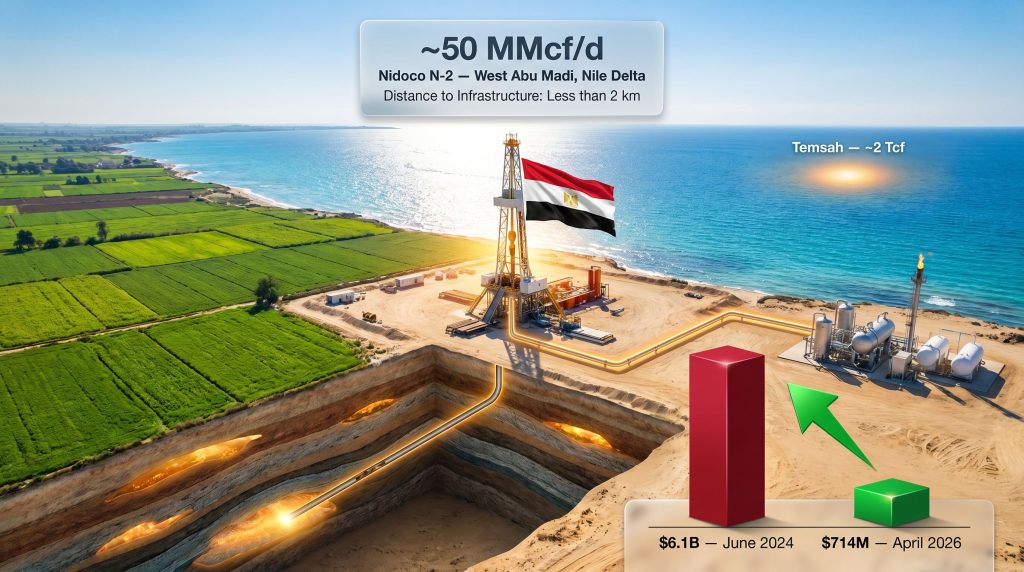
The Nidoco N-2 exploratory well, drilled in the West Abu Madi concession area under the operatorship of Eni in partnership with BP, represents a specific category of development that is often underappreciated in mainstream energy coverage: the infrastructure-proximate, directionally drilled near-shore well.
This category sits in a distinct economic tier compared to either conventional onshore wells or standard offshore developments. The key differentiating factors are worth examining systematically:
- Surface location: Onshore pad, eliminating the need for jack-up rigs, offshore accommodation vessels, or floating production units
- Target location: Shallow offshore reservoir beneath coastal waters, accessed by steering the wellbore at a calculated angle from the onshore surface location
- Infrastructure distance: Less than 2 kilometres from existing production facilities, removing the need for long-distance pipeline construction or new processing plant commissioning
- Capital intensity: Substantially lower than equivalent offshore development, due to onshore rig day rates, simplified logistics, and avoided marine infrastructure costs
- Time to first production: Measured in weeks rather than the months or years associated with conventional offshore tie-ins
The combination of these factors creates a development scenario that is genuinely rare in upstream operations: a well that delivers production economics closer to a workovers programme than a frontier exploration project.
The Infrastructure Proximity Advantage: A Quantified Perspective
To appreciate why the Nidoco N-2's location matters so profoundly, consider how dramatically infrastructure proximity compresses development timelines across different discovery categories:
| Discovery Type | Typical Time to First Production | Primary Infrastructure Requirement |
|---|---|---|
| Deepwater frontier discovery | 5 to 10 years | New platform, subsea pipeline, FPSO or fixed facility |
| Shallow offshore, remote location | 2 to 4 years | New pipeline corridor, processing facility |
| Near-infrastructure shallow offshore | Weeks to months | Minimal modification of existing facilities |
| Nidoco N-2 (West Abu Madi, 2026) | Weeks | Sub-2 km tie-in to operational facilities |
The commercial implication of this timeline compression is substantial. Capital committed to the Nidoco N-2 programme begins generating revenue within the same fiscal quarter as drilling completion, a dynamic that fundamentally alters the internal rate of return calculation for operators and their host government partners.
Egypt's Arrears Resolution: The Policy Foundation Behind Renewed Exploration
From $6.1 Billion to $714 Million: Understanding the Fiscal Rehabilitation
No analysis of Egypt's current exploration momentum is complete without examining the upstream payment crisis that preceded it. By June 2024, Egypt had accumulated approximately $6.1 billion in outstanding dues owed to international oil and gas partners, a figure that represented one of the most significant country-level payment arrears in the region's upstream history.
The build-up of these arrears was driven by a convergence of pressures:
- Chronic foreign currency shortages following a series of external shocks, including the COVID-19 pandemic's impact on tourism revenues and remittance flows
- The fiscal burden of energy subsidies, which reduced the cash available for repatriation to foreign partners
- An overvalued official exchange rate that complicated foreign currency settlement mechanisms
- Elevated debt servicing requirements on sovereign borrowings
By the end of April 2026, outstanding dues had been reduced to approximately $714 million, a reduction of more than 88% in under two years. Egypt's Ministry of Petroleum and Mineral Resources indicated that full settlement of remaining arrears was projected for the end of June 2026.
This trajectory of fiscal rehabilitation represents one of the most consequential shifts in Egypt's upstream investment environment in recent memory. The speed of the reduction signals a deliberate prioritisation of energy sector credibility, with direct consequences for exploration capital allocation.
How Payment Reliability Translates Into Exploration Decisions
International energy companies operate within sophisticated country risk frameworks when allocating exploration budgets. Payment reliability sits near the top of these frameworks, because even prolific geology produces no economic return if production revenues are not remitted on schedule. Furthermore, the broader implications for global energy markets are significant when a major producing nation restores fiscal credibility at this pace.
When Egypt's arrears were at their peak, operators faced a fundamental dilemma: continuing to invest in a productive basin while receivables accumulated without clear settlement timelines. As payment conditions improved, this dilemma resolved in a way that directly stimulated new drilling commitments, concession extensions, and the expanded exploration programmes that produced discoveries like Nidoco N-2.
Egypt's Ministry of Petroleum and Mineral Resources confirmed that consistent payment schedules encouraged international partners to broaden their exploration activity and extend existing agreements, creating a multiplier effect where fiscal discipline generates exploration outcomes that further improve fiscal capacity through new production revenues.
The Dual Discovery Pattern: Eni's Parallel Find in the Temsah Concession
The Nidoco N-2 announcement does not exist in isolation. In April 2026, Reuters reported that Eni had made a separate gas and condensate discovery in the Temsah concession in the Eastern Mediterranean, with preliminary estimates pointing to approximately 2 trillion cubic feet (Tcf) of gas and 130 million barrels of associated condensates.
The simultaneous emergence of significant finds across two geologically distinct areas, one in the Nile Delta's shallow near-shore environment and another in the deeper Eastern Mediterranean, illustrates how arrears resolution unlocks exploration capital across multiple concession areas simultaneously rather than sequentially. According to AGBI, Egypt's gas output is expected to rise materially as these parallel developments progress toward production.
Directional Drilling: The Technical Innovation That Made This Discovery Economical
How Onshore-to-Offshore Directional Drilling Works
Directional drilling is the practice of intentionally steering a wellbore along a non-vertical trajectory to reach a subsurface target that is horizontally displaced from the surface drilling location. While the technology has been in commercial use for decades, its application in the specific context of accessing shallow offshore reservoirs from onshore surface locations represents a cost optimisation strategy that is increasingly influential across MENA upstream operations.
In the Nidoco N-2 case, the surface drilling pad is located onshore in Kafr El-Sheikh, while the productive reservoir target lies beneath the shallow coastal waters of the Nile Delta margin. The wellbore is progressively steered at a calculated inclination and azimuth from the onshore surface location until it intersects the offshore reservoir at the optimal geometric position.
The technical enablers of this approach include:
- Measurement While Drilling (MWD) tools, which provide real-time directional data to guide the wellbore trajectory
- Rotary Steerable Systems (RSS), which allow continuous directional control without interrupting drilling rotation
- Advanced formation evaluation logging run in deviated wellbores to confirm reservoir quality at the target location
- Extended-reach drilling (ERD) technology for wells where the horizontal displacement from surface to target is significant relative to the vertical depth
The Cost Efficiency Case for This Approach
The economic advantage of drilling from an onshore pad to access offshore reservoirs is measurable across several cost categories:
- Onshore rig day rates are typically 60 to 80 percent lower than equivalent offshore jack-up rates
- Marine logistics, offshore catering, accommodation, and helicopter transport costs are entirely eliminated
- Subsea completion and wellhead infrastructure, which can represent tens of millions of dollars per well offshore, are replaced by conventional onshore wellhead equipment
- Environmental permitting for onshore operations is generally less complex than for offshore equivalents in most jurisdictions, reducing pre-drilling delay
Major regional operators including Saudi Aramco, Abu Dhabi National Oil Company (ADNOC), and Petroleum Development Oman (PDO) have deployed extended-reach directional drilling to access offshore reservoirs from onshore locations across multiple fields. The Nidoco N-2 approach fits squarely within this established MENA industry pattern, positioning it as a replicable model for other near-shore discoveries along the Egyptian coastline.
Egypt's Position in the Eastern Mediterranean Gas Landscape
Comparing Egypt's Recent Discoveries to Regional Benchmarks
The Eastern Mediterranean has emerged over the past decade as one of the world's most actively explored gas provinces, with material discoveries across Egyptian, Israeli, and Cypriot waters reshaping regional energy trade patterns. Egypt's recent finds sit within this broader context:
| Discovery | Location | Estimated Resource | Lead Operator |
|---|---|---|---|
| Nidoco N-2 (2026) | West Abu Madi, Nile Delta | Approx. 50 MMcf/d production rate | Eni, in partnership with BP |
| Temsah concession (2026) | Eastern Mediterranean, offshore Egypt | Approx. 2 Tcf gas + 130 MMbbl condensate | Eni |
| Zohr field (2015) | Offshore Egypt, Mediterranean | Approx. 30 Tcf gas | Eni |
| Leviathan field | Offshore Israel | Approx. 22 Tcf gas | Chevron, NewMed Energy |
The LNG Export Question: Balancing Domestic Demand Against Hard Currency Earnings
Egypt operates two LNG liquefaction facilities at Idku and Damietta, infrastructure that positions the country as a potential gas re-export hub for the broader Eastern Mediterranean region. However, both facilities have operated below nameplate capacity in recent years due to insufficient domestic production surpluses. The evolving LNG supply outlook for the region makes this dynamic particularly worth monitoring, as incremental Egyptian production could shift the regional supply balance meaningfully.
As incremental production additions accumulate from multiple smaller near-infrastructure discoveries alongside larger frontier developments, a strategic inflection point approaches: at what production threshold does Egypt shift from a net importer of gas purchasing power constraints to a consistent LNG exporter generating material foreign currency revenues?
This question carries significant implications for Egypt's external balance and sovereign credit trajectory. LNG export revenues denominated in hard currency directly address the foreign exchange shortage that originally drove the accumulation of arrears to international partners, creating a self-reinforcing cycle where production growth improves fiscal reliability, which in turn attracts the investment capital needed for further production growth.
Speculative Consideration: If Egypt's dual-track exploration strategy, combining near-infrastructure Nile Delta tie-ins with larger Eastern Mediterranean frontier discoveries, delivers cumulative production additions of 500 MMcf/d or more over the next three to five years, the country could realistically return to sustained LNG export volumes that materially reduce its reliance on external financing. This remains a scenario projection rather than a confirmed outcome, and investors should treat forward-looking estimates with appropriate caution.
The next major ASX story will hit our subscribers first
What the Nidoco N-2 Discovery Signals for Egypt's Energy Security
Short-Term Supply Impact: The Additive Logic of Smaller Discoveries
A single well producing 50 MMcf/d does not transform a national energy balance. However, the Egypt gas discovery in the Nile Delta is best understood not as a standalone event but as one component of a portfolio strategy where multiple near-infrastructure finds, each individually modest, combine to generate cumulative production additions that meaningfully offset decline rates from maturing fields.
This additive logic is particularly relevant in mature basins like the Nile Delta, where the era of supergiant discoveries has largely passed but the infrastructure density and geological maturity create optimal conditions for a different kind of value creation: rapid, lower-capital, infrastructure-proximate developments that aggregate into material supply contributions. In addition, the commodity market volatility associated with such supply shifts warrants careful monitoring, particularly given how commodity market volatility can amplify or dampen the investment signals that discoveries like Nidoco N-2 generate.
Medium to Long-Term Investment Thesis
For international energy companies evaluating Egypt as an upstream destination, the combination of factors present in mid-2026 creates a more compelling risk-adjusted investment case than has existed for several years:
- Arrears resolution removes the primary financial risk that previously deterred long-cycle capital commitments
- Directional drilling economics lower the minimum viable discovery size for profitable development in near-shore areas
- Existing infrastructure density across the Nile Delta reduces development capital requirements for incremental discoveries
- Concession extension framework emerging from the improved payment relationship provides longer planning horizons for multi-well programmes
The presence of Eni and BP as active operators anchors international investor confidence in the basin's commercial viability, providing a credibility signal that smaller independent operators and financial investors use when assessing their own Egypt exposure. Furthermore, OPEC's market influence on broader energy pricing creates an external backdrop that shapes how quickly this investment thesis translates into committed capital. Ongoing trade war impacts on global demand forecasts also remain a variable that upstream planners must factor into longer-horizon development decisions.
Frequently Asked Questions: Egypt Gas Discovery in the Nile Delta
What was discovered in Egypt's Nile Delta in 2026?
A new natural gas discovery was confirmed at the Nidoco N-2 exploratory well located in the West Abu Madi concession area within the Kafr El-Sheikh region of the Nile Delta. The well is capable of producing approximately 50 million cubic feet of gas per day and was drilled using directional drilling technology that allowed an onshore surface location to access shallow offshore reservoir targets. Ocean Energy Resources has provided additional technical context on the offshore geology underpinning this find.
Who operates the Nidoco N-2 well?
The well is operated by Eni in partnership with BP, functioning within the established joint venture framework involving Egyptian state energy entities EGPC and Petrobel.
How quickly will Nidoco N-2 begin producing gas?
Due to the well's position less than 2 kilometres from existing production facilities, tie-in operations and the commencement of early production were expected within weeks of the May 2026 discovery announcement, an unusually compressed timeline for any upstream development.
How did Egypt reduce its arrears to foreign energy partners so rapidly?
Egypt reduced outstanding dues owed to international oil and gas partners from approximately $6.1 billion in June 2024 to around $714 million by the end of April 2026, representing a reduction of more than 88% in under two years. Egypt's Ministry of Petroleum and Mineral Resources projected full settlement of remaining arrears by the end of June 2026. This reduction reflected a combination of improved foreign currency availability, fiscal prioritisation of upstream sector credibility, and structural economic adjustments.
What is the Temsah concession discovery and how does it relate to Nidoco N-2?
In April 2026, Eni made a separate discovery in the Temsah concession in the Eastern Mediterranean, distinct from the Egypt gas discovery in the Nile Delta geographically and geologically. Preliminary estimates for the Temsah find indicated approximately 2 trillion cubic feet of gas alongside 130 million barrels of associated condensates. Together, the Nidoco N-2 and Temsah discoveries illustrate how Egypt's improved payment environment has stimulated simultaneous exploration activity across multiple concession areas.
Why is directional drilling particularly valuable at the Nidoco N-2 location?
Directional drilling from an onshore surface pad to access shallow offshore reservoirs eliminates the need for offshore rigs, marine infrastructure, and subsea completion systems. At Nidoco N-2, this approach substantially reduced capital costs, compressed the timeline to first production, and leveraged proximity to existing onshore processing facilities, making a discovery that might otherwise require years of offshore development commercially viable within weeks.
Key Metrics: Egypt's Nile Delta Gas Discovery at a Glance
| Metric | Detail |
|---|---|
| Well name | Nidoco N-2 |
| Concession area | West Abu Madi, Kafr El-Sheikh, Nile Delta |
| Production capacity | Approximately 50 MMcf/d |
| Operator | Eni, in partnership with BP |
| Distance to existing infrastructure | Less than 2 kilometres |
| Expected production start | Within weeks of May 2026 announcement |
| Egypt arrears to foreign partners (June 2024) | Approximately $6.1 billion |
| Egypt arrears to foreign partners (April 2026) | Approximately $714 million |
| Arrears reduction | More than 88% in under 24 months |
| Temsah concession parallel discovery | Approximately 2 Tcf gas and 130 million barrels of condensate |
This article contains forward-looking statements and scenario projections regarding Egypt's energy production trajectory, LNG export potential, and upstream investment environment. These projections are based on publicly available information and editorial analysis and should not be construed as investment advice. Actual outcomes may differ materially from those projected. Readers should conduct independent due diligence before making investment decisions related to any companies or assets mentioned.
Want to Stay Ahead of Major Resource Discoveries Before the Broader Market Catches On?
While Egypt's Nile Delta gas finds illustrate how infrastructure proximity and fiscal reform can rapidly unlock resource value, Discovery Alert's proprietary Discovery IQ model delivers real-time alerts on significant ASX mineral discoveries the moment they are announced — transforming complex geological and market data into actionable investment insights for both short-term traders and long-term investors. Explore how historic discoveries have generated extraordinary returns on Discovery Alert's dedicated discoveries page, and begin your 14-day free trial today to position yourself ahead of the market.