June 4, 2026
The Geological Case for the Congolese-Zambian Copperbelt in a Copper-Constrained World
Few geological provinces on Earth combine the scale, grade, and near-surface accessibility of the Central African Copperbelt. As global copper demand accelerates on the back of electrification infrastructure, grid expansion, and electric vehicle production, the copper supply crunch is quietly worsening. Ore grades at mature porphyry copper operations in Chile and Peru continue to decline, capital costs for new greenfield developments in remote jurisdictions are escalating, and the pipeline of world-class discoveries has thinned to a trickle over the past two decades.
Against that backdrop, the Congolese-Zambian Copperbelt stands apart. It hosts some of the largest copper systems ever defined, with individual deposits frequently exceeding one billion tonnes of mineralisation sitting at or near the surface. That combination of scale and shallow depth is geologically rare and economically decisive. Low strip ratios, accessible ore, and proximity to established mining infrastructure compress the capital intensity of development in ways that most other copper jurisdictions simply cannot match.
For context on the scale of operations already embedded in this district, Barrick Gold's Lumwana mine hosts a resource of approximately 1.6 billion tonnes at roughly 0.5% copper, delivering a projected mine life exceeding 62 years. Ivanhoe Mines' Kamoa-Kakula complex, straddling the Democratic Republic of Congo side of the belt, has been described by independent analysts as one of the highest-grade large-scale copper discoveries of the modern era. First Quantum's Kansanshi operation adds further weight to the district's credentials as a Tier-1 copper address.
It is within this extraordinary geological and economic context that the Midnight Sun Mining Dumbwa copper discovery in Zambia is emerging as one of the most closely watched exploration narratives in the junior mining sector today. Furthermore, the Zambia copper outlook continues to attract significant institutional interest as the district's profile rises.
When big ASX news breaks, our subscribers know first
What Makes Basement-Dome Hosted Copper Systems Geologically Distinctive
Understanding why the Dumbwa discovery is attracting serious attention requires a working knowledge of what makes Copperbelt-style sediment-hosted copper deposits structurally different from other major copper deposit types globally.
Unlike porphyry copper systems, which are typically associated with large intrusive bodies, require extensive drilling at depth, and carry moderate to high strip ratios, sediment-hosted Copperbelt deposits form as flat-lying, stratiform lenses of copper sulphide mineralisation. These lenses accumulate within specific sedimentary sequences and are often structurally controlled by basement dome architecture, meaning the underlying geology creates natural traps that concentrate mineralisation in predictable, laterally continuous zones.
The table below compares the key geological characteristics across deposit styles:
| Feature | Copperbelt Sediment-Hosted | Porphyry Copper | IOCG Systems |
|---|---|---|---|
| Typical Strip Ratio | Low (near-surface) | Moderate to High | Variable |
| Grade Range | 0.3% to 1.5%+ Cu | 0.2% to 0.8% Cu | 0.3% to 1.0%+ Cu |
| Deposit Scale | Commonly exceeds 1 billion tonnes | 500Mt to 5Bt | 100Mt to 2Bt |
| Exploration Pathfinder | Soil geochemistry and copper clearings | Alteration halos | Magnetic anomalies |
| Processing Complexity | Moderate | Moderate to High | High |
At Dumbwa, the mineralisation is described as occurring across three flat-lying sulphide lenses that are stacked with a gentle eastward dip of approximately 15 degrees. This structural geometry is directly analogous to the deposit architecture observed at Lumwana next door, reinforcing the geological credibility of the comparison.
How Does Mineralisation Zonation Work at Dumbwa?
A defining feature of this deposit style is its mineralisation zonation. Moving outward from the thermal core of the system, mineralisation transitions progressively from bornite-dominant zones through chalcopyrite-dominant transitional zones and ultimately into pyrite-rich, copper-depleted margins. This zonation pattern reflects the temperature and structural strain gradient that existed during mineralisation.
The highest-grade bornite zones tend to cluster near the centre of the system, where heat and strain were most concentrated, while the outer margins yield progressively lower copper values as conditions cooled. The role of soil geochemistry in tracking these zonation patterns across surface expressions has proven to be exceptionally reliable at Dumbwa.
This outward zonation from bornite to chalcopyrite to pyrite is a critical framework for interpreting grade variability across any drill grid in a Copperbelt-style system. It explains why individual intercepts vary and why bulk tonnage, rather than high-grade selective mining, is the appropriate mental model for these deposits.
The Dumbwa Discovery: Scale, Dimensions, and Geological Significance
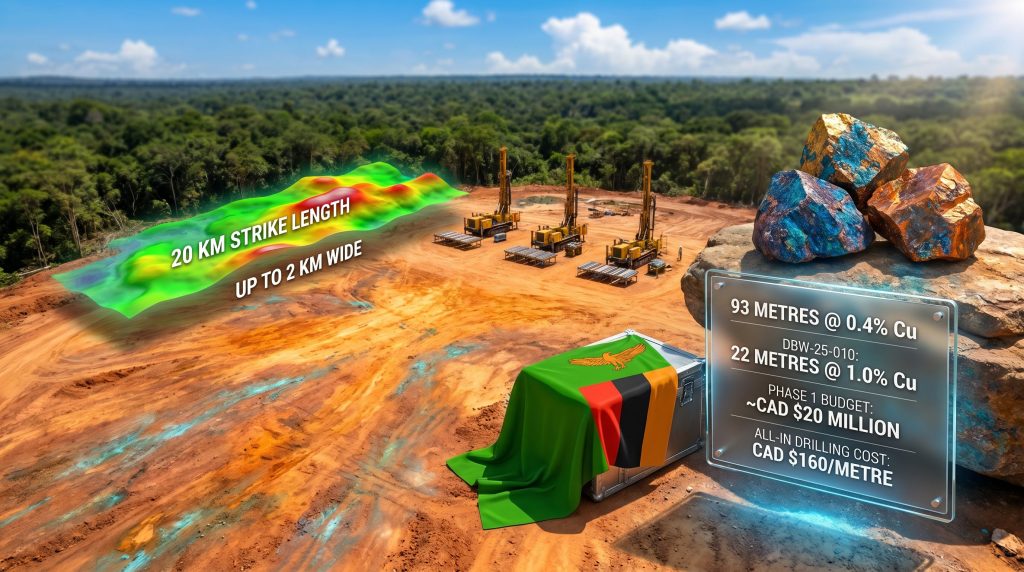
The Midnight Sun Mining Dumbwa copper discovery in Zambia is located within a district that already hosts several of Africa's largest producing copper mines. The project's defining surface expression is a copper-in-soil geochemical anomaly extending approximately 20 kilometres in strike length and up to 2 kilometres in width, a footprint that is exceptional by any exploration standard.
This anomaly was not identified through a single round of soil sampling. It was assembled through multiple generations of geochemical data collected by different exploration companies over an extended period. When that data was consolidated and interpreted holistically, it revealed a continuous, laterally persistent geochemical signature that demanded systematic follow-up drilling.
Soil copper values across the anomaly range from approximately 500 parts per million at lower-intensity sections up to a peak of 7,300 parts per million, with the highest values coinciding spatially with biological phenomena known as copper clearings. These are areas where surface copper concentrations are toxic to vegetation, leaving open expanses devoid of plant life within otherwise dense jungle, and they serve as some of the most compelling natural pathfinders for near-surface, high-grade copper mineralisation known in the Copperbelt context.
The comparison with Lumwana is not merely aspirational. Midnight Sun Mining shares the same deposit style, the same structural host, and the same district-scale geochemical expression as Lumwana. The key geologist behind Dumbwa's exploration program previously contributed to the transformation of Lumwana's defined resource from approximately 900 million tonnes to the current 1.6 billion tonne resource at around 0.5% copper.
| Parameter | Lumwana Mine (Barrick) | Dumbwa (Exploration Stage) |
|---|---|---|
| Deposit Style | Basement-dome hosted sulphide | Basement-dome hosted sulphide |
| Total Resource | Approximately 1.6 billion tonnes at 0.5% Cu | Resource estimate pending |
| Mine Life | 62+ years | Pre-resource |
| Depth Profile | Near-surface | Near-surface intercepts confirmed |
| Soil Anomaly Footprint | Large multi-kilometre system | 20 km strike, up to 2 km wide |
| Drilled Strike Defined | Fully delineated | 5.3 km confirmed to date |
How the Systematic Drilling Methodology Is Building a Defensible Dataset
One of the most operationally notable aspects of the Dumbwa program is its deliberate, methodical approach to drill planning. Rather than targeting the most visually prospective or geochemically intense zones first, the program commenced at the southern boundary of the anomaly and has been progressing northward, fence line by fence line.
The drill grid is structured as follows:
- Holes are spaced at 50-metre intervals across the strike of the system
- Fence lines are positioned at 100 to 200-metre intervals in the north-south direction
- Each completed fence informs the precise placement of the subsequent fence
- Visual mineralisation in core, including massive chalcopyrite and bornite, allows geologists to adjust fence placement without waiting for assay results
This approach prioritises data continuity over headline-chasing. It produces a drill dataset where every hole contributes to a spatially coherent, independently auditable picture of the system. This is exactly the kind of database that major mining companies and technical reviewers require when evaluating an asset for potential acquisition, joint venture, or resource certification.
Starting at the least promotional end of a deposit and working systematically toward areas of greater visual intensity is a methodology that prioritises long-term credibility over short-term market excitement. It is a discipline rarely seen in junior exploration and one that institutional capital tends to reward.
The program is supported by dipole-dipole induced polarisation (IP) geophysical surveys, which were used in early-stage drill targeting, though it has since become clear that the soil geochemistry is the single most reliable guide to subsurface mineralisation at Dumbwa. A near one-to-one correlation between surface geochem values and downhole copper grades has been observed consistently across the drilled portion of the system.
Operational productivity has been remarkable. Drilling continued through the Zambian rainy season at greater than 97% productivity, an achievement that reflects both the physical accessibility of the terrain and the quality of the on-ground drilling team. With roads already in place and flat topography across much of the tenure, drill moves are rapid and low-cost compared to the logistics challenges facing projects in more remote or mountainous jurisdictions.
The program is currently operating with four drill rigs, generating approximately 10,000 metres of drilling per month. Importantly, the assay delays that created a bottleneck earlier in the program have been resolved through a combination of internal QAQC remediation and a transition of pending samples to Intertech in Perth as a secondary laboratory.
Current Drill Results: What the Data Reveals About Dumbwa's Grade Profile
The simultaneous release of assay results from 99 drill holes represented one of the largest single-batch data releases seen from a junior explorer in recent memory. The volume alone signalled the scale of the program, but the geological content of the results provided the first comprehensive picture of what Dumbwa actually looks like as a copper system.
| Hole Reference | Intercept Length | Copper Grade | Significance |
|---|---|---|---|
| Selected key intercept | 93 metres | 0.4% Cu | Demonstrates system width and bulk-tonnage continuity |
| DBW-25-010 | 22 metres | 1.0% Cu | Higher-grade bornite-dominant zone within broader system |
| Additional intercept | 15 metres | 0.98% Cu | Confirms grade variability and higher-grade zonation |
When interpreting drill results of this nature, the 93-metre intercept at 0.4% copper is significant not because it represents exceptional grade by high-grade exploration standards, but because it demonstrates the width and lateral continuity that define economic bulk-tonnage mining targets.
It is worth noting that following the batch release, the company's share price experienced a sell-off of approximately 25%. Market participants accustomed to high-grade intercepts from vein-hosted or porphyry systems may have misread bulk-tonnage metrics. The appropriate comparator is not a narrow high-grade gold intercept but rather the grade profile of Lumwana itself. Lumwana operates economically at a cut-off grade of approximately 0.13% copper, well below what many retail investors might assume is the threshold for a viable copper mine.
In sediment-hosted Copperbelt systems, strip ratio, processing simplicity, and deposit scale determine economics more than any individual drill intercept grade. A 93-metre intersection of disseminated sulphides at 0.4% copper, sitting near surface in Zambia, is a compelling bulk-tonnage result when evaluated in its correct geological context.
Grade variability across the system follows the mineralisation zonation logic described earlier. Areas intersecting bornite-dominant core zones produce higher copper values, while sections affected by crosscutting faults or representing cooler, outer-margin mineralisation yield more moderate results. This pattern is consistent with Lumwana's own three-deposit structure, comprising the Chimiwungo, Malundwe, and Kamaranda zones, each with varying grade profiles that collectively define a world-class operation.
Copper Clearings as Exploration Pathfinders: A Phenomenon Unique to the Copperbelt
Among the lesser-known aspects of Copperbelt exploration is the role of copper clearings as natural discovery tools. These are areas where copper concentrations at the surface reach levels that are phytotoxic, meaning plants cannot survive. What results is a striking visual contrast: open, vegetation-free expanses surrounded by dense tropical bush or jungle.
At Dumbwa, copper clearings coincide with the highest geochemical values recorded across the entire anomaly footprint. Drilling is currently advancing into these clearing zones, which begin at approximately the 4.5 to 5-kilometre mark from the southern boundary and extend northward. These zones have not yet been fully penetrated by the systematic drill grid, meaning the geological information they may yield remains one of the more significant near-term unknowns in the program.
Given the one-to-one correlation that has already been established between surface geochemistry and subsurface mineralisation, the expectation within the exploration team is that drilling beneath the highest geochemical values should intersect some of the more mineralised portions of the system encountered to date. Furthermore, recent coverage from the Junior Mining Network confirms that the Dumbwa system remains open along strike, with drilling ongoing beyond the current 5.3-kilometre defined extent.
The next major ASX story will hit our subscribers first
The QAQC Process and Why Laboratory Integrity Matters
The delay in assay reporting that preceded the 99-hole batch release was a direct consequence of rigorous quality assurance and quality control protocols detecting anomalies in laboratory results. This is not a failure of exploration methodology. It is, paradoxically, evidence that the system is working as intended.
QAQC in exploration drilling works through the insertion of two types of reference materials into sample submission batches:
-
Certified reference standards: Pre-measured samples with known assay values, inserted at regular intervals to verify that the laboratory is returning results within acceptable tolerance of the true value.
-
Blanks: Inert material with no mineralisation, inserted to detect cross-contamination within the laboratory process.
When results from either type of reference material deviate beyond acceptable limits, the responsible course of action is to halt reporting, investigate the source of error, and remediate before releasing data. The alternative, releasing assay batches without resolving QAQC anomalies, would undermine the defensibility of the entire drill database.
Following remediation at the primary laboratory, pending samples have been redirected to Intertech in Perth as a secondary analytical facility, providing both a quality check and a pathway to accelerate data throughput. The outcome is a drill database that, while delayed in its release, can be relied upon by technical reviewers and potential acquirers examining the project.
Financial Structure of the Phase 1 Drill Program
The economic structure underpinning Dumbwa's Phase 1 program is one of the more favourable capital efficiency profiles available in the junior copper exploration space. Zambia's established mining infrastructure, accessible terrain, and competitive labour market contribute to an all-in drilling cost of CAD $160 per metre, inclusive of assaying. This is a materially lower cost per metre than comparable programs in more remote jurisdictions.
| Parameter | Detail |
|---|---|
| Phase 1 Strike Coverage | 11.2 kilometres (first half of total anomaly) |
| Phase 1 Budget | Approximately CAD $20 million |
| All-In Drilling Cost | CAD $160 per metre |
| Active Drill Rigs | 4 rigs operating |
| Monthly Drilling Rate | Approximately 10,000 metres |
| Projected Remaining Treasury (Post Phase 1) | Approximately CAD $15 million |
| Phase 1 Completion Target | End of Q3 2025 |
| Total Anomaly Strike Length | Approximately 20 kilometres |
| Phase 2 Coverage | Remaining 9 to 10 kilometres to the north |
The projected retention of approximately CAD $15 million in treasury following Phase 1 completion provides a meaningful runway for geochemical preparation of the northern anomaly, eastern fence line extension drilling, potential mineral resource estimation work, and early Phase 2 planning without immediate recourse to equity markets.
An important dimension of the financial picture is the role of the Kazeba oxide copper asset as a potential non-dilutive funding source.
The Kazeba Oxide Asset and Its Strategic Role in Corporate Funding
While Dumbwa represents the flagship growth asset, Midnight Sun Mining also holds the Kazeba oxide copper deposit, a distinctly different style of mineralisation that serves a complementary corporate purpose.
Kazeba hosts an indicated resource of 2.33 million tonnes at 1.41% copper, defined through more than 300 drill holes. The deposit is a near-surface oxide system, beginning at surface and extending to a maximum depth of approximately 30 metres, making it well-suited to low-capital processing routes such as solvent extraction-electrowinning (SX-EW) or heap leach.
| Parameter | Kazeba Oxide | Dumbwa Sulphide |
|---|---|---|
| Resource Status | Indicated resource defined | Pre-resource, exploration stage |
| Tonnage | 2.33 million tonnes | Bulk-tonnage target, TBD |
| Grade | 1.41% Cu | Variable, bulk-tonnage profile |
| Maximum Depth | 30 metres | Near-surface, flat-lying lenses |
| Drill Holes Completed | 300+ | 120+ and ongoing |
| Strategic Role | Monetisation and non-dilutive funding | Flagship growth asset |
| Processing Route | Oxide (SX-EW or heap leach) | Sulphide (flotation) |
The company's stated intention is to monetise Kazeba through a sale or partnership transaction, directing proceeds toward Dumbwa's ongoing exploration without diluting shareholders. Oxide copper deposits of this scale and grade attract a specific universe of acquirers, including established oxide copper producers already operating SX-EW circuits who can incorporate additional oxide feed into existing infrastructure without significant capital expenditure.
Eastern Extension Drilling and the Significance of Fence Line Adjustments
One of the more technically significant developments to emerge from the batch assay release is the recognition that several early fence lines were positioned slightly too far to the west. This was identified through the progressive understanding of the deposit's east-west mineralisation zonation as more drill data accumulated.
The implication is positive rather than concerning. The eastward extension of existing fence lines means the drill program is now capturing portions of the mineralised system that were missed in the initial grid pass. One of the four active rigs has been redeployed to execute these eastern extensions across much of the 4-kilometre section already drilled, with the expectation of adding additional width to the mineralised envelope and capturing higher-grade bornite zones that may sit toward the centre-east of the system.
This kind of iterative refinement is a normal and healthy feature of systematic exploration drilling. It reflects a program that is genuinely learning from each completed fence and adjusting accordingly, rather than mechanically executing a predetermined plan without incorporating new geological understanding.
Key Risks and Uncertainties Every Investor Should Understand
Dumbwa is an exploration-stage asset. No mineral resource estimate exists. No economic study has been completed. The following risks are material and should be weighed carefully alongside the geological opportunity:
-
Pre-resource status: There is no formal quantification of the copper endowment at Dumbwa. Scale and grade assumptions remain directional and analogical at this stage.
-
Grade variability: The bulk-tonnage nature of the system means grade is highly variable across the drill grid. Sections of lower-grade or economically marginal mineralisation are already evident and will continue to appear as drilling advances northward.
-
Cut-off grade sensitivity: The economic viability of a bulk-tonnage copper deposit is highly sensitive to the assumed cut-off grade. Strip ratio, processing recovery, copper price, and operating cost assumptions all interact to determine what material is classified as ore versus waste.
-
Further capital requirements: While the company holds an estimated CAD $15 million post-Phase 1, Phase 2 drilling of the remaining 9 to 10 kilometres of anomaly will require additional funding, which may involve equity issuance.
-
Laboratory and QAQC execution risk: While current QAQC processes appear resolved, the earlier delays underscore the ongoing operational risk of laboratory-dependent timelines in remote exploration programs.
-
No guarantee of geological analogy: Structural and geochemical similarities with Lumwana are scientifically supportable, but analogies do not guarantee equivalent economic outcomes.
Milestone Roadmap: What to Watch for Next
| Milestone | Expected Timing | Significance |
|---|---|---|
| Ongoing systematic drill result releases | Near-term, rolling basis | Confirms continuity and refines grade profile |
| Phase 1 drilling completion (11.2 km) | End of Q3 2025 | Defines first half of the total anomaly |
| Eastern fence line extension results | H2 2025 | Expands mineralised footprint to the east |
| Northern geochem resampling completion | H2 2025 | Informs Phase 2 drill targeting |
| Kazeba oxide asset transaction | Timing undisclosed | Non-dilutive funding pathway execution |
| Mineral resource estimate decision | Post Q3 2025 | First formal quantification of Dumbwa's copper endowment |
| Phase 2 drilling commencement | Late 2025 to 2026 | Covers remaining 9 to 10 kilometres of anomaly |
Frequently Asked Questions: Midnight Sun Mining and Dumbwa
What Is the Dumbwa Copper Project and Where Is It Located?
Dumbwa is a copper sulphide exploration project located in the Zambian section of the Congolese-Zambian Copperbelt, one of the world's premier copper districts. It is surrounded by several of Africa's largest operating copper mines.
How Large Is the Dumbwa Copper-in-Soil Anomaly?
The geochemical anomaly extends approximately 20 kilometres in strike length and up to 2 kilometres in width, with copper values ranging from 500 parts per million to a peak of 7,300 parts per million.
What Drill Results Has Midnight Sun Mining Reported at Dumbwa?
The most recent batch release covered 99 drill holes simultaneously. Headline results include a 93-metre intersection at 0.4% copper and higher-grade intervals of up to 1.0% copper over 22 metres.
How Does Dumbwa Compare to Barrick's Lumwana Mine?
Both deposits share the same geological style (basement-dome hosted sulphide), the same district, and similar surface geochemical expressions. The key geologist directing Dumbwa's exploration previously contributed to expanding Lumwana's resource from 900 million tonnes to 1.6 billion tonnes.
What Is a Copper Clearing and Why Is It Significant at Dumbwa?
A copper clearing is an area where surface copper concentrations are high enough to be toxic to vegetation, producing open, plant-free zones within dense bush. At Dumbwa, copper clearings coincide with peak geochemical values and are considered strong indicators of high-concentration mineralisation at depth.
Does Midnight Sun Mining Have a Mineral Resource Estimate for Dumbwa?
No. Dumbwa remains at the exploration stage. A decision on commissioning a mineral resource estimate is expected after Phase 1 drilling is completed at the end of Q3 2025.
What Is the Kazeba Oxide Copper Deposit and How Does It Relate to Dumbwa?
Kazeba is a separate, near-surface oxide copper deposit hosting an indicated resource of 2.33 million tonnes at 1.41% copper. The company intends to monetise Kazeba to fund Dumbwa's exploration without additional equity dilution.
What Are the Main Risks of Investing in an Exploration-Stage Copper Discovery?
Key risks include the absence of a mineral resource estimate, grade variability across the system, potential future capital raises, reliance on analogical rather than proven economics, and general commodity price exposure.
What Are the Next Key Catalysts for Midnight Sun Mining?
The primary catalyst is the systematic release of drill results as Phase 1 progresses northward. Eastern fence line extension results and any update on the Kazeba asset transaction are secondary near-term catalysts.
How Is Midnight Sun Mining Funded Through Its Phase 1 Drill Program?
Phase 1 is fully funded with an approximate budget of CAD $20 million, leaving an estimated CAD $15 million in treasury upon completion of the 11.2-kilometre Phase 1 strike coverage.
Bull Case vs. Bear Case: Assessing Dumbwa at This Stage of Exploration
| Factor | Bull Case | Bear Case |
|---|---|---|
| Anomaly Scale | 20 km strike is exceptionally rare at the exploration stage | Anomaly size alone does not guarantee a resource |
| Geological Analogy | Structurally identical to Lumwana, same district, same style | Analogies do not guarantee equivalent grade or economics |
| District Quality | Surrounded by Tier-1 producing operations | District proximity does not reduce project-specific risk |
| Capital Efficiency | CAD $160 per metre all-in is among the lowest in peer group | Low cost does not offset the risk of a below-threshold grade profile |
| Funding Position | Approximately CAD $15 million post-Phase 1 provides meaningful runway | Phase 2 and resource work will likely require additional capital |
| Resource Timeline | MRE decision possible post-Q3 2025, providing a valuation anchor | No resource estimate means no basis for formal economic assessment yet |
| Grade Profile | Bulk-tonnage systems can be highly economic at moderate grades with low strip ratios | Grade variability may include material below economic cut-off thresholds |
The Midnight Sun Mining Dumbwa copper discovery in Zambia sits at an inflection point between a compelling geological hypothesis, now partially validated through more than 5.3 kilometres of drilled strike length, and the significant work still required to convert that hypothesis into a formally defined, economically characterised copper deposit. The geological district is exceptional, the exploration methodology is unusually rigorous for a junior company, and the structural analogy with Lumwana provides a credible interpretive framework. At the same time, no resource exists, grade variability is real, and the economic case remains to be built.
This article is intended for informational purposes only and does not constitute financial advice. Investing in exploration-stage mining companies involves substantial risk, including the potential loss of the entire investment. Past geological analogies and historical deposit comparisons are not indicative of future results. Readers should conduct their own due diligence and consult a qualified financial adviser before making any investment decisions.
Want to Be First When the Next Major Copper Discovery Hits the ASX?
Discovery Alert's proprietary Discovery IQ model scans ASX announcements in real time, instantly identifying significant mineral discoveries across copper and more than 30 other commodities — visit the Discovery Alert discoveries page to understand how historic finds have generated substantial returns, and begin a 14-day free trial to position yourself ahead of the broader market.