June 25, 2026
Why Sedimentary Copper Systems Are Reshaping the Global Discovery Landscape
The copper mining industry has spent decades fixating on porphyry systems as the dominant source of new large-scale supply. Yet some of the most consequential discoveries of the past two decades have come from a different geological playbook entirely: sediment-hosted copper deposits, where mineralisation accumulates within ancient marine and fluvial sedimentary sequences rather than crystallising around intrusive bodies. These systems offer a distinct risk-reward profile, often featuring predictable stratigraphic targeting, high-grade intervals within defined sedimentary packages, and the potential for rapid tonnage accumulation when multiple mineralised horizons stack vertically within the same column.
It is within this context that the Marimaca Copper Pampa Medina drill results deserve careful attention. What began as a modest satellite oxide feed project has evolved, through systematic geological reinterpretation and a consolidated land position, into something that is generating serious discussion about independent resource-scale potential.
When big ASX news breaks, our subscribers know first
From Satellite Feed to Independent System: The Pampa Medina Thesis Evolves
Location, History, and the Geological Reset
Pampa Medina occupies a low-altitude position in Chile's coastal Atacama Desert, approximately 28 kilometres east of the Marimaca Oxide Deposit. Exploration activity at the site dates to 1993, when initial geochemistry surveys and shallow track-drill programmes were completed. Follow-up drilling programmes in 2007 and 2008 added further data, but neither phase fully tested the lower sedimentary units that subsequent geological modelling would identify as the most prospective targets.
The critical inflection came in 2024, when land consolidation across the project area enabled a revised geological model. That reinterpretation redirected drilling downward into Jurassic-Triassic sedimentary units comprising sandstones, conglomerates, tuffs, and black shales. These units sit within a stratigraphically defined column: overlain by andesitic volcanics and underlain by an Upper Palaeozoic metamorphic complex of older sediments, volcanics, and intrusions. This architecture creates a clearly bounded mineralised envelope, which is one of the structural prerequisites for a sediment-hosted copper system capable of building significant tonnage. For a broader view of the Chile copper outlook, the region's infrastructure and regulatory environment further strengthen the investment case.
What Makes Pampa Medina Architecturally Unusual
Manto-style sedimentary-hosted copper mineralisation differs fundamentally from porphyry and iron oxide copper-gold systems. Rather than forming around a hydrothermal intrusive source, manto copper deposits develop when copper-bearing brines migrate through permeable sedimentary units and precipitate mineralisation at redox boundaries, often within organic-rich or reducing horizons such as black shales.
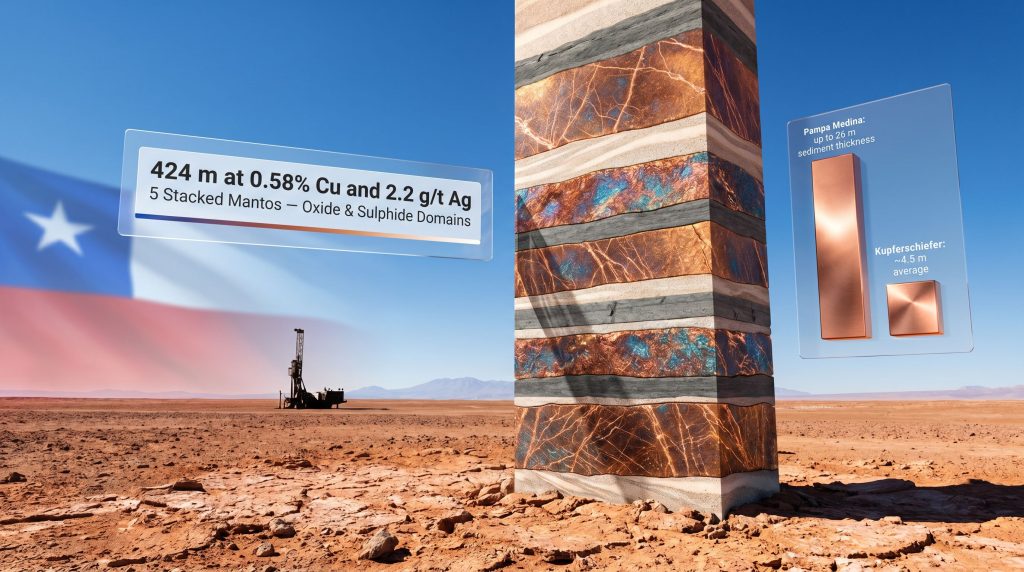
What distinguishes Pampa Medina from most conventional manto systems is the vertical stacking of multiple independently mineralised horizons within a single stratigraphic column. Where a typical manto system may offer one dominant mineralised layer, Pampa Medina has now confirmed five discrete mantos, each contributing independently to the tonnage argument. The mineralised sediment reaches up to 26 metres thick in some areas, nearly six times the approximately 4.5-metre average thickness associated with the Kupferschiefer system in Europe.
Critically, the system also exhibits dual-domain mineralisation: a near-surface oxide zone amenable to conventional heap-leach processing and a deeper sulphide zone dominated by leachable bornite and chalcocite. This combination provides both near-term development optionality and longer-term sulphide resource upside.
Dissecting the Standout Step-Out Hole: Five Mantos in One Column
The Headline Intercept in Full
The programme's standout step-out hole returned a 424-metre downhole intercept grading 0.58% copper and 2.2 g/t silver, commencing at 424 metres depth and drilled to a total depth of 904 metres. When interpreting drill results of this nature, it is important to note that true widths are estimated at 80 to 90% of reported downhole lengths, providing confidence that the intercept reflects genuine mineralised thickness rather than geometric artefact.
The hole was positioned as a 150-metre step-out between two previously released programme holes, meaning it fills a gap in the spatial framework rather than testing entirely new ground. The fact that the step-out returned grades and widths consistent with, and in places exceeding, earlier holes is geologically significant: it demonstrates continuity of the mineralised system rather than isolated high-grade pods.
The Five Stacked Mantos: A Horizon-by-Horizon Breakdown
The five mantos confirmed within the intercept span both oxide and sulphide domains and represent independently mineralised sedimentary units rather than subdivisions of a single body. Furthermore, understanding true widths vs apparent widths is essential context when evaluating the significance of these intercepts.
| Manto | Depth (from) | High-Grade Interval | Grade (Cu) | Grade (Ag) | Domain |
|---|---|---|---|---|---|
| 1 | 432 m | 32 m | 1.02% Cu | 3.1 g/t Ag | Oxide |
| 2 | 494 m | 8 m (within 22 m at 1.23% Cu) | 2.54% Cu | 21.0 g/t Ag | Oxide |
| 3 | 568 m | 12 m (within 22 m at 1.53% Cu) | 2.23% Cu | 19.7 g/t Ag | Oxide |
| 4 | 698 m | 10 m | 1.38% Cu | 4.4 g/t Ag | Sulphide |
| 5 | 752 m | 8 m | 1.29% Cu | 10.8 g/t Ag | Sulphide |
Key Insight: The architectural significance here is easy to underestimate. Each manto is independently mineralised, meaning each contributes its own width and grade to the cumulative intercept without relying on adjacent horizons. In a conventional single-horizon manto, tonnage depends entirely on lateral continuity. In a vertically stacked system, tonnage builds in two dimensions simultaneously, compressing the drill density required to establish resource-scale confidence.
Broader Programme Highlights: What Else Has Been Returned?
The standout step-out hole does not stand alone. Across the broader programme, other notable intercepts include:
- 40 m at 2.1% Cu within a wider mineralised envelope
- 38 m at 1.48% Cu from 540 m, sitting within a 198 m at 0.65% Cu interval
- 6 m at 11.98% Cu and 82.0 g/t Ag, representing one of the highest-grade individual intervals reported
- 18 m at 5.11% Cu and 53.4 g/t Ag in a dominantly bornite-mineralised section
- An earlier programme intercept of 6 m at 12.0% Cu within 26 m at 4.1% Cu
These results establish a coherent northeast-southwest structural spine extending approximately 2 kilometres southward from the original discovery hole, which Marimaca Copper's management has identified as a thick, high-grade centre zone that the current 150-metre infill programme is systematically testing.
How Pampa Medina Compares to the World's Major Sedimentary Copper Systems
The Kupferschiefer Benchmark
The Kupferschiefer is the reference standard for sediment-hosted copper in Europe, a system that has been mined for centuries across Germany and Poland and is characterised by laterally extensive but thin mineralised shale horizons averaging approximately 4.5 metres thick. By contrast, Pampa Medina's mineralised sediment reaches 26 metres in some areas, and management has stated that grades and widths returned in current drilling are exceeding Kupferschiefer deposits across every drill hole completed to date.
The comparison is not superficial. Both systems share analogous mineralising processes, reducing boundary precipitation, and similar primary sulphide assemblages dominated by bornite and chalcocite. The measurable difference lies in physical scale: sediment thickness, stacking geometry, and grade consistency.
Pampa Medina vs. Kamoa-Kakula: Where the Analogy Holds
| Attribute | Kamoa-Kakula | Kupferschiefer | Pampa Medina |
|---|---|---|---|
| System type | Sedimentary-hosted | Sedimentary-hosted | Sedimentary-hosted |
| Stacking geometry | Single dominant horizon | Thin, laterally extensive | Multiple stacked vertical horizons |
| Sediment thickness | Variable | ~4.5 m average | Up to 26 m |
| Mineralisation style | Chalcocite-dominant | Chalcocite/bornite | Bornite/chalcocite (sulphide) + oxide |
| Scale classification | Tier-1 (confirmed) | Tier-1 (confirmed) | Tier-1 (potential, unconfirmed) |
Kamoa-Kakula in the Democratic Republic of Congo has become the benchmark for what a Tier-1 sediment-hosted copper discovery looks like at full development scale. A Tier-1 copper deposit is broadly defined as a system capable of sustaining production of at least 100,000 tonnes of copper per year for a minimum of 20 years. Whether Pampa Medina meets that threshold remains the open question that the current drill campaign is designed to resolve.
It is worth noting that the Pampa Medina comparisons to these systems are based on measurable geological attributes and do not constitute a confirmed resource equivalence. Investors should treat Tier-1 classification as a potential threshold under active investigation, not a confirmed outcome.
Two Development Scenarios, One Economic Framework
Scenario A: Bulk-Tonnage Open Pit
If the broad 400-metre intercept envelope, grading approximately 0.5% copper, proves continuous across the full area of interest, the geological configuration would support a large-scale open-pit operation. Chile has established infrastructure, an experienced mining workforce, and well-developed permitting frameworks for large open-pit copper operations, which reduces the incremental capital burden relative to greenfield locations in less developed jurisdictions.
Scenario B: High-Grade Underground Operation
Where grade selectivity is available through targeting only the highest-grade manto horizons within the stacked sequence, a 20 to 50-metre underground mining horizon becomes an economically viable alternative. This configuration would reduce ore tonnes mined while concentrating on the highest-value intervals, improving head grades delivered to the processing plant.
Management's position is that the sediment-hosted stacking geometry delivers competitive unit economics under either scenario, and that resolving which path is optimal does not need to happen before the maiden resource estimate is completed. The economic logic rests on the fundamental cost competitiveness of sediment-hosted systems compared to equivalent-scale porphyry operations, which typically carry higher strip ratios, lower average grades, and more complex metallurgical profiles.
Silver as an Underappreciated Value Layer
One dimension of the Pampa Medina project that receives less attention than copper grades is the silver co-product potential. Silver mineralisation is broadly correlated with copper across the system, with certain horizons returning silver grades that would be economically meaningful even as a by-product credit in isolation.
Key silver intervals identified to date include:
- 82.0 g/t Ag over 6 metres, coincident with the highest-grade copper interval
- 53.4 g/t Ag over 18 metres within a high-grade bornite zone
- 21.0 g/t Ag within the second manto of the standout step-out hole
- 19.7 g/t Ag within the third manto of the same hole
At feasibility stage, silver by-product credits can meaningfully reduce the net cost per pound of copper produced, improving project economics and widening the range of copper price scenarios under which a project remains viable.
The next major ASX story will hit our subscribers first
Programme Status and the Path to a Maiden Resource
Where the Drill Campaign Stands
The current programme parameters are well-defined:
- Total programme scope: 30,000 to 35,000 metres
- Area of interest: 3 km x 1.5 km (core); broader mineralised horizon interpreted across approximately 5 km x 4 km
- Current drill spacing: 150 metres (infill phase, down from initial 300-metre scout spacing)
- Programme conclusion target: September 2026
- True width estimation: 80 to 90% of reported downhole lengths
Core-cutting delays that previously affected result release cadence have been resolved, and the infill phase is expected to generate a more consistent flow of results as the September target approaches. Regional step-out drilling to test northern and western extensions identified in geophysical work is also planned alongside the main infill campaign, meaning the currently drilled 3 x 1.5 km area of interest may not represent the full system boundary.
The Maiden Resource: What It Will and Will Not Represent
A maiden inferred resource estimate, based on 150-metre drill spacing, is targeted approximately six to seven months after the September 2026 programme conclusion, placing first resource delivery in H1 2027. Under NI 43-101 and JORC-equivalent classification frameworks, 150-metre spacing typically meets the threshold for an inferred resource category.
Management has been explicit that the maiden resource will represent only a partial snapshot of the mineralisation delineated to date, not a full system capture. This is an important distinction for investors: the first resource figure will be an entry-point number, establishing a quantified foundation that institutional-level project evaluation requires. The gap between that figure and the full extent of the known system represents both geological upside and the inherent uncertainty of pre-resource copper exploration.
The Two-Stage Production Strategy: Oxide First, Sulphide Later
Any oxide resource confirmed at Pampa Medina is intended to be developed ahead of the sulphide opportunity, with the specific objective of expanding the Marimaca Oxide Deposit's cathode output from 50,000 tpa to 75,000 tpa. That expanded oxide production provides two things simultaneously: operational cash flow and the runway needed to continue fully delineating the deeper sulphide system before committing to a development pathway.
This sequencing is both technically rational, since oxide processing via heap leach is less capital-intensive and faster to construct than sulphide concentrator circuits, and financially prudent, as it avoids requiring a sulphide development decision before the system's full scale is understood.
Key Data Summary: Pampa Medina at a Glance
| Parameter | Detail |
|---|---|
| Programme scope | 30,000 to 35,000 m |
| Area of interest | 3 km x 1.5 km (core); ~5 km x 4 km interpreted |
| Current drill spacing | 150 m (infill phase) |
| Programme end target | September 2026 |
| Headline intercept | 424 m at 0.58% Cu, 2.2 g/t Ag (from 424 m) |
| True width estimate | 80 to 90% of downhole lengths |
| Stacked mantos confirmed | 5 (oxide and sulphide domains) |
| Peak manto grade | 8 m at 2.54% Cu, 21.0 g/t Ag |
| Sediment thickness (max) | 26 m (vs. ~4.5 m Kupferschiefer average) |
| Maiden resource target | H1 2027 (inferred, 150 m spacing basis) |
| Oxide production expansion target | 50,000 tpa to 75,000 tpa |
What the Pampa Medina Results Mean for the Copper Supply Outlook
Chile remains the world's largest copper-producing nation, accounting for roughly 27% of global mine supply. Within that context, a new manto-style discovery within established mining infrastructure corridors carries amplified strategic significance. The broader copper supply crunch elevates the importance of new mine development, with forecasts pointing to a 330,000-tonne copper supply deficit at precisely the stage when long-lead exploration projects are converting into quantified resources.
For investors, the Marimaca Copper Pampa Medina drill results represent a system that is advancing through the most value-generative phase of the exploration-to-development transition. Maiden resource estimates function as the first institutional-grade valuation anchor for pre-resource copper projects, and the gap between current drilling and what the first resource will formally capture is where speculative upside is most concentrated and most uncertain simultaneously.
Sediment-hosted copper systems have historically been valued at inferred resource stage on a contained-metal basis, with premiums applied where grade, geometry, and processing simplicity compare favourably to porphyry alternatives of equivalent scale. Furthermore, the copper price growth drivers underpinning current market conditions add an additional layer of strategic relevance to the Pampa Medina thesis. Whether Pampa Medina ultimately satisfies the criteria for Tier-1 classification remains to be confirmed through the resource estimate process.
Disclaimer: This article is intended for informational purposes only and does not constitute financial advice. Forward-looking statements, exploration targets, and Tier-1 classification references reflect management's stated views and geological interpretations, which remain subject to confirmation through ongoing drilling and resource estimation. Investors should conduct independent due diligence before making investment decisions. Past exploration results are not a guarantee of future resource outcomes.
Frequently Asked Questions: Marimaca Copper Pampa Medina Drill Results
What is the best drill intercept reported at Pampa Medina?
The standout step-out hole returned 424 m at 0.58% Cu and 2.2 g/t Ag from 424 m depth, containing five discrete high-grade mantos. The highest-grade individual manto within that hole returned 8 m at 2.54% Cu and 21.0 g/t Ag within a 22-metre interval grading 1.23% Cu. Earlier programme intercepts include 6 m at 12.0% Cu within 26 m at 4.1% Cu in dominantly bornite mineralisation.
What does stacked mantos mean in geological terms?
Multiple independently mineralised sedimentary horizons occurring at different depths within the same stratigraphic column, each contributing separately to the total mineralised thickness and grade. The key distinction from a single thick mineralised zone is that each horizon formed independently and retains independent geological continuity.
When will the maiden resource estimate for Pampa Medina be released?
A maiden inferred resource is targeted approximately six to seven months after the September 2026 programme conclusion, placing delivery in H1 2027.
How does Pampa Medina compare to the Marimaca Oxide Deposit?
The Marimaca Oxide Deposit holds Proved and Probable Reserves of 179 Mt at 0.42% total copper, supporting a 50,000 tpa cathode operation over 13 years. Pampa Medina is at an earlier exploration stage but is being evaluated for independent resource-scale potential that could materially exceed its original role as a supplementary oxide feed source.
Is there silver production potential at Pampa Medina?
Yes. Silver mineralisation is broadly correlated with copper across the system, with individual intervals returning up to 82.0 g/t Ag, providing potential by-product credits that could improve project economics at the feasibility stage. In addition, the Pampa Medina project overview provides further geological context for how silver mineralisation correlates with the copper-bearing horizons identified to date.
Want to Track the Next Major Copper Discovery the Moment It Hits the ASX?
Discovery Alert's proprietary Discovery IQ model delivers real-time alerts on significant ASX mineral discoveries — instantly converting complex geological data into actionable investment insights for both short-term traders and long-term investors. Explore how historic mineral discoveries have generated substantial returns and begin your 14-day free trial today to position yourself ahead of the broader market.