July 10, 2026
Australia's East Coast Gas Market Sits at a Crossroads
Tight gas has long occupied an awkward position in Australia's domestic energy conversation. Technically recoverable but commercially challenging, laterally extensive but difficult to flow without the right combination of horizontal drilling and hydraulic fracture stimulation, it has represented an enormous theoretical resource base that the industry has historically struggled to monetise at scale. That calculus is now shifting, and the Denison Gas Baffle Creek discovery is among the clearest illustrations of why.
The east coast gas market has been under structural pressure for more than a decade. The commissioning of large-scale LNG export terminals in Queensland redirected significant volumes of domestic gas toward international buyers, tightening the supply pipeline for industrial users who depend on contracted gas for continuous manufacturing operations. Legacy fields in the Cooper and Surat basins have matured, with natural field decline compressing available volumes without substantial new investment. The result is a market where supply adequacy has become a persistent concern rather than a background assumption.
Against this backdrop, new onshore discoveries of material scale carry weight that extends well beyond the individual company making the announcement. Furthermore, they signal potential rebalancing in a market that has grown increasingly dependent on a narrowing set of producing assets. Understanding the LNG supply outlook helps contextualise just how significant a domestic find of this nature truly is.
When big ASX news breaks, our subscribers know first
What the Denison Gas Baffle Creek Discovery Actually Represents
Geology, Geography, and the Denison Trough Advantage
The Baffle Creek field sits within the Denison Trough, a sedimentary sub-basin in Central Queensland that is geologically related to but distinct from the broader Bowen Basin system. The host formation is the Reids Dome beds, a sequence of deep sandstone units charged with gas and, critically, with liquid hydrocarbons that give the reservoir its condensate-rich character.
The Denison Trough has historically received less exploration attention than the Surat or Cooper basins, partly because its tight sandstone reservoirs were considered technically demanding relative to the conventional and coal seam gas targets that attracted capital elsewhere. That relative neglect, however, created a genuine opportunity. Modern seismic interpretation techniques and advances in horizontal well construction have changed the economic threshold for tight gas development, making previously uneconomic formations viable targets for sustained production.
Breaking Down the Resource Numbers
| Discovery Attribute | Detail |
|---|---|
| Field Name | Baffle Creek Field |
| Geological Formation | Reids Dome Beds, Denison Trough |
| Resource Type | Tight Gas (Liquids-Rich / Gas Condensate) |
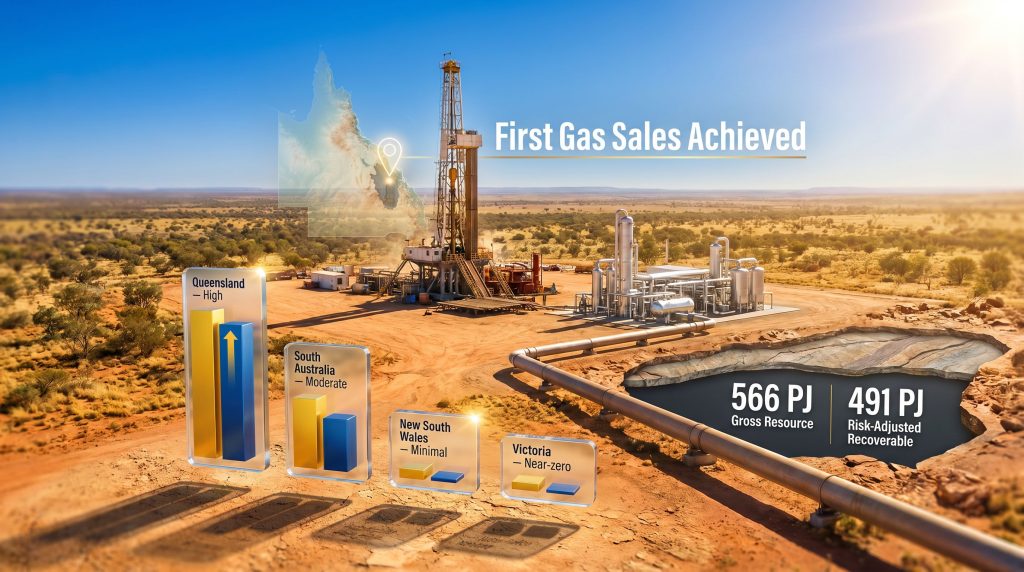
| Risk-Adjusted Recoverable Resource | 491 petajoules (PJ) |
| Gross Resource Assessment | 566 petajoules (PJ) |
| Exploration Program | Four-well program, ATP 2060 |
| Key Well | Baffle Creek 7 (horizontal tight gas well) |
| Production Status | First gas sales achieved; long-term production testing underway |
| Delivery Infrastructure | Connected to Queensland Gas Pipeline (QGP) via Yellowbank gas plant |
The distinction between the 566 PJ gross figure and the 491 PJ risk-adjusted recoverable resource is not merely technical housekeeping. In petroleum exploration, risk-adjusted recoverable resources account for geological uncertainty, reservoir connectivity, and recovery factor assumptions. A high risk-adjusted figure relative to the gross assessment signals strong confidence in the resource's deliverability, which has direct implications for project financing and the negotiation of long-term offtake agreements.
According to Denison Gas Executive Chairman Dr Xingjin Wang, a volume of 566 petajoules is sufficient to power every Queensland household for approximately five years, and critically, gas from the field is already flowing to industrial users on the east coast.
Tight Gas vs. Conventional Gas vs. Coal Seam Gas: Why the Distinction Matters
Understanding what makes a tight gas reservoir different from conventional gas or coal seam gas (CSG) is essential for contextualising the significance of this find:
- Conventional gas accumulates in porous reservoir rocks with high natural permeability, allowing gas to flow freely to a well without significant intervention.
- Coal seam gas (CSG) is adsorbed onto coal matrix surfaces and released by reducing reservoir pressure through water extraction, a process that generates large volumes of produced water requiring management.
- Tight gas is trapped within low-permeability sandstone or carbonate formations. The gas is present in commercial volumes, but the reservoir matrix will not release it without mechanical intervention — specifically horizontal drilling combined with hydraulic fracture stimulation to create flow pathways.
The liquids-rich character of the Baffle Creek reservoir adds a further commercial dimension. Gas condensate commands pricing linked to crude oil benchmarks rather than domestic gas tariffs. Reviewing the crude oil market overview illustrates why this dual revenue stream — pipeline gas plus condensate sales — materially improves field economics compared to a dry gas discovery of equivalent size.
How a Four-Well Program Changed the Picture
The ATP 2060 Exploration Sequence
Denison Gas completed a four-well exploration program under ATP 2060 that systematically derisked the Baffle Creek play across a laterally extensive area. The program's value was not simply in confirming gas presence, which had been suspected from earlier data, but in demonstrating that the resource was consistent across the structural extent of the play rather than confined to isolated pockets.
The Baffle Creek 7 well represents the technical centrepiece of the program, having been completed as one of Queensland's longest tight gas horizontal wells. Horizontal drilling through tight sandstone formations dramatically increases the contact area between the wellbore and the reservoir compared to a vertical well. Fracture stimulation of Baffle Creek 7 is scheduled for the third quarter of 2026, a step that will provide the clearest indication yet of sustained production rates from the formation.
Applying Modern Technology to Overlooked Data
Emeritus Professor Andrew Garnett of the University of Queensland's Gas and Energy Transition Research Centre has noted that the oil and gas industry holds numerous examples where reanalysis of existing subsurface data using contemporary interpretation methods has revealed significant resources that earlier assessment frameworks missed. His view is that when technological innovation is paired with a commercially committed operator and a supportive regulatory environment, the pathway from overlooked data to producing asset can compress substantially.
This observation carries particular weight for the Denison Trough. The basin has been drilled before. Older vertical wells encountered the Reids Dome beds but were not designed to evaluate tight sandstone targets systematically. The seismic dataset, reprocessed and reinterpreted through modern workflows, revealed a laterally continuous reservoir system that the original exploration paradigm had not been equipped to recognise.
Infrastructure Proximity: The Hidden Competitive Advantage
One of the least discussed but most commercially significant aspects of the Denison Gas Baffle Creek discovery is its geographic relationship to existing midstream infrastructure. The field sits east of the Yellowbank gas plant, providing direct connectivity to the Queensland Gas Pipeline. For most tight gas discoveries of comparable scale, the pathway from exploration confirmation to first commercial gas sales involves years of pipeline construction and compression facility development.
At Baffle Creek, however, that infrastructure already exists. Consequently, the development timeline appears genuinely anomalous by industry standards. First gas sales have already been achieved during the production testing phase — a milestone that typically follows years of development activity rather than preceding the completion of the well stimulation programme.
Queensland's Policy Architecture and the Inter-State Gas Divide
A Fragmented National Approach to Onshore Gas
The Denison Gas Baffle Creek discovery does not exist in a policy vacuum. It emerges from a regulatory environment that has diverged sharply across Australian states over the past decade, with consequences now playing out through supply adequacy and domestic gas pricing dynamics. Monitoring natural gas price trends reveals just how acutely these policy differences are being felt at a market level.
| Jurisdiction | Onshore Gas Policy Stance | Domestic Supply Contribution | Exploration Activity Level |
|---|---|---|---|
| Queensland | Pro-development; active exploration framework | High, primary east coast supplier | High |
| New South Wales | Restricted; limited new exploration approvals | Low | Minimal |
| Victoria | Moratorium on onshore unconventional gas | Negligible | Near-zero |
| South Australia | Conditionally open | Moderate | Moderate |
Queensland Natural Resources and Mines Minister Dale Last has been direct in characterising this imbalance, noting that Queensland is effectively functioning as the primary supply engine for the entire east coast gas network while other jurisdictions decline to develop their own onshore resources. His framing of the Baffle Creek discovery as potentially replicating the Surat Basin's transformation into a major gas production province reflects a genuine strategic ambition rather than purely rhetorical positioning.
Three Scenarios for the East Coast Market
The forward trajectory for the east coast gas market depends significantly on whether the current policy divergence persists or narrows:
- Status Quo Continuation: Queensland discoveries including Baffle Creek absorb growing demand, but the concentration of supply in a single jurisdiction increases systemic risk for the national market.
- Policy Reversal in Southern States: Renewed exploration in NSW and Victoria adds supply diversity, reducing Queensland's disproportionate burden while improving national energy security.
- Accelerated Electrification: Faster-than-expected renewable deployment reduces residential and some industrial gas demand, but peaking requirements and hard-to-abate industrial processes sustain a structural floor for domestic gas well beyond current planning horizons.
None of these scenarios eliminates the commercial significance of the Baffle Creek resource. Even under an aggressive electrification trajectory, the east coast industrial gas market is expected to require substantial domestic supply for decades. The broader commodity outlook 2025 underscores that domestic energy resources remain central to Australia's long-term industrial competitiveness.
The Surat Basin Parallel and What It Would Take to Repeat It
The Surat Basin's emergence as Australia's dominant CSG-to-LNG production province required the convergence of geological confirmation, infrastructure investment, workforce development, and a sustained regulatory framework giving project developers sufficient certainty to commit capital over multi-decade horizons. Minister Last's suggestion that the Denison Trough could follow a comparable trajectory is speculative at this stage, but it is not without geological foundation.
Local member Ann Leahy has pointed to the Maranoa region's historical identity as the birthplace of Australian natural gas production, and to the region's existing workforce capability as an asset that could support accelerated development. The skilled labour and institutional knowledge accumulated through decades of Surat Basin activity represent genuine enablers for a Denison Trough expansion, provided the resource base continues to be derisked through additional exploration and production testing.
Frequently Asked Questions: Denison Gas Baffle Creek Discovery
What is the Denison Gas Baffle Creek discovery?
The Denison Gas Baffle Creek discovery is a major onshore tight gas find located in the Baffle Creek field within the Denison Trough of Central Queensland. The resource has been assessed at 566 PJ gross and 491 PJ on a risk-adjusted recoverable basis, making it one of the largest onshore east coast gas discoveries in at least a decade. First gas sales have already been achieved, with long-term production testing currently underway.
Where exactly is the Baffle Creek field located?
The Baffle Creek field is situated in the Denison Trough, a sedimentary sub-basin in Central Queensland that forms part of the broader Bowen Basin geological system. It lies east of the Yellowbank gas plant and has direct pipeline access to the Queensland Gas Pipeline.
How does tight gas differ from conventional gas and coal seam gas?
Tight gas is contained in low-permeability sandstone formations and requires horizontal drilling and hydraulic fracture stimulation to flow commercially. Conventional gas flows naturally from porous reservoir rocks, while coal seam gas is released from coal matrix by depressurisation through water extraction. Tight gas typically carries a higher development cost but can be highly commercial where infrastructure proximity reduces midstream investment requirements.
Is the Baffle Creek gas field already producing?
Yes. First gas sales from the Baffle Creek field have been confirmed, with gas already being delivered to industrial manufacturers on the east coast via the Queensland Gas Pipeline. Long-term production testing is ongoing, and fracture stimulation of the Baffle Creek 7 horizontal well is scheduled for the third quarter of 2026.
What is the significance of 491 PJ versus 566 PJ in resource reporting?
The 566 PJ figure represents the gross resource assessment — the total estimated gas volume in place before applying recovery and geological confidence adjustments. The 491 PJ risk-adjusted recoverable resource reflects the volume the company expects to produce after accounting for reservoir uncertainty and recovery efficiency. A high ratio between these two figures indicates strong geological confidence in the resource's deliverability.
The next major ASX story will hit our subscribers first
Supply Chain and Investment Implications
Who Benefits First from Baffle Creek Gas?
The immediate commercial beneficiaries of the Baffle Creek discovery are industrial gas users on the east coast, particularly manufacturers for whom gas is both a fuel source and a chemical feedstock. The liquids-rich nature of the reservoir creates an additional condensate revenue stream that supports project economics independently of the pipeline gas price, providing commercial resilience if domestic prices soften as new supply enters the market.
In addition, the speed of commercialisation at Baffle Creek carries implications for how domestic gas pricing behaves in the near term. New supply reaching the market ahead of expectations can moderate the price premium that tight markets generate, though the quantum of Baffle Creek's contribution relative to total east coast demand means any pricing impact will be gradual rather than immediate.
Energy Security as a Structural Imperative
At a national level, discoveries of this scale contribute to Australia's medium-term energy security framework by demonstrating that the domestic resource base remains capable of delivering material new supply through exploration. The Denison Gas Baffle Creek discovery is therefore not merely a company-level milestone — it is a data point in the broader story of Australia's energy exports and the domestic supply challenge that underpins them.
Additional wells within ATP 2060 and adjacent permit areas will be the primary mechanism for answering whether the Baffle Creek discovery represents an isolated find or the leading edge of a more extensive play. The geological conditions that made Baffle Creek commercially viable — the Reids Dome beds' lateral continuity and the presence of a liquids-rich gas system — are not confined to the immediate area already drilled. Whether those conditions persist at sufficient quality across a larger area to support a scaled production hub remains the central unanswered question for the Denison Trough's longer-term potential.
Disclaimer: This article is intended for informational purposes only and does not constitute financial or investment advice. Readers should conduct their own due diligence and consult a licensed financial adviser before making any investment decisions. Resource estimates and forward-looking statements are subject to geological uncertainty and should not be relied upon as guarantees of future outcomes.
Want to Track the Next Major Australian Gas Discovery Before the Market Moves?
Discovery Alert's proprietary Discovery IQ model scans ASX announcements in real time, instantly alerting subscribers to significant mineral and energy discoveries — explore the historic returns major discoveries have delivered to understand the opportunity, then begin your 14-day free trial at Discovery Alert to position yourself ahead of the broader market.