August 5, 2026
When a Second Corridor Changes Everything: Understanding the Paladin Energy Atlas Uranium Discovery
The history of Athabasca Basin uranium exploration is largely a story of structural corridors revealing themselves incrementally. Discoveries that begin as narrow, high-grade intercepts in a single drillhole routinely evolve into basin-defining resource systems over successive campaigns. The world's most productive uranium jurisdiction has taught investors one consistent lesson: the first hole rarely tells the full story, and the real value often lies in what the structural geology implies about continuity at depth and along strike.
That context matters when evaluating the Paladin Energy Atlas uranium discovery at the Patterson Lake South project in Saskatchewan, Canada. This is not simply a positive drill result to be filed alongside quarterly production updates. It represents a structural shift in how the PLS land package should be evaluated, introducing a second mineralised corridor that, if it develops along basin precedent, could materially alter the long-term resource thesis for one of Canada's most closely watched pre-development uranium assets.
When big ASX news breaks, our subscribers know first
What Is the Atlas Discovery and Where Does It Sit Within PLS?
Geology, Location, and Structural Setting
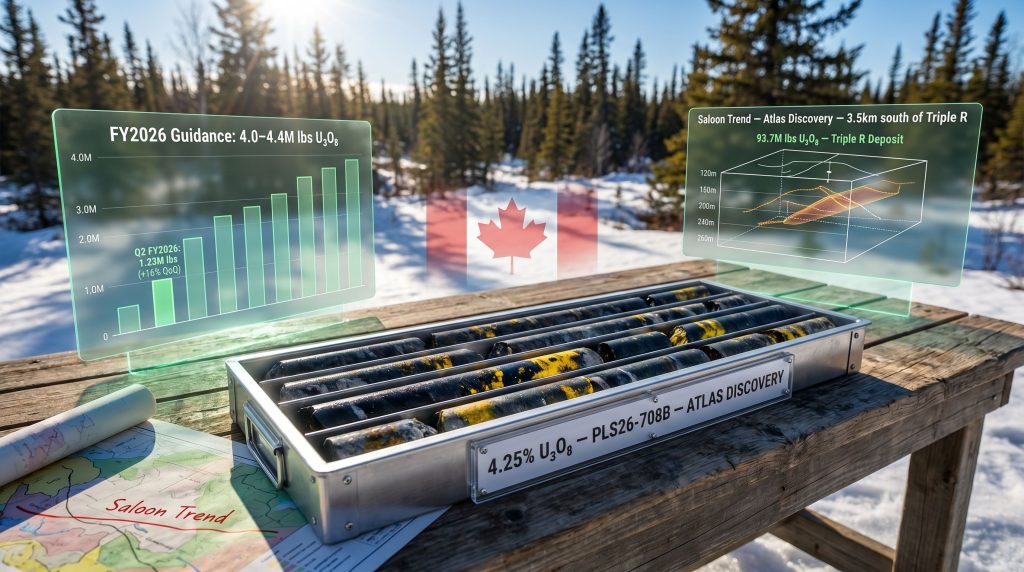
Atlas is a newly identified uranium mineralisation zone situated approximately 3.5 kilometres south of the Triple R deposit within the Patterson Lake South project. The mineralisation is hosted within steeply dipping shear zones at depths ranging from roughly 120 metres to 260 metres below surface, a depth profile that is considered shallow by Athabasca Basin standards and broadly supportive of lower-cost mining scenarios.
The discovery sits along what geologists have designated the Saloon Trend, a district-scale structural corridor that has now been validated across multiple drillholes as a genuine multi-target system rather than a localised anomaly. Critically, Atlas shares the same high-grade geological architecture as Triple R, namely basement-hosted shear zone mineralisation with steep dip geometries that concentrate uranium into economically meaningful intervals.
PLS Project Asset Summary
| Project Asset | Location | Resource Scale | Current Status |
|---|---|---|---|
| Triple R Deposit (PLS) | Athabasca Basin, Canada | 93.7M lbs U₃O₈ at 1.41% grade | Pre-development; EIS judicial review ongoing |
| Atlas Discovery (PLS) | 3.5km south of Triple R | Open along strike and at depth | Active drilling; assays pending |
| Langer Heinrich Mine | Namibia | Major operating uranium mine | Producing; restarted late 2024 |
| Manyingee Project | Western Australia | ~8,000 tonnes U (in-situ leach) | Early-stage; rights negotiations |
One detail that is not widely appreciated outside technical circles is the significance of shear zone hosting in Athabasca-style deposits. Unlike unconformity-proximal mineralisation, which sits at the boundary between the sedimentary basin and underlying basement rocks, basement-hosted shear zone deposits like Triple R and Atlas can extend considerable distances into the underlying crystalline basement. This means the resource geometry is fundamentally three-dimensional, and shallow intercepts in early-stage drilling frequently understate total endowment.
Why Does 4.25% U₃O₈ Actually Matter? Understanding Grade in Context
Global Uranium Benchmarks and Why Athabasca Operates on a Different Scale
To appreciate why the Paladin Energy Atlas uranium discovery headline grades are significant, it helps to understand where most uranium sits on the global grade spectrum. The overwhelming majority of operating uranium mines worldwide produce ore grading below 0.1% U₃O₈, with many in-situ recovery operations processing mineralisation at concentrations closer to 0.05%. Even the better conventional deposits outside Canada rarely exceed 0.5%.
The Athabasca Basin operates in a different dimension entirely. Triple R's resource grade of 1.41% U₃O₈ is already among the largest uranium mines in the world for grade at this scale. When Atlas returns a 3.0 metre interval grading 4.25% U₃O₈ within a broader 8.0 metre intersection averaging 1.75%, the result is genuinely high-grade even relative to the basin's elevated benchmarks.
Why Grade Is an Economic Multiplier: Grade does not merely determine how much uranium sits in the ground. It directly shapes the economics of extraction. Higher-grade ore requires processing smaller volumes of material per pound of uranium recovered, which compresses operating costs per pound produced. At Athabasca grades, the cost structure is fundamentally different from that of lower-grade jurisdictions, which is precisely why the basin commands premium valuations relative to resource base alone.
Drill Results Summary: Key Atlas Intercepts
| Drillhole | Interval (m) | Grade (% U₃O₈) | Depth (m) | Significance |
|---|---|---|---|---|
| PLS26-708B | 8.0m | 1.75% (avg) | ~190m | Flagship intercept; contains high-grade sub-interval |
| PLS26-708B (sub-interval) | 3.0m | 4.25% | ~190m | Highest-grade result from Atlas program |
| PLS26-718 | 5.5m | 2.86% | TBC | Confirms multi-hole grade consistency |
| Saloon East holes | 2,759m total | Assays pending | TBC | Eight holes; results at Saskatchewan Research Council laboratory |
Seven of eight drillholes intersected significant uranium mineralisation across 2,408 metres of drilling during the 2026 winter program. The 87.5% hit rate across the program is a statistically meaningful indicator of structural continuity rather than isolated grade pods, which is the critical differentiator between a genuine discovery and a statistical outlier.
How Atlas Reshapes the PLS Resource Thesis
From Single Deposit to District-Scale System
Prior to the Atlas result, the investment framework for PLS rested almost exclusively on Triple R's 93.7 million pound resource base and the timeline to production commencement. Atlas introduces a second mineralised corridor on the same land package, fundamentally shifting the analytical frame from single-deposit development to district-scale resource aggregation.
This distinction carries real valuation implications. Single-deposit development projects are priced on their ability to deliver one mine economically. District-scale systems, where multiple high-grade bodies share geological architecture on a common land package, attract different valuation methodologies, including resource optionality premiums that reflect the potential for sequential or parallel mine development over a longer operational horizon. Furthermore, understanding uranium investment strategies helps contextualise why this structural shift matters to sophisticated resource investors.
Three Scenario Pathways for Atlas Resource Development
Scenario 1: Conservative (Atlas as Satellite Deposit)
- Atlas drilling defines a modest standalone resource of 5 to 15 million pounds U₃O₈
- Adds incremental value to PLS but does not materially alter mine planning or sequencing
- Market assigns limited re-rating premium until EIS resolution provides development certainty
Scenario 2: Base Case (Atlas as Tier-2 PLS Corridor)
- Continued step-out drilling extends Atlas along strike and at depth into a 20 to 40 million pound resource
- PLS total resource base approaches or exceeds 130 million pounds U₃O₈
- Strengthens the district-scale thesis and supports a modest valuation re-rate independent of permitting timeline
Scenario 3: Bull Case (Atlas as Triple R Parallel)
- Atlas mineralisation connects with or mirrors Triple R's structural system at depth along the Saloon Trend
- Combined PLS resource potentially exceeds 150 million pounds U₃O₈
- Transforms PLS from a single Tier-1 deposit into a multi-deposit uranium district, a structural re-rating trigger that would demand a material premium
The Variable That Determines Which Scenario Plays Out: The open-along-strike geometry reported in current drilling is the critical differentiator between Scenario 1 and Scenario 3. Each successive drill campaign narrows the probability range between these outcomes. Investors pricing PDN today are implicitly making a bet on where Atlas ultimately lands.
The EIS Judicial Review: Regulatory Overhang and How Atlas Modifies the Risk Framework
Understanding the Métis Nation of Saskatchewan Legal Challenge
The Environmental Impact Statement approval for PLS development is subject to a judicial review initiated by the Métis Nation of Saskatchewan. This legal process introduces timeline uncertainty for construction commencement and first production at PLS, and it has been a persistent overhang on the stock's ability to fully reflect the project's resource value.
A less commonly discussed aspect of this situation is the distinction between exploration permitting and development permitting in Saskatchewan's regulatory framework. Exploration drilling at PLS operates under a separate permitting structure from mine development approvals. The judicial review therefore affects the development timeline but does not constrain the ongoing drilling program's ability to generate news flow and expand the resource base.
How Atlas Modifies the Risk-Reward Profile Under Regulatory Uncertainty
| Risk Factor | PLS Without Atlas | PLS With Atlas |
|---|---|---|
| Single point of failure | EIS resolution dictates near-term value entirely | Resource growth continues independent of EIS timeline |
| Newsflow between catalysts | Limited without major drill program | Continuous through summer 2026 program |
| Downside scenario | EIS delay compresses valuation directly | Larger resource base provides partial valuation buffer |
| Upside scenario | Triple R development alone | District-scale system commands premium methodology |
Critical Investor Consideration: Exploration results, regardless of their grade quality or strike consistency, do not generate cash flow until permits are cleared and mine construction begins. Investors should assess Atlas optionality within the context of the unresolved EIS timeline rather than treating drill results as a production-equivalent catalyst. The value is real but it is contingent on a regulatory pathway that remains uncertain.
How Langer Heinrich Funds the Atlas Opportunity
Financial Foundation: Production Cash Flow as Exploration Capital
One structural advantage that is often underweighted in pure exploration narratives is the capacity of an operating mine to self-fund discovery work without diluting existing shareholders. Langer Heinrich in Namibia currently provides exactly this function for Paladin's PLS exploration program.
The operating economics at Langer Heinrich are straightforward. Production costs sit at approximately US$40 per pound of uranium produced, against a realised price of approximately US$68 per pound, generating an operating margin of roughly US$28 per pound. At the current production trajectory, that margin accumulates into meaningful exploration capital across a full financial year.
Production Growth Trajectory at Langer Heinrich
| Period | Production (M lbs U₃O₈) | Key Metric |
|---|---|---|
| Q2 FY2026 | 1.23M lbs | +16% quarter-on-quarter growth |
| FY2026 Guidance | 4.0 to 4.4M lbs | Full-year target range |
| FY2027 Target | Full capacity | Ramp completion milestone |
As of the March 2026 quarter, Paladin held approximately US$183 million in net cash, a balance sheet position that provides the financial runway to sustain aggressive exploration at PLS through multiple drilling seasons without near-term equity issuance pressure. This is a materially different risk profile from junior uranium explorers pursuing similar targets on borrowed time and dilutive capital raises.
The next major ASX story will hit our subscribers first
Benchmarking Atlas Against Athabasca Basin Discovery Precedents
What Basin History Tells Us About Early-Stage Intercept Quality
The Athabasca Basin hosts several uranium systems that began as narrow, high-grade drill intercepts before systematic step-out campaigns revealed their full resource potential. Projects including NexGen Energy's Arrow deposit and the historical development of McArthur River demonstrate a consistent pattern: initial discovery holes at Athabasca-calibre grades almost always understate total resource endowment because the structural systems hosting the mineralisation are laterally and vertically extensive.
What distinguishes Atlas from less compelling early-stage results is how it performs against the four criteria that Athabasca basin geologists typically use to assess discovery quality. In addition, the Patterson Corridor East uranium project provides useful regional context for understanding how structural corridors like the Saloon Trend can develop across a district:
-
Grade threshold: Intercepts consistently above 1% U₃O₈ across meaningful widths. Atlas satisfies this with an 8.0 metre average of 1.75% and a peak of 4.25%.
-
Structural hosting: Mineralisation associated with basement shear zones or unconformity-proximal fault systems capable of hosting laterally extensive bodies. Atlas mineralisation is confirmed within steeply dipping shear zones, consistent with the Triple R architecture.
-
Depth profile: Shallow-to-moderate depth supporting lower mining cost assumptions and reduced pre-production capital requirements. The 120 to 260 metre depth range at Atlas is shallow by basin standards.
-
Open geometry: Discovery holes that remain open along strike and at depth, indicating the current intercepts represent a resource floor rather than a ceiling. Paladin's reporting explicitly confirms Atlas remains open in both dimensions.
Atlas satisfies all four criteria based on reported drilling data.
Near-Term Newsflow Pipeline: Catalysts Through H2 2026
What Investors Should Be Watching Through the Back Half of Calendar 2026
The combination of a re-mobilised summer drilling program and pending assay results from earlier winter holes creates a near-continuous catalyst pipeline that is structurally unusual for a pre-development uranium project. This is the practical benefit of land-based targets on the Saloon Trend, which allow year-round drilling access without the weather-related interruptions that affect some basin positions.
The key data points expected through H2 2026:
-
Atlas Extension Results – Ongoing summer drilling targeting strike and depth extensions of the initial discovery intercepts from the winter program
-
Saloon East Assays – Eight drillholes totalling 2,759 metres currently being processed at the Saskatchewan Research Council laboratory; results will provide structural context across the broader Saloon Trend corridor
-
Triple R Resource-to-Reserve Conversion – Ongoing technical work converting the 93.7 million pound resource into bankable reserves, a prerequisite for project financing and a milestone that runs parallel to the EIS process
-
Langer Heinrich Quarterly Production Data – Continued cash flow generation updates that underpin the balance sheet thesis and confirm the operational platform supporting PLS exploration
Investor Framework for H2 2026: The dual-catalyst structure combining exploration newsflow from Canada with quarterly operational data from Namibia creates a more defensible market attention profile than a single-catalyst development story. Each component serves a different investor psychology: production data satisfies value-oriented holders focused on cash generation, while Atlas extension results attract growth-oriented positioning around resource optionality.
Frequently Asked Questions: Paladin Energy Atlas Uranium Discovery
What is the Atlas uranium discovery?
Atlas is a newly identified high-grade uranium mineralisation zone discovered during Paladin Energy's 2026 winter drilling program at the Patterson Lake South project in Saskatchewan's Athabasca Basin. It sits approximately 3.5 kilometres south of the Triple R deposit along the Saloon Trend structural corridor.
What grades did the Atlas discovery return?
The standout intercept is 3.0 metres grading 4.25% U₃O₈ within a broader 8.0 metre interval averaging 1.75% U₃O₈ from drillhole PLS26-708B at approximately 190 metres depth. A second hole, PLS26-718, returned 5.5 metres at 2.86% U₃O₈, confirming that the high grades are not confined to a single hole.
How many holes hit mineralisation at Atlas?
Seven of eight drillholes intersected significant uranium mineralisation across a total of 2,408 metres of drilling during the winter 2026 campaign.
Is Atlas an extension of Triple R?
No. Atlas is a geologically separate discovery located 3.5 kilometres south of Triple R along the Saloon Trend. It represents a distinct mineralised zone on the PLS land package rather than a resource extension of the existing Triple R deposit.
Does the EIS judicial review stop Atlas drilling?
The Métis Nation of Saskatchewan judicial review relates to the Environmental Impact Statement approval required for mine development at PLS. Exploration drilling operates under separate permitting and has not been suspended as a result of the judicial review.
What is Paladin's current uranium production?
Paladin Energy is currently producing uranium at the Langer Heinrich Mine in Namibia. Q2 FY2026 production reached 1.23 million pounds of U₃O₈, representing 16% quarter-on-quarter growth. Full-year FY2026 guidance is 4.0 to 4.4 million pounds.
What comes next for the Atlas program?
A summer 2026 drilling campaign has been mobilised with Atlas as a priority target alongside Triple R resource-to-reserve conversion work. Assay results from eight Saloon East holes totalling 2,759 metres are also pending from the Saskatchewan Research Council laboratory, with results expected to provide district-scale structural context through the second half of calendar 2026.
Synthesising the Investment Framework: Atlas as Unpriced Optionality
Three Pillars of the PLS District Thesis
The most analytically useful way to frame the Paladin Energy Atlas uranium discovery is as resource optionality that current market valuations have not yet fully incorporated. The EIS judicial review has functioned as a valuation suppressor, directing investor attention toward near-term permitting risk rather than longer-term resource potential. Atlas disrupts that framing by adding a growth variable that is independent of the permitting outcome.
However, it is worth noting that uranium market volatility remains a key consideration when assessing how quickly the market re-rates exploration successes of this nature. Consequently, the divergence between spot and term prices adds another layer of complexity to timing any re-rating thesis around Atlas.
The investment framework rests on three interconnected pillars:
-
Grade validates the geological system. A 4.25% U₃O₈ intercept within a multi-hole winter program confirms Atlas as a genuine Athabasca-calibre discovery. The 87.5% hit rate across eight holes indicates structural continuity, not statistical luck.
-
District scale changes the valuation methodology. A second high-grade corridor on the PLS land package shifts the asset from a single-deposit story toward a multi-deposit district framework. That is a structural change in how sophisticated resource investors approach valuation, independent of any permitting timeline.
-
Langer Heinrich de-risks the exploration thesis. Operating margins of approximately US$28 per pound and a net cash position of approximately US$183 million provide the financial capacity to systematically drill out Atlas across multiple seasons without the balance sheet pressure that undermines smaller explorers pursuing similar targets.
This article is intended for informational purposes only and does not constitute financial advice. Exploration results and forward-looking statements involve inherent uncertainty, and past drill intercepts do not guarantee future resource outcomes or production economics. Always conduct independent research before making investment decisions.
Want to Track the Next Major Uranium Discovery the Moment It Hits the ASX?
Discovery Alert's proprietary Discovery IQ model scans ASX announcements in real time, instantly identifying high-grade mineral discoveries like those reshaping the Athabasca Basin narrative — translating complex geological data into actionable insights for investors at every experience level. Explore historic discovery returns on Discovery Alert's dedicated discoveries page and begin your 14-day free trial today to position yourself ahead of the broader market.