June 25, 2026
When Proximity to Production Transforms an Exploration Result Into a Strategic Asset
The economics of mineral discovery are rarely linear. Two drill results returning identical grades can carry vastly different valuations depending on a single variable: where the mineralisation sits relative to existing infrastructure. This asymmetry sits at the heart of how sophisticated mining investors evaluate early-stage discoveries, and it is precisely this framework that makes the DPM Metals Chelopech mine Bulgaria porphyry discovery worth examining with more than passing interest.
Understanding why requires stepping back from the headline intercept numbers and appreciating the structural logic of mine-adjacent discoveries within the context of one of the world's most productive copper-gold metallogenic corridors.
When big ASX news breaks, our subscribers know first
The Western Tethyan Belt: A Geological Address That Commands Attention
Southeastern Europe's Copper-Gold Highway
The Western Tethyan Belt stretches across southeastern Europe in a broad arc, hosting some of the continent's most significant copper-gold deposits. This metallogenic province formed as ancient oceanic crust was subducted beneath the European plate, triggering the magmatic and hydrothermal processes responsible for concentrating copper and gold into economically recoverable concentrations. The copper-gold giants of the Tethyan Belt have produced world-class operations across Bulgaria, Serbia, Romania, and beyond, establishing a geological track record that reduces exploration risk compared to frontier terrains.
Bulgaria's position within this corridor is well established. The Chelopech mine, operated within DPM Metals' Bulgarian portfolio, has been extracting copper and gold from this terrain for decades. Its geological heritage as a high-sulphidation epithermal and porphyry-related system reflects the broader mineralising events that shaped the Tethyan Belt, making near-mine discoveries geologically coherent rather than coincidental.
How Porphyry Systems Actually Work
A porphyry copper-gold deposit forms when magmatic fluids, enriched in metals and sulfur, migrate outward from a cooling igneous intrusion and interact with surrounding rocks. As these fluids cool and react, they deposit copper and gold across a broad, roughly concentric zone of alteration. The innermost zones tend to be potassically altered and metal-rich, while outer zones display phyllic and argillic alteration characteristics.
Phyllic alteration, characterised by the mineral assemblage of quartz, sericite, and pyrite, serves as a critical exploration vector in porphyry systems. Its presence across a large spatial footprint suggests that a substantial hydrothermal system operated in the area, even before a drill bit confirms the grade beneath it.
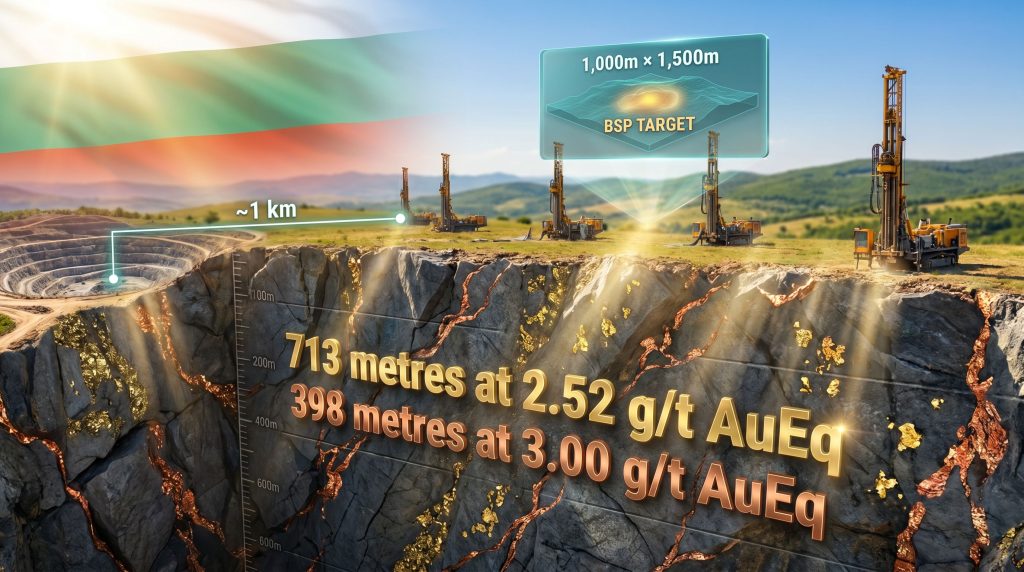
The identification of a phyllic alteration envelope exceeding 1,000 metres by 1,500 metres at BSP is therefore not merely a geological footnote. It is a proxy for system scale, indicating a hydrothermal event of sufficient magnitude to potentially host hundreds of millions of tonnes of mineralised material. At this stage, that remains a possibility rather than a confirmed resource, but the alteration geometry provides a compelling exploration framework.
Breaking Down the Drill Results: What the Numbers Actually Mean
Headline Intercept Analysis From EX_BRESPO_03
The standout result from the BSP discovery program speaks for itself when placed against global porphyry benchmarks. The key data from the headline drillhole are summarised below:
| Metric | Value |
|---|---|
| Total Interval | 713 metres at 2.52 g/t AuEq |
| Gold Grade (Total Interval) | 1.31 g/t Au |
| Copper Grade (Total Interval) | 1.16% Cu |
| Depth (from) | 1,172 metres downhole |
| High-Grade Sub-Interval | 398 metres at 3.00 g/t AuEq |
| Gold Grade (Sub-Interval) | 1.48 g/t Au |
| Copper Grade (Sub-Interval) | 1.45% Cu |
| Depth (Sub-Interval from) | 1,487 metres downhole |
Contextualising Grade Against Global Porphyry Benchmarks
To appreciate the significance of these numbers, consider that the vast majority of the world's large-tonnage porphyry copper-gold deposits average between 0.3 and 0.8 g/t gold equivalent. Projects at the upper end of that range are routinely described as high-quality. BSP's reported interval of 2.52 g/t AuEq over 713 metres, and its higher-grade sub-interval of 3.00 g/t AuEq over 398 metres, sit well above that range.
This grade premium matters for several reasons. In bulk-tonnage porphyry economics, grade and width function as multiplicative value drivers rather than additive ones. A deposit that is both wider and higher grade than a peer system does not simply offer a proportionally larger value — it can fundamentally alter the economics of extraction by supporting higher ore throughput at improved margins. Furthermore, when interpreting drill results at this stage, the caveat remains that a single drillhole defines an intersection, not a resource. Continuity must be demonstrated across multiple holes before economic modelling can begin in earnest.
At porphyry scale, the distinction between a discovery-stage intercept and a defined resource is not merely semantic. It represents the difference between geological potential and bankable mineralisation. Investors who understand this distinction are better positioned to evaluate the risk-reward profile of early-stage announcements like BSP.
The system is also described as remaining open for expansion, meaning drilling has not yet encountered the edges of the mineralised envelope. This open-ended geometry is a hallmark of early-stage porphyry discoveries and signals that the true footprint of the system is not yet constrained.
Situating BSP Within DPM Metals' Bulgarian Portfolio
The Chelopech Mine as the Strategic Anchor
The Chelopech mine operates as an underground copper-gold producer with a stated mine life extending to 2036. This operational context matters enormously when evaluating BSP. A producing mine with a defined end-of-life creates a natural urgency around near-mine discovery, as any mineralisation that can be incorporated into the existing mine plan extends revenue-generating capacity beyond the current horizon.
BSP sits approximately one kilometre from the active mine's existing Mineral Reserve boundary, within the southeastern portion of the Brevene exploration licence. That distance is not a minor geographic detail. It establishes geological continuity between the known orebody and the new discovery, and it places BSP within a zone where existing surface and underground infrastructure may be directly leveraged.
The internal target-generation process that led to BSP's discovery is worth noting. Rather than relying solely on new regional exploration, DPM's geological team reprocessed legacy data from previous deep drillhole campaigns conducted below and adjacent to existing orebodies. This approach, sometimes described as brownfield data mining, reduces the cost per discovery and can surface targets that were invisible to earlier exploration campaigns that lacked modern processing techniques or conceptual models.
Infrastructure Proximity as an Economic Multiplier
The difference between a standalone greenfield discovery and a mine-adjacent find is rarely captured in early-stage grade comparisons alone. The comparison below illustrates why location within the DPM Metals Chelopech mine Bulgaria porphyry discovery concession boundary changes the economic calculus materially:
| Factor | Standalone Greenfield | Mine-Adjacent (BSP) |
|---|---|---|
| Infrastructure Capital | High (full build required) | Low-to-moderate (leverage existing) |
| Permitting Complexity | Extended (new licence areas) | Potentially simplified (within existing licence) |
| Estimated Time to Production | 7 to 15+ years | Potentially 3 to 7 years |
| Valuation Framework | Standalone project premium | Infrastructure optionality premium |
| Mine-Life Impact | Separate asset | Direct extension of Chelopech operations |
The potential to access BSP mineralisation through extensions of existing underground workings, rather than constructing a new decline or open pit, could compress the capital intensity of development significantly. This remains speculative at this stage of exploration, but the geometric possibility exists given the spatial relationship between the two systems.
Serial Discovery: What Four Finds in Three Years Actually Signals
A Track Record That Reflects Methodology, Not Luck
Since the beginning of calendar year 2023, DPM Metals has announced four significant discoveries across its Bulgarian exploration portfolio:
- Čoka Rakita – the first in the sequence, establishing confidence in the company's geological model
- Dumitru Potok – the second discovery, expanding the known mineralised footprint
- The Wedge Zone – the third find, demonstrating continued target-generation capability
- Brevene South Porphyry (BSP) – the most recent and, by drill intercept metrics, potentially the most significant
Four discoveries in approximately three years within a single exploration jurisdiction is an unusual outcome. In the junior exploration sector, discovery rates of this frequency typically reflect one of two things: either exceptional geological endowment in the licence area, or a systematic and technically rigorous approach to target identification. In DPM's case, the evidence points to both operating simultaneously.
The methodology of reprocessing existing deep drillhole datasets to identify BSP is particularly instructive. Legacy exploration data collected under earlier geological paradigms often contains signals that only become interpretable once conceptual models evolve. DPM's internal target-generation initiative applied modern porphyry exploration thinking to historical data, surfacing a target that earlier campaigns had effectively walked past. This is a lower-cost pathway to discovery than regional greenfields exploration and suggests the team's intellectual capital is functioning as a genuine competitive advantage.
DPM's chief executive indicated that the company's exploration success reflects the quality of its geological team and the known mineral potential of the Western Tethyan Belt, framing BSP as confirmation of the geological thesis rather than a departure from it. The emphasis on economic potential assessment as a near-term objective signals that the company intends to move efficiently through the discovery-to-resource pipeline. In a broader context of mining industry consolidation, near-mine discoveries of this calibre attract strategic attention well before the resource stage.
The 15,000-Metre Program: What the Drilling Commitment Reveals
Five Rigs, One Target, One Year
The scale of the drilling commitment at BSP is itself a statement of conviction. Deploying five high-capacity drill rigs exclusively to a single target, with up to 15,000 metres of planned footage through the end of calendar year 2026, represents a significant allocation of capital and logistics. For context, most early-stage exploration programs at newly identified targets operate with one or two rigs while initial results are assessed.
The decision to accelerate immediately with five rigs suggests the company's geological team has sufficient confidence in the system's scale and continuity to justify an intensive campaign without waiting for sequential confirmation drilling. This approach compresses the timeline from discovery to resource estimation but carries the execution risk of a large program delivering variable results across the full drill pattern.
How a Porphyry Discovery Progresses Toward Economic Assessment
For investors unfamiliar with the lifecycle of a porphyry copper-gold discovery, the pathway from initial intercept to production decision involves several distinct stages:
-
Discovery drilling – Confirming the existence, orientation, and initial grade of mineralisation. BSP is currently at this stage.
-
Extensional and infill drilling – Defining the three-dimensional shape and grade distribution of the system across multiple drill sections.
-
Geological and block modelling – Constructing a three-dimensional model that allows tonnage and grade to be estimated systematically.
-
Maiden Mineral Resource Estimate (MRE) – The first formal quantification under JORC Code or equivalent international standards, separating inferred, indicated, and measured categories based on mineral deposit tiers.
-
Metallurgical testwork – Determining the recoveries achievable for gold and copper through the processing flowsheet, a critical economic variable often underestimated in early-stage analysis.
-
Scoping or Pre-Feasibility Study – An initial assessment of economic viability under assumed cost and price frameworks.
-
Definitive feasibility study and Development Decision – Full bankable assessment if economics support advancement to production.
Given BSP's proximity to the Chelopech mine and its existing processing infrastructure, steps six and seven may carry materially lower capital requirements than they would for a standalone project, potentially accelerating the timeline to a development decision if the resource case is confirmed.
The next major ASX story will hit our subscribers first
Frequently Asked Questions: DPM Metals and the Chelopech Porphyry Discovery
What is the Brevene South Porphyry (BSP) discovery?
BSP is a newly identified high-grade copper-gold porphyry mineralisation zone within DPM Metals' Brevene exploration licence in Bulgaria. It sits approximately one kilometre from the active boundary of the Chelopech mine's existing Mineral Reserves and is defined by a large hydrothermal alteration envelope exceeding 1,000 metres by 1,500 metres.
How significant are the drill results from BSP?
The headline intersection of 713 metres at 2.52 g/t gold equivalent, including a higher-grade sub-interval of 398 metres at 3.00 g/t AuEq, is considered exceptional relative to global porphyry benchmarks. Most large-tonnage porphyry deposits average well below 1 g/t AuEq, making BSP an outlier on both grade and interval width.
What is DPM's current drilling commitment at BSP?
Five dedicated high-capacity drill rigs are operating at the target, with up to 15,000 metres of drilling planned through the end of 2026. The program's stated objectives are to define the full mineralisation footprint and support an initial economic assessment.
How does BSP relate to the Chelopech mine?
BSP sits within the Brevene exploration licence contiguous with the Chelopech mine concession, approximately one kilometre from the existing Mineral Reserve boundary. This spatial relationship creates the possibility of integrating BSP mineralisation with existing mine infrastructure rather than pursuing a standalone development pathway.
What is DPM Metals' broader discovery track record?
The company has announced four significant discoveries since early 2023: Čoka Rakita, Dumitru Potok, the Wedge Zone, and now the Brevene South Porphyry. This rate of discovery within a single jurisdiction is uncommon in the junior exploration sector and reflects systematic geological methodology.
What is the current mine life of the Chelopech operation?
The Chelopech underground copper-gold mine carries a stated mine life extending to 2036, establishing a clear strategic imperative for near-mine resource growth through discoveries like the DPM Metals Chelopech mine Bulgaria porphyry discovery.
Key Takeaways: Assessing the Strategic Weight of the BSP Discovery
-
Grade: At 2.52 g/t AuEq over 713 metres, BSP represents an unusually high-grade porphyry result against global benchmarks
-
Scale indicator: The 1,000m by 1,500m phyllic alteration envelope points to a large hydrothermal system with an as-yet-undefined mineralisation footprint
-
Location advantage: Contiguity with the Chelopech mine concession provides a direct infrastructure and development pathway unavailable to standalone discoveries
-
Discovery momentum: BSP is the company's fourth significant find in approximately three years, reflecting a systematic and repeatable exploration methodology
-
Drilling conviction: Five rigs and 15,000 metres of planned footage through end-2026 indicates high internal confidence in the target's scale
-
Strategic timing: With the Chelopech mine life running to 2036, BSP arrives at a critical juncture for long-term production planning and reserve replacement
Disclaimer: This article is for informational purposes only and does not constitute financial advice. The information presented includes forward-looking statements, exploration results, and project-stage assessments that involve inherent uncertainty. Mineral discovery and exploration outcomes are speculative by nature, and past discovery success does not guarantee future results. Readers should conduct their own due diligence and consult a licensed financial adviser before making any investment decisions.
Want to Be Alerted the Moment the Next High-Grade Porphyry Discovery Hits the ASX?
Discovery Alert's proprietary Discovery IQ model scans ASX announcements in real time, instantly identifying significant mineral discoveries like the high-grade copper-gold intercepts reshaping DPM Metals' Bulgarian portfolio — translating complex data across 30+ commodities into a single, actionable gold-equivalent metric. Explore historic discoveries and the exceptional returns they've generated, then begin your 14-day free trial at Discovery Alert to position yourself ahead of the market.