June 4, 2026
The Supply Chain Fault Line That's Reshaping Western Mining Priorities
Every major industrial conflict of the past decade has quietly reinforced a single uncomfortable reality: the minerals powering modern defence, electronics, and manufacturing are overwhelmingly sourced from a single geopolitical competitor. Tungsten, one of the hardest naturally occurring metals on earth, sits at the centre of this vulnerability. With a melting point exceeding 3,400 degrees Celsius and properties that make it irreplaceable in armour-piercing ammunition, aerospace components, and industrial cutting tools, tungsten is not a commodity that can simply be substituted. Yet more than 80% of global tungsten supply is controlled by China, according to the US Geological Survey, leaving Western defence industries exposed to the kind of export restriction risk that moved from theoretical to operational when Beijing imposed controls on antimony and tungsten in late 2024.
Against this backdrop, the Resolution Minerals Horse Heaven tungsten gold drill campaign represents far more than a routine exploration update. It sits at the intersection of critical minerals policy, genuine geological discovery, and a funding environment increasingly shaped by strategic necessity rather than pure commodity speculation. Furthermore, antimony supply risks have become a central concern for Western governments seeking to reduce dependence on Chinese-controlled supply chains.
When big ASX news breaks, our subscribers know first
Idaho's Central Mineral Belt: A Jurisdiction With Proven Credentials
Idaho has been a producing mining state for well over a century, with the Coeur d'Alene district alone generating billions of dollars in silver, lead, and zinc output across its long operational history. Less well known outside specialist geology circles is the central Idaho mineral belt, a structurally complex corridor hosting gold, antimony, and tungsten mineralisation that has seen episodic but significant production dating back to the nineteenth century.
The Stibnite mining district within this belt is particularly significant. It hosts the Stibnite deposit operated by Perpetua Resources, which is widely recognised as a strategic antimony project advancing toward production in the United States. For exploration companies operating in the same geological neighbourhood, proximity to a permitted analogue carries genuine de-risking weight: it signals that the host geology is understood, that regulatory pathways have been navigated, and that comparable mineralisation styles exist at a commercially validated scale.
What Makes the Stibnite District Geologically Distinctive
The central Idaho mineral belt is dominated by Cretaceous-age intrusive systems that have driven large-scale hydrothermal circulation through structurally prepared host rocks. This process is responsible for the gold-antimony-tungsten mineral associations that appear repeatedly across the district. Scheelite, the calcium tungstate mineral that carries economic tungsten grades, tends to form in calc-silicate or skarn-adjacent settings within these hydrothermal systems, which explains why tungsten and gold can appear as co-products within the same deposit rather than as entirely separate mineralisation events.
This geological context matters when assessing the Horse Heaven project, because it suggests the four-commodity nature of the system (gold, tungsten, antimony, and silver) is a product of the same fundamental geological architecture rather than a coincidental overlap of unrelated mineral occurrences. In addition, tungsten's strategic importance to Western defence and industrial supply chains makes discoveries of this nature particularly significant.
Project Scale and the Golden Gate Discovery: What Exploration Has Established So Far
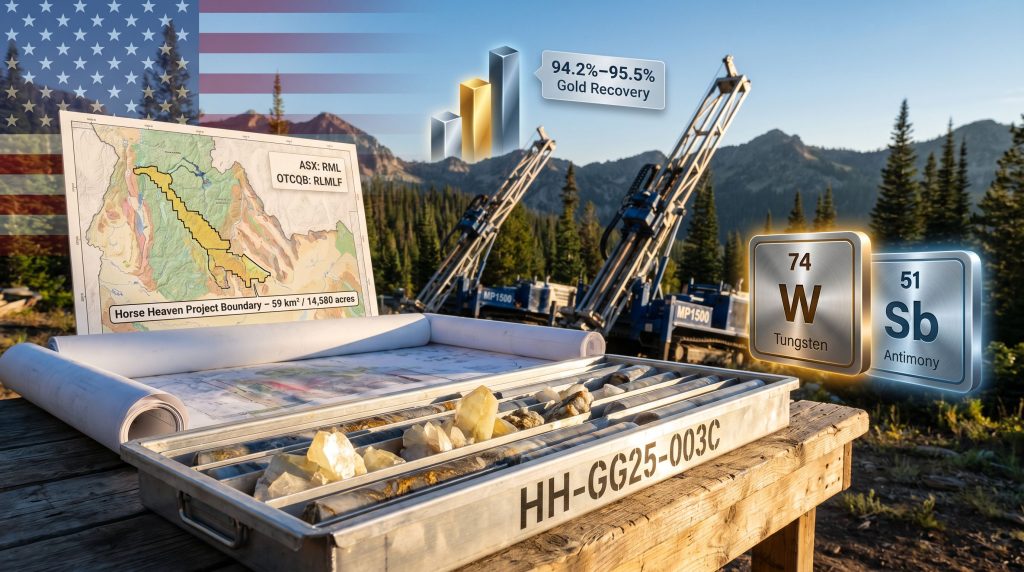
The Horse Heaven Antimony-Tungsten-Gold-Silver Project, held by Resolution Minerals (ASX: RML, OTCQB: RLMLF), covers approximately 59 square kilometres (14,580 acres) across central Idaho following recent tenement additions. The project hosts several distinct target areas, with the Golden Gate discovery corridor representing the most advanced and drill-tested zone.
Golden Gate encompasses both a northern and southern target, with historical tungsten mine workings situated between them. The spatial relationship across this corridor is significant: scheelite has been visually identified in multiple drill holes, tungsten was mined commercially at Golden Gate as recently as 1980, and a 500-by-600-metre coincident gold and tungsten soil anomaly overlies the area targeted by the 2026 program. For further context on Resolution Minerals' drill program, recent reporting has highlighted the strong metallurgical recoveries underpinning this campaign.
Phase 1 Drilling: The Foundation for the 2026 Expansion
The 2025 Phase 1 campaign delivered 14 holes totalling 3,780 metres, and produced results that directly drove the decision to scale up operations in 2026. Critically, gold mineralisation was intersected in every hole drilled from surface, a consistency that is uncommon at this stage of exploration and that significantly reduces geological uncertainty about the system's continuity.
The three headline intercepts from prior campaigns illustrate both the width and the grade profile of the Golden Gate system:
Selected Historical Drill Results — Golden Gate
| Hole ID | Intersection Width | Grade | From Depth |
|---|---|---|---|
| HH-GG25-001C | 189.2 metres | 1.30 g/t gold | 34.1 metres |
| HH-GG25-002C | 265.2 metres | 0.60 g/t gold | Surface |
| HH-GG25-003C | 253.0 metres | 1.50 g/t gold | Surface |
Broad intersections commencing at or near surface are a hallmark of shallow, potentially open-pittable gold systems. The combination of widths exceeding 250 metres with grades in the 0.6 to 1.5 g/t range is characteristic of bulk-tonnage open-cut style deposits rather than high-grade narrow vein systems, and the economic implications of this distinction are substantial. Lower-grade wide systems typically require less selective (and therefore cheaper) mining methods, and their processing characteristics tend to favour conventional circuits.
Importantly, the system remained open at depth and along strike following Phase 1, a geological signal that the full extent of mineralisation had not yet been defined and that the potential resource scale remained unconstrained.
The 2026 Golden Gate Drill Campaign: Program Parameters and Strategic Targets
The scale of the 2026 program reflects both the quality of Phase 1 results and the elevated strategic context around domestic US tungsten and antimony supply. Resolution has mobilised two MP1500 diamond core drill rigs to the Golden Gate area, executing a program that substantially expands on anything attempted at the project to date.
2026 Drill Program at a Glance
| Parameter | Detail |
|---|---|
| Drill rig type | MP1500 diamond core rig |
| Number of rigs mobilised | Two |
| Total planned metres | Up to 13,700 metres |
| Maximum planned holes | Up to 45 holes |
| Primary targets | Tungsten and gold mineralisation at Golden Gate |
| Program duration | Continuing throughout 2026 |
The program is targeting three interconnected objectives:
-
Extensions to known gold mineralisation at Golden Gate North and Golden Gate South, both along strike and at depth beyond the Phase 1 drill fence.
-
Testing the broader tungsten system spatially associated with historical mine workings and the large coincident soil anomaly.
-
Generating sufficient drill density and geological data to support a maiden JORC-compliant resource estimate, which would represent a transformative step change in the project's development maturity.
The use of diamond core drilling (as opposed to reverse circulation) is worth noting. Diamond core preserves intact rock samples that allow visual identification of scheelite under ultraviolet light, detailed structural geology logging, and the collection of representative metallurgical composite samples. For a system where tungsten mineralogy is a key variable, diamond core is the appropriate tool.
Technical Note: Scheelite fluoresces under shortwave ultraviolet light, appearing as a bright blue-white luminescence. This allows geologists to rapidly screen drill core for tungsten mineralisation even before laboratory assay results are available, providing near-real-time feedback on the tungsten system during drilling.
Metallurgical Test Work: Why Recovery Rates Matter More Than Many Investors Realise
One of the most under-appreciated milestones in early-stage mineral project development is the initial metallurgical test work. A deposit can host impressive drill intercepts and still represent a development dead-end if the mineralogy resists conventional processing. Conversely, strong early metallurgical results reduce technical risk in a way that directly influences the credibility of future economic studies.
The metallurgical test work conducted by IMO Labs in Perth on composite drill core samples from Golden Gate produced results that sit at the favourable end of the spectrum for both oxide and sulphide material.
Oxide Material: Cyanide Leach Performance
Oxide Gold Recovery Results
| Sample Type | Recovery Range | Leach Duration | Residue Grade (48 hrs) |
|---|---|---|---|
| Oxide composites | 94.2% to 95.5% | 24 hours | 0.04 g/t gold |
Oxide material refers to the shallow, weathered zone of the deposit where sulphide minerals have been oxidised over geological time. This material is typically amenable to direct cyanide leaching without the need for pre-treatment, making it the least capital-intensive ore type to process.
Recoveries of 94.2% to 95.5% through standard cyanide leach are considered highly favourable by industry benchmarks, and the residue grade of just 0.04 g/t gold after 48 hours across all grind sizes tested confirms that gold extraction is both efficient and complete. These results are consistent with either heap leach or conventional carbon-in-leach (CIL) processing, both of which are well-understood, widely deployed technologies with established capital and operating cost profiles.
Sulphide Material: Flotation Performance
Sulphide Rougher Flotation Results
| Parameter | Result |
|---|---|
| Maximum concentrate grade | Up to 49 g/t gold |
| Recovery at standard grind | Above 86% |
| Recovery at finer grind | Up to 88.7% |
| Source material | Below supergene zone |
Sulphide material sits below the oxidised zone and requires a different processing approach. Flotation concentrates the gold into a smaller mass of sulphide minerals that can then be further processed or sold as a concentrate to a smelter. A concentrate grade of 49 g/t gold is commercially robust by industry standards, and recoveries above 88% at finer grind sizes confirm that the gold is well-liberated and responds to conventional flotation chemistry.
The trade-off identified in the test work (finer grinding improves recovery but dilutes concentrate grade) is a standard optimisation variable, and ongoing test work is designed to identify the most economically efficient grind size. This is normal practice at this stage of project development and does not represent a metallurgical complication.
Investor Perspective: The combination of oxide and sulphide recoveries at Golden Gate suggests the project could be developed using entirely conventional processing technology. This is a meaningful risk reduction at the pre-resource stage, since projects requiring refractory treatment (pressure oxidation, roasting, or bioleaching) carry substantially higher capital costs and development risk.
Historical Tungsten Grades and What the Stockpile Data Signals
The tungsten dimension of the Horse Heaven story is often overshadowed by the gold headlines, yet it deserves independent analysis. Historical stockpile sampling at the Johnson Creek mill site returned grades of 1.85% WO₃ (tungsten trioxide), which is the standard commercial expression of tungsten grade.
To contextualise this figure: operating tungsten mines globally typically process ore grades ranging from approximately 0.1% to 0.5% WO₃ for large-scale operations, with higher-grade deposits in the 0.5% to 1.5% WO₃ range considered economically attractive. A stockpile grade of 1.85% WO₃ sits above this range and, while stockpile material does not represent a resource estimate, it provides early evidence that the tungsten system at Golden Gate has the potential to deliver economically meaningful grades.
The fact that tungsten was commercially mined at this location as recently as 1980 also signals that the geological system was productive enough to sustain past operations, even under the less sophisticated extraction and economic conditions of that era. Consequently, the relevance of tungsten for defence aerospace applications only strengthens the strategic case for domestic US projects of this nature.
The next major ASX story will hit our subscribers first
The US Critical Minerals Policy Context: Tailwinds Without Guarantees
The broader regulatory and policy environment in the United States has become notably more supportive of domestic critical minerals exploration and development since 2024. Tungsten and antimony have both been classified as critical minerals by the US government, and executive-level interest in onshoring supply chains for defence-relevant commodities has grown substantially.
The FAST-41 permitting pathway, a federal mechanism designed to streamline environmental review and permitting for infrastructure projects, has been applied to the Antimony Ridge component of the Horse Heaven project. This pathway does not guarantee approval or accelerate regulatory outcomes beyond statutory requirements, but it does impose coordination and transparency obligations on federal agencies involved in the review process, which can reduce administrative uncertainty for proponents.
Resolution has also secured a $20 million funding commitment associated with the Horse Heaven project, which provides operational runway for the 2026 drill campaign and beyond. Furthermore, antimony in defence applications continues to drive policy urgency around securing non-Chinese sources of supply.
How Horse Heaven Compares Within the US Critical Minerals Exploration Landscape
| Asset Attribute | Horse Heaven | Typical Early-Stage Critical Minerals Project |
|---|---|---|
| Commodity mix | Gold, Tungsten, Antimony, Silver | Usually single or dual commodity |
| Proximity to analogue | Adjacent to Perpetua Resources' Stibnite | Often geologically isolated |
| Metallurgical data | Oxide and sulphide both tested | Rarely available at early stage |
| Historical mine workings | Yes, tungsten mined to 1980 | Uncommon |
| Project footprint | ~59 km² (14,580 acres) | Variable |
Development Pathways and What to Watch in the Months Ahead
Three plausible development trajectories exist for the Horse Heaven project as the 2026 drill campaign progresses:
-
Standalone Development: The project advances as an independent operation targeting gold, tungsten, and antimony production with its own processing infrastructure, potentially anchored by the oxide heap leach pathway given its low capital intensity.
-
Strategic Partnership or Offtake Agreement: A defence contractor, industrial tungsten consumer, or government-linked procurement body secures an offtake or equity stake in exchange for providing development capital, reflecting the growing trend of end-user investment in upstream critical mineral supply.
-
Merger and Acquisition Activity: The project is acquired by a larger producer seeking US-based critical mineral exposure, a scenario that has precedent in the antimony sector where consolidation has accelerated following the tightening of Chinese export policy.
The near-term milestones most likely to move the development narrative forward include:
-
Assay results from the first holes of the 2026 program, which will either confirm or expand upon the gold and tungsten system defined in Phase 1.
-
Completion of metallurgical optimisation work on sulphide composites, which will refine the processing parameters ahead of any scoping-level economic study.
-
Progress toward a maiden JORC-compliant resource estimate, which requires sufficient drill density to support geological modelling and grade interpolation across the Golden Gate corridor. The Horse Heaven project page provides further detail on the geological targets underpinning this objective.
Frequently Asked Questions
What is the Horse Heaven project and where is it located?
The Horse Heaven Antimony-Tungsten-Gold-Silver Project is located in central Idaho, USA, within the historically productive Stibnite mining district. The project covers approximately 59 km² (14,580 acres) and hosts gold, tungsten, antimony, and silver mineralisation across several target areas. It is held by Resolution Minerals (ASX: RML, OTCQB: RLMLF).
What are the primary targets in the 2026 drill program?
The 2026 Resolution Minerals Horse Heaven tungsten gold drill campaign is focused on extensions to gold mineralisation at Golden Gate North and South, the broader tungsten system associated with historical mine workings, and a 500-by-600-metre coincident gold and tungsten soil anomaly identified during surface sampling programs.
What gold grades has previous drilling returned at Golden Gate?
| Hole ID | Width | Grade | From |
|---|---|---|---|
| HH-GG25-001C | 189.2 m | 1.30 g/t Au | 34.1 m |
| HH-GG25-002C | 265.2 m | 0.60 g/t Au | Surface |
| HH-GG25-003C | 253.0 m | 1.50 g/t Au | Surface |
What did the metallurgical test work show?
Oxide material produced gold recoveries of 94.2% to 95.5% via cyanide leach, with residue grades of just 0.04 g/t after 48 hours. Sulphide flotation achieved recoveries of up to 88.7% at finer grind sizes, with concentrate grades reaching 49 g/t gold.
Why is tungsten classified as a critical mineral?
Tungsten is essential to armour-piercing ammunition, aerospace components, industrial cutting tools, and electronics. Its extreme melting point and hardness make it technically irreplaceable in many defence and manufacturing applications. With China controlling over 80% of global supply, Western governments including the United States have formally classified tungsten as a critical mineral requiring domestic supply chain development.
What is the FAST-41 permitting pathway?
FAST-41 is a federal permitting coordination framework established under the Fixing America's Surface Transportation Act. It requires federal agencies to coordinate their environmental review processes through a centralised system, with defined timelines and accountability measures. The Antimony Ridge component of Horse Heaven has been accepted into this framework, which imposes process discipline on the multi-agency review without predetermining the outcome.
Key Takeaways
The 2026 Resolution Minerals Horse Heaven tungsten gold drill campaign brings together several attributes that are individually noteworthy and collectively unusual at the early-stage exploration phase:
-
Broad gold mineralisation from surface in all Phase 1 holes, with widths exceeding 250 metres, is consistent with a bulk-tonnage open-pittable deposit style.
-
Strong metallurgical recoveries for both oxide (94%+) and sulphide (88%+) material confirm conventional processing pathways are viable, substantially reducing technical risk before a resource estimate exists.
-
A co-located tungsten system with historical production history and scheelite visible in drill core adds a strategic commodity dimension that elevates the project's relevance to defence and industrial supply chain investors.
-
The macro environment, characterised by Chinese export restrictions on tungsten and antimony, US critical minerals policy acceleration, and growing defence sector procurement urgency, amplifies the strategic significance of Idaho-based polymetallic discoveries.
-
Proximity to Perpetua Resources' permitted Stibnite project provides a geological and jurisdictional analogue that reduces uncertainty about the district's development potential.
This article is intended for informational purposes only and does not constitute financial or investment advice. Exploration-stage mineral projects carry significant technical, regulatory, and market risks. Readers should conduct their own due diligence and seek independent professional advice before making any investment decisions. Past drill results and metallurgical test work do not guarantee the existence of a commercial mineral deposit.
Want to Be First to Identify the Next Major Mineral Discovery on the ASX?
Discovery Alert's proprietary Discovery IQ model scans ASX announcements in real time, instantly identifying significant mineral discoveries across critical commodities — including tungsten, antimony, and gold — so subscribers can act ahead of the broader market. Explore historic discoveries and their exceptional returns to understand what early positioning in transformative finds can mean for a portfolio, and begin your 14-day free trial at Discovery Alert today.