June 10, 2026
When Gold Becomes a Growth Engine: Understanding Resource-Driven Economic Acceleration
Few economic phenomena are as instructive as watching a resource-dependent nation navigate the intersection of commodity cycles, institutional reform, and geopolitical volatility simultaneously. For investors and analysts tracking frontier and emerging markets, Ghana's current economic trajectory offers a compelling case study in how a well-timed convergence of mining output, monetary stabilisation, and fiscal discipline can produce growth outcomes that consistently exceed market expectations.
The Ghana mining sector economic growth story unfolding in 2026 is not simply a function of elevated gold prices, though that tailwind is undeniably significant. What makes Ghana's acceleration particularly noteworthy is the structural underpinning beneath the headline numbers — a combination of IMF-anchored fiscal reform, monetary easing, and deliberate policy redesign that has transformed a post-default economy into one of West Africa's fastest-growing nations.
When big ASX news breaks, our subscribers know first
GDP Acceleration: Reading Beyond the Headline Number
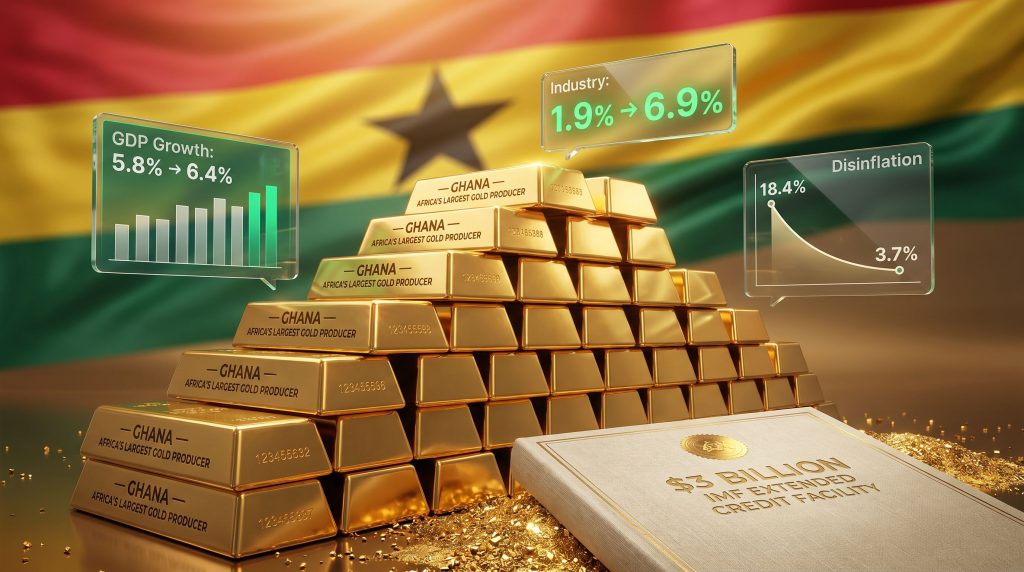
Ghana's gross domestic product expanded at an annual rate of 6.4% in the first quarter of 2026, accelerating from 5.8% recorded in the immediately preceding quarter. On a quarterly basis, the economy grew by 1.6%, a figure that signals continued positive momentum rather than a statistical anomaly driven by base effects.
Government Statistician Alhassan Iddrisu presented these findings to reporters in Accra, confirming that the industrial sector was the standout performer of the quarter. The scale of that outperformance is worth dwelling on.
The industrial sector's growth rate moved from 1.9% to 6.9% between quarters, representing a near-fourfold acceleration and the strongest industrial performance Ghana has recorded in close to two years.
Finance Minister Cassiel Ato Forson subsequently revised the full-year 2026 growth forecast upward to above 6%, a significant upgrade from the government's earlier projection of 4.8%. That revision is not a minor statistical adjustment; it reflects a fundamental reassessment of Ghana's economic capacity and resilience.
Sector-by-Sector Performance Breakdown
The sectoral composition of Q1 2026 growth reveals a shifting economic architecture, where resource extraction is now driving momentum more decisively than services or agriculture.
| Economic Sector | Q1 2026 Growth | Prior Quarter | Trend |
|---|---|---|---|
| Industry (incl. Mining) | 6.9% | 1.9% | Strong Acceleration |
| Services | 7.1% | 8.6% | Moderate Deceleration |
| Agriculture | 4.0% | 5.3% | Mild Softening |
The gold and oil-and-gas subsectors served as the twin engines of industrial expansion. Services, while still growing robustly at 7.1%, showed signs of cooling relative to prior-quarter highs. Agriculture expanded steadily but at a reduced pace, consistent with seasonal patterns and slightly less favourable precipitation in key farming regions.
The critical analytical point here is that industrial acceleration of this magnitude, driven primarily by mining activity, has historically been a precursor to broader-based economic expansion in Ghana, provided that resource revenues are efficiently channelled into productive public investment and infrastructure.
Mining's Structural Role in Ghana's Economic Architecture
To understand why Ghana's industrial surge carries such macroeconomic significance, it is necessary to appreciate the structural weight that mining carries within the national economy. This is not a sector that sits at the margins; it sits at the core. According to the Ghana Chamber of Mines industry data, the sector's contribution has remained consistently significant across multiple economic cycles.
GDP Contribution and Sovereign Identity
The mining and quarrying sector contributes approximately 5.5% to 6% of Ghana's GDP, a figure that has remained broadly consistent across multiple commodity cycles. When indirect economic contributions through transport, equipment supply, financial services, and local procurement are incorporated, the sector's total economic footprint is substantially larger than the direct GDP share suggests.
Ghana holds the distinction of being Africa's largest gold producer, a position that anchors its industrial identity, informs its sovereign credit profile, and shapes how international investors perceive the country's economic risk and opportunity profile. This ranking reflects not merely historical legacy but continued investment in new and expanded mining operations, as declining ore grades in South Africa's ageing deep-level mines have shifted continental leadership northward.
Academic research employing econometric modelling has confirmed a statistically significant positive long-run relationship between mineral revenue and real GDP growth in Ghana, suggesting that mining's contribution to economic expansion is not merely cyclical but structurally embedded in the country's growth trajectory. This distinction matters enormously for long-term economic planning and investor confidence assessments. Furthermore, research on Ghana's investment potential reinforces the view that the sector's structural role is set to deepen over the coming decade.
Foreign Exchange: The Hard Currency Backbone
Perhaps the most consequential dimension of the Ghana mining sector economic growth dynamic is mining's role as the primary generator of foreign exchange. The sector accounts for an estimated one-third to 40% of Ghana's gross foreign exchange earnings, making it the single largest source of hard currency inflows for the national economy.
This concentration of foreign exchange generation in a single sector creates both opportunity and vulnerability:
- When gold prices rise, Ghana's current account position strengthens, reserves accumulate, and the cedi tends to stabilise or appreciate
- When gold prices fall or production volumes decline, the opposite pressures emerge with magnified intensity
- Elevated gold prices throughout 2025 and into 2026, driven partly by gold's geopolitical rally, have materially strengthened Ghana's foreign exchange reserves and provided a meaningful buffer against external shocks
Ghana's mining sector generates between one-third and 40% of the country's total foreign exchange earnings, making it the most important export industry in the national economy.
Fiscal Contribution: Taxes, Royalties, and State Equity
Mining is Ghana's largest tax-paying sector, contributing through three primary fiscal channels:
- Corporate income taxes on mining company profits, calculated under Ghana's mineral income tax framework
- Mineral royalties assessed as a percentage of the gross value of minerals extracted, payable to the government regardless of profitability
- Dividend flows from state equity stakes held through the Ghana National Petroleum Corporation and related entities in joint venture operations
This multi-channel fiscal architecture means that the government captures resource rents across different stages of the value chain, though the efficiency of that capture and its translation into productive public investment remains a subject of ongoing policy debate and academic scrutiny.
Policy Reforms Reshaping Ghana's Investment Climate
Ghana's improved economic performance does not exist in a policy vacuum. A deliberate sequence of fiscal, monetary, and structural reforms has created the conditions for mining-led growth to translate into broader macroeconomic gains.
The IMF Programme: Fiscal Anchor in a Post-Default Economy
Ghana entered a $3 billion IMF Extended Credit Facility in 2023 following the country's sovereign default on external debt obligations in 2022. That default, triggered by a combination of accumulated fiscal imbalances, pandemic-era spending pressures, and deteriorating external financing conditions, represented a significant sovereign credit event that temporarily undermined investor confidence in Ghanaian assets.
The IMF programme has since served as a fiscal anchor, imposing discipline on government expenditure while supporting a series of structural reforms designed to improve domestic revenue mobilisation and debt sustainability. The measurable outcomes of this programme have been striking:
- Inflation has declined from 18.4% year-on-year recorded in May 2025 to 3.7% in May 2026, a dramatic disinflationary trajectory achieved within twelve months
- The benchmark policy rate has been reduced from a peak of 28% to 14%, with the Bank of Ghana pausing its easing cycle to assess ongoing inflationary pressures from higher global fuel costs
- Fiscal consolidation has restored sufficient investor confidence to enable Ghana's return to international capital markets
It is important to note that while the IMF programme has created a more favourable macroeconomic environment for the mining sector, this does not constitute direct government backing or project-level support for specific mining operations. The programme's benefits are macroeconomic in nature, improving the general investment climate rather than specifically subsidising or designating individual mining projects.
Monetary Policy Normalisation and the Cost of Capital
The reduction in the Bank of Ghana's benchmark rate from 28% to 14% represents one of the most consequential changes in Ghana's economic landscape for mining operators and domestic businesses alike.
Lower borrowing costs reduce the weighted average cost of capital for mining companies, making project expansion and equipment investment more financially attractive at any given gold price level. For domestic businesses in the mining supply chain, reduced borrowing costs improve working capital management and support capacity expansion. This transmission mechanism from monetary policy to real economic activity is a key reason why the industrial sector's acceleration has been so pronounced.
The central bank's decision to hold rates at 14% rather than continuing to cut reflects a measured approach to policy normalisation. Inflation ticked upward for a second consecutive month to 3.7% in May 2026, partly attributable to higher fuel costs flowing from Middle East supply disruptions, and the Bank of Ghana's response suggests a preference for consolidating disinflation gains before resuming the easing cycle.
The New Gold Royalty Regime
Ghana's government introduced a new gold royalty regime in 2026, representing a deliberate effort to recalibrate how resource rents are captured and redistributed through the fiscal framework. The reform signals the government's intent to ensure that elevated gold prices translate more directly into public revenue. Considering gold as a strategic asset has become increasingly important for policy makers seeking to maximise national benefit from commodity cycles.
The policy challenge is to maximise resource rent capture while preserving sufficient investor attractiveness to sustain capital flows into new and existing mining operations. Ghana's royalty reform represents an attempt to navigate this tension, though the precise calibration of the new rates will determine whether it achieves the intended fiscal outcome without deterring investment.
Ghana's Natural Hedge Against Geopolitical Disruption
The US-Israeli military conflict with Iran, which commenced on 28 February 2026, has created significant turbulence in global commodity markets, with particular consequences for oil-dependent economies facing rising energy import costs. Ghana's experience of this geopolitical shock illustrates a distinctive economic dynamic that deserves careful analytical attention.
The Dual Commodity Effect
For most import-dependent developing economies, geopolitical conflict in the Middle East is an unambiguous negative: energy import costs rise, inflation accelerates, current account deficits widen, and currency pressure intensifies. Ghana faces these same headwinds. However, Ghana also benefits from a countervailing force that most such economies lack.
Geopolitical instability historically drives gold prices higher as institutional investors, central banks, and sovereign wealth funds allocate toward safe-haven assets. The record gold price drivers of recent years demonstrate how sustained this dynamic can be. For Ghana, this creates a natural economic hedge: the same global instability that raises energy import costs simultaneously boosts the value of its primary export commodity.
Unlike oil-dependent economies that are purely harmed by Middle East conflict, Ghana's gold-export orientation means geopolitical risk can simultaneously increase the value of its primary export while raising import costs — a dual-edged but net-positive dynamic at current gold price levels.
This structural asymmetry partially insulates Ghana's terms of trade from the worst effects of geopolitical disruption, explaining how inflation has remained at 3.7% in May 2026 despite the ongoing conflict, compared to 18.4% recorded in May 2025 before the combined effects of the IMF programme and gold price appreciation had fully taken hold.
Gold as a Macroeconomic Stabiliser
The safe-haven dynamics driving gold demand during periods of geopolitical stress are well-documented in academic and practitioner literature. What is less frequently discussed is how this dynamic operates at the national economy level for gold-exporting countries.
When institutional investors globally rotate into gold as a defensive allocation, the resulting price appreciation generates additional foreign exchange earnings, strengthens reserves, and reduces sovereign borrowing costs for nations whose creditworthiness is tightly linked to commodity export revenues. For Ghana specifically, elevated gold prices during the Iran conflict period have provided a meaningful fiscal buffer that has allowed the government to absorb higher fuel import costs without requiring compensatory austerity measures that would otherwise dampen growth.
Long-Term Growth Constraints: The Challenges Ghana Must Confront
Acknowledging Ghana's impressive current performance requires equal attention to the structural vulnerabilities that could constrain the sustainability of mining-led growth over the medium and long term.
The Resource Revenue Translation Problem
One of the most counterintuitive findings from academic analysis of Ghana's mining sector concerns the relationship between government expenditure, foreign direct investment, and real GDP growth. While mineral revenue positively correlates with real GDP growth, certain econometric models have identified negative relationships between government expenditure and real GDP in specific specifications, suggesting potential inefficiencies in how resource rents are converted into productive public investment.
This phenomenon, sometimes described as the "resource revenue translation problem," is observed across multiple resource-dependent economies and reflects a range of underlying inefficiencies:
- Absorption capacity constraints: rapid increases in resource revenue can exceed an economy's capacity to deploy capital productively, leading to inflation in the non-traded sector rather than genuine productive expansion
- Governance and procurement inefficiencies: resource revenues channelled through government spending can be absorbed by corruption, inefficient procurement, and poorly designed projects
- Dutch Disease dynamics: strong resource export performance can appreciate the real exchange rate, reducing the competitiveness of non-resource tradeable sectors and narrowing the economic base
Addressing this translation gap — between mineral revenue collection and tangible development outcomes — is arguably the most important long-term policy challenge Ghana faces in converting its geological endowment into sustained broad-based prosperity.
Environmental Sustainability and Social Licence
Rapid mining expansion generates environmental liabilities that carry real economic costs if left unaddressed. Land degradation, water contamination, and community displacement associated with large-scale mining operations can undermine agricultural productivity, increase public health expenditures, and generate social tensions that ultimately impose costs on mining operations themselves.
Ghana's artisanal and small-scale mining sector, colloquially known as galamsey, presents a particularly acute regulatory challenge. Operating largely outside formal compliance frameworks, galamsey miners have caused significant damage to river systems and forest reserves, with surveys indicating that several major water bodies have been contaminated by mercury and cyanide used in informal gold processing. Addressing mine reclamation challenges of this scale requires sustained policy commitment and significant financial resources, representing a long-term liability that will need to be borne by future governments and communities.
Building Economic Linkages Beyond the Mine Gate
Mining directly employs a significant workforce, but its potential contribution to economic development extends well beyond direct employment. The sector's indirect economic linkages — through transport and logistics, equipment supply, financial services, food provision, and local procurement — are often underdeveloped relative to the sector's overall economic scale.
Strengthening these backward and forward linkages between the mining sector and domestic industries is critical to converting mineral wealth into broad-based employment and income growth. Policy frameworks that incorporate:
- Mandatory local content requirements for equipment and consumables procurement
- Supplier development programmes that build domestic capacity to compete for mining contracts
- Skills transfer obligations that build transferable technical capabilities in local workforces
- Infrastructure investment requirements that serve both mining and broader community needs
…can substantially amplify the sector's economic multiplier effect and reduce the dual-economy dynamic where mining enclaves generate wealth that flows primarily to foreign investors and corporate entities rather than circulating through domestic supply chains.
The next major ASX story will hit our subscribers first
Ghana's Competitive Position Among African Gold Producers
Situating Ghana's performance within the broader African gold mining landscape provides important context for assessing the country's competitive advantages and strategic vulnerabilities. The broader gold market outlook for 2025 and beyond reinforces why Ghana's positioning is particularly favourable at this point in the commodity cycle.
| Indicator | Ghana | Regional Context |
|---|---|---|
| GDP Contribution (Mining) | ~5.5% to 6% | Among the highest in Sub-Saharan Africa |
| Foreign Exchange Share | 33% to 40% | Comparable to major mineral exporters |
| Gold Producer Ranking | Africa's Largest | Ahead of South Africa, Mali, Tanzania |
| IMF Programme Status | Active ($3B ECF) | Post-default stabilisation phase |
| Q1 2026 GDP Growth | 6.4% | Among the strongest in West Africa |
Ghana's continental leadership in gold production reflects several structural advantages over regional peers. The country benefits from a relatively stable democratic governance framework compared to several West African neighbours experiencing political instability and military coups. A more developed financial sector, established legal infrastructure for mining investment, and longer institutional history with large-scale foreign mining operations provide competitive advantages in attracting the patient capital that major mining projects require.
The combination of gold and oil-and-gas production also provides greater commodity diversification than single-resource economies, reducing the vulnerability to sector-specific shocks while maintaining the benefits of resource sector scale. This diversification within the extractive sector is a genuine competitive advantage that Ghana has not always fully capitalised on in terms of policy design and investor communication.
Key Takeaways: Ghana's Mining-Led Growth in Context
The following summary consolidates the most significant findings from this analysis of the Ghana mining sector economic growth trajectory:
- GDP growth accelerated to 6.4% in Q1 2026, prompting a full-year forecast revision to above 6% from 4.8%
- Industrial sector performance nearly quadrupled from 1.9% to 6.9%, driven primarily by gold and oil-and-gas output
- Mining contributes 5.5% to 6% of GDP and generates 33% to 40% of foreign exchange earnings, making it the structural backbone of Ghana's external accounts
- IMF-anchored fiscal consolidation has reduced inflation from 18.4% to 3.7% and cut benchmark borrowing costs from 28% to 14%, creating measurably improved investment conditions
- A new gold royalty regime introduced in 2026 signals the government's intent to capture a greater share of resource rents during the current period of elevated gold prices
- Geopolitical risk from the Iran conflict presents a dual economic effect for Ghana: rising energy import costs are partially offset by gold price appreciation driven by safe-haven demand
- Long-term structural challenges including the resource revenue translation problem, environmental sustainability pressures, and underdeveloped domestic economic linkages represent the most significant constraints on sustaining mining-led growth over the coming decade
This article contains analysis and forward-looking assessments based on currently available economic data and reporting. Readers should note that economic forecasts, commodity price projections, and assessments of policy outcomes involve inherent uncertainty. Nothing in this article constitutes financial or investment advice. Investors and analysts should conduct their own due diligence and consult qualified advisors before making investment decisions.
Want To Capitalise on the Next Major ASX Mineral Discovery Before the Broader Market?
Discovery Alert's proprietary Discovery IQ model delivers real-time alerts on significant ASX mineral discoveries — turning complex resource data into actionable investment insights for both short-term traders and long-term investors. Explore how historic discoveries have generated substantial returns on Discovery Alert's dedicated discoveries page, and begin your 14-day free trial today to position yourself ahead of the market.