July 16, 2026
The Hidden Cost of Standing Still: How Ghana's Upstream Oil Sector Lost a Decade
When an oil-producing nation stops drilling, the consequences do not announce themselves immediately. The decline is gradual, masked for a time by favourable commodity prices or optimistic budget revisions. But eventually, the arithmetic becomes undeniable. For Ghana, that reckoning has arrived in the form of a $16.5 billion gap between the petroleum revenues the country could have earned and what it actually collected between 2019 and 2025 — a stark illustration of Ghana oil production decline and lost revenue at its most consequential.
This is not a story about a price crash or a geopolitical shock. It is a story about what happens when investment continuity is treated as optional in a sector where natural field depletion is mathematically certain.
When big ASX news breaks, our subscribers know first
Why Petroleum Is Central to Ghana's Fiscal Architecture
Ghana entered commercial oil production in 2010 following the discovery of the offshore Jubilee Field, positioning itself as one of West Africa's most promising emerging petroleum exporters. For more than a decade, crude oil revenue became a cornerstone of the country's public finance system, funding budget commitments, servicing external debt, and providing the government with foreign currency earnings that domestic tax collection alone could not reliably generate.
According to data published by the Ghana Extractive Industries Transparency Initiative (GHEITI) in its 2024 report, petroleum receipts accounted for approximately 9% of Ghana's total government revenue in 2023. While that proportion may appear modest in absolute terms, its role is disproportionately significant because it functions as hard-currency income in an economy with persistent current account pressures.
Ghana's offshore production base rests on three principal assets:
- Jubilee Field – the country's flagship producing asset, operated by Tullow Oil, and the field that first established Ghana as a petroleum producer
- TEN Field (Tweneboa-Enyenra-Ntomme) – a second-generation deepwater development that came online after Jubilee
- Sankofa-Gye Nyame (SGN) Field – a more recent addition to Ghana's producing portfolio, adding gas alongside crude output
All three fields now sit in the declining phase of their production curves, a predictable consequence of reservoir maturity that was always going to require proactive investment to offset.
Ghana Oil Production Decline and Lost Revenue: The Full Statistical Picture
From Peak to Collapse: Six Years of Consecutive Contraction
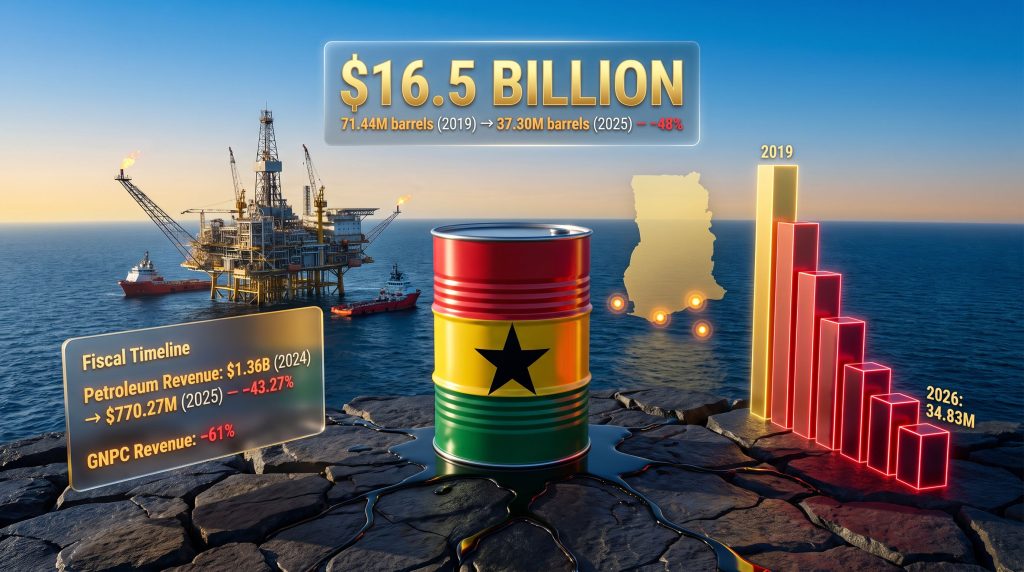
Ghana's crude oil output reached its highest recorded level in 2019, when the country produced 71.44 million barrels. What followed was not a temporary dip but a sustained, uninterrupted decline that persisted across six consecutive years.
By 2025, production had fallen to 37.30 million barrels, representing a contraction of approximately 48% from the 2019 peak. Ghana's Energy Commission projects that output will decline further to 34.83 million barrels in 2026, which would mark a seventh consecutive year of falling production.
| Year | Output (Million Barrels) | Change vs. 2019 |
|---|---|---|
| 2019 | 71.44 | Peak year |
| 2025 | 37.30 | -48% |
| 2026 (Projected) | 34.83 | Further decline |
To contextualise what a 48% production decline means in practical terms: Ghana is now extracting roughly the same volume of crude it produced in the early years of its oil industry, before the TEN and SGN fields were even online. The country has effectively erased more than a decade of upstream development gains.
The $16.5 Billion Revenue Gap Explained
The Institute for Energy Security (IES), a Ghana-based pan-African think tank focused on energy sector governance and security in West Africa, constructed a counterfactual scenario to quantify the cost of Ghana's production underperformance. The methodology applied a conservative 3% annual production growth rate to Ghana's 2019 output baseline, representing the modest expansion that sustained upstream investment and new petroleum agreements would have been expected to deliver.
Under this scenario, Ghana could have produced an additional 221 million barrels between 2019 and 2025. At prevailing oil prices across the period, the IES estimated this represents approximately $16.5 billion in foregone gross petroleum revenue. Furthermore, understanding current crude prices helps contextualise just how significant this shortfall truly is.
Important distinction: The $16.5 billion figure represents potential gross revenue, not net fiscal receipts. Actual government income would depend on royalty structures, GNPC equity arrangements, and contractor cost recovery provisions. Nevertheless, even discounted for these factors, the scale of the shortfall points to a profound and avoidable structural failure in upstream sector management.
Annual Petroleum Revenue: The Fiscal Deterioration in Detail
The annual revenue trajectory illustrates how the production decline has translated directly into budget pressure:
| Period | Petroleum Revenue | Change |
|---|---|---|
| 2024 full year | $1.36 billion | Baseline |
| 2025 full year | $770.27 million | -43.27% |
| H1 2024 | $840 million | Baseline |
| H1 2025 | $370 million | -56% |
The 2025 revenue collapse was compounded by a simultaneous decline in crude prices. Ghana's average realised oil price fell from $86 per barrel in 2024 to $75 per barrel in 2025, creating a fiscal double-bind in which lower volumes intersected with lower unit values. Monitoring crude oil price trends is therefore essential for understanding the full fiscal exposure facing resource-dependent economies like Ghana. This is the structural vulnerability of resource-dependent economies: volume risk and price risk tend to materialise together rather than offsetting each other.
What Is Actually Causing the Decline? Field-Level and Structural Analysis
Reservoir Maturity and Field-Level Performance
The production deterioration is visible at the individual field level, with each of Ghana's three major assets registering significant output losses in the first half of 2025 alone:
- Jubilee Field recorded a 32.8% production decline in H1 2025, the steepest single-period fall among Ghana's major producing assets
- TEN Field contracted by 14.0% over the same period, compounded by delayed liftings and an absence of new inflow well development
- Sankofa-Gye Nyame Field declined by 11.6%, reflecting broadly similar reservoir maturity dynamics
Natural depletion in offshore oil fields is not a surprise. Every producing reservoir experiences declining pressure and flow rates over time, a phenomenon the industry refers to as the natural decline curve. The standard response is to continuously drill new wells, both to maintain pressure and to access undrained portions of the reservoir. What makes Ghana's situation unusual is the degree to which this standard response was simply not executed.
The Investment Vacuum: No New Agreements Since 2018
The IES report identified several structural causes operating simultaneously, which is what distinguishes this situation from ordinary field maturity:
- No new petroleum licensing agreements have been signed since 2018, leaving Ghana's upstream pipeline entirely dependent on ageing existing fields with no greenfield development to provide future production replacement
- Insufficient new well drilling across all three major fields has allowed the natural decline curve to run unchecked rather than being slowed by reservoir management activity
- Operational shutdowns and maintenance backlogs have imposed additional production losses beyond the underlying geological decline
- Policy decisions affecting GNPC's revenue share reduced the corporation's capacity to co-invest in field development at precisely the moment when capital deployment was most needed
The IES characterised these failures as accumulative rather than isolated, concluding that Ghana's production decline reflects structural, operational, and policy shortcomings that built up over an unusually extended period, rather than any single triggering event.
A Critical Concept: The Reserve Replacement Ratio
One technical dimension that tends to be under-discussed in mainstream coverage of Ghana's oil situation is the concept of the reserve replacement ratio (RRR). This metric measures the volume of new reserves added to a producer's portfolio relative to the volume extracted in a given year. An RRR below 1.0 means a producer is drawing down its resource base faster than it is replenishing it.
Ghana's upstream licensing freeze since 2018, combined with negligible new exploration activity in proven basins, strongly implies that the country's RRR has been running well below replacement level for several years. Once that gap becomes sufficiently large, no amount of operational optimisation can substitute for the geological reality that there are fewer barrels available to produce. This is why the IES recommendation to prioritise new licensing agreements carries more technical weight than it might initially appear.
Fiscal Consequences: How Production Decline Destabilises Ghana's Public Finances
Budget Pressure in a Post-Restructuring Economy
Ghana completed a sovereign debt restructuring process in 2023 following the country's 2022 debt distress episode. That restructuring created an obligation to manage public finances with exceptional discipline, making the sustained collapse of petroleum revenue particularly poorly timed. A 43% single-year decline in oil receipts does not merely reduce one budget line; it cascades through the entire fiscal framework by:
- Reducing available foreign currency for external debt servicing
- Compressing the government's capacity to fund capital expenditure
- Increasing pressure to borrow to fill the revenue shortfall, potentially at elevated risk premiums
- Undermining medium-term budget frameworks built on more optimistic production assumptions
GNPC's Financial Crisis: An Institution Under Severe Strain
The Ghana National Petroleum Corporation (GNPC) has experienced some of the most acute financial damage. The corporation's revenue has fallen by more than 61% as a direct result of sustained production decline. This was then compounded by a government policy decision that reduced GNPC's share of petroleum revenue from 30% to 15%, cutting the corporation's income base in half at the structural level even before factoring in declining production volumes.
The most serious governance concern to emerge from the period relates to $561.65 million in oil revenue linked to GNPC's subsidiary Explorco, which the Public Interest and Accountability Committee (PIAC) identified in its April 2025 annual report as unaccounted for. This is not a minor bookkeeping discrepancy. At a time when Ghana is attempting to attract new upstream investment to reverse its production decline, unresolved revenue transparency issues of this magnitude create a credibility problem that financial commitments alone cannot overcome.
Governance transparency is not peripheral to investment recovery in upstream oil sectors. It is foundational. Prospective operators and financiers conduct extensive due diligence on revenue accountability frameworks before committing capital to a jurisdiction.
Additionally, Ghana's oil revenue fell to $399.6 million in the second half of 2025, further underscoring the severity of the fiscal deterioration and the urgency of the recovery agenda.
Ghana's Recovery Plan: Evaluating the $3.5 Billion Investment Commitment
What Has Been Announced
President John Dramani Mahama's administration has responded to the production crisis with a series of upstream investment announcements totalling more than $3.5 billion, as disclosed in Ghana's 2026 national budget:
| Investment Component | Announced Value | Details |
|---|---|---|
| Jubilee and TEN Drilling Program | $2 billion | Framework agreement for 20 new wells |
| Offshore Cape Three Points Block | $1.5 billion | Memorandum of understanding with block partners |
| Voltaian Basin Exploration | Not yet quantified | GNPC drilling from October 2026 |
| Total Announced | Over $3.5 billion | Per Ghana 2026 national budget |
The Gap Between Announcements and Outcomes
A critical distinction that investors and policymakers must maintain is the difference between announced investment commitments and contracted, deployed capital. A framework agreement and a memorandum of understanding are preliminary instruments. They signal intent and establish a basis for negotiation, but they do not guarantee that drilling rigs will be mobilised or that wells will be completed on schedule.
The timeline consideration is also significant. Even if the $2 billion Jubilee and TEN drilling program proceeds without delay, new wells in deepwater offshore fields typically require 18 to 36 months from final investment decision to first production contribution. Given that Ghana's Energy Commission already forecasts a further production decline in 2026, new drilling is unlikely to reverse the output trajectory before 2027 at the earliest under an optimistic schedule.
The Voltaian Basin: Ghana's Exploration Wildcard
The Voltaian Basin represents a genuinely distinct exploration proposition within Ghana's upstream portfolio. Unlike the country's proven offshore fields, the Voltaian is an onshore sedimentary basin with limited prior commercial development history. GNPC's plan to begin drilling there from October 2026 introduces both upside potential and material geological risk.
The basin's commercial viability remains unproven at scale. Exploration drilling in frontier basins carries a fundamentally different risk profile to development drilling in established producing fields. Success could meaningfully diversify Ghana's production base beyond its exclusively offshore character. Failure would not directly affect existing production but would represent a significant capital allocation without return.
Three Scenarios for Ghana's Oil Production Trajectory
Scenario 1: Stabilisation (Base Case)
The $3.5 billion investment program deploys broadly on schedule. New well drilling at Jubilee and TEN partially offsets natural field decline. Production stabilises in the range of 35 to 40 million barrels annually through 2028 without achieving meaningful growth.
Scenario 2: Accelerated Recovery (Optimistic)
New licensing rounds attract additional international operators. Voltaian Basin exploration delivers commercial results. Production recovers toward 50 to 55 million barrels per year by 2029 to 2030, partially rebuilding the revenue base lost since 2019.
Scenario 3: Continued Structural Decline (Pessimistic)
Investment commitments face delays or fail to convert into contracted drilling programs. No new licensing agreements are finalised. Production falls below 30 million barrels per year by 2027, with petroleum revenue potentially dropping below $600 million annually.
The next major ASX story will hit our subscribers first
The Structural Lesson: What Ghana's Experience Teaches Other Resource Producers
Investment Continuity Is Not Discretionary
The single most important insight from Ghana's upstream crisis is that investment continuity in maturing oil fields is not optional. It is a maintenance requirement, analogous to infrastructure upkeep. A government that treats upstream investment as a discretionary item to be deferred during periods of fiscal pressure is effectively choosing to accelerate field decline. The production losses that follow are not reversible on demand.
Ghana had a window between 2018 and 2022 when proactive licensing and investment could have built a replacement production pipeline. That window has not permanently closed, but the cost of allowing it to narrow for six years is now embedded in the country's fiscal trajectory. Consequently, the commodity price impact of sustained production declines extends far beyond the oil sector, affecting sovereign creditworthiness and the broader resource investment climate.
Governance as a Prerequisite, Not an Afterthought
The PIAC's identification of the Explorco revenue accountability gap illustrates a dimension of Ghana's upstream challenges that production statistics alone do not capture. Transparency institutions like PIAC and GHEITI play an active role in maintaining the governance standards that underpin investor confidence in a resource-dependent economy. The credibility of Ghana's recovery narrative depends not just on drilling commitments but on resolving outstanding accountability questions that prospective upstream partners will scrutinise.
However, governance reform alone is insufficient without a well-considered investment strategy that aligns capital deployment with realistic production timelines and fiscal sustainability objectives.
Key Takeaways for Analysts and Observers
- Ghana's $16.5 billion revenue gap is the cumulative product of policy inertia, not commodity market forces, and represents the core of the Ghana oil production decline and lost revenue crisis
- The fiscal damage extends well beyond petroleum receipts, affecting debt dynamics, infrastructure capacity, and sovereign creditworthiness
- Recovery is technically achievable but requires simultaneous and coordinated action across licensing, capital deployment, drilling execution, and governance reform
- The announced $3.5 billion investment commitment is a necessary but not sufficient condition for production recovery; the critical variable is execution speed
- The Voltaian Basin exploration program carries genuine upside but also material geological uncertainty that should not be conflated with the more predictable outcomes of development drilling in established fields
- Ghana's experience carries transferable lessons for other mid-tier African producers managing the transition from production growth to field maturity
Furthermore, broader oil price rally dynamics in global markets mean that recovering production volumes could deliver outsised fiscal benefits if Ghana's upstream sector can be stabilised in time to capture favourable pricing conditions.
Disclaimer: This article contains forward-looking statements, production forecasts, and fiscal projections sourced from publicly available reports by the Institute for Energy Security (IES), Ghana's Energy Commission, GHEITI, and PIAC. These projections are inherently uncertain and subject to revision. Nothing in this article constitutes investment advice. Readers seeking comprehensive data on West African petroleum sector developments are encouraged to consult reporting from Ecofin Agency and the Ghana Extractive Industries Transparency Initiative.
Want to Stay Ahead of Significant Mineral Discoveries Before the Broader Market?
While Ghana's upstream decline illustrates the steep cost of missed resource opportunities, Discovery Alert's proprietary Discovery IQ model delivers real-time alerts on significant ASX mineral discoveries — transforming complex geological data into actionable insights for both traders and long-term investors. Explore historic discoveries and their exceptional returns to understand what early positioning in a major find can mean, and begin your 14-day free trial today to secure a market-leading advantage.