July 17, 2026
Africa's Downstream Deficit: Why Refining Capacity Is the Continent's Most Valuable Missing Asset
For decades, a striking paradox has defined African energy economics. The continent sits atop vast crude oil reserves, pumping millions of barrels daily into global markets, yet simultaneously imports the majority of its refined petroleum products at significant foreign exchange cost. This structural contradiction has persisted not because of resource scarcity, but because of a chronic underinvestment in downstream processing infrastructure. The result is a value chain that exports raw commodities and reimports finished goods, a cycle that transfers wealth offshore at every transaction.
Understanding this dynamic is essential context for evaluating the Ghana PHDC refinery project, one of the most ambitious downstream infrastructure initiatives in African history. The Petroleum Hub Development Corporation's proposed integrated petroleum hub at Jomoro is not merely a large construction project. It represents a deliberate attempt to restructure Ghana's position in the global energy value chain, shifting from crude exporter to regional refining powerhouse.
When big ASX news breaks, our subscribers know first
What the PHDC Petroleum Hub Is Designed to Achieve
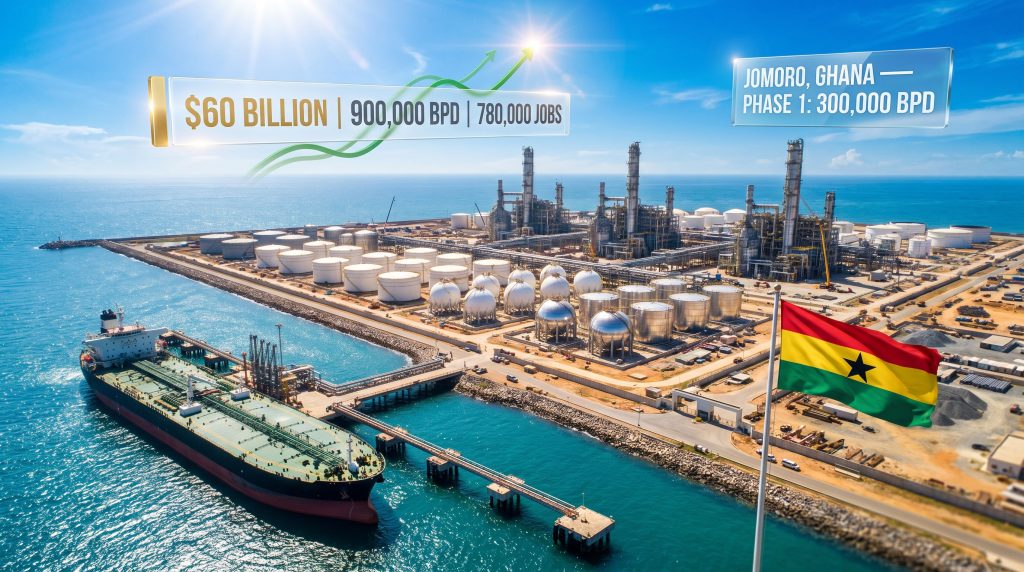
The PHDC was established with a mandate to transform Ghana into a hub for refined product processing and export across West Africa and the broader continent. The project's scale is genuinely extraordinary. The total three-phase development carries a projected cost of $60 billion, making it one of the largest single infrastructure investment programmes in African history.
The numbers across each phase tell a compelling story of progressive scale:
| Project Parameter | Specification |
|---|---|
| Total Hub Investment | $60 billion (all phases) |
| Phase 1 Capital Cost | $12 billion |
| Phase 1 Refining Capacity | 300,000 barrels per day (bpd) |
| Maximum Hub Refining Capacity | 900,000 bpd (expandable to 1.5 million bpd) |
| Petrochemical Plant Capacity | 90,000 bpd (Phase 1); five plants total by 2036 |
| Storage Infrastructure | 3 million m³ (Phase 1); 10 million m³ at full build-out |
| Total Land Footprint | 12,356 acres |
| Location | Jomoro Municipal District, Western Region, Ghana |
| Groundbreaking Date | August 19, 2024 |
| Full Hub Completion Target | 2036 |
The hub's free-zone designation under Ghanaian law is a critical structural feature that is often underappreciated in mainstream analysis. As a special economic zone, the PHDC hub operates under a distinct regulatory and tax framework designed to attract foreign capital, streamline export logistics, and enable competitive pricing of refined products in international markets. This model mirrors approaches taken at globally significant refining and petrochemical clusters such as Jurong Island in Singapore and the Ruwais industrial complex in the United Arab Emirates, both of which leveraged free-zone status to become world-class processing destinations.
Why Jomoro Was Selected Over Ghana's Existing Port Infrastructure
The site selection for the PHDC hub is one of the project's most technically significant decisions, and one that is frequently misunderstood in generalist coverage. The choice of Jomoro in Ghana's Western Region was driven primarily by marine geography rather than political considerations.
Waters offshore Jomoro reach depths of approximately 27 metres, compared with roughly 16 metres at Ghana's existing Port of Tema. This difference may appear modest in isolation, but in maritime logistics it is transformative. The deeper draft at Jomoro means the hub can accommodate Very Large Crude Carriers (VLCCs) and Ultra Large Crude Carriers (ULCCs), the world's largest tanker classes, which are simply unable to call at Tema's shallower berths.
| Port Feature | Jomoro (PHDC Site) | Tema (Existing) |
|---|---|---|
| Offshore Water Depth | ~27 metres | ~16 metres |
| Vessel Size Capability | All classes including VLCC/ULCC | Limited to mid-size tankers |
| Primary Function | Export-oriented refining hub | Import and domestic distribution |
| Proximity to Offshore Fields | Western Region (near Jubilee/TEN fields) | Eastern corridor |
This vessel size capability matters enormously for the hub's commercial model. An export-oriented refinery needs to load refined product cargoes efficiently onto large vessels to remain competitive in international markets. The ability to accommodate any class of tanker in the world gives the PHDC hub a structural freight cost advantage over alternatives constrained by shallower port access.
Jomoro's location in the Western Region also places it geographically closer to Ghana's offshore oil production zones, including the prolific Jubilee and TEN fields, reducing crude supply logistics complexity compared with transporting feedstock eastward to Tema.
How Phase One Construction Is Structured
The Core Infrastructure Commitments
Phase 1 of the Ghana PHDC refinery project centres on four integrated components:
- One 300,000 bpd crude oil refinery, the first of three planned across the full hub development
- One 90,000 bpd petrochemical processing plant, with four further plants targeted by 2036
- 3 million cubic metres of petroleum storage tank capacity
- A deep-water marine jetty capable of handling both crude import and refined product export logistics
Construction of Phase 1 is being led by the TCP-UIC Consortium, comprising Touchstone Capital Group, UIC Energy Ghana, China Wuhan Engineering, and China Construction Third Engineering Bureau. The involvement of Chinese engineering firms reflects a broader pattern in African infrastructure development, where Chinese construction contractors have developed significant expertise and competitive cost structures for large-scale industrial projects.
A preliminary storage agreement was signed with Mighty Gager on March 17 covering construction of 2 million tonnes of oil storage tank capacity, representing a tangible early contract milestone for Phase 1. Furthermore, groundbreaking on Phase 1 in August 2024 signalled a formal transition from planning to active project execution.
The Land Acquisition Bottleneck
The resolution of land compensation payments has been identified by PHDC leadership as the single most critical prerequisite before full construction mobilisation can proceed at the Jomoro site.
This is arguably the most important near-term detail for observers tracking the project's progress. The original site plan covered 20,000 acres, but following local community petitioning and consultation, the footprint was reduced to 12,356 acres (approximately 5,000 hectares). Within the retained boundary, PHDC has committed to preserving wetland areas rather than converting them for industrial use.
The compensation process involves residential, agricultural, and ecologically sensitive land categories. PHDC has indicated that disbursements are targeted for completion within the current calendar year, after which full construction mobilisation and contractor deployment are expected to follow. Until that process concludes, site access remains partially constrained.
Large-scale African infrastructure projects have a documented history of delays stemming from protracted land compensation disputes. The PHDC's proactive reduction of its land footprint and public commitment to wetland preservation suggest an awareness of this risk, though the timeline remains dependent on administrative execution.
The Demand Foundation: Why Sub-Saharan Africa Needs This Capacity
Population Growth as the Structural Driver
The commercial rationale for the Ghana PHDC refinery project rests on a demand trajectory that is, by most analytical frameworks, genuinely compelling. Sub-Saharan Africa's population is projected to roughly double by 2050, and liquid fuel consumption is strongly correlated with population growth and economic development in regions where electric vehicle penetration remains nascent.
According to energy consultancy Citac, gasoil demand across sub-Saharan Africa is forecast to rise by 59% from 2023 levels to approximately 70 million tonnes per year, while gasoline demand is projected to climb by 50% to around 60 million tonnes per year. These are not marginal increments. They represent a structural step-change in regional fuel consumption that existing infrastructure is wholly inadequate to absorb.
At the country level, the numbers are equally instructive. Ghana's domestic fuel consumption grew by 15.3% year-on-year to 4.5 billion litres in the most recently reported period, according to the head of Ghana's Chamber of Oil Marketing Companies, Riverson Oppong, speaking at the GhIPCON conference in Accra. Ghana's GDP expanded by 6% in 2025 according to the Ghana Statistical Service, reinforcing the well-established correlation between economic growth velocity and accelerating fuel demand.
The Import Substitution Opportunity
West African nations currently spend significant foreign exchange importing refined products from European, Middle Eastern, and Asian refineries, despite sitting above substantial crude reserves. This dynamic imposes a double cost: the foreign exchange burden of import payments and the foregone value-added processing margin that could otherwise be retained domestically. In addition, African mining finance trends illustrate how similar structural dependencies have constrained industrial value capture across the continent's resource sectors.
The PHDC hub's export-oriented model is designed to flip this equation. Rather than exporting crude at commodity prices and reimporting refined products at a premium, the hub would process crude locally and distribute finished products across West Africa and beyond, including to landlocked Sahel nations that currently depend entirely on coastal import routes for their fuel supply.
Comparing PHDC to Ghana's Existing Refining Infrastructure
Ghana's current refining landscape provides essential context for appreciating the transformative scale of the PHDC project.
| Refinery | Ownership | Capacity | Location |
|---|---|---|---|
| Tema Oil Refinery | State-owned | 45,000 bpd | Tema, east of Accra |
| Sentuo Refinery | Privately owned | 40,000 bpd | Tema, east of Accra |
| PHDC Hub (Phase 1) | PHDC / TCP-UIC Consortium | 300,000 bpd | Jomoro, Western Region |
| PHDC Hub (Full Build) | PHDC | 900,000 bpd (expandable to 1.5M bpd) | Jomoro, Western Region |
Ghana's combined existing refining capacity of approximately 85,000 bpd falls materially short of domestic consumption requirements, let alone any export ambition. Phase 1 of the PHDC hub alone would deliver more than three times that figure. At full build-out, Ghana would operate refining capacity exceeding 900,000 bpd, positioning it alongside the continent's most significant processing nations.
For regional context, Nigeria's Dangote Refinery carries a nameplate capacity of 650,000 bpd and has been widely cited as Africa's largest refinery. The PHDC hub's full capacity would surpass that benchmark, though the two projects serve partly different market orientations and product mixes. The PHDC hub's integrated petrochemical component, producing plastics feedstocks, industrial chemicals, and fertiliser precursors in addition to road fuels, represents a degree of downstream complexity that further differentiates the project.
The next major ASX story will hit our subscribers first
Projected Economic Impact and Sovereign Revenue
| Economic Impact Metric | Projected Figure |
|---|---|
| Estimated GDP Impact | ~70% increase in Ghana's GDP (full build-out) |
| Export Tax Revenue by 2030 | ~$1.56 billion annually |
| Direct and Indirect Jobs Created | Over 780,000 positions |
| Development Timeline | 3 phases (2024 to 2036) |
A 70% GDP uplift projection will attract scepticism from macroeconomic analysts, and appropriately so. Projections of this magnitude, spanning more than a decade and contingent on successful multi-phase execution, carry substantial uncertainty. Investors and policymakers should treat such figures as indicative of directional ambition rather than a reliable point forecast. Nonetheless, the infrastructure multiplier effects, encompassing road, power, water, and logistics development stimulated by construction and ongoing operations, are real and well-documented in comparable megaproject contexts globally.
The secondary industrialisation potential is a dimension that receives insufficient attention in most coverage of the project. A fully operational petrochemical complex alongside three refineries would create feedstock supply chains for domestic plastics manufacturing, fertiliser production, and industrial chemicals, seeding an entirely new layer of value-added industrial activity in Ghana's Western Region. This aligns closely with broader green industrial investment strategies emerging across the African continent.
Key Risks That Investors and Policymakers Must Monitor
Financing Complexity at Historic Scale
Mobilising $60 billion in project finance across a 12-year development horizon is among the most complex capital structuring challenges in emerging market infrastructure history. The project's dependence on consortium partners, international development finance institutions, and potentially sovereign co-investment means that any disruption to one financing stream can cascade through the overall programme. Comparable megaprojects in LNG development, such as Mozambique LNG and Qatar's North Field expansion, required years of intensive project finance structuring before reaching final investment decision.
Energy Transition Timing Risk
The 2036 full completion target intersects with an accelerating global energy transition. Developed market refined product demand is already past its structural peak in several product categories. However, the counter-argument for sub-Saharan Africa is substantive: electric vehicle adoption in the region is forecast to lag developed markets by decades, and liquid fuel demand growth is expected to persist well beyond 2036 on population and economic development trajectories alone. Shifts in global oil futures pricing will, furthermore, directly influence the hub's long-term feedstock economics and export competitiveness. The PHDC hub's export markets are, by design, concentrated in regions where this demand durability is most credible.
Construction Execution Over 12 Years
Multi-phase projects spanning more than a decade face compounding execution risks including cost escalation, contractor performance variability, political transition between administrations, and commodity price volatility affecting both capital costs and feedstock economics. African industrial decarbonisation pressures may also reshape the regulatory environment in which the hub operates over its extended development horizon. Ghana's relative political stability within the West African context is a genuine project enabler, but 12 years is a long horizon across which that stability must be maintained.
Frequently Asked Questions: Ghana PHDC Refinery Project
What is the PHDC refinery project?
The Ghana PHDC refinery project is a three-phase, $60 billion integrated petroleum hub being developed at Jomoro in Ghana's Western Region. At full capacity it will operate three refineries totalling 900,000 bpd, five petrochemical plants, 10 million cubic metres of storage, and deep-water marine infrastructure targeting West African and broader African refined product markets.
When will Phase 1 be complete?
Phase 1, encompassing a 300,000 bpd refinery, a 90,000 bpd petrochemical plant, and 3 million cubic metres of storage, carries a five-year construction timeline from commencement. Full hub completion across all three phases is targeted by 2036.
Who is building the project?
Phase 1 is being led by the TCP-UIC Consortium, comprising Touchstone Capital Group, UIC Energy Ghana, China Wuhan Engineering, and China Construction Third Engineering Bureau.
Why was Jomoro chosen as the site?
Jomoro's offshore water depth of approximately 27 metres enables the site to accommodate the world's largest crude tankers and refined product vessels, a capability unavailable at Ghana's existing Tema port, which has an offshore depth of roughly 16 metres.
What are the projected economic benefits?
PHDC projects the hub will contribute to approximately a 70% increase in Ghana's GDP at full build-out, generate around $1.56 billion in annual export tax revenue by 2030, and create over 780,000 direct and indirect employment positions. These figures are long-range projections subject to material execution and market uncertainty.
This article contains forward-looking projections and economic forecasts sourced from PHDC disclosures, energy consultancy Citac, the Ghana Statistical Service, and reporting by Argus Media. All projections involve material uncertainty and should not be construed as guarantees of future outcomes. Readers are encouraged to conduct independent analysis before making investment or commercial decisions.
Want to Identify the Next Major Resource Discovery Before the Market Moves?
Discovery Alert's proprietary Discovery IQ model delivers real-time alerts on significant ASX mineral discoveries, transforming complex resource data into actionable investment insights — much like the structural shifts reshaping Africa's downstream energy sector represent transformative opportunities for well-positioned investors. Explore how historic discoveries have generated substantial returns on Discovery Alert's dedicated discoveries page, and begin your 14-day free trial to ensure you're positioned ahead of the market.