June 19, 2026
The Quiet Countdown: Why Africa's Mining Lease Renewals Are Now High-Stakes Political Events
Across the African continent, a structural realignment is reshaping the relationship between sovereign governments and the international mining companies that have long extracted wealth from their soil. This is not a sudden development. It is the cumulative result of decades of fiscal arrangements negotiated when commodity prices were a fraction of current levels, combined with growing political sophistication among resource-holding nations and a generational shift in how African governments assess the long-term value of their mineral endowments.
At the heart of this shift lies a deceptively simple mechanism: the mining lease expiry. What was once treated as a routine administrative renewal has become one of the most consequential moments in modern resource governance. When a lease expires today, it is not just a contract question. It is a renegotiation of national identity, fiscal sovereignty, and the distribution of economic power between foreign capital and domestic communities.
Nowhere is this dynamic more sharply illustrated than in Ghana, where the question of Ghana local control of Gold Fields' Tarkwa mine is now approaching a decisive threshold. Furthermore, this situation reflects broader shifts in mining geopolitics that are reshaping investment decisions across the continent.
When big ASX news breaks, our subscribers know first
Understanding Tarkwa: A Mine That Shapes an Entire Company's Economics
Scale, Output, and Strategic Weight
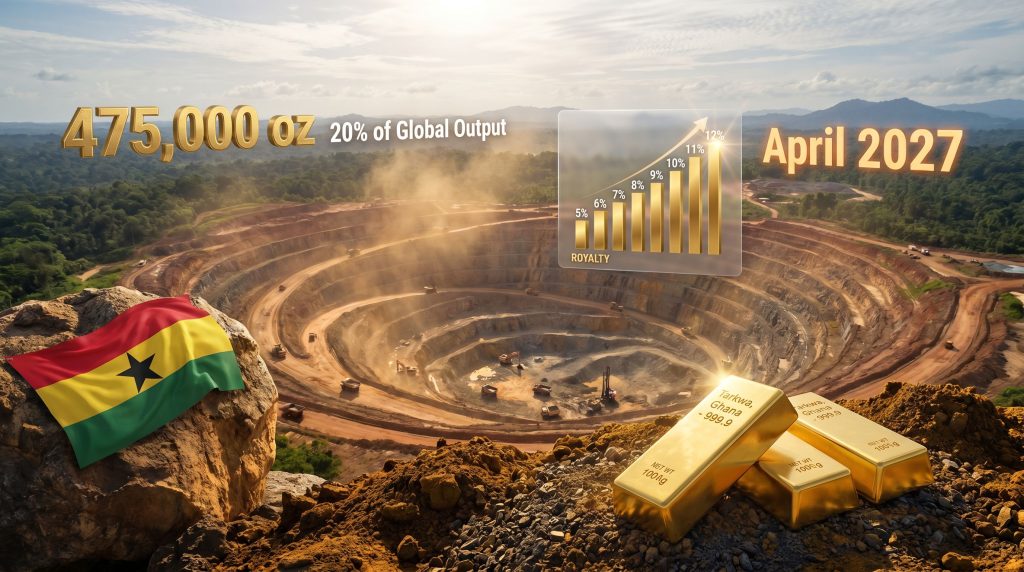
The Tarkwa mine sits in southwestern Ghana's Tarkwa district and represents one of West Africa's most productive gold operations. In the most recent full year of reporting, the mine generated approximately 475,000 ounces of gold, making it not just a major contributor to Ghana's national output but a foundational pillar of Gold Fields' entire global portfolio.
To understand why this single asset commands such strategic attention, consider the following breakdown:
| Metric | Figure |
|---|---|
| Tarkwa annual gold production | ~475,000 oz |
| Gold Fields total global output | ~2.5 million oz |
| Tarkwa share of Gold Fields output | ~20% |
| Gold Fields global footprint | Africa, Australia, South America |
| Gold Fields' stake in Tarkwa | ~90% |
| Government of Ghana free-carry interest | ~10% |
At spot prices exceeding $4,000 per ounce, Tarkwa's gross annual gold output represents well over $1.9 billion in revenue exposure. For a single mine to account for one-fifth of a globally diversified producer's total output is an extraordinary concentration of asset risk, and it explains why Gold Fields has reportedly been working on a 20-year operations and investment plan specifically for Tarkwa. The current gold price outlook only intensifies these stakes for both the operator and the Ghanaian government.
The Free-Carry Interest and What It Actually Means
Ghana's current 10% free-carry interest in the Tarkwa operation is a mechanism that entitles the state to a proportional share of profits without requiring it to contribute development capital. On the surface, this appears advantageous for Ghana. In practice, however, a free-carry interest grants the holder no operational authority, no board control, and no ability to shape day-to-day management decisions.
A free-carry interest is economically passive. It provides income but no influence. The distinction between receiving a share of profits and holding operational control is the central tension driving Ghana's current lease review.
Gold Fields Ghana Limited has held the Tarkwa concession since 1993, giving the company more than three decades of continuous operational presence at the site. The current mining lease is scheduled to expire in April 2027, and the Ghanaian government is actively evaluating whether continuity or structural change better serves national interests.
How Ghana Arrived at This Crossroads: A Policy Escalation Timeline
From Passive Royalty Recipient to Active Resource Steward
Ghana's shift from a largely passive role in its mining sector to a more assertive posture has been gradual but consistent. The country has incrementally tightened its fiscal take from gold production, most visibly through royalty rate increases. Ghana raised gold bullion royalties from 5% to as much as 12%, more than doubling the state's share of gross production value. At current gold prices, this uplift in the royalty rate represents a substantial transfer of wealth from operators to the state treasury.
This royalty escalation follows a logic that is well understood in resource economics: agreements negotiated during low-price environments systematically undervalue the resource at high-price conditions. When gold was trading below $1,500 per ounce, a 5% royalty represented a different economic reality than it does today with prices exceeding $4,000 per ounce.
The Damang Precedent: Ghana's Dress Rehearsal
The policy decision with the most direct relevance to the Tarkwa situation occurred earlier in 2026, when Gold Fields' other Ghanaian operation, the Damang mine, reached its own lease expiry point. Rather than offering a straightforward renewal, Ghana's government assumed control of the asset and conducted a competitive tender process. The winning bid was submitted by Engineers and Planners Co., a Ghanaian firm, which was awarded the Damang concession.
Critically, Ghana restricted participation in that tender to local companies only. This was not merely a procedural preference. It was a clear policy statement about the government's vision for ownership distribution within the gold sector.
The Damang outcome is not historical background. It is a live policy template. It demonstrated that Ghana possesses both the political will and the administrative capability to run a competitive tender for a major gold asset when a lease expires, and that it is prepared to exclude international bidders from that process.
There is an additional dimension to the Damang outcome that carries political weight. Engineers and Planners Co., the firm awarded the concession, is associated with a family member of President John Mahama. This has added a layer of public scrutiny to how the Tarkwa review process will be managed and whether it will be perceived as genuinely competitive and transparent.
Scenario Analysis: Four Pathways for Tarkwa's Future
Comparing the Options
| Scenario | Core Description | Key Probability Drivers | Implications for Gold Fields |
|---|---|---|---|
| Lease Extension | Ghana renews Gold Fields' operating rights under revised commercial terms | Strong operational track record; technical complexity of the asset | Continuity with likely royalty or equity renegotiation |
| Competitive Local Tender | Ghanaian companies submit bids; winner assumes operational control | Damang precedent; political pressure for local ownership | Loss of roughly 20% of global output; asset write-down risk |
| Hybrid Joint Venture | Increased Ghanaian equity stake with Gold Fields retaining operational management | Balances sovereignty objectives with technical continuity | Diluted economics but preserved operational presence |
| State Acquisition | Government entity assumes full operational and financial control | Highest ambition scenario; requires substantial state capital and capability | Full exit from Ghana's largest gold operation |
What the Signals Are Actually Saying
Ghana's Ministry of Lands and Natural Resources has declined to provide official comment on the Tarkwa renewal process. This deliberate silence is itself a negotiating posture. By maintaining ambiguity, the government preserves maximum flexibility and places the burden of uncertainty squarely on Gold Fields' planning horizon.
Gold Fields, for its part, has confirmed it submitted an early lease renewal application and characterised its engagements with Ghanaian authorities as constructive. This proactive approach suggests the company is prioritising a negotiated outcome over a confrontational one. The company's publicly stated 20-year investment plan for Tarkwa further signals its intent to remain a long-term operator, rather than winding down ahead of the lease expiry.
According to reporting by Mining Weekly, evaluation criteria being considered for any bid process include commitments around environmental rehabilitation, local employment generation, and infrastructure development within host communities surrounding the mine.
The Geopolitical Layer: South African Companies Under Pressure
A Diplomatic Undercurrent That Cannot Be Ignored
The Tarkwa lease review is not occurring in a geopolitical vacuum. President Mahama's administration is navigating significant political pressure related to a wave of anti-immigrant demonstrations in South Africa. More than 2,700 nationals from Ghana, Nigeria, Mozambique, and Malawi have been assisted in returning home from South Africa, amid concerns that xenophobic tensions could escalate further.
Gold Fields is headquartered in Johannesburg, South Africa, which places the company directly in the frame of this bilateral diplomatic tension. South African-headquartered mining companies operating in Ghana are, consequently, facing heightened political scrutiny in ways that would not have been as acute even two years ago.
It is important to distinguish between two forces that are likely operating simultaneously:
- Economic sovereignty logic: Ghana's push for greater mineral ownership is a long-running structural trend, independent of bilateral relations with South Africa.
- Diplomatic signalling: The current political climate creates additional pressure on the Mahama administration to demonstrate assertiveness toward South African corporate interests.
Conflating these two forces risks misreading the policy trajectory. Ghana's resource nationalism agenda would be advancing regardless of the South African diplomatic context. However, that context may be accelerating the timeline and raising the political cost of any outcome that is perceived as too favourable to foreign operators.
Financial Exposure and Strategic Options for Gold Fields
Quantifying the Risk
For investors monitoring Gold Fields, the Tarkwa lease expiry represents one of the most material single-asset risk events on the company's near-term calendar. At current gold prices above $4,000 per ounce, a production base of approximately 475,000 ounces per year translates to enormous gross revenue exposure from this single asset alone. In addition, the broader gold market outlook suggests sustained elevated prices, which only increases the fiscal incentive for Ghana to pursue structural change.
Gold Fields' strategic response options can be broadly categorised as follows:
- Early engagement: Already executed. The company has submitted a proactive renewal application ahead of the April 2027 deadline.
- Equity concessions: Offering Ghana an increased ownership stake, potentially moving beyond the current 10% free-carry to a more meaningful equity position, as a negotiating lever.
- Community investment commitments: Accelerating local employment pledges, supplier development programmes, and infrastructure contributions to strengthen the renewal case.
- Long-term investment signalling: Publicly presenting the 20-year Tarkwa operations plan as evidence of committed long-term stewardship.
- Legal backstops: Bilateral investment treaty protections and international arbitration mechanisms exist as last-resort options, though invoking them would be politically damaging and operationally counterproductive.
Investor Note: Gold Fields' earnings guidance and share price trajectory are materially sensitive to the Tarkwa outcome. The April 2027 lease deadline should be treated as a key risk event requiring close monitoring across the company's quarterly disclosures.
The next major ASX story will hit our subscribers first
Ghana Within the African Resource Nationalism Spectrum
How Ghana's Approach Compares Regionally
| Country | Primary Policy Mechanism | Target Commodity | State Ownership Requirement |
|---|---|---|---|
| Ghana | Lease non-renewal; royalty escalation; local-only tenders | Gold | Under active development |
| Tanzania | Contract renegotiation; mandatory state equity | Gold, Diamonds | Minimum 16% government stake |
| DRC | Revised mining code | Cobalt, Copper | 10% state stake plus local content rules |
| Zambia | Windfall tax proposals; ownership review | Copper | Evolving framework |
| Zimbabwe | Mandatory beneficiation; export restrictions | Gold, Lithium | Domestic processing requirements |
The Unintended Consequences Risk
Resource nationalism strategies carry inherent risks that policymakers must weigh against the appeal of maximum short-term revenue capture. Furthermore, the wave of mining industry consolidation occurring globally means Ghana must carefully balance assertiveness with remaining an attractive destination for long-term capital.
- Investor confidence erosion: Retroactive changes to lease terms or ownership structures signal policy unpredictability, which raises the risk premium demanded by all future investors in the sector.
- Technical capability gaps: Large-scale gold operations like Tarkwa require sophisticated geological, metallurgical, and operational expertise. Transitioning ownership without retaining that expertise poses real production continuity risks.
- Capital replacement challenges: The capital required to sustain a mine of Tarkwa's scale is substantial. Replacing international mining capital with domestic sources is achievable in principle but demands either significant state financial commitment or new foreign partnerships.
- Precedent effects: The terms on which Tarkwa is resolved will be watched closely by every international mining company with African exposure, shaping investment decisions across the continent.
Frequently Asked Questions: Ghana Tarkwa Mine Local Control
What is the current ownership structure of the Tarkwa mine?
Gold Fields Ghana Limited holds approximately 90% of the Tarkwa operation, with the Government of Ghana retaining a 10% free-carry interest, meaning the state receives a proportional share of profits without contributing development capital. This arrangement has been in place since Gold Fields acquired the concession in 1993.
When does the Tarkwa mining lease expire?
The current Tarkwa mining lease is scheduled to expire in April 2027. Ghana's government is evaluating whether to renew the lease for Gold Fields or pursue an alternative arrangement, potentially including a local-only competitive tender process.
How much gold does the Tarkwa mine produce?
Tarkwa produced approximately 475,000 ounces of gold in the most recent full year of operations, representing roughly 20% of Gold Fields' total global output of approximately 2.5 million ounces per year.
What happened to Gold Fields' Damang mine in Ghana?
The Damang mine was transferred to state control when its lease expired in 2026. A competitive tender restricted to Ghanaian companies was subsequently conducted, with the concession awarded to Engineers and Planners Co. The Damang process is widely regarded as the direct policy precedent for how Ghana local control of Gold Fields' Tarkwa mine may ultimately be approached.
What are Ghana's royalty rates on gold mining?
Ghana has raised gold royalties to as high as 12%, up from a previous rate of 5%, more than doubling the state's share from gold production value.
What criteria will Ghana use to evaluate Tarkwa bids?
Evaluation criteria reportedly include commitments around environmental rehabilitation, local employment generation, and infrastructure development in communities surrounding the mine.
Key Milestones to Watch Before April 2027
The period between now and the April 2027 lease deadline will produce several decision points that investors, industry observers, and policymakers should monitor closely. Increased gold M&A activity globally also means that the strategic value of assets like Tarkwa is being reassessed continuously, adding further complexity to any renewal negotiations.
- Minerals Commission announcements: Any formal tender notice or lease renewal confirmation from Ghana's Minerals Commission will be the clearest signal of the government's chosen direction.
- Gold Fields quarterly disclosures: Watch for increasing specificity around Tarkwa lease risk in the company's investor communications as the deadline approaches.
- Ghanaian parliamentary debate: Legislative discussions around mining policy reform may surface the government's preferred approach before any formal public announcement.
- Diplomatic trajectory: The evolution of South Africa-Ghana relations will remain a contextual factor shaping the political environment around the final decision.
- Gold price levels: Sustained gold prices above $4,000 per ounce materially increase the fiscal incentive for Ghana to pursue structural change rather than a straightforward renewal.
The Ghana local control of Gold Fields' Tarkwa mine situation is ultimately a convergence of commodity price politics, African resource sovereignty, bilateral diplomatic tensions, and the enduring question of who captures the long-term value of a nation's finite mineral wealth. The outcome will set a precedent not only for Ghana's gold sector but for the terms on which major international mining companies negotiate lease renewals across the African continent in an era of elevated commodity prices and rising resource nationalism.
This article is intended for informational purposes only and does not constitute financial or investment advice. Forward-looking statements and scenario projections involve inherent uncertainty. Readers should conduct independent research before making investment decisions. For ongoing coverage of Ghana's mining governance landscape and African resource nationalism trends, Mining Weekly at miningweekly.com provides comprehensive reporting across African mining jurisdictions.
Want to Track the Next Major Mineral Discovery Before the Market Does?
Discovery Alert's proprietary Discovery IQ model scans ASX announcements in real time, instantly converting complex mineral data across 30+ commodities into clear, actionable insights — explore historic discoveries and their returns to understand the opportunity, then begin your 14-day free trial at Discovery Alert to position yourself ahead of the broader market.