June 19, 2026
Tailings Management Is Rewriting the Economics of Australian Gold Development
The global mining industry learned hard lessons from a series of catastrophic tailings dam failures in the 2010s and early 2020s. Brumadinho in Brazil. Mount Polley in Canada. The human and environmental cost of those events permanently shifted the regulatory and social calculus around how mine waste is stored. In Australia, that shift has been playing out not just through updated technical standards, but through direct regulatory intervention at the project approval stage. The result is a new reality for developers: tailings management is no longer a backend engineering consideration. It is a front-door approval issue.
Nowhere is this more visible right now than at the McPhillamys gold project in New South Wales, where the Regis McPhillamys alternative tailings strategy has forced a fundamental reconception of its waste storage approach. This followed a federal heritage protection decision in 2024 that blocked the project's original tailings storage facility design. The revised concept, centred on an integrated waste landform, represents more than a technical workaround. It reflects a broader industry reckoning with how mine waste is planned, sited, and justified in an era of heightened environmental and cultural heritage scrutiny.
When big ASX news breaks, our subscribers know first
Understanding What Was Actually Blocked at McPhillamys
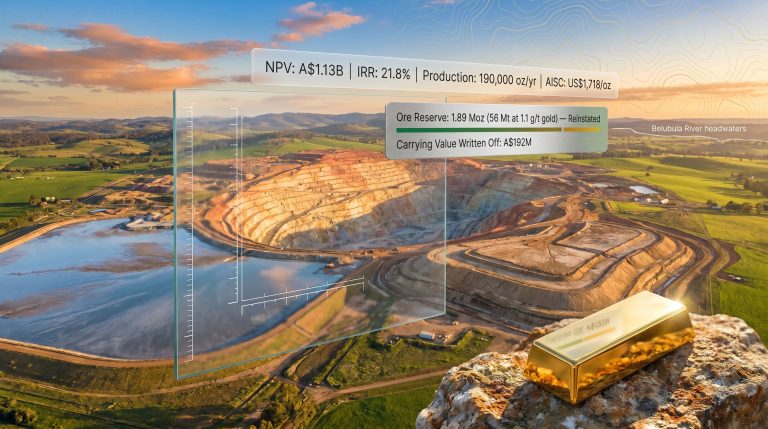
McPhillamys sits approximately 250 kilometres west of Sydney in the central-west region of New South Wales. The project is operated by Regis Resources and is widely regarded as one of the most significant undeveloped gold assets in eastern Australia, carrying a development value in the vicinity of one billion dollars.
The 2024 federal decision that halted progress was specific in its scope. It did not cancel the mine. It did not void the project's broader approval framework. What it targeted was a single component: the proposed tailings storage facility, which had been designed to sit near the headwaters of the Belubula River. This waterway carries recognised Aboriginal cultural heritage values, and the federal intervention was made on those grounds.
This distinction matters enormously for understanding the current situation. The open pit design, the ore processing infrastructure, and the surrounding site approvals remain technically intact. McPhillamys was not sent back to square one. It was blocked at the waste storage stage, which means the revised strategy does not require reconstructing the entire approval from the beginning.
The 2024 federal decision was a surgical intervention, not a wholesale project cancellation. This framing is central to why Regis was able to develop an alternative concept faster than its own initial estimates suggested was possible.
Furthermore, broader gold sector challenges around regulatory approvals and environmental sensitivities are making stories like McPhillamys increasingly common across the Australian resources industry.
What the Integrated Waste Landform Actually Does
Engineering Logic Behind Co-Disposal
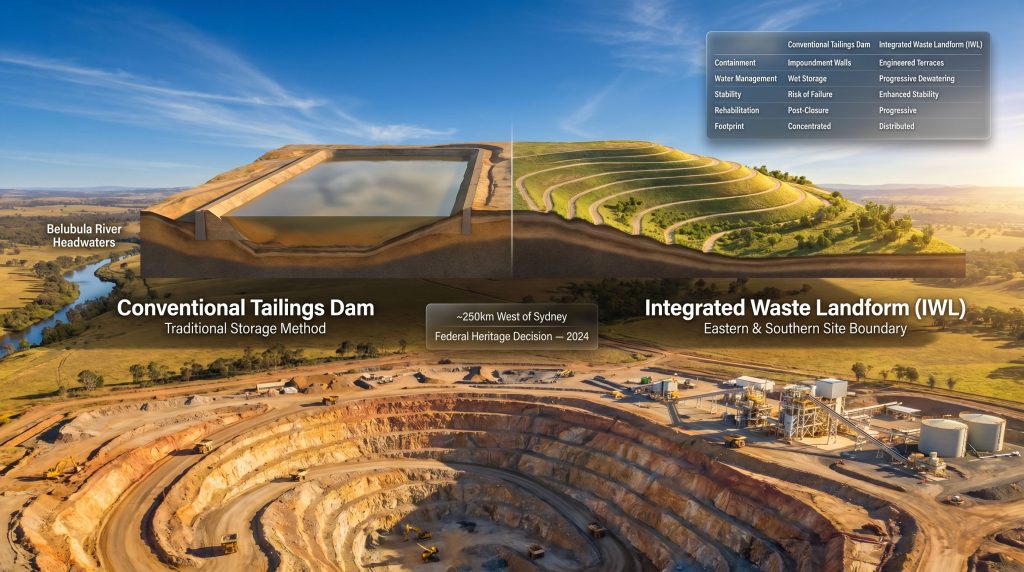
A conventional tailings storage facility operates on a straightforward but risk-laden principle: fine-grained processed material is pumped as water-laden slurry into a containment dam held behind an engineered embankment. The structure must be continuously managed throughout the mine's life and monitored indefinitely after closure. Large volumes of process water are retained within the dam, and the consequence profile of a structural failure is substantial.
An integrated waste landform (IWL) departs from this logic entirely. Rather than separating coarse waste rock and fine tailings into distinct storage areas, the two material streams are co-disposed into a single engineered landform. The coarse waste rock provides structural integrity, while the processed tailings fill the voids within that matrix. The resulting structure is shaped and contoured, rather than impounded behind a wall, and can begin rehabilitation progressively as operations advance.
At McPhillamys, Regis has proposed positioning this IWL along the eastern and southern edges of the project site, a deliberate choice designed to move waste storage away from the environmentally and culturally sensitive Belubula River corridor to the west. Regis Resources has outlined this revised approach as a practical pathway forward given the constraints imposed by the 2024 federal decision.
Comparing Tailings Management Approaches
| Characteristic | Conventional Tailings Dam | Integrated Waste Landform (IWL) | Dry Stack Tailings |
|---|---|---|---|
| Waste integration | Tailings stored separately | Tailings and rock co-disposed | Filtered tailings only |
| Water impoundment | High volume retained | Minimal impoundment required | No impoundment |
| Capital intensity | Moderate | Low to moderate | High (filtration plant) |
| Structural failure risk | Higher | Lower | Very low |
| Progressive rehabilitation | Deferred to closure | Possible during operations | Possible during operations |
| Best suited to | High tailings volume, flat sites | Sites with abundant waste rock | Water-scarce environments |
Why Dry Stack Was Not Selected
The McPhillamys project generates substantial open pit waste rock volumes. This is a critical engineering variable. Dry stack tailings systems require significant capital investment in filtration infrastructure to dewater tailings sufficiently for mechanical stacking. At the scale of McPhillamys, the co-disposal approach leverages the project's inherent waste rock inventory as a structural input, eliminating the need for high-capacity filtration equipment and reducing upfront capital requirements.
The IWL is, in this context, a resource-efficient solution that makes practical use of material the project will produce regardless. Paste tailings and thickened tailings systems offer intermediate options, reducing pond size without eliminating water impoundment entirely. However, they do not resolve the siting sensitivity in the same way a fully landform-based design does. For McPhillamys specifically, the primary driver is not just technical performance but regulatory geography. The IWL's placement on the eastern and southern perimeter directly addresses the spatial conflict that caused the original design to fail.
Regis's Own Position: Workable, Not Preferred
One of the more instructive aspects of the McPhillamys situation is how Regis Resources has characterised the IWL publicly. The company has been transparent in stating that the original tailings dam design remains its technically preferred solution. The IWL is described as a practical and technically sound alternative, which is a careful but meaningful distinction.
This language is not unusual in mining project communications, but it carries real analytical weight. When an operator describes its revised plan as workable rather than superior, investors and regulators alike should recognise that trade-offs have been accepted. The IWL likely involves compromises in operational logistics, material handling complexity, or long-term rehabilitation cost relative to the original design.
When a mining company tells you its revised plan is technically sound and practical, it is also implicitly telling you that its original plan was technically better. Understanding the gap between those two positions is part of assessing project execution risk.
The Regulatory Hurdle That Remains
Three Pathways, Very Different Outcomes
Substituting a fundamentally different waste storage system within an existing approved project triggers a question that has no simple answer: does this change require new regulatory approval, or can it be accommodated within the existing framework?
Under Australian environmental law, the materiality of a project modification determines the approval pathway required. The three scenarios Regis now faces are meaningfully different in their timeline implications:
- No additional approval required – Regulators assess the IWL as falling within the scope of existing state and federal approvals, allowing construction planning to proceed without a new referral process.
- State-level modification – The New South Wales planning approval requires a formal amendment to reflect the revised waste storage design. This adds regulatory process time but does not restart the project from scratch.
- New federal referral – If the IWL is determined to introduce new environmental or heritage considerations not covered by the original approvals, a fresh federal assessment could be triggered. This is the most time-intensive scenario and could add years to the timeline.
The gap between pathways two and three is potentially measured in years, not months. Investors monitoring McPhillamys should treat regulatory pathway determination as the single most important near-term milestone for the project. A definitive feasibility study will ultimately be required to reflect whatever tailings solution is formally approved before development can proceed.
The Heritage Question Has Not Disappeared
Moving the waste landform away from the Belubula River headwaters is a logical and constructive design response. However, the eastern and southern site edges are not automatically free of cultural heritage sensitivity. New South Wales has a complex and geographically distributed Aboriginal heritage landscape, and the footprint of any new landform structure requires its own heritage assessment.
The critical question is whether the IWL's repositioned footprint avoids the specific heritage values that triggered the 2024 federal decision, or whether it introduces new areas of sensitivity that require fresh evaluation. Regis has indicated the revised design is intended to work within the existing approvals framework, but this remains subject to regulatory interpretation rather than operator determination.
What Infrastructure Already Exists
A factor that often goes underappreciated in assessments of McPhillamys is how much foundational work has already been completed. Feasibility studies, environmental impact assessments, mining leases, and processing facility approvals represent years of technical and regulatory investment. The mine design itself has not been invalidated by the tailings decision.
This positions McPhillamys as a project with genuine acceleration potential relative to a true greenfield development. Once the tailings question achieves regulatory resolution, the pathway from clearance to construction commencement is considerably shorter than it would be for a project starting from scratch. The infrastructure groundwork is laid. The ore body is defined. The processing design is approved.
The original Regis estimate that the Regis McPhillamys alternative tailings strategy could take up to a decade to develop now looks like a worst-case framing. The IWL concept has emerged considerably faster, suggesting the company's technical teams identified co-disposal as a viable path more quickly than external observers anticipated.
The next major ASX story will hit our subscribers first
ESG Dimensions of the IWL Approach
Where Landform Design and ESG Expectations Converge
The integrated waste landform approach carries several attributes that align with the direction of travel in ESG expectations across the Australian mining sector. In addition, understanding natural capital in mining has become increasingly important as companies seek to quantify and manage their environmental footprint more rigorously.
The key ESG benefits of the IWL approach include:
- Reduced catastrophic risk profile – Without a large impounded water body, the consequence severity of a structural failure event is substantially lower than with a conventional tailings dam. This has direct implications for insurance, community relations, and investor ESG screening criteria.
- Progressive rehabilitation capability – The contoured landform structure can be vegetated and stabilised in stages during the operational life of the mine, rather than deferring all rehabilitation to the closure phase. This reduces post-mining financial liability and improves the project's closure cost certainty.
- Reduced long-term monitoring burden – Conventional tailings dams require ongoing geotechnical surveillance for decades after closure. A stable, compacted landform with no retained water impoundment has a fundamentally different and less demanding long-term management requirement.
- Improved community defensibility – In a region with recognised heritage sensitivities, a design that demonstrably moves waste storage away from culturally significant waterways carries social licence value that a technically superior but poorly sited conventional dam cannot match.
The Post-Brumadinho Regulatory Context
The global tailings management framework shifted materially following the Brumadinho dam failure in Brazil in January 2019, which killed 270 people and released approximately 12 million cubic metres of iron ore tailings. The International Council on Mining and Metals, together with the United Nations Environment Programme, subsequently developed the Global Industry Standard on Tailings Management, published in 2020. Australian regulators and operators have progressively incorporated its principles into project design and approval frameworks.
Within this context, landform-based disposal systems that eliminate or minimise water impoundment represent not just a regulatory workaround for the Regis McPhillamys alternative tailings strategy but a directional alignment with where institutional expectations around tailings management are heading. Consequently, projects that demonstrate this alignment may face a less adversarial approval environment than those defending conventional dam designs near sensitive receptors. The broader mining sustainability transformation underway across the sector reinforces this trajectory, as does growing awareness of mine reclamation importance in shaping long-term project viability.
Key Facts: McPhillamys IWL Strategy at a Glance
| Factor | Detail |
|---|---|
| Project location | ~250km west of Sydney, central-west New South Wales |
| Blocking event | Federal heritage protection decision, 2024 |
| Heritage sensitivity | Belubula River headwaters, Aboriginal cultural heritage values |
| Original design | Conventional tailings storage facility (tailings dam) |
| Revised design | Integrated waste landform (co-disposal of tailings and waste rock) |
| IWL location on site | Eastern and southern site perimeter |
| Core mine layout status | Unchanged under revised plan |
| Regis's stated preference | Original tailings dam design remains the optimal technical solution |
| Regulatory pathway | Undetermined: modification or new federal referral remains possible |
| Previously flagged timeline | Up to 10 years for an alternative; IWL emerged significantly faster |
| Key ESG benefit | Reduced failure risk, progressive rehabilitation, lower long-term liability |
Frequently Asked Questions
What is the McPhillamys gold project?
McPhillamys is a large-scale open pit gold development located approximately 250 kilometres west of Sydney in New South Wales, operated by Regis Resources. It is considered one of the most significant undeveloped gold assets in eastern Australia, with development costs in the vicinity of one billion dollars.
Why was the original tailings plan blocked?
The original tailings storage facility was proposed near the headwaters of the Belubula River, a site with recognised Aboriginal cultural heritage values. A federal heritage protection decision in 2024 blocked this specific component of the project. The broader mine approval framework was not cancelled.
What is an integrated waste landform?
An IWL is a co-disposal system that combines processed tailings with coarse waste rock from open pit mining to create a single engineered landform. Rather than impounding liquid tailings behind a dam wall, the material is shaped into a stable, contoured structure that can be progressively rehabilitated during the mine's operational life.
Does the IWL require new regulatory approvals?
This remains a key uncertainty. Depending on how regulators assess the materiality of the design change, the IWL may require a state-level modification to existing New South Wales approvals or, in a more significant scenario, a new federal environmental referral. Regis has indicated the revised design is intended to function within the existing approvals framework.
Is the IWL Regis's preferred technical solution?
No. Regis has publicly stated the original tailings dam design remains the optimal technical solution for the project. The IWL is being advanced as a practically and technically sound alternative that enables the project to move forward within the current regulatory environment.
This article is intended for informational purposes only and does not constitute financial advice. Statements regarding timelines, regulatory outcomes, and project development scenarios involve uncertainty and should not be interpreted as guarantees of future performance. Readers should conduct independent research and seek professional advice before making investment decisions. References to regulatory processes reflect publicly available information and may be subject to change.
Want to Stay Ahead of Major ASX Mineral Discoveries as They Happen?
Discovery Alert's proprietary Discovery IQ model delivers real-time alerts on significant ASX mineral discoveries the moment they are announced, turning complex exploration data into actionable investment insights — explore historic discovery returns on the dedicated discoveries page to understand what early positioning can mean, then begin your 14-day free trial at Discovery Alert to secure your market-leading edge.