June 19, 2026
Africa's Gold Refining Bottleneck: Why Infrastructure Lags Behind Production
Across sub-Saharan Africa, a recurring pattern has defined gold-producing nations for decades: mining output expands faster than the downstream infrastructure required to process it. Countries drill, blast, and extract at an accelerating pace, yet the refining capacity needed to convert raw doré into tradeable, investment-grade gold bars frequently becomes the binding constraint. The result is a structural inefficiency that limits sovereign revenue, suppresses employment in value-added industries, and forces nations to export partially processed material at a discount. Zimbabwe is now confronting this exact challenge head-on, and the licensing of a Zimbabwe second gold refinery in Bulawayo represents a pivotal attempt to break that cycle.
When big ASX news breaks, our subscribers know first
Why Zimbabwe's Gold Refining Infrastructure Is Under Strain
The Capacity Ceiling: Understanding Fidelity Gold Refinery's Limitations
Zimbabwe's entire gold output currently flows through a single chokepoint: Fidelity Gold Refinery, the state-owned entity that legally handles all gold sales and processing within the country. While Fidelity has served as a functional institution for decades, its architecture was not designed to absorb the kind of production surge Zimbabwe is now engineering.
The risks of a single-refinery system are not theoretical. When one facility manages an entire nation's precious metal output, any operational disruption — whether from power outages, equipment failure, or administrative delays — cascades directly into national revenue shortfalls. Furthermore, as Zimbabwe accelerates toward higher production targets, the refinery's processing ceiling becomes a hard limit on how much of that growth can be monetised domestically.
Zimbabwe's Gold Output Trajectory: A Decade of Accelerating Growth
The scale of Zimbabwe's gold production expansion over the past ten years is remarkable by any regional standard. Output has more than doubled across the decade, driven initially by the formalisation of artisanal and small-scale mining, and more recently by mid-tier commercial operations coming online with improved ore recovery technology. For broader context on recent gold production insights, the trajectory across the region reflects similar structural pressures.
| Year | Estimated Output | Primary Driver |
|---|---|---|
| 2015–2016 | Baseline pre-growth era | Artisanal and small-scale sector expansion |
| 2024 | ~43–44 tonnes | Improved recovery rates, new project activity |
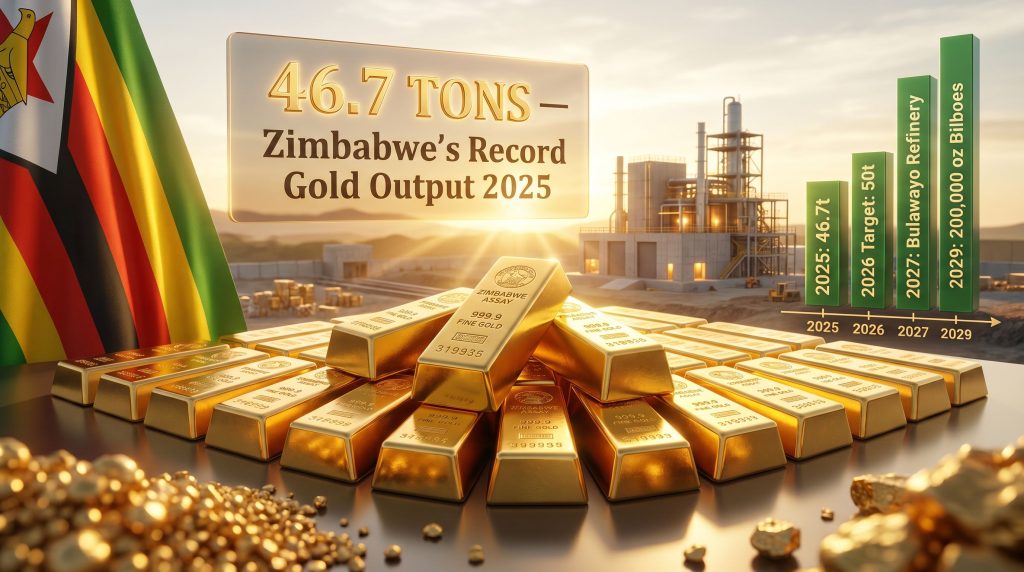
| 2025 | 46.7 tonnes (record) | Expanded mid-tier commercial production |
| 2026 (target) | 50 tonnes | New project commissioning, price incentives |
| 2029 (projected) | 50+ tonnes | Bilboes and Mutapa expansions reaching capacity |
A 130% improvement in the global gold price over the prior three years has been instrumental in catalysing fresh capital into Zimbabwean operations. Higher prices improve the economics of marginal deposits and incentivise producers to expand throughput aggressively. The consequence is a self-reinforcing production cycle that Fidelity's existing infrastructure was not built to accommodate.
It is worth noting a critical geological dimension that often goes unreported in mainstream coverage. Zimbabwe sits on the Zimbabwe Craton, one of the world's oldest and most geologically stable Archean cratons, estimated at approximately 2.7 billion years old. The craton hosts a series of greenstone belts — ancient volcanic and sedimentary sequences known globally as among the most prolific gold-bearing geological environments. These belts, including the Midlands and Gwanda greenstone belts, have consistently delivered mineralisation with favourable structural controls. This geological foundation underpins the long-term production ambitions that make refinery infrastructure so strategically important.
What Is Zimbabwe's Second Gold Refinery in Bulawayo?
Key Facts About the Newly Licensed Bulawayo Refinery
Featured Snippet: Zimbabwe has granted a licence for a second gold refinery to be constructed in Bulawayo, the country's second-largest city. The facility is designed to supplement the existing state-owned refining system and is expected to be commissioned in 2027. The identities of the private investors behind the project have not yet been publicly disclosed, with government officials indicating those details will be released at the time of commissioning.
The core facts, as confirmed through reporting by Bulawayo24 and other regional outlets, are as follows:
- Location: Bulawayo, Zimbabwe's industrial heartland and second most populous urban centre
- Commissioning timeline: Expected in 2027
- Primary purpose: To absorb gold production volumes that exceed Fidelity's operational capacity
- Investor identity: Withheld pending commissioning; officials confirmed disclosure will occur at that stage
- Ministerial comment: Zimbabwe's Ministry of Mines declined to issue a public statement on the project
The decision to withhold investor identities until commissioning is itself a notable governance detail. In mature mining jurisdictions, transparency around capital ownership is typically a precondition for licensing, not a post-commissioning formality. This approach may reflect Zimbabwe's historically complex relationship between state institutions and private capital, particularly in the resource sector, where political sensitivities around ownership can be acute.
Why Bulawayo Was Selected as the Refinery Location
The choice of Bulawayo over Harare is strategically logical for several reasons that extend beyond simple geography:
- Industrial legacy: Bulawayo was Zimbabwe's manufacturing hub throughout the 20th century and retains a denser concentration of industrial infrastructure than any other city outside the capital
- Mining corridor proximity: The Matabeleland region surrounding Bulawayo hosts numerous active gold operations, reducing the logistical distance between mine output and refining
- Existing infrastructure: Power grid connectivity, rail linkages, and road networks are comparatively well-developed relative to more remote mining corridors
- Labour pool: Bulawayo retains a skilled industrial and technical workforce, a legacy of its manufacturing history, which is directly applicable to refinery operations
- Export positioning: The city's proximity to southern African transport corridors supports onward gold movement to international markets
According to The Herald Online, the construction of the new facility reinforces Bulawayo's growing role as a strategic industrial node in Zimbabwe's minerals economy.
How Does Zimbabwe's Refining Expansion Fit Into Its Broader Gold Strategy?
The Policy Logic Behind Domestic Value Addition
Zimbabwe's minerals beneficiation policy framework has for years mandated in-country processing of raw natural resources rather than exporting unrefined material. The underlying economic logic is compelling: a country that exports doré bars for offshore refining is, in effect, exporting a portion of the employment, tax revenue, and industrial activity that could be retained domestically.
Gold refining is not merely a technical process; it is an economic multiplier. A refined gold bar commands a premium over doré because it meets the purity specifications required by international trading platforms, central banks, and jewellery manufacturers. By capturing that value-addition step domestically, Zimbabwe retains a larger proportion of each ounce's worth within its own fiscal system. This aligns closely with the broader gold market outlook that emphasises downstream value capture as a key strategic priority for producer nations.
Comparing Zimbabwe's Refining Model to Regional Peers
| Country | Primary Refinery | Ownership Structure | Approx. Annual Capacity |
|---|---|---|---|
| Zimbabwe | Fidelity Gold Refinery | State-owned | ~50 tonnes (approaching ceiling) |
| South Africa | Rand Refinery | Industry consortium | 500+ tonnes |
| Tanzania | Tanzania Refinery Ltd | State and private hybrid | ~50–60 tonnes |
| Ghana | Precious Minerals Marketing Co. | State-owned | ~100+ tonnes |
The comparison is instructive. South Africa's Rand Refinery, established in 1920 and operating as an industry consortium rather than a pure state monopoly, has the capacity to process far more than South Africa's own annual output, attracting refining business from across the continent. Zimbabwe's refinery infrastructure, by contrast, is currently sized to barely meet domestic production targets, with no meaningful surplus capacity. The introduction of a second operator could, over time, position Zimbabwe as a regional refining hub.
Who Are the Major Gold Producers Driving Zimbabwe's Output Growth?
Mutapa Gold Resources: The State's Flagship Producer
Mutapa Gold Resources operates as a subsidiary of Zimbabwe's sovereign wealth fund and functions as the state's primary vehicle for direct participation in gold production. In the financial year ending March 2025, Mutapa produced 104,626 ounces, representing a 10% year-on-year decline attributable to lower ore grades encountered during that period, according to Reuters reporting from June 2026.
The grade decline is a geologically significant data point. Gold ore grades naturally vary across a deposit, and mining lower-grade zones temporarily suppresses output without necessarily diminishing the resource's overall long-term value. Mutapa's expansion plans suggest its technical teams view the grade reduction as cyclical rather than structural.
The company has secured funding for expansion works across two of its mine sites, with a stated target of doubling annual production to 220,000 ounces by 2029. For context, achieving that target would make Mutapa alone responsible for a volume of gold representing approximately one-sixth of Zimbabwe's entire current annual national output.
Caledonia Mining and the Bilboes Development Project
Caledonia Mining's Bilboes project represents the single most significant near-term addition to Zimbabwe's production pipeline. The key facts are as follows:
- Financing: USD $150 million raised via a seven-year convertible bond in January 2026
- Project scale: Projected to become Zimbabwe's largest single gold operation
- Production start: Scheduled for late 2028
- Projected output: 200,000 ounces per annum from 2029, sustained over an initial decade
- National significance: At full production, Bilboes would represent roughly 15–20% of Zimbabwe's current total national output on its own
The convertible bond structure used to finance Bilboes is itself noteworthy from an investment architecture perspective. Convertible bonds provide debt capital with an embedded option for bondholders to convert into equity, allowing the issuer to raise capital at a lower interest rate than a conventional bond. For a project of Bilboes' scale and risk profile, this instrument reflects a sophisticated approach to balancing capital cost against dilution risk for existing shareholders.
The Artisanal and Small-Scale Mining Sector's Contribution
A dimension of Zimbabwe's gold economy that frequently receives insufficient analytical attention is the role of artisanal and small-scale mining operators. This sector contributes a substantial share of total national output, though precise figures are inherently difficult to verify given the informal nature of much of the activity.
Fidelity Gold Refinery has historically served as the mandated buying and processing channel for ASM output, functioning as both a price-setter and a compliance mechanism. A second refinery would, in theory, introduce competitive dynamics into the buying market. If the Bulawayo facility is permitted to purchase directly from ASM operators, it could improve the prices received by small-scale miners and simultaneously improve formalisation rates.
What Are the Investment and Economic Implications of a Second Refinery?
Infrastructure Investment as a Signal of Sovereign Confidence
The licensing of a private refinery in a sector previously defined by state monopoly carries a signalling function that extends beyond the immediate operational question. When a government creates the regulatory space for non-state actors to enter the gold value chain, it communicates a degree of openness that can catalyse investment in adjacent infrastructure: assaying laboratories, logistics services, gold trading operations, and financial products linked to domestically refined bullion.
This partial liberalisation, if it proceeds credibly, could attract further downstream capital that has historically bypassed Zimbabwe in favour of more predictable jurisdictions. In addition, the gold M&A activity observed across comparable markets suggests that infrastructure credibility is often the precursor to consolidation and increased foreign participation.
Gold Price Tailwinds Amplifying Zimbabwe's Refinery Economics
The economics of gold refinery investment are directly sensitive to the gold price. At elevated price levels, the revenue generated per ounce refined is higher, the incentive to bring marginal production online increases, and the throughput volumes available to a refinery expand. The gold price record highs observed in recent years have therefore simultaneously improved Fidelity's revenue position and created the demand pressure that makes a second refinery commercially viable.
This dynamic creates a self-reinforcing investment cycle: higher prices attract production capital, which increases output volumes, which creates refining bottlenecks, which justify infrastructure investment, which in turn enables further production growth.
Risk Factors and Structural Challenges
Investor Caution: Despite a compelling growth narrative, Zimbabwe's gold sector carries material structural risks that investors and analysts should weigh carefully. Currency instability, historically inconsistent regulatory enforcement, and power supply constraints in Bulawayo are not peripheral concerns. They are systemic features of the operating environment that have derailed infrastructure projects in Zimbabwe before.
The specific risk factors worth monitoring include:
- Foreign exchange risk: Zimbabwe's currency history introduces complexity around revenue repatriation and dollar-denominated cost structures
- Governance transparency: The decision to withhold investor identities until commissioning raises legitimate questions about ownership disclosure standards
- Power supply reliability: Bulawayo has experienced chronic electricity supply challenges, and gold refining is an energy-intensive industrial process
- Regulatory consistency: Zimbabwe's track record of policy shifts in the resource sector means that the current openness to private refining operators cannot be treated as permanently settled
- Project execution risk: Infrastructure delivery timelines in Zimbabwe's mining sector have historically been optimistic, and a 2027 commissioning target should be treated as aspirational until construction progress is demonstrably on schedule
The next major ASX story will hit our subscribers first
Zimbabwe Gold Sector Outlook: Key Milestones to Watch Through 2029
Production and Infrastructure Timeline
| Milestone | Projected Date | Strategic Significance |
|---|---|---|
| 50-tonne national output target | 2026 | Tests Fidelity's operational ceiling in real time |
| Bulawayo refinery commissioning | 2027 | Introduces second domestic processing stream |
| Bilboes production commencement | Late 2028 | Largest single gold operation in Zimbabwe |
| Mutapa reaches 220,000 oz target | 2029 | State producer achieves strategic doubling |
| Bilboes reaches 200,000 oz/yr | 2029 | Material uplift to national production totals |
What Would Success Look Like for Zimbabwe's Gold Sector?
Measuring the success of this infrastructure expansion requires criteria that go beyond simply hitting tonnage targets. Genuine systemic success would be evidenced by:
- Achieving the 50-tonne 2026 output target without processing bottlenecks creating revenue delays
- Transparent public disclosure of the Bulawayo refinery's ownership structure at commissioning
- Bilboes and Mutapa expansions advancing on their stated schedules without material regulatory interruption
- Demonstrated improvement in ASM formalisation rates as a second refining channel becomes available
- Measurable inflows of foreign direct investment into downstream gold infrastructure, signalling broader market confidence
Furthermore, the gold price impact on mining equities will be a useful barometer of how international investors are pricing Zimbabwe's execution risk as these milestones approach.
Frequently Asked Questions: Zimbabwe's Second Gold Refinery
Where will Zimbabwe's second gold refinery be located?
The new refinery has been licensed for construction in Bulawayo, Zimbabwe's second-largest city and primary industrial centre, situated in the Matabeleland region.
When will the Bulawayo gold refinery be commissioned?
The facility is expected to be commissioned in 2027, based on information provided by Zimbabwean government officials to Bloomberg News.
Who owns the new Bulawayo gold refinery?
The private investors behind the project have not been publicly identified. Officials have indicated that ownership details will be disclosed at the point of commissioning.
Why does Zimbabwe need a second gold refinery?
Zimbabwe's gold production reached a record 46.7 tonnes in 2025, with a national target of 50 tonnes in 2026. The existing Fidelity Gold Refinery is approaching its operational capacity ceiling, creating a structural need for additional processing infrastructure to handle projected output from projects including Bilboes and the Mutapa expansion.
What is Zimbabwe's largest gold project currently under development?
The Bilboes project, being developed by Caledonia Mining with USD $150 million in convertible bond financing, is projected to become Zimbabwe's largest single gold operation, targeting annual output of 200,000 ounces from 2029 following a late 2028 production commencement.
From Monopoly to Multi-Stream: Zimbabwe's Refining Transformation
The Strategic Imperative of Capturing More Value Per Ounce
The licensing of the Zimbabwe second gold refinery in Bulawayo is not an incremental operational adjustment. It represents a meaningful structural shift in Zimbabwe's approach to managing the gold value chain, moving from a centralised state monopoly model toward a more distributed, competitive processing architecture.
For a nation whose geology provides a genuine long-term competitive advantage in gold production, the ability to refine domestically is not a luxury. It is a sovereign economic imperative. Each ounce processed within Zimbabwe's borders rather than offshore generates marginal fiscal revenue, industrial employment, and technical capability that compounds over time.
The convergence of rising output volumes, a sustained gold price environment, expanding private sector participation, and major project commissioning in the 2028 to 2029 window creates conditions that have not previously existed simultaneously in Zimbabwe's gold economy. Whether the country's institutional capacity can execute against that opportunity — and whether the Bulawayo refinery becomes the tangible proof point of that capability — will be among the most closely watched developments in African gold production over the next three years.
Disclaimer: This article contains forward-looking statements, production forecasts, and financial projections sourced from company announcements and independent media reporting. These figures are subject to change based on operational, regulatory, and market conditions. Nothing in this article constitutes financial or investment advice. Readers should conduct their own due diligence before making investment decisions.
Want to Capitalise on the Next Major Gold Discovery Before the Broader Market?
Discovery Alert's proprietary Discovery IQ model delivers real-time alerts on significant ASX mineral discoveries — instantly converting complex geological and market data into actionable investment insights for both short-term traders and long-term investors. Explore historic examples of major mineral discoveries and their returns on Discovery Alert's dedicated discoveries page, and begin your 14-day free trial today to position yourself ahead of the market.